Type K Thermocouple: Range, Accuracy & When It Drifts
A Type K thermocouple measures from −270 to 1,372 °C (−454 to 2,502 °F) and is the default sensor in furnaces, kilns, and exhaust-gas streams because it is inexpensive and stable in oxidizing heat. Its real-world limit is not the range but two drift mechanisms: green rot, a permanent negative drift in low-oxygen heat, and K-state ordering, a reversible error between 250 and 550 °C. Check the wire colours against the thermocouple color code finder.
Four things decide whether a Type K element can be trusted in a given service: the grade-wire range, the tolerance class at the working temperature, the two drift mechanisms, and the point at which Type N or Type J becomes the better choice.
What Is a Type K Thermocouple Made Of?
A Type K thermocouple pairs a positive leg of Chromel (nickel-chromium, roughly 90 % Ni / 10 % Cr) against a negative leg of Alumel (nickel with about 5 % aluminium, manganese, and silicon). The junction produces approximately 41 µV/°C near ambient, the highest output of the common base-metal types. Type K accounts for the majority of industrial thermocouples in service because the alloys are low cost, the output is large enough for simple instrumentation, and the chromium content forms a protective oxide layer that keeps the sensor stable in clean oxidizing and inert atmospheres.
The same chromium is the source of its principal failure mode. Type K is defined in IEC 60584:2013 and ASTM E230; the broader family is compared in the thermocouple types overview.
Temperature Range: Grade Wire vs Extension Wire
Thermocouple grade wire carries the full measuring range; extension wire only carries the signal back to the instrument and is rated far lower.
| Parameter | Celsius | Fahrenheit |
|---|---|---|
| Grade wire, full range (IEC 60584:2013) | −270 to 1,372 °C | −454 to 2,502 °F |
| Continuous service, heavy gauge | up to ~1,100 °C | up to ~2,012 °F |
| Continuous service, fine gauge (0.25 mm) | up to ~700 °C | up to ~1,292 °F |
| Extension wire (type KX) | −25 to 200 °C | −13 to 392 °F |
Wire diameter sets the upper continuous limit. A 3 mm element tolerates 1,100 °C; a 0.25 mm element oxidizes through far sooner and is rated near 700 °C. Intermittent exposure above the continuous limit is possible to roughly 1,260 °C, at the cost of accelerated drift. Extension cable must never see process heat; above 200 °C the KX alloy adds its own error to the signal.
How Accurate Is Type K? Class 1 vs 2
Two standards define Type K tolerance. IEC 60584:2013 uses Class 1 and Class 2; ASTM E230 uses Standard and Special. Each is stated as a fixed value or a percentage of reading, whichever is greater.
| Standard / class | Tolerance | Valid range |
|---|---|---|
| IEC 60584:2013 Class 1 | ±1.5 °C or ±0.004·|t| | −40 to 1,000 °C |
| IEC 60584:2013 Class 2 | ±2.5 °C or ±0.0075·|t| | −40 to 1,200 °C |
| ASTM E230 Special | ±1.1 °C or ±0.4 % | 0 to 1,250 °C |
| ASTM E230 Standard | ±2.2 °C or ±0.75 % | 0 to 1,250 °C |
The percentage term dominates at high temperature. Worked from the IEC formulas: a Class 1 sensor holds ±1.5 °C at 300 °C (the 0.004·300 = 1.2 °C term is below the 1.5 °C floor), widens to ±2.4 °C at 600 °C, and reaches ±4.0 °C at 1,000 °C. A Class 2 sensor at the same points holds ±2.5, ±4.5, and ±7.5 °C. These figures are the sensor tolerance alone; lead resistance, cold-junction error, and instrument error add to them. Calibration against a reference, covered in temperature transmitter calibration, is the only way to tighten the as-installed figure.
Green Rot: Why Type K Reads Low in Heat
Green rot is the failure that ends most Type K elements run hot. Between roughly 800 and 1,050 °C in a marginally oxidizing, reducing, or alternating atmosphere, oxygen reaches the chromium in the Chromel leg but is too scarce to form a sealing oxide. Chromium is preferentially oxidized and depleted from the alloy. The depleted alloy generates less EMF, so the sensor reads low; the drift is permanent and commonly reaches tens of degrees before the wire embrittles and breaks. The name comes from the green, friable Chromel that results.
Specific conditions bring it on: low free oxygen, hydrogen or carbon monoxide present, or cyclic exposure that alternately oxidizes and reduces the surface. In the field on reformer and ethylene-cracking furnace thermowells, Type K elements are commonly removed showing 15 to 25 °C of negative drift after a single high-temperature campaign, the positive wire visibly green and brittle. Confirmation is a negative drift that worsens over weeks at temperature, paired with discolored or brittle positive wire on removal.
Three corrective measures apply: seal the element in a gas-tight, magnesium-oxide-packed sheathed thermocouple to exclude the atmosphere, increase wire gauge to extend life, or change to Type N, whose nicrosil-nisil alloys resist the mechanism. Type S or R is specified above 1,100 °C where base-metal alloys cannot survive.
Why Does Type K Drift at 250–550 °C?
A second, separate drift appears between about 250 and 550 °C. The nickel-chromium positive leg undergoes short-range atomic ordering, called the K-state, that changes its EMF output. Unlike green rot the effect is reversible: the EMF returns when the element is cycled above 600 °C or cooled below 250 °C, so the error shows as hysteresis rather than permanent loss. The magnitude is modest, commonly 1 to 3 °C, and reaches about 5 °C in heavily cycled wire.
The practical consequence is calibration uncertainty. A Type K calibrated at 700 °C does not hold the same correction when measuring 400 °C on a falling cycle. Where the process dwells in the 250–550 °C band and precision matters, three options exist: accept the 1–3 °C ordering band as part of the uncertainty budget, specify a stabilizing anneal, or move to Type N, which suppresses K-state ordering by alloy design. The distinction is operational: green rot is permanent and reads low; K-state is reversible and reads either direction.
Type K survives to roughly 1260 °C, but sustained oxidising heat above that brings drift and green rot. When a process runs hotter than base-metal wire can tolerate, engineers step up to a noble-metal Type R, S or B thermocouple, whose platinum–rhodium legs hold calibration to 1600 °C and beyond.
Type K vs Type N vs Type J
Temperature and atmosphere, not output alone, decide the choice among base-metal types.
| Attribute | Type K | Type N | Type J |
|---|---|---|---|
| Alloys | Chromel / Alumel | Nicrosil / Nisil | Iron / Constantan |
| Range (grade) | −270 to 1,372 °C | −270 to 1,300 °C | −210 to 1,200 °C |
| Practical continuous | ≤1,100 °C | ≤1,200 °C | ≤750 °C |
| Output near ambient | ~41 µV/°C | ~27 µV/°C | ~52 µV/°C |
| Green rot / K-state | susceptible | resistant | not applicable |
| Reducing atmosphere | poor | fair | good (≤750 °C) |
| Cost | lowest | moderate | low |
Type K is the correct default for clean oxidizing or inert service up to 1,100 °C. Type N is the replacement when green rot or K-state ordering threaten stability, or where the process sits in the 300–1,200 °C band for long campaigns; the Type N thermocouple trades a slightly lower output for drift resistance.
Type J suits reducing atmospheres and cost-driven duty up to 750 °C, but the iron leg rusts in moist or oxidizing service and limits its life; the Type J thermocouple page covers that constraint. For applications below 0 °C the Type K loses accuracy faster than Type T, and an RTD versus thermocouple comparison applies below 600 °C where resistance sensors are more stable.
Which Color Code Identifies Type K Wire?
Color code identifies the type and polarity, and it differs by standard, which is a frequent source of miswiring.
| Standard | Positive leg | Negative leg | Overall jacket |
|---|---|---|---|
| ANSI/ASTM MC96.1 (US) | yellow | red | brown (grade) / yellow (extension) |
| IEC 60584:2007 | green | white | green |
The reliable rules: under ANSI the negative leg is always red; under IEC the negative leg is always white and the Type K jacket is green. Legacy British (BS) and Japanese (JIS) codes assign different colors again, so identify the governing standard before trusting jacket color. Polarity matters because a reversed Type K junction reads a falling temperature as rising. Extension cable must be matched KX alloy; substituting copper introduces a second uncontrolled junction at the terminal.
Specifying a Type K Probe
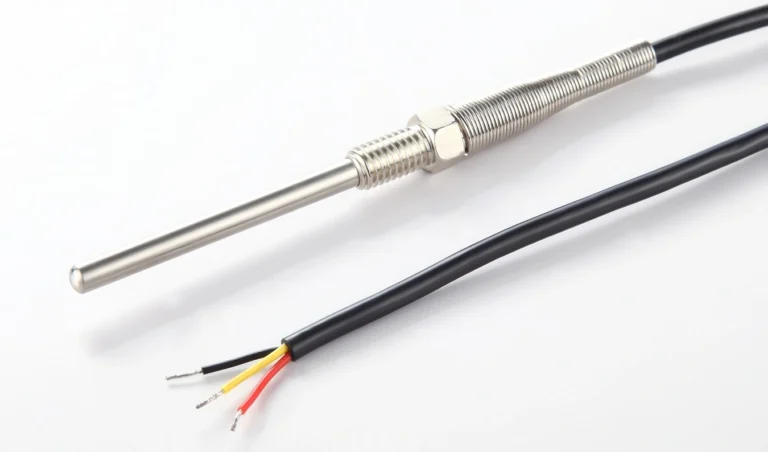
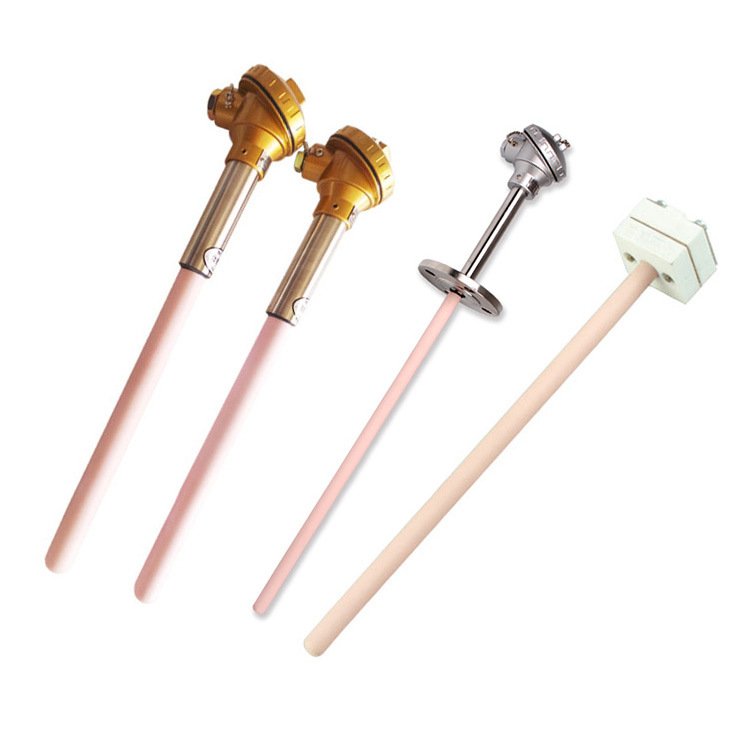
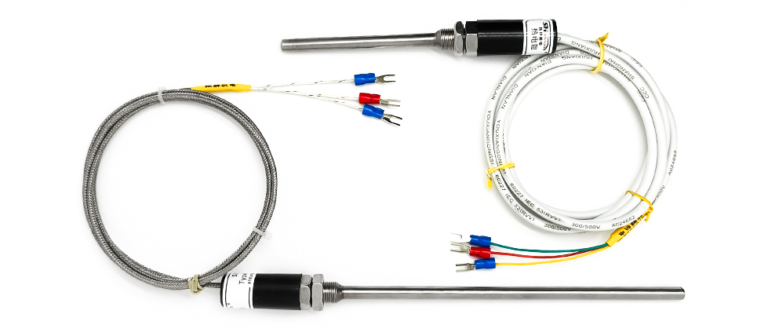
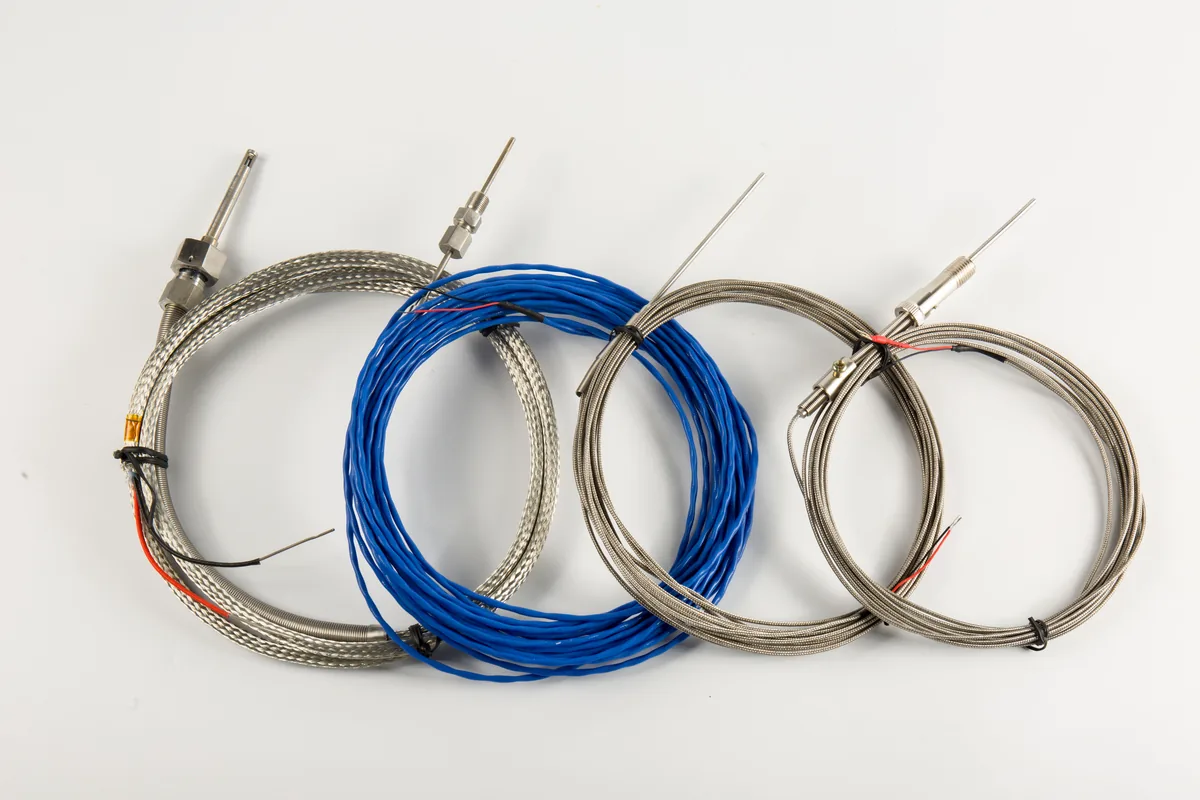
The element is specified as a construction, not as bare wire. A magnesium-oxide-insulated sheathed thermocouple gives fast response, vibration tolerance, and a gas-tight barrier against green rot, and it bends to route around obstructions. An assembled thermocouple adds a flanged or threaded process connection and terminal head for fixed installations. Hazardous-area service uses an explosion-proof thermocouple with a certified head.
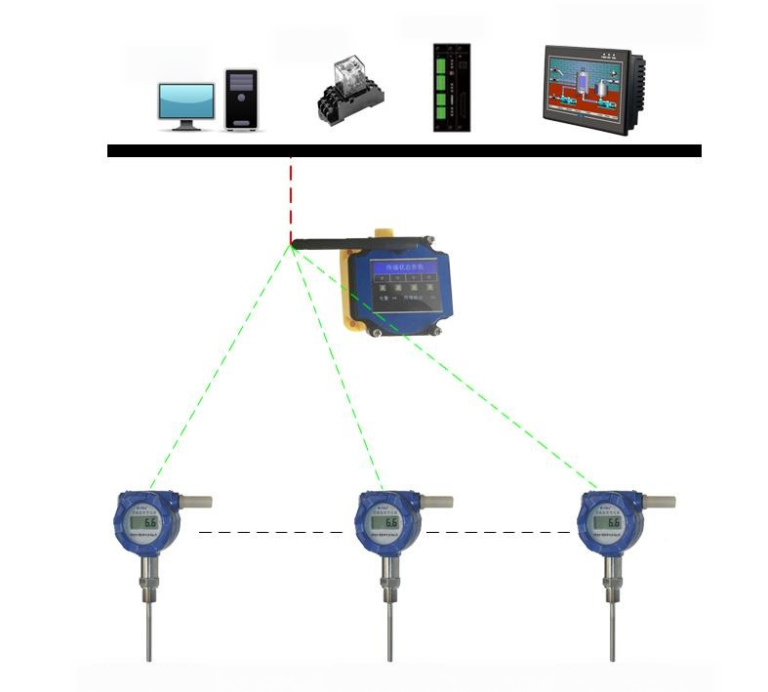
The millivolt output is converted to 4–20 mA at the head by a transmitter such as the SBW temperature transmitter or HM100 temperature transmitter, which also performs cold-junction compensation and linearization.
- Clean oxidizing or inert service, ≤1,100 °C: Type K, magnesium-oxide-insulated sheathed element, gauge sized to the continuous limit.
- Marginal-oxygen or reducing atmosphere above 800 °C: gas-tight sealed sheath, or change to Type N to avoid green rot.
- Cyclic duty in the 250–550 °C band with precision targets: budget the 1–3 °C K-state band, or specify Type N.
- Reducing atmosphere or cost-driven duty ≤750 °C: Type J, with the iron-leg corrosion limit understood.
- Continuous service above 1,100 °C: Type N to 1,200 °C, or noble-metal Type S/R above that.
Sheathed Thermocouples
Mineral-insulated Type K with a gas-tight sheath that resists green rot; bendable, fast response.
View Specs →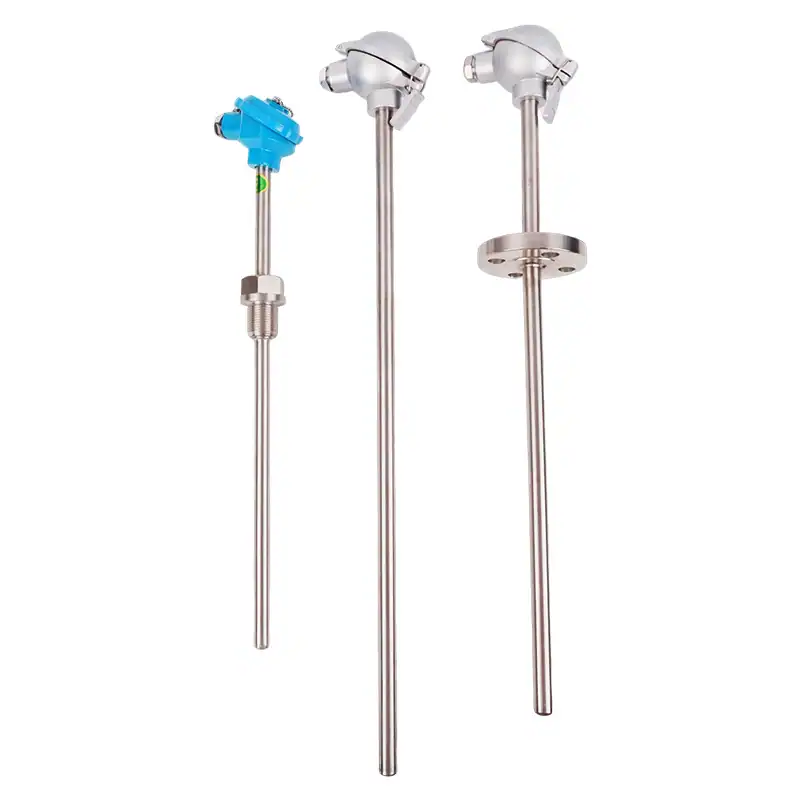
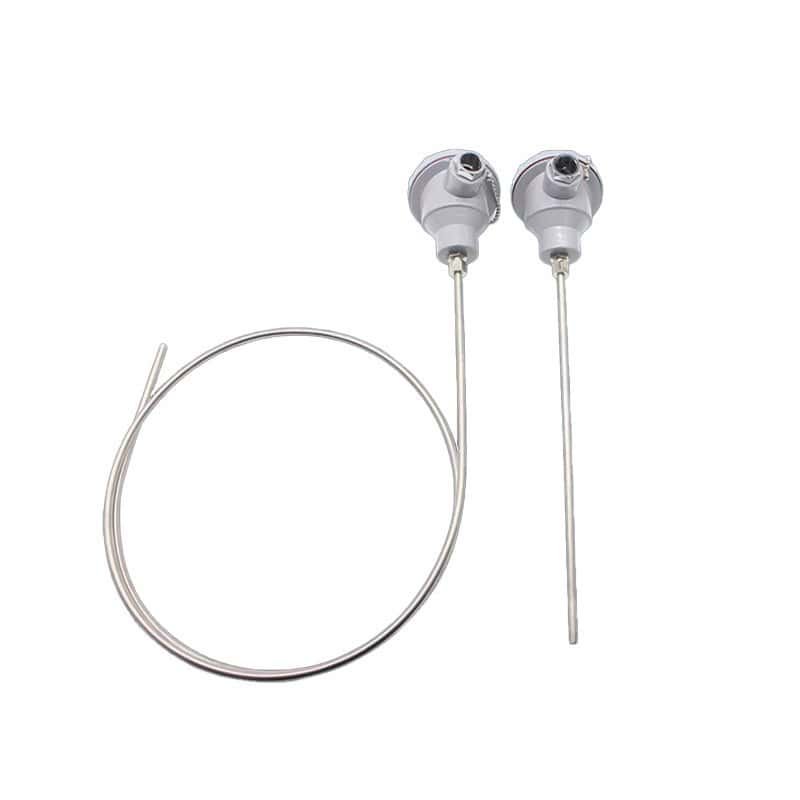
Assembled Thermocouples
Thermowell-mounted Type K with flanged or threaded process connection and terminal head.
View Specs →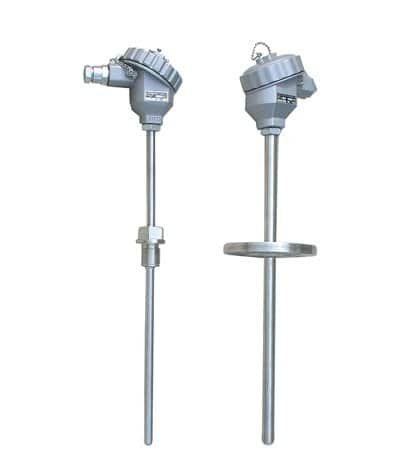
Explosion-Proof Thermocouples
NEPSI-certified Type K for hazardous areas, with flameproof head for zoned plant service.
View Specs →Spec a Type K thermocouple with our engineers
Send your temperature, atmosphere, and process connection. We will return a Type K or Type N element, tolerance class, sheath, and transmitter selection.
Request a QuoteFor a Type K element built into a sheathed or assembled probe, see HMK’s industrial thermocouples.
Frequently Asked Questions
What is the temperature range of a Type K thermocouple?
Grade wire spans −270 to 1,372 °C (−454 to 2,502 °F) per IEC 60584:2013. Continuous service is limited by wire gauge, near 1,100 °C for heavy gauge and 700 °C for fine 0.25 mm wire.
What is the accuracy of a Type K thermocouple?
IEC 60584:2013 Class 1 holds ±1.5 °C or ±0.004·|t|, Class 2 ±2.5 °C or ±0.0075·|t|. ASTM E230 Special holds ±1.1 °C or ±0.4 %, Standard ±2.2 °C or ±0.75 %. The percentage term governs above about 375 °C.
Why does a Type K thermocouple read low?
The usual cause is green rot: in low-oxygen heat between 800 and 1,050 °C the chromium in the positive leg is selectively oxidized, lowering EMF. The drift is permanent and can reach tens of degrees. A gas-tight sheath or a change to Type N prevents it.
What is the difference between Type K and Type N?
Type N uses nicrosil-nisil alloys that resist green rot and K-state ordering, giving better long-term stability above 300 °C at a slightly lower output and higher cost. Type K is cheaper and adequate for clean oxidizing service up to 1,100 °C.
What are the Type K thermocouple wire colors?
Under ANSI/ASTM MC96.1 the positive leg is yellow and the negative is red. Under IEC 60584:2007 the positive is green and the negative is white, with a green jacket. Confirm the governing standard before wiring.
What is the maximum continuous temperature for Type K?
About 1,100 °C (2,012 °F) for heavy-gauge grade wire in oxidizing atmosphere. Intermittent exposure reaches roughly 1,260 °C with accelerated drift. Above 1,100 °C continuous, specify Type N or a noble-metal Type S or R.