Temperature Element vs Transmitter: When You Need Each
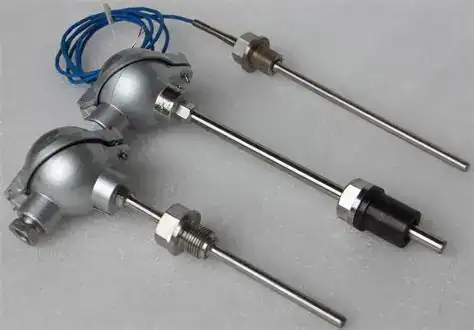
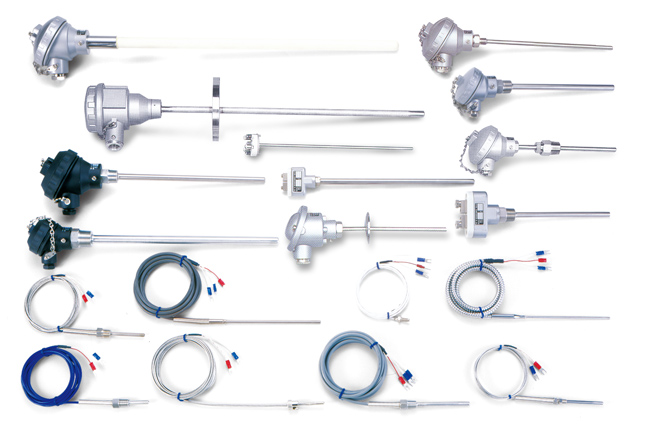
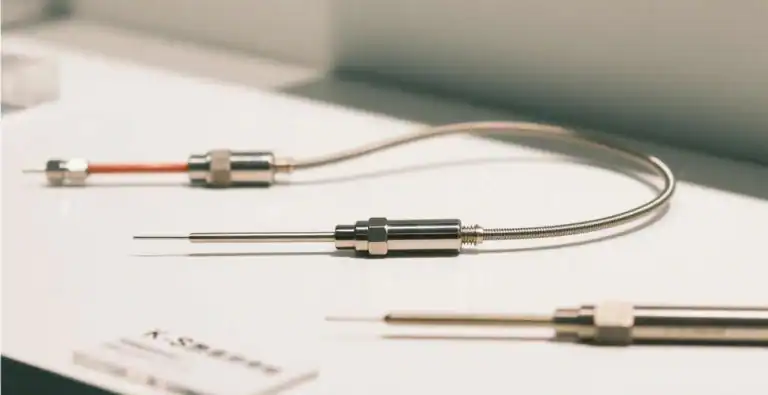
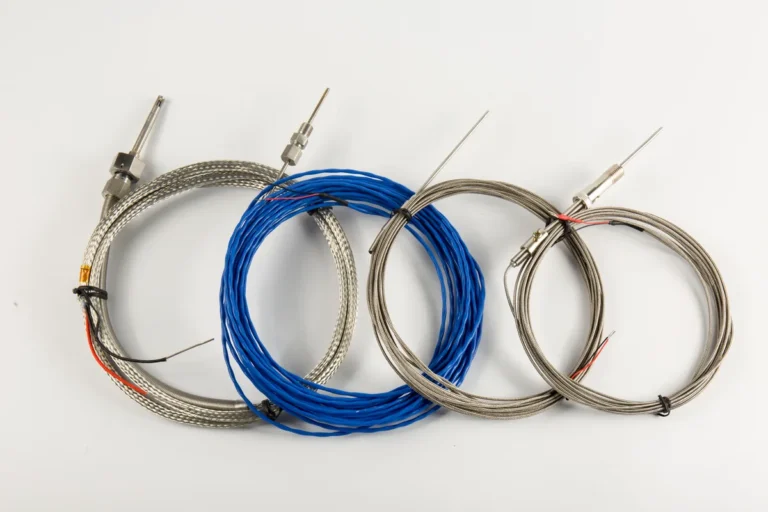
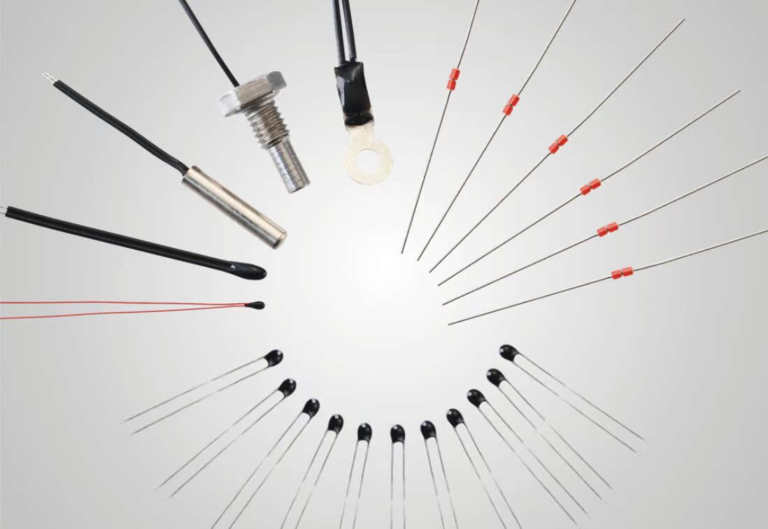
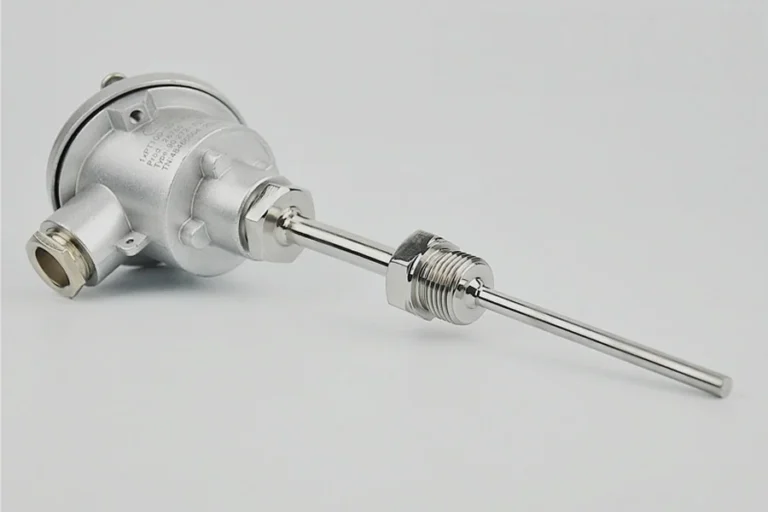
A temperature element is the bare sensor (a PT100 resistance bulb, a Type K thermocouple junction, a thermistor, or a small IC) that converts heat into a tiny electrical signal: a few millivolts for a TC, a fractional ohm change for an RTD. A temperature transmitter is the conditioning module that sits next to the element and converts that fragile signal into a 4-20 mA loop a DCS, PLC, or recorder can read cleanly across hundreds of metres of plant wiring.
For the sensing-element choice itself, see RTD vs thermistor.
The Short Answer: Element vs Transmitter at a Glance
In 40+ years specifying refinery and chemical-plant DCS temperature loops, the decision between “just the element” and “element plus transmitter” comes down to five conditions, not engineering preference. For HVAC, refrigeration, boiler-draft, or local-indication temperature reads, our temperature gauge definition and 5-type selection guide is the better starting point. For the mechanism behind the dial — bimetallic strip versus filled-system and gas-actuated — see our 3-mechanism working principle guide.
What a Temperature Element Is (RTD / Thermocouple / Thermistor / IC)
A temperature element is a passive sensor; it generates a signal directly from the physics of heat, with no built-in electronics, no loop power, and no signal conditioning. The four families a process spec engineer will meet in the field:
| Element family | Working principle | Standard | Typical range |
|---|---|---|---|
| RTD (PT100 / PT1000) | Platinum wire resistance changes with temperature (α=0.00385 Ω/Ω/°C) | IEC 60751 | -200 to +850 °C |
| Thermocouple (Type K, J, T, S, B, N, R, E) | Two dissimilar metals generate a small mV across a junction | IEC 60584-1 | -270 to +1820 °C (Type B) |
| Thermistor (NTC / PTC) | Semiconductor resistance changes sharply with temperature | IEC 60539 | -55 to +200 °C |
| IC sensor (LM35, DS18B20) | Doped silicon junction voltage tracks temperature linearly | – | -55 to +150 °C |
The element produces the signal. It does not amplify, isolate, linearise, or transmit it. That is the transmitter’s job.
What a Temperature Transmitter Is (4-20 mA and HART)
A temperature transmitter is an active two-wire device that accepts a raw element signal (millivolts from a TC, or resistance from an RTD), then performs three operations the element cannot:
- Amplification and linearisation: converts the non-linear sensor output to a calibrated temperature value, with built-in cold-junction compensation for thermocouples.
- Conversion to 4-20 mA: encodes the temperature as a current loop that is immune to most lead-wire voltage drops and EMI.
- Digital overlay (HART): superimposes a digital protocol on the analog loop for configuration, diagnostics, and trim from the DCS console.
A modern industrial unit such as the HMK HM100 Integrated Temperature Transmitter accepts a universal input (PT100 / PT1000 / TC Types K, J, T, S, B, E, N, R), delivers the 4-20 mA + HART output, and fits inside a standard DIN 43729 sensor head with no external enclosure needed.
The Core Difference at a Glance
The six dimensions that matter on a spec sheet, side by side:
| Dimension | Temperature element (bare RTD / TC) | Temperature transmitter (HM100-class) |
|---|---|---|
| Output signal | mV (TC) or Ω (RTD), raw | 4-20 mA + HART, conditioned |
| Accuracy at the DCS | Degrades with cable length | ±0.1 °C, lead-wire-immune |
| Lead wire sensitivity | High (RTD 3-wire compensates partly) | Negligible up to 1 km |
| DCS / PLC compatibility | Requires a separate input card per element type | Universal — any AI card reads 4-20 mA |
| Cost order (per loop) | Low (just the sensor + cable) | Higher (sensor + transmitter + 2-wire cable) |
| Typical use | Local gauges, short-range lab, redundant sensors | DCS process loops, hazardous-area service, long runs |
For the equivalent comparison on the pressure side, see our pressure transmitter types pillar. The same logic of “raw sensor vs conditioned 4-20 mA” carries over directly.
Five Conditions That Make a Transmitter Required
These are the five spec-sheet triggers that flip a bare element into a transmitter-required loop. Hit any one and the integrated unit becomes the honest specification:
1. Lead-wire run > 30 m. A 3-wire PT100 over 200 m of standard copper picks up roughly 0.4 °C of error from lead resistance drift across plant temperature swings (Sinopec refinery field measurement, Ye Dong files). A head-mount transmitter installed within 1 m of the element drops that error to about 0.02 °C; the rest of the run is on a current loop that is immune.
2. EMI / RFI environment. In plants rich with variable-frequency drives, large motors, or radio sources, raw TC mV signals are 1,000 times more vulnerable to induced noise than a 4-20 mA loop. The current loop is also fault-current-bounded; a noise spike rarely propagates to the DCS input as a temperature jump.
3. DCS or multi-drop architecture. Analog mV / Ω inputs need a dedicated AI card per sensor type. The 4-20 mA transmitter output is universal: every AI channel reads it, and HART overlay carries the device tag and diagnostics back to the control system.
4. Periodic verification mandated. China’s JJG 229-2010 verification regulation for industrial Pt and Cu RTDs requires annual bench calibration. Transmitter-equipped loops support digital re-trim at the head, so a 5-minute HART command replaces a half-day field swap.
5. Hazardous-area certification. Ex ia certification is granted to the transmitter, not the bare element. A bare PT100 in an Ex zone must terminate in an Ex enclosure, at which point you may as well install the transmitter and gain everything in points 1-4.
Quantified Signal Degradation: Lead Wire and TC Loop Noise
The decision is easier to defend when the numbers are explicit. Two field references we re-use whenever spec engineers ask:
RTD lead-wire example. A standard 3-wire PT100 over 200 m of 0.5 mm² (20 AWG) copper has roughly 8 Ω of one-way lead resistance per leg. The 3-wire bridge compensates for matched legs but not for ambient-temperature mismatch between legs running in different conduits. We have measured 0.3 to 0.5 °C of drift across a 24-hour cycle on this exact configuration in a Sinopec atmospheric-distillation rundown line.
TC noise floor. A Type K thermocouple at 200 °C produces roughly 8 mV against the reference junction. The 1 mV/100 °C resolution band is well inside the EMI footprint of a 30 kW variable-frequency drive 15 m away. A 4-20 mA transmitter at the same head turns that 8 mV into a 9.28 mA current, a signal a hundred times harder for VFD noise to corrupt.
The takeaway is not that bare elements always fail. It is that you need to look at your wire run, your conduit routing, and your DCS card budget before deciding the element alone is enough.
Is PT100 a Transmitter? Identity Clarification
This is one of the most frequent confusions on procurement forms. Three clean answers:
| Question | Answer |
|---|---|
| Is PT100 a thermocouple? | No. A PT100 is an RTD (resistance-temperature detector). It works on resistance change, not on dissimilar-metal voltage. |
| Is PT100 a transmitter? | No. PT100 is the element: the bare platinum resistance bulb. It needs an external transmitter (or a DCS RTD input card) to produce a 4-20 mA signal. |
| Is RTD the same as PT100? | PT100 is one type of RTD. The RTD family also includes PT500, PT1000, Cu50, and Ni100. China’s GB/T 30121 specifies the PT100 / PT1000 industrial grades and their 3-wire and 4-wire termination conventions. |
If a vendor calls a “PT100 transmitter,” they mean a transmitter sized to accept a PT100 input. The transmitter is a separate module that the PT100 wires into.
When to Specify the HMK HM100 Integrated Temperature Transmitter
For loops that hit any of the five conditions in the section above, the HMK HM100 Integrated Temperature Transmitter is sized exactly for the spec. The HM100 accepts a universal input (PT100 / PT1000 RTDs, plus Type K, J, T, S, B, E, N, R thermocouples) and delivers a 4-20 mA + HART output at ±0.1 °C reference accuracy. The unit fits inside a standard DIN 43729 sensor head, so it integrates directly with a HMK or third-party RTD / TC element without extra enclosure. Galvanic isolation is rated to 1500 V between input, output, and ground.
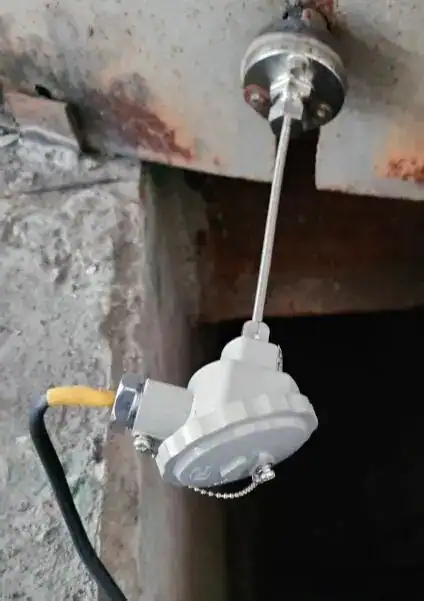
A typical commissioning pattern: PT100 four-wire element terminated in the HM100 head, head bolted to the protection-tube thermowell, 2-conductor twisted-shielded cable from the head back to the DCS marshalling cabinet. The cable run can be 1 km or longer without measurable accuracy loss. Compared to a bare PT100 plus dedicated RTD input card on the DCS, the transmitter approach costs roughly 1.5x more per loop in hardware, but consistently saves that back in commissioning labour, calibration time, and DCS card count on plants with more than about 30 temperature points.
For the broader transmitter-family taxonomy on the pressure side, see our pressure transmitter types pillar. For the cousin selection question on pressure, see can gauge pressure be negative.
Choosing the RTD element itself? Our Pt100 vs Pt1000 guide covers lead-wire error, self-heating, and matching the existing instrument input.
FAQ
What’s the difference between a temperature element and a temperature transmitter?
The element is the bare sensor (PT100, thermocouple) that produces a small raw signal. The transmitter is a conditioning box that converts that raw signal to an industrial 4-20 mA + HART loop the DCS can read across long cable runs.
Is PT100 a transmitter or an element?
PT100 is the element, a platinum RTD. It needs a separate transmitter (head-mount or field-mount) to produce a 4-20 mA output.
Do I need a transmitter for short-range RTDs?
For runs under about 30 m in a low-EMI environment with a DCS that accepts direct RTD inputs, a bare 3-wire or 4-wire PT100 often performs within spec. Past 30 m, in EMI-rich plants, or where Ex certification matters, a transmitter becomes the honest specification.
Which is better, RTD or thermocouple, when feeding a transmitter?
RTDs (PT100, PT1000) win on accuracy and repeatability up to about 600 °C. Above 600 °C, thermocouples take over because RTDs become fragile. The transmitter handles either input; the choice is driven by your process temperature, not by the transmitter.
How do you connect an RTD to a transmitter?
A 3-wire PT100 terminates on three screw terminals in the transmitter head (typically labelled R, R+, R-). A 4-wire PT100 uses four terminals and gives the cleanest accuracy. The transmitter then outputs 4-20 mA on a separate 2-wire loop back to the DCS.
Next step: Send your spec sheet for a model recommendation in 24 h. Get in touch →
Related: When you do need the transmitter, see how to calibrate a temperature transmitter (RTD & TC) for the field procedure and TUR check.