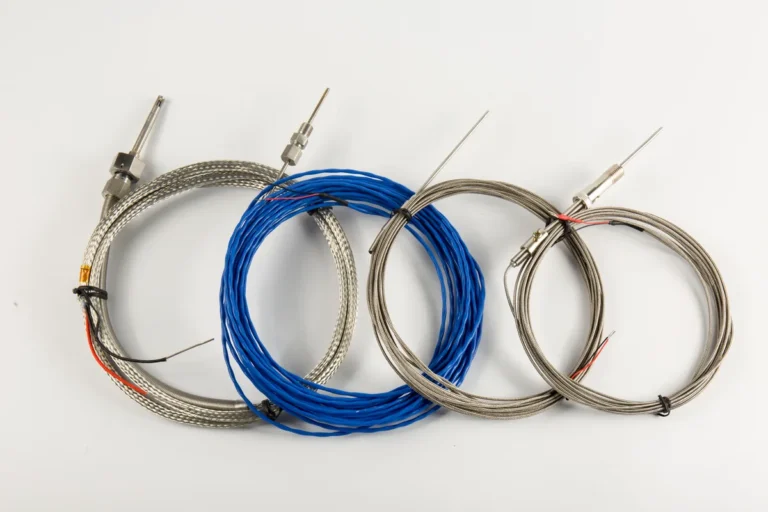
Temperature Gauge: Definition, 5 Types, and Selection Guide
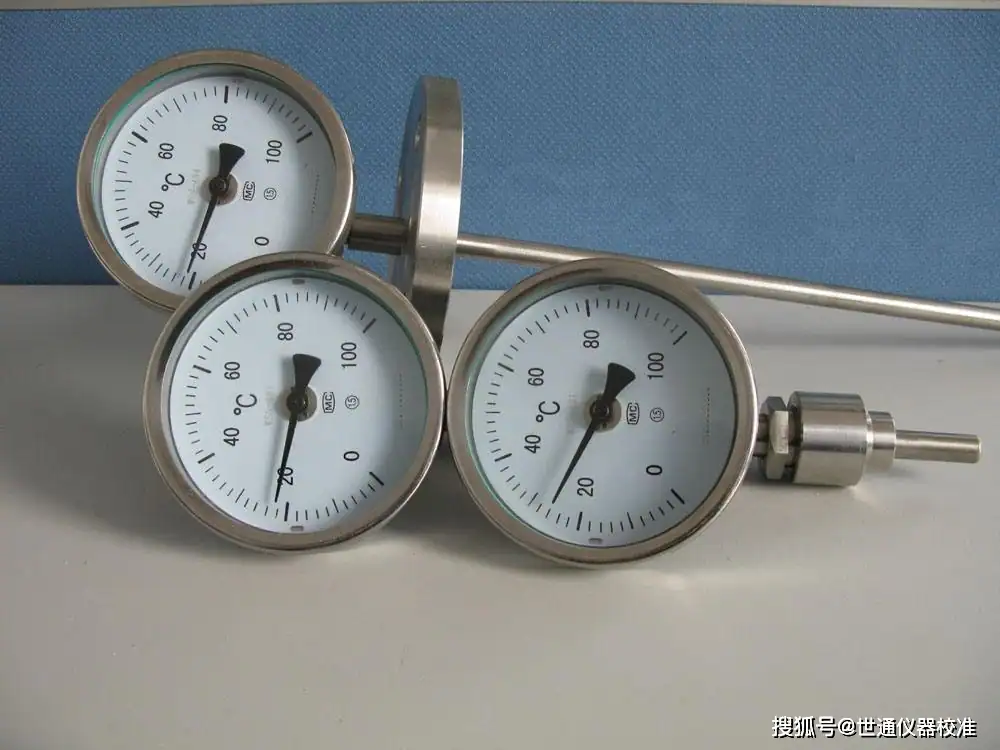
A temperature gauge measures process temperature locally and displays the reading on a dial or digital screen. The phrase covers five distinct designs (bimetallic, liquid-filled, gas-filled, vapor-pressure, and electrical) that span -270°C to 1,800°C and four accuracy classes. This guide answers what a temperature gauge is, how each type works, the spec ranges and accuracy classes, and which one to pick for your application. Industrial spec engineers, jump to section 3 and 5. Vehicle owners, jump to section 8.
Dial gauges are the mechanical branch of temperature measurement; for the electrical families (thermocouple, RTD, thermistor) and how to choose among all of them, see the types of temperature sensors reference.
What a Temperature Gauge Is
A temperature gauge is a field-mounted instrument that converts temperature into a visible reading, either by a mechanical pointer on a dial or a digital LCD. It sits at a measurement point in the process and displays the reading where the operator can see it.
The line between “thermometer” and “temperature gauge” is fuzzy in everyday speech, but engineers reserve “gauge” for the rugged industrial form: a fixed mount, a graduated dial or digital readout, and a process connection (NPT, BSP, or sanitary). A laboratory glass thermometer is a thermometer; a 100 mm dial thermometer with a stem and a 1/2″ NPT thread is a temperature gauge.
Four contexts cover roughly 95% of where you will see one: process plant piping (steam, hot oil, glycol), HVAC ductwork, automotive dashboards, and laboratory baths.
How a Temperature Gauge Works (3 Sensing Mechanisms)
All temperature gauges share the same job: convert a temperature into a deflection or a voltage, but they do it three different ways.
Bimetallic. A coiled strip of two metals with different thermal expansion rates. Heat unwinds the coil, the rotation drives a pointer through a shaft. No fluid, no power, no wires. In our experience, this is the default for HVAC and general-purpose hot-water service. Our deeper guide walks through the bimetallic, filled, and gas-actuated mechanisms side by side.
Filled-system. A sealed bulb, a capillary, and a Bourdon spiral filled with a working fluid. As the bulb heats up, the fluid expands and presses the Bourdon to uncoil; the motion drives the pointer. Three filling fluids: liquid (silicone or oil-based; legacy mercury fills are now restricted by the Minamata Convention), gas (nitrogen or helium), or vapor (boiling-point fluid). Used where the bulb has to sit far from the dial: boiler drums, vessel insulation runs, refrigeration loops.
Electrical. An RTD (resistance changes with temperature) or a thermocouple (Seebeck-effect millivolts) feeds an electronic conditioner driving an LCD. Power needed (battery or 24 VDC), but accuracy and remote signaling are an order of magnitude better than mechanical.
Five Types of Temperature Gauges and Their Ranges
The three sensing mechanisms expand into five practical types in the field. The differences come from which working fluid fills the system, or whether the sensor is a resistance element or a thermocouple. Spec ranges are typical of industrial OEM datasheets (Wika, Ashcroft, Tempsens).
| Type | Range | Accuracy | Power | Best fit |
|---|---|---|---|---|
| Bimetallic | -50 to +500°C | ±1.0 to ±2.5% FS | None | General industrial, hot water, HVAC |
| Liquid-filled | -200 to +700°C | ±1.0% FS | None | Process plant, capillary remote mount |
| Gas-filled | -270 to +800°C | ±1.5% FS | None | Cryogenics through high temp |
| Vapor-pressure | -50 to +350°C | ±1.5% FS | None | Steam and condensate service |
| Electrical (RTD or thermocouple + LCD) | -200 to +1,800°C | ±0.1 to ±0.5% FS | Battery or 24 VDC | Process control, remote, audit trail |
A few things to read off this table. First, the range floor: only gas-filled and electrical reach below -200°C, so cryogenic service narrows fast. Second, the range ceiling: thermocouple-driven electrical gauges reach 1,800°C (Type B or R/S), well past any mechanical option. Third, accuracy: every mechanical type sits at ±1.0% FS or worse; only electrical gauges deliver ±0.5% or better. If you are speccing for a control loop with a tight setpoint, mechanical will not get you there.
The vapor-pressure row is the one we see most engineers underuse. It tracks the saturated-vapor curve of the working fluid, which means the dial reads a true thermodynamic state, useful when the process itself is steam or a refrigerant.
Accuracy Classes per DIN 16203 and IEC 60751
Three standards govern temperature-gauge accuracy, and each applies to a different sensor family.
| Standard | Applies to | Classes | Tolerance at reference |
|---|---|---|---|
| DIN 16203-1 | Mechanical (bimetallic + filled) | 1.0 / 1.5 / 2.0 / 2.5 | ±1.0 to ±2.5% FS |
| IEC 60751 | RTD (Pt100, Pt1000) | AA / A / B / W0.1 | ±0.1°C (AA) to ±0.3°C (B) at 0°C |
| ASTM E230 / IEC 584-2 | Thermocouple | Class 1 / 2 / 3 | ±1.5°C (Class 1) to ±4°C (Class 3) typical |
Class 1.6 mechanical and Class B RTD are the workhorses we see on most process-plant datasheets. For a calibration master gauge, request Class 0.6 mechanical or Class AA RTD; for general indication on a hot-water radiator, Class 2.5 mechanical is enough. The ±% in DIN 16203 is referenced to full scale, which is why a 0–600°C Class 1.6 gauge has a real tolerance of ±9.6°C across the dial, more than people expect.
Selection Matrix: Which Type for Which Application
Given the five types and the standards above, the actual selection rule is application-driven. Here are the five recurring matches I recommend on plant walks.
| Application | Recommended type | Why |
|---|---|---|
| Boiler steam (high temp, vibration) | Liquid-filled with silicone fill, glycerin-damped case | Wide range, shock-tolerant |
| Cryogenic LNG storage | Gas-filled (helium or nitrogen charge) | Reaches -270°C floor |
| Process control loop needing remote readout | RTD + 4-20 mA transmitter | ±0.1% FS, SCADA-ready |
| Hot-water radiator, HVAC return | Bimetallic | Cheapest, no power, ±2.5% FS is fine |
| Furnace zone above 700°C | Type K or N thermocouple + electronic indicator | 1,200°C+ ceiling |
Two failure modes show up repeatedly. First, picking bimetallic for a vibrating pump skid: the pointer flutters, the gear linkage wears, and you replace the gauge inside a year. Move to a glycerin-filled case with a liquid-filled element. Second, picking a cheap mechanical gauge for a control loop and discovering ±1.6% FS does not give the operator stable enough readings to PID against; switch to an RTD plus transmitter and the loop settles within minutes.
Mechanical vs Digital: A Practical Comparison
The decision most engineers actually face is mechanical or digital. The trade-off is cost, accuracy, and whether the data has to leave the panel.
| Dimension | Mechanical (bimetallic / filled) | Digital indicator (LCD) | Transmitter (4-20 mA / HART) |
|---|---|---|---|
| Accuracy | ±1.0 to ±2.5% FS | ±0.25 to ±0.5% FS | ±0.1 to ±0.25% FS |
| Response time | 5 to 30 seconds | 1 to 5 seconds | <1 second |
| Power | None | Battery or 24 VDC | 24 VDC loop |
| Vibration | Glycerin-filled case OK | Avoid >2g RMS | OK with ratings |
| Remote / logging | None | Local only | PLC, SCADA, audit trail |
| Relative cost | 1× | 2 to 3× | 5 to 10× |
| When to choose | Local-only, no power | Tight tolerance, still local | Remote, alarming, SIL |
A mechanical gauge wins when the budget is tight and the answer only has to sit on the panel. A digital indicator wins when accuracy matters but the reading still stays local. A transmitter wins when the data has to travel; see section 7.
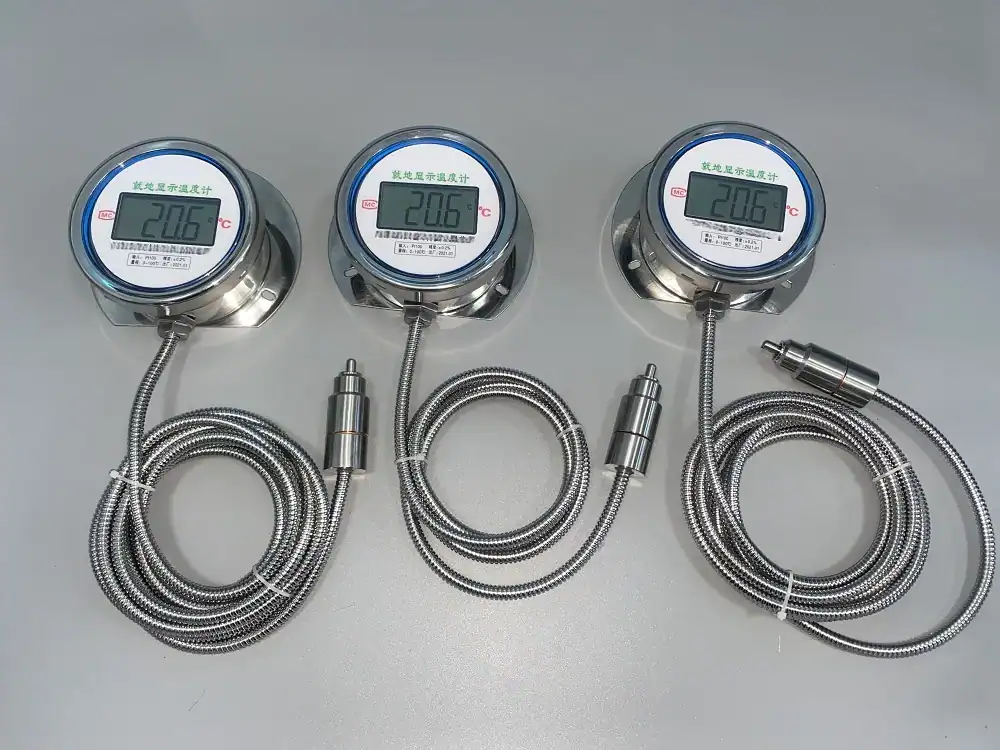
When to Replace a Gauge with a Temperature Transmitter
Every couple of years the same conversation happens on a plant floor: someone on our team asks whether the row of dial gauges should be replaced with transmitters. The answer is yes if any of the five conditions below is true.
- The system feeds a SCADA, PLC, or DCS, so local-only readings cannot be trended.
- You need historical logs or alarm audit trails, and a mechanical gauge has no memory.
- High- or low-temperature interlocks are required for safety (IEC 61511 SIL2 or SIL3).
- The gauge is mounted where an operator cannot easily see it (height, hazardous area, or insulated jacket).
- Long-term accuracy better than ±0.5°C is required: only RTDs or precision thermocouples reach this.
For these cases, a 4-20 mA or HART temperature transmitter replaces the dial. The sensor element stays the same, an RTD or a thermocouple, but the output goes back to the control room. See RTD vs Thermocouple for picking the sensor and Cold Junction Compensation for the wiring detail that determines whether your readings drift.
Automotive Dashboard Context: One Word, Two Worlds
Vehicle owners search “temperature gauge” for a different reason: a needle moving on a dashboard, or a red warning light. On a car, the temperature gauge is almost always either a bimetallic dial driven by a thermistor in the cooling jacket, or a digital readout from the engine ECU. The reading bands look like this.
| Band | Coolant temp | What it means |
|---|---|---|
| Cold (left) | <70°C | Engine warming up |
| Normal (centre) | 80 to 105°C | Operating range |
| Hot (right) | >115°C | Stop and let it cool |
| Red warning light | Sensor open or temp >120°C | Pull over immediately |
For the regulatory text on vehicle warning indicators, see the NHTSA standards on dashboard tell-tales.
FAQ
What is a temperature gauge in simple terms?
A field-mounted instrument that measures temperature at a single point in a process and displays the reading on a dial or digital screen. See section 1.
What are the 5 types of temperature gauges?
Bimetallic, liquid-filled, gas-filled, vapor-pressure, and electrical (RTD or thermocouple driving an electronic indicator). The five span -270°C to 1,800°C with accuracy classes from ±2.5% FS down to ±0.1% FS. See section 3.
What’s the accuracy of a typical temperature gauge?
A general-purpose mechanical gauge is Class 1.6 per DIN 16203, meaning ±1.6% of full scale. An electrical gauge with a Class B RTD reaches ±0.3°C at 0°C. A precision thermocouple Class 1 reaches ±1.5°C across the working range. See section 4.
What’s the difference between a temperature gauge and a thermometer?
“Thermometer” covers any temperature-reading device, including laboratory glass and digital handhelds. “Temperature gauge” is reserved for the rugged, fixed-mount industrial form with a process connection and a dial or digital display. See section 1.
When should I use a transmitter instead of a gauge?
When the data has to leave the panel (SCADA, audit trail, SIL interlocks, or a sensor mounted out of sight). See section 7.
What does the temperature warning light on my car mean?
Either the coolant temperature has crossed about 120°C, or the temperature sensor circuit is open. Either way, pull over and let the engine cool before driving on. See section 8.
Need this temperature read remotely? Compare HMK 4-20 mA / HART temperature transmitters with Pt100 RTD or Type K thermocouple inputs. Send your spec sheet for a model recommendation in 24 h.