Type R vs S vs B Thermocouple: Noble-Metal Selection
Above about 1200 °C (2192 °F), base-metal thermocouples such as Type K oxidize and drift, and the choice narrows to three platinum-rhodium types: R, S and B. They share a high ceiling, a low output, and a vulnerability to contamination, yet they are not interchangeable. Type R and Type S differ mainly in rhodium content and in whether the point is industrial or a reference standard, while Type B reaches the highest temperature of the three yet is useless below 600 °C.
This guide compares the three on composition, range, accuracy and protection. For the base-metal types and the wider family, see the thermocouple types overview; if you are weighing a thermocouple against an RTD, see RTD vs thermocouple.
Common Traits of Noble-Metal Thermocouples
R, S and B are noble-metal thermocouples built from platinum and platinum-rhodium alloys, and four shared properties separate them from base-metal types. Each reaches at least 1600 °C (2912 °F), far beyond the practical limit of Type K or Type N. Their output is low, near 10 µV/°C, roughly one quarter of the 41 µV/°C a Type K delivers near ambient. Because the legs are platinum and rhodium rather than nickel alloys, they are costly. And the platinum is chemically fragile: contamination that base-metal alloys shrug off degrades it permanently.
These shared traits are why we reserve noble-metal types for high-temperature work that base metals cannot survive. The three are defined in IEC 60584:2013 and ASTM E230, the same standards that define Type K and Type J.
Composition, Range and Accuracy
The three types differ in alloy, upper limit, and output, and those three numbers drive most of the selection. The table states each against IEC 60584:2013.
| Attribute | Type S | Type R | Type B |
|---|---|---|---|
| Positive / negative leg | Pt10%Rh / Pt | Pt13%Rh / Pt | Pt30%Rh / Pt6%Rh |
| Standard range | 0 to 1600 °C (32 to 2912 °F) | 0 to 1600 °C (32 to 2912 °F) | 0 to 1700 °C (32 to 3092 °F) |
| Continuous service | ≤1450 °C | ≤1450 °C | ≤1600 °C |
| Intermittent peak | ~1600 °C | ~1600 °C | ~1700 °C |
| Output (near working heat) | ~10 µV/°C | ~11 µV/°C | ~9 µV/°C (near zero below 600 °C) |
| Tolerance, IEC Class 1 | ±1 °C, then ±[1+0.003(t−1100)] °C | ±1 °C, then ±[1+0.003(t−1100)] °C | Class 2 only: ±0.0025·|t| above 600 °C |
| Lower usable limit | ~0 °C | ~0 °C | ~600 °C |
Two columns carry the most weight. The output column shows why noble-metal loops need careful reference and cabling: at roughly a quarter of a Type K signal, every microvolt of cold-junction or lead error converts into a larger temperature error. The tolerance column shows that Type S and Type R hold ±1 °C up to 1100 °C, then widen by formula, while Type B is specified only to Class 2 and only above 600 °C. The conversion from millivolts to temperature follows the IEC 60584:2013 reference function, which the thermocouple mV-to-°C calculator evaluates directly.
Type R vs Type S: Industrial and Reference Grades
The difference between Type R and Type S is 3 % rhodium, and that small change decides cost, output, and role. Type R uses a Pt13%Rh positive leg; Type S uses Pt10%Rh. The extra rhodium gives Type R a slightly higher output and marginally better stability at the top of the range, at a higher price per metre.
The practical split is by application, not by physics. Type S is the historical reference standard: it served as the standard interpolation instrument of IPTS-68 between 630.74 °C and 1064.43 °C, and it remains the type of choice for laboratory and calibration work where traceability outweighs ruggedness. Type R is the industrial member of the pair, specified for kilns, glass forehearths, ceramic and heat-treatment furnaces, and reformer thermowells running above 1100 °C. For most plant service either type performs identically inside its tolerance band; the deciding factors are whether an existing instrument is already calibrated for one, and whether the point is a process measurement (Type R) or a reference (Type S). Both ship as mineral-insulated sheathed thermocouples for direct process insertion.
The 600 °C Lower Limit of Type B
Type B is the highest-temperature thermocouple of the three and the only one that cannot be used at low temperature. Its Pt30%Rh against Pt6%Rh pairing produces almost no output below 600 °C, and the curve is double-valued below about 42 °C: one millivolt reading maps to two different temperatures, so the instrument cannot resolve which it is seeing. Below roughly 600 °C the signal is too small to trust, which is why Type B is specified only for the upper end of its 0 to 1700 °C range.
The near-zero low-temperature output has one useful consequence. Type B generates almost no EMF below 50 °C, so the cold-junction voltage at a normal ambient is negligible, and a Type B loop can run without cold-junction compensation while holding its high-temperature accuracy. That removes one error source the other two types require, and it is the reason Type B is favored in glass melting, steelmaking, and sapphire and single-crystal growth furnaces, where the process sits well above 1500 °C and lead drift is unwanted. Type B also resists grain growth and drift better than R or S at extreme heat, which extends element life in continuous service. The reference behavior of the other types is covered in cold-junction compensation.
Contamination and Ceramic Protection
The shared weakness of all three types is contamination of the platinum, and it dictates the protection hardware. Platinum and platinum-rhodium are degraded by silicon, by metallic vapors from iron, nickel and copper, by reducing atmospheres, and by hydrogen. Any of these diffuses into the platinum lattice, changes the alloy, and shifts the calibration permanently. Silicon is the most common culprit: it arrives from refractory brick, from silica in a protection tube, or from organic vapors that crack to silicon at heat.
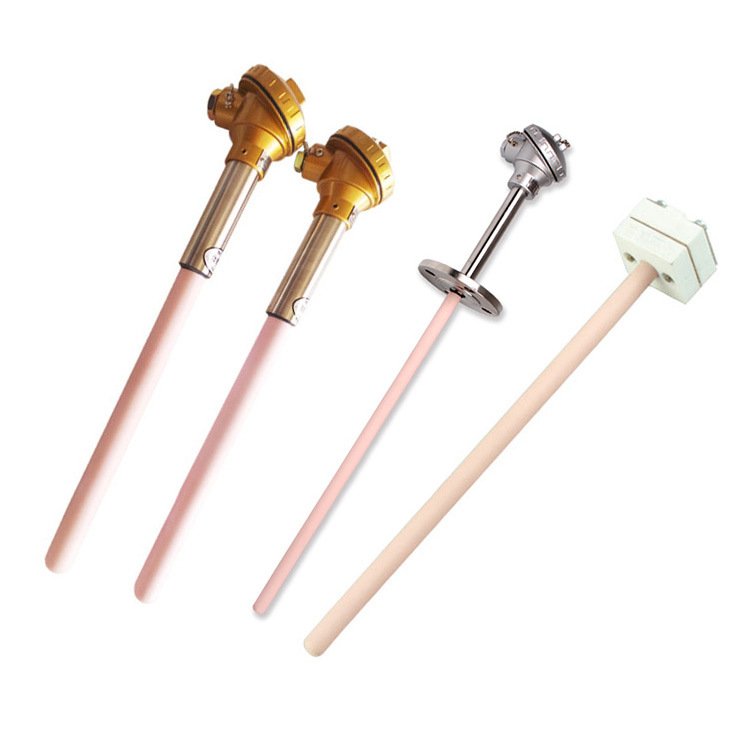
In the field on glass-forehearth and reformer thermowells, noble-metal elements pulled after a high-temperature campaign commonly show negative drift of several degrees, traced to silicon pickup through a porous or breached outer tube. That failure mode sets the protection rule. A noble-metal element must sit inside a gas-tight, high-purity recrystallized alumina (Al₂O₃, 99.7 % or better) tube that excludes the process atmosphere, and it must never touch a base-metal sheath or thermowell at temperature, because iron and nickel migrate into the platinum. In high-silica or reducing service a secondary outer tube is added. This is why we supply noble-metal sensors above the mineral-insulated range as ceramic-protected assembled thermocouples rather than bare elements, and for multi-zone furnaces and reactors the same principle scales to multi-point thermocouples.
Low Output: Reference and Cable Errors
Because all three types produce only about 10 µV/°C, the reference junction and the lead cable contribute a larger share of total error than on a base-metal loop. The instrument must hold a tight cold-junction reading, and the run from sensor to transmitter must use the correct platinum-grade compensating cable, since ordinary copper or base-metal extension wire injects its own thermal EMF into the low signal. A small reference error that a Type K would absorb becomes a visible temperature error on a noble-metal loop.
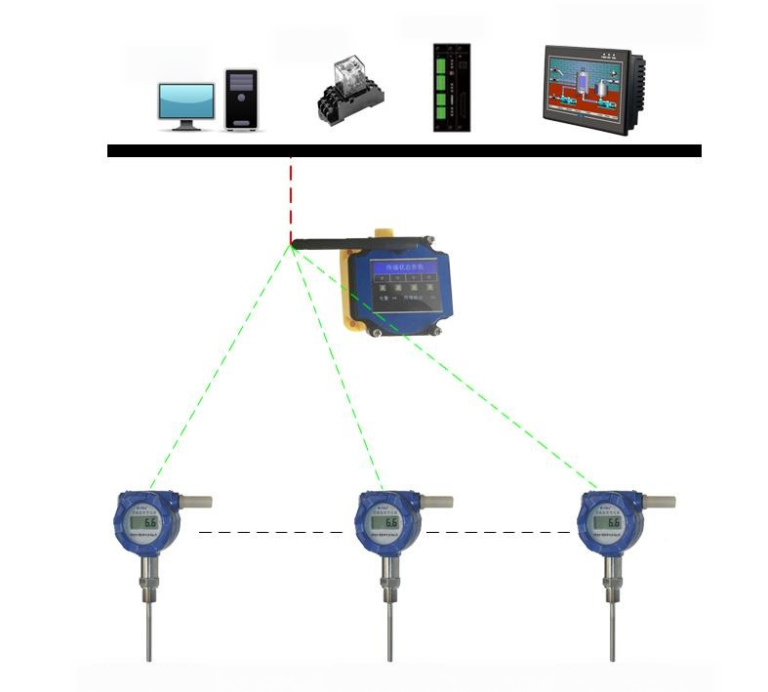
The wiring difference matters most where the head and the instrument sit far apart in a hot plant. Standard base-metal extension practice does not transfer; the rules specific to extension wire vs compensating cable apply here. Mounting a head transmitter at the thermowell, rather than running the raw noble-metal signal across the plant, shortens the vulnerable low-level run and converts the reading to 4-20 mA at the source. The reference functions behind every conversion are published by NIST under ITS-90.
Selecting the Right Noble-Metal Thermocouple
Temperature, atmosphere, and whether the point is a process or a reference decide the type. The table maps common high-temperature services to the right noble-metal choice.
| Service | Typical temperature | Recommended type | Reason |
|---|---|---|---|
| Laboratory / calibration reference | up to 1600 °C | Type S | Reference-grade standard, IPTS-68 heritage |
| Kiln, ceramic and heat-treat furnace | 1100–1450 °C | Type R | Industrial standard, slightly higher output |
| Glass forehearth / reformer thermowell | 1100–1500 °C | Type R | Rugged process service above base-metal limit |
| Glass melting, steelmaking | 1500–1700 °C | Type B | Highest range, best drift resistance |
| Sapphire / single-crystal growth | >1500 °C | Type B | Runs without cold-junction compensation |
| Reducing or high-silica atmosphere | any | R, S or B in sealed alumina | Contamination control governs, not type |
The deciding question on the data sheet is rarely R versus S, which perform alike in plant service. It is whether the point exceeds 1500 °C, which moves the call to Type B, and whether the atmosphere demands a sealed recrystallized-alumina sheath. Specify the sheath and protection to the atmosphere first, then the type to the temperature:
- Type R: continuous oxidizing service to 1450 °C, the industrial default.
- Type B: above 1500 °C, or where running without cold-junction compensation is an advantage.
- Type S: where the element must match a reference standard documented under ASTM E230.
Noble-Metal Thermocouples by HMK TECH
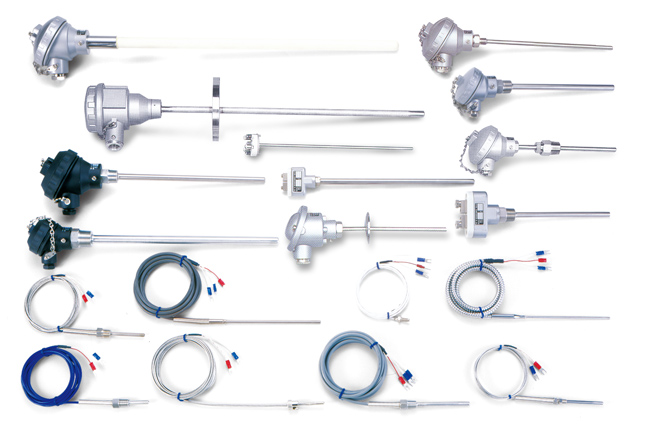
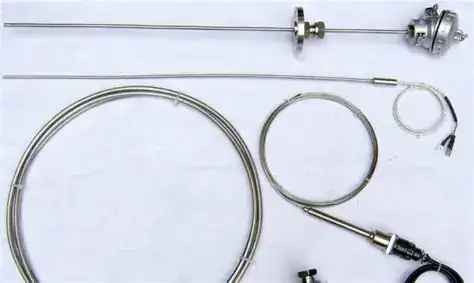
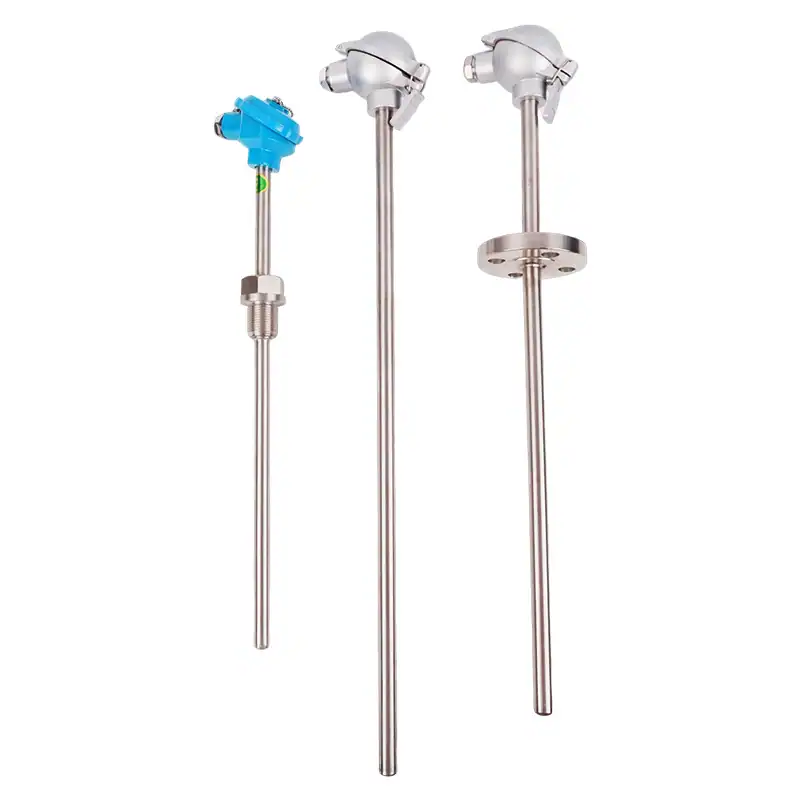
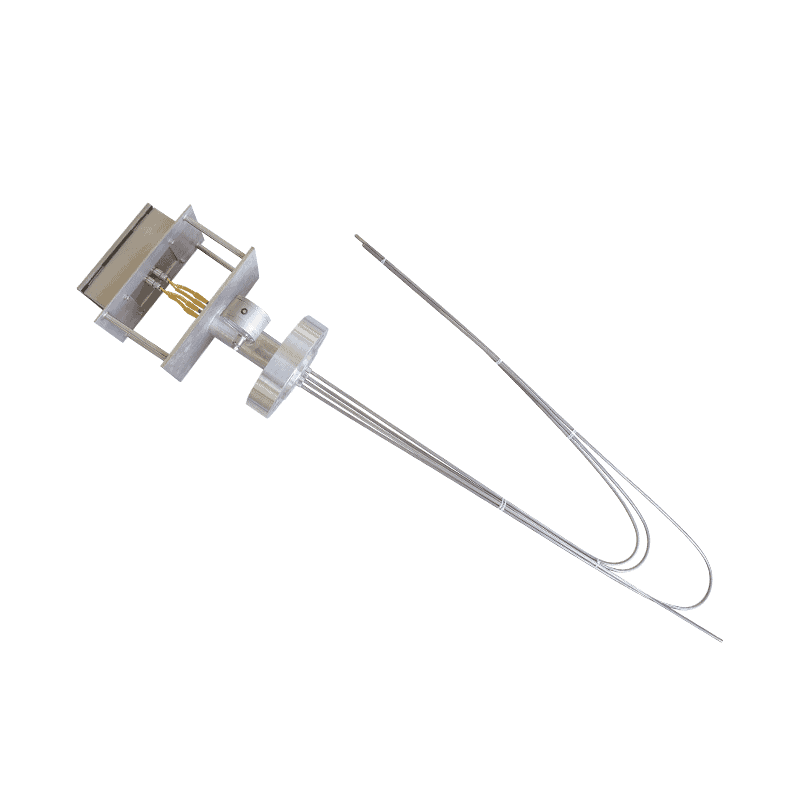
HMK manufactures all three platinum-rhodium types to the ranges and constructions above. Type S (PtRh10-Pt, model WRP/WRPK) and Type R (PtRh13-Pt, model WRQ/WRQK) ship in mineral-insulated sheathed form to around 1300 °C. Type B, together with R and S, ships in ceramic-protected assembled form for service above that, and as multi-point assemblies for furnace and reactor profiles. Each is supplied with the recrystallized-alumina protection and platinum-grade compensating cable the service requires.
Frequently Asked Questions
What is the difference between Type R and Type S thermocouples?
Type R uses a Pt13%Rh positive leg and Type S uses Pt10%Rh. The extra 3 % rhodium gives Type R a slightly higher output and marginally better high-temperature stability at a higher cost. Type S is the laboratory and calibration reference standard; Type R is the industrial process type. Both share the same 0 to 1600 °C range and ±1 °C Class 1 tolerance to 1100 °C.
Which thermocouple can measure the highest temperature?
Among the three noble-metal types, Type B has the highest range at 0 to 1700 °C (3092 °F), with intermittent peaks near 1820 °C. Type R and Type S both reach 1600 °C (2912 °F). All three exceed the practical limit of base-metal types such as Type K and Type N.
Why can’t a Type B thermocouple be used at low temperatures?
Type B produces almost no output below 600 °C, and its curve is double-valued below about 42 °C, meaning one millivolt reading maps to two possible temperatures. The signal is too small and ambiguous to resolve, so Type B is specified only for the upper part of its range.
Do noble-metal thermocouples need cold-junction compensation?
Type R and Type S require cold-junction compensation like any thermocouple. Type B is the exception: it generates almost no EMF below 50 °C, so the reference-junction voltage at normal ambient is negligible, and a Type B loop can run without cold-junction compensation while holding high-temperature accuracy.
Why are platinum thermocouples so easily damaged?
The platinum and platinum-rhodium legs are poisoned by silicon, by metallic vapors from iron, nickel and copper, by reducing atmospheres, and by hydrogen. These diffuse into the platinum and shift the calibration permanently. Noble-metal elements must be protected in a gas-tight, high-purity recrystallized alumina tube and kept out of direct contact with base-metal sheaths.
Where base-metal duty will do in place of noble metals, see HMK’s industrial thermocouples.
Specifying a noble-metal thermocouple for high-temperature service?
Send the working temperature, atmosphere, and insertion length, and our temperature engineers will return a sheath-and-type specification for the point.