HMK Temperature Sensors
Sheathed Thermocouples
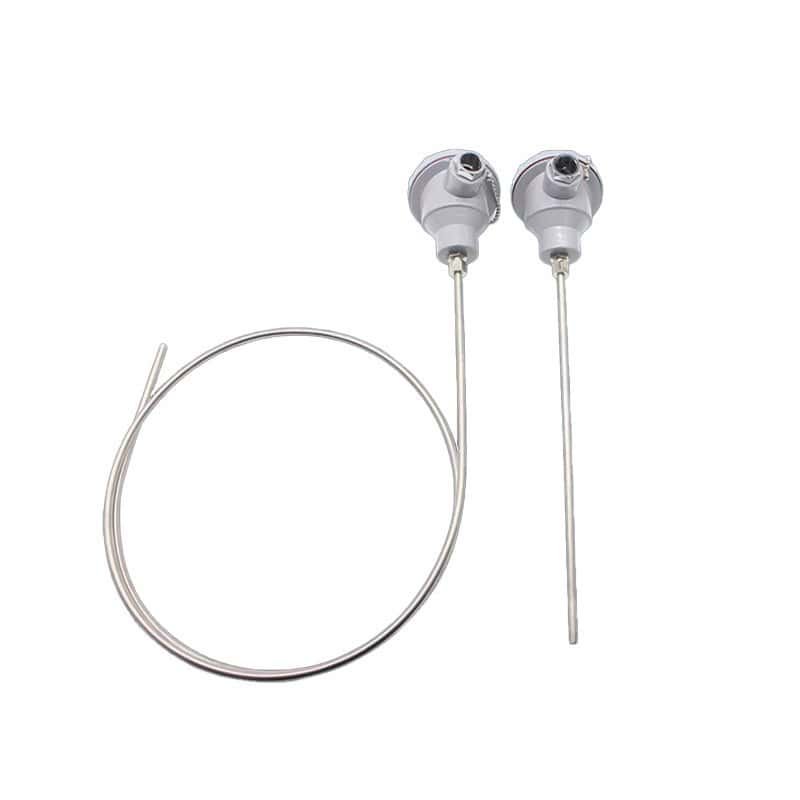
Mineral-insulated metal-sheathed (MIMS) thermocouples with compacted MgO insulation inside stainless steel or Inconel sheaths. All 8 IEC 584 types (K, N, E, J, T, S, R, B) with sheath diameters from Φ2 to Φ8 mm. Temperature range 0 °C to 1300 °C. Bendable, high-pressure rated, fast thermal response.
Why Choose Sheathed Thermocouples?
Purpose-built for demanding temperature measurement where durability, accuracy, and fast response are critical.
Mineral-Insulated Construction
MgO insulation compacted inside metal sheaths provides excellent electrical isolation, vibration resistance, and pressure tolerance. Sheath materials include 1Cr18Ni9Ti stainless steel, GH3030, and GH3039 Inconel alloys for temperatures up to 1300°C.
Complete Type Coverage
All 8 standard thermocouple types per IEC 584: base metal K, N, E, J, T for general industrial use (up to 1100°C), and noble metal S, R, B for ultra-high temperature applications up to 1300°C.
5 Junction Box Styles
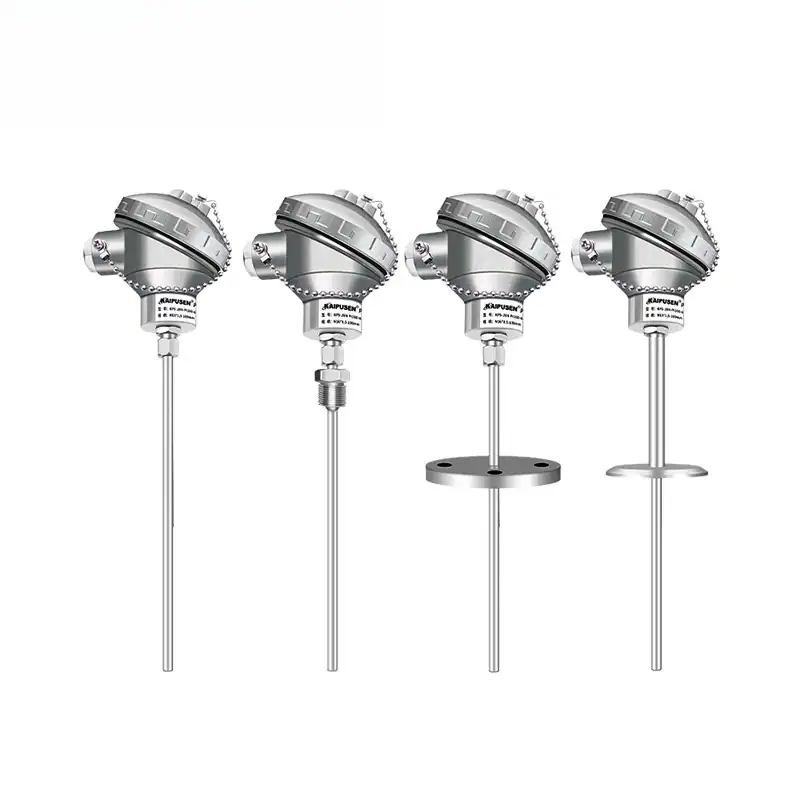
Waterproof (IP55/IP65), circular plug-in, flat socket, handle type, and compensating wire extension. Single or dual element configurations. Thread and flange mounting options with custom lengths from 100 to 3000 mm.
Thermocouple Type Selection Guide
Choose the right thermocouple type based on your temperature range, accuracy requirements, and application environment. This table covers all 8 IEC 584 types available in our sheathed configuration.
| Type | Wire Materials | Temp Range | Class I Tolerance | Class II Tolerance | Best For |
|---|---|---|---|---|---|
| K | NiCr–NiSi | -40–1100°C | ±1.5°C or ±0.004|t| | ±2.5°C or ±0.0075|t| | Most common — general industrial, furnaces, HVAC |
| N | NiCrSi–NiSi | -40–1100°C | ±1.5°C or ±0.004|t| | ±2.5°C or ±0.0075|t| | Better stability than K at high temp; nuclear, ceramics |
| E | NiCr–CuNi | -40–900°C | ±1.5°C or ±0.004|t| | ±2.5°C or ±0.0075|t| | Highest EMF output; cryogenics, food processing |
| J | Fe–CuNi | -40–750°C | ±1.5°C or ±0.004|t| | ±2.5°C or ±0.0075|t| | Reducing atmospheres; plastics, rubber processing |
| T | Cu–CuNi | -200–350°C | ±0.5°C or ±0.004|t| | ±1.0°C or ±0.0075|t| | Low temp & cryogenics; food, pharma, lab |
| S | Pt10Rh–Pt | 0–1300°C | ±1.0°C or ±[1+0.003(t-1100)] | ±1.5°C or ±0.0025|t| | High temp precision; glass, ceramics, steel |
| R | Pt13Rh–Pt | 0–1300°C | ±1.0°C or ±[1+0.003(t-1100)] | ±1.5°C or ±0.0025|t| | Similar to S with higher Rh; biotech, pharma |
| B | Pt30Rh–Pt6Rh | 600–1300°C | — | ±4.0°C or ±0.005|t| | Highest temp; glass melting, sintering furnaces |
Quick Selection Tip: For general industrial use below 800°C, Type K is the most cost-effective choice. For low-temperature or cryogenic applications, choose Type T. For temperatures above 1100°C, noble metal types S, R, or B are required. Need help selecting? Contact our engineers.
Technical Specifications
Core parameters for mineral-insulated sheathed thermocouples across all IEC 584 types.
| Parameter | Value |
|---|---|
| Thermocouple Types | K, N, E, J, T, S, R, B (per IEC 584 / GB/T 16839) |
| Temperature Range | -200°C to 1300°C (type and sheath dependent) |
| Sheath Diameters | Φ2, Φ3, Φ4, Φ5, Φ6, Φ8 mm |
| Sheath Materials | 1Cr18Ni9Ti (304 SS), GH3030 (Inconel), GH3039 (Inconel) |
| Insulation Material | MgO (magnesium oxide), high-density compacted |
| Junction Type | Insulated (standard) or Grounded (shell type) |
| Element Configuration | Single or Dual element |
| Insulation Resistance | ≥1000 MΩ (1 m length, 500V DC, 20°15°C, RH≤80%) |
| Insertion Length | 100–3000 mm (customizable) |
| Bending | Bendable; min radius ≥ 5× sheath OD |
| Mounting Options | No fixing, Fixed threaded, Movable threaded, Fixed flange, Movable flange |
| Junction Box Styles | Waterproof, Splash-proof, Circular plug-in, Flat socket, Handle, Comp. wire, Element only |
| Protection Grade | IP65 (waterproof junction box) |
| Standards | IEC 584, IEC 61515, GB/T 18404-2001 |
Wire Diameter & Material Specifications
Thermocouple wire dimensions and materials for single and dual element configurations.
| Sheath OD (mm) | Single Element Wire Φ (mm) | Dual Element Wire Φ (mm) | Available TC Types |
|---|---|---|---|
| Φ2 | 0.20 | — | K, N, E, T |
| Φ3 | 0.35 | 0.20 | K, N, E, J, T, S, R, B |
| Φ4 | 0.50 | 0.25 | K, N, E, J, T, S, R, B |
| Φ5 | 0.65 | 0.35 | K, N, E, J, T, S, R, B |
| Φ6 | 0.80 | 0.50 | K, N, E, J, T, S, R, B |
| Φ8 | 1.10 | 0.65 | K, N, E, J, T, S, R, B |
Recommended Operating Temperatures
Maximum continuous and short-term temperatures vary by wire material, sheath alloy, and diameter. Exceeding short-term limits accelerates sensor degradation.
| Wire Material (Type) | Sheath Material | Sheath OD | Continuous (°C) | Short-Term (°C) |
|---|---|---|---|---|
| NiCr–NiSi (K/N/E) | 1Cr18Ni9Ti | Φ2–Φ3 | 600 | 800 |
| NiCr–NiSi (K/N/E) | 1Cr18Ni9Ti | Φ4–Φ5 | 800 | 1000 |
| NiCr–NiSi (K/N/E) | 1Cr18Ni9Ti | Φ6–Φ8 | 800 | 1100 |
| NiCr–NiSi (K/N/E) | GH3030 | Φ3–Φ8 | 900 | 1100 |
| Fe–CuNi (J) | 1Cr18Ni9Ti | Φ3–Φ8 | 500–600 | 600–750 |
| Cu–CuNi (T) | 1Cr18Ni9Ti | Φ2–Φ5 | 250 | 300 |
| Cu–CuNi (T) | 1Cr18Ni9Ti | Φ6–Φ8 | 300 | 350 |
| Pt10Rh–Pt (S) | GH3030 | Φ2–Φ4 | 1000 | 1100 |
| Pt10Rh–Pt (S) | GH3030 | Φ5–Φ8 | 1100 | 1200 |
| Pt30Rh–Pt6Rh (B) | GH3039 | Φ2–Φ4 | 1000 | 1100 |
| Pt30Rh–Pt6Rh (B) | GH3039 | Φ5–Φ8 | 1100 | 1200 |
Configuration Options
Sheathed thermocouples are available in multiple junction box styles to suit different installation requirements. Each style has insulated and grounded junction variants.
Waterproof Type (WRxx-13x)
Series 131/231/331/431/531
IP65 sealed junction box. OD Φ3–Φ8, lengths 100–2000 mm. Ideal for outdoor and high-humidity environments.
Circular Plug-in (WRxx-16x)
Series 161/261/361/461/561
Quick-disconnect circular connector. OD Φ3–Φ8, lengths 100–2000 mm. Easy removal for maintenance and calibration.
Flat Socket Type (WRxx-17x)
Series 171/271/371/471/571
Flat blade socket connection. OD Φ3–Φ8, lengths 100–2000 mm. Compact profile for tight spaces.
Handle Type (WRxx-18x)
Series 181/182
Portable handheld configuration. OD Φ3–Φ8, lengths 300–3000 mm. For spot-check and mobile measurement.
Compensation Wire (WRxx-19x)
Series 191/291/391/491/591
Direct compensating wire extension with no junction box. Connects directly to instrumentation for simplified installations.
Element Only (WRxx-10x)
Bare MI Cable
Raw MI cable without junction box or fittings. For OEM integration or custom assembly. Available in all types and diameters.
Model Numbering System
Decode any sheathed thermocouple model number using this guide. The model code specifies everything from wire type to junction box style.
Model Code Format:
W – R – [Material] – K – [Elements] – [Mounting] – [Junction Box] – [Terminal] – [Additional]
MATERIAL CODE
P = Pt10Rh(S) • Q = Pt13Rh(R) • M = NiCrSi(N)
N = NiCr(K) • E = NiCr-CuNi(E) • C = Cu(T) • F = Fe(J)
ELEMENT COUNT
blank = Single element
2 = Dual element
MOUNTING STYLE
1 = No fixing • 2 = Fixed threaded • 3 = Movable threaded
4 = Fixed flange • 5 = Movable flange
JUNCTION BOX
2 = Splash-proof • 3 = Waterproof • 6 = Circular plug
7 = Flat socket • 8 = Handle • 9 = Comp. wire • 0 = Element
TERMINAL FORM
1 = Insulated junction (standard)
2 = Grounded / shell junction
ADDITIONAL DEVICES
Y = Pre-set thermowell • S = Pipe connector • G = Nipple connector
Example: WRN-K-131 = W(sheathed) R(thermocouple) N(Type K) K(MI cable) 1(no fixing) 3(waterproof box) 1(insulated junction). This is a Type K sheathed thermocouple with waterproof junction box and insulated measuring tip.
Application Areas
Sheathed thermocouples are used across industries where reliable, durable temperature measurement is critical.
Petrochemical & Refining
Pipeline temperature monitoring, reactor vessels, distillation columns, catalytic crackers. Type K or N in stainless steel sheaths handle the moderate temperatures and corrosive environments.
Steel & Metallurgy
Blast furnace monitoring, continuous casting, rolling mills, heat treatment furnaces. Noble metal types S and B with Inconel sheaths withstand extreme heat and molten metal proximity.
Power Generation
Boiler flue gas, steam turbine bearings, generator windings, exhaust stacks. Dual-element configurations provide redundancy for critical monitoring points.
Glass & Ceramics
Kiln temperature measurement, annealing furnace control, glass forming processes. Noble metal types withstand corrosive glass melt chemistry at 1200°C and above.
Food & Pharmaceutical
Autoclaving, sterilization validation, freeze-drying. Type T for cryogenic applications; waterproof junction boxes meet IP65 hygiene requirements.
HVAC & Building
Duct temperature, chiller monitoring, boiler control. Type K with waterproof junction box is the standard cost-effective solution for building automation systems.
Frequently Asked Questions
Need a Custom Thermocouple Configuration?
Our application engineers can help you select the correct thermocouple type, sheath material, diameter, junction box style, and temperature range. We offer custom lengths, dual-element configurations, and special mounting options for OEM and industrial installations.
Our engineers typically respond within 12 business hours with detailed technical specifications and pricing.
Free Tool: Thermocouple mV ↔ °C Calculator
Verify your sheathed thermocouple readings in seconds. Covers Type K, J, T, N, E, S, R, B with IEC 60584-1 reference tables, cold-junction compensation, and Class 1 / Class 2 tolerance — no login, no spreadsheet. Great companion for commissioning, calibration, and troubleshooting field installations.
Open Thermocouple Calculator →
See also: a thermowell wake frequency calculation against ASME PTC 19.3 TW-2016 — the bench-to-publication six-step workflow.