RTD vs Thermistor: How to Choose for Process Measurement
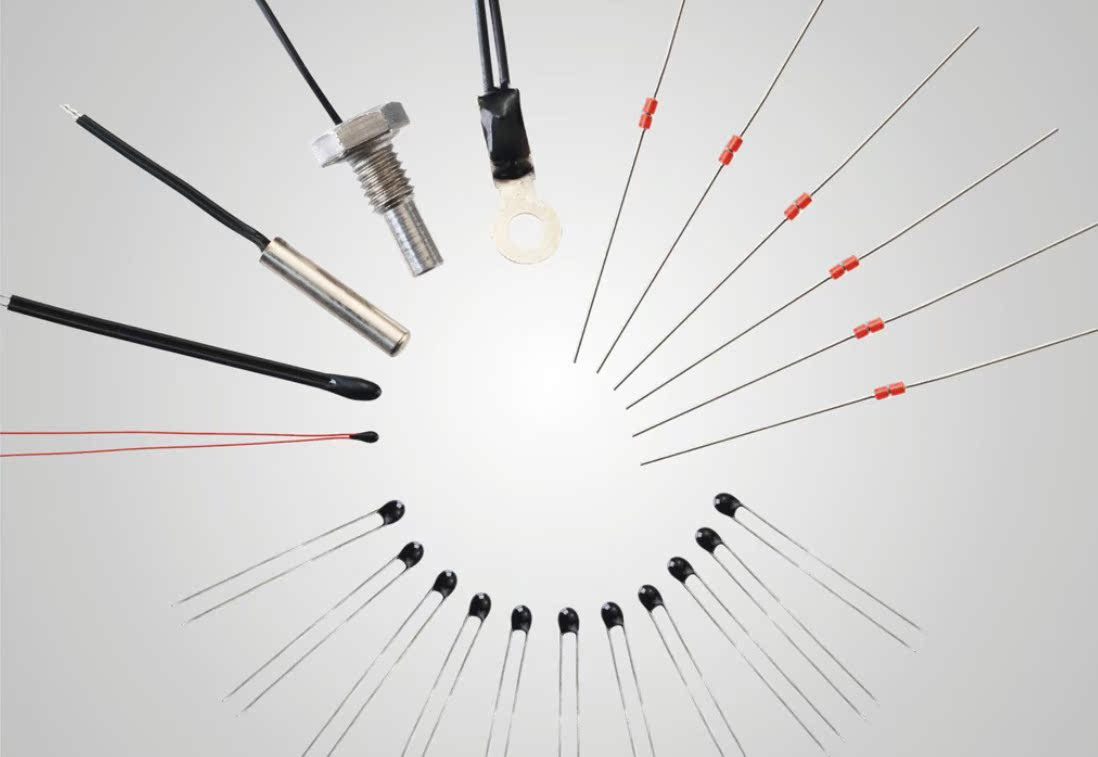
An RTD and a thermistor are both resistance-based temperature sensors, but they behave in opposite ways. An RTD is a metal element, almost always platinum, whose resistance rises slowly and linearly with temperature. A thermistor is a sintered metal-oxide element whose resistance changes sharply and exponentially.
The first thing to settle for a measurement point is which of those two behaviors the loop needs: a wide, standardized, interchangeable signal, or a narrow, fast, high-sensitivity one. For most process service the answer is the platinum RTD; for tight-range OEM and HVAC duty it is often the thermistor. The numbers behind that split follow.
RTD vs Thermistor at a Glance
The two elements differ on every axis that matters to a specifier. The table states the typical figures for an industrial Pt100 and a common NTC thermistor.
| Attribute | Pt100 RTD | NTC thermistor |
|---|---|---|
| Element | Platinum wire or thin film, 100 Ω at 0 °C | Sintered metal oxide, 2,252 Ω–10 kΩ at 25 °C |
| R/T behavior | Near-linear, positive coefficient | Exponential, negative coefficient |
| Sensitivity | 0.385 Ω/°C | several %/°C, about −4 %/°C near 25 °C |
| Usable range | −200 to +600 °C (−328 to +1,112 °F) | −50 to +150 °C (−58 to +302 °F), some to 300 °C |
| Standard | IEC 60751:2022 / ASTM E1137-08, fixed curve | no cross-vendor standard curve |
| Interchangeability | high, by tolerance class | low, curve is vendor-specific |
| Long-term drift | low, order ±0.1 °C over years | higher, curve ages with thermal cycling |
The Pt100 wins on range, standardization, and stability. The thermistor wins on raw sensitivity and, at the element level, on price. Everything else follows from those facts.
How Each Sensor Works
A platinum RTD relies on the predictable temperature coefficient of pure platinum. Both IEC 60751:2022 and ASTM E1137-08 fix that coefficient at α = 0.003851 Ω/Ω/°C, so a 100 Ω element gains 0.385 Ω for every degree Celsius. Resistance and temperature track a slightly curved but well-behaved function, the Callendar–Van Dusen equation, which every transmitter linearizes from stored constants.
A thermistor works differently. Its resistance follows an exponential law set by a material constant, the beta value, typically 3,000–4,000 K. Near room temperature an NTC element loses roughly 4 % of its resistance per degree, which is why it resolves small changes so well. That same exponential law is the limitation: sensitivity collapses at the ends of the span, so a single thermistor serves only across a narrow window. PTC thermistors invert the sign but suit protection and switching, not measurement.
Accuracy and Interchangeability
Accuracy on a datasheet and accuracy in a plant are not the same number. The decisive property in process service is interchangeability, and this is where the Pt100 separates from the thermistor.
A Pt100 follows a published curve. IEC 60751:2022 defines tolerance classes against that curve: Class AA at ±0.1 °C, Class A at ±0.15 °C, and Class B at ±0.3 °C, each at 0 °C, with the band widening at temperature (Class B is ±0.3 + 0.005·|t| °C). Because the standard fixes both the curve and the coefficient, any compliant Class A Pt100 drops into any Class A input and reads the same, with no field recalibration. GB/T 30121-2013, the Chinese adoption of IEC 60751:2008, fixes the same curve and the same Class A tolerance of ±(0.15 + 0.002·|t|) °C, and names petroleum and chemical plants among its primary applications. In the field on the reformer and tank-farm loops we run, that standardization lets a Class A spare interchange within its band without re-trimming the transmitter. For the class boundary, see Pt100 Class A vs Class B.
A thermistor has no equivalent. Each manufacturer publishes its own resistance-temperature table, and a 10 kΩ part from one vendor does not match a 10 kΩ part from another. Matched and interchangeable thermistors exist and can hold ±0.1 to ±0.2 °C, but only over a narrow band and only within one product family. The practical consequence is procurement, not physics: a thermistor point locks the plant to a single supplier and part number, while a Pt100 point stays sourced from any qualified vendor. That is the main reason process and EPC specifications standardize on Pt100.
Temperature Range and Long-Term Stability
The usable range follows from the element chemistry. A platinum RTD measures from −200 °C (−328 °F) to +600 °C (+1,112 °F) in common industrial builds, with wire-wound elements rated to +850 °C (+1,562 °F) under IEC 60751:2022. A thermistor is confined to roughly −50 to +150 °C (−58 to +302 °F); specialized parts reach 300 °C (572 °F) but lose accuracy and life there. Both standards reference the ITS-90 temperature scale for the underlying definition.
Long-term stability points the same way. A Pt100 drifts on the order of ±0.1 °C over years of moderate service and ages predictably. A thermistor’s resistance curve shifts with thermal cycling and self-heating history, so a part that started at ±0.2 °C can move further over its life. For a control loop that must hold the same reading after five years, the platinum element is the safer specification; for a consumer or short-life OEM device, thermistor drift is rarely the limiting factor. The Pt100/Pt1000 choice within the RTD family is covered in Pt100 vs Pt1000.
Response Time and Self-Heating
A thermistor responds faster because its bead is small and its thermal mass is low, and its high sensitivity makes small changes easy to read. Both strengths carry a cost that shows up in real wiring.
Self-heating is the first. Every resistance sensor dissipates I²R as the instrument passes its measuring current, which sits at 0.3–1 mA for a Pt100. At 1 mA a 100 Ω Pt100 dissipates only 0.1 mW and self-heats on the order of 0.05 °C. A 10 kΩ thermistor at the same 1 mA dissipates 10 mW, a hundred times the power in a far smaller bead, so its excitation current must stay well below that to hold self-heating in check. The high resistance and high sensitivity that make a thermistor responsive also make self-heating easy to provoke.
Lead resistance is the second. A two-wire Pt100 adds the copper lead resistance directly to the element, and at 0.385 Ω/°C each 1 Ω of lead reads as 2.6 °C of error. A 50 m run of 20 AWG copper adds about 3 Ω, near 8 °C of offset, which is why field RTDs use three-wire or four-wire connection to cancel the leads. On the long cable runs from field RTDs to the marshalling cabinet, three-wire connection is the standard practice for exactly this reason.
| Pt100 connection | Lead-resistance effect | Typical residual error |
|---|---|---|
| 2-wire | full lead resistance adds to element | about 2.6 °C per 1 Ω of lead |
| 3-wire | matched leads cancel to first order | < 0.1 °C with balanced leads |
| 4-wire | true Kelvin sensing, leads removed | negligible |
A thermistor’s resistance is so high that lead resistance stays negligible by comparison, but that advantage rarely offsets its range and interchangeability limits in plant service.
Signal and Transmitter Integration
A laboratory can read a sensor with a bench meter; a plant must land the signal on a 4–20 mA or HART loop. This is the integration question, and it favors the Pt100 decisively.
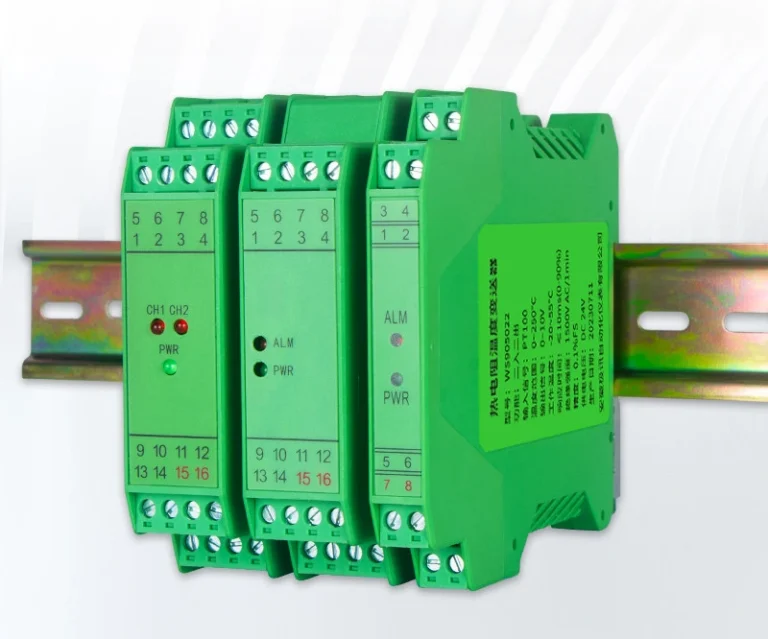
Virtually every industrial temperature transmitter accepts a Pt100 input natively, in two-, three-, or four-wire configuration, with the IEC 60751:2022 curve already stored for linearization. A head-mount transmitter such as the HMK SBW temperature transmitter takes the Pt100 directly and outputs a linearized 4–20 mA signal; the choice between a bare RTD element and a transmitter is itself a standard one. Thermistors are rarely offered as a standard input on process transmitters because there is no universal curve to store, so a thermistor point usually needs custom signal conditioning or a board-level circuit. For an OEM building its own electronics that is acceptable; for a plant standardizing on loop hardware it is friction, which is why we specify Pt100 inputs on our loop hardware.
Cost: Element vs Installed Loop
The thermistor’s price advantage is real at the element level and disappears at the loop level. A thermistor bead costs less than a platinum element and suits high-volume OEM production where the same circuit reads the same part forever. In a plant the installed cost includes the transmitter input, the interchangeability that keeps spares generic, and the recalibration avoided by a standardized curve. In retrofit work we see the element saving erased once those line items are counted, so our default for plant points is the Pt100 despite the dearer element. Element price decides OEM economics; installed loop cost decides plant economics.
When to Choose RTD vs Thermistor
The selection reduces to range, standardization, and where the signal has to go. The list states the rule for each case.
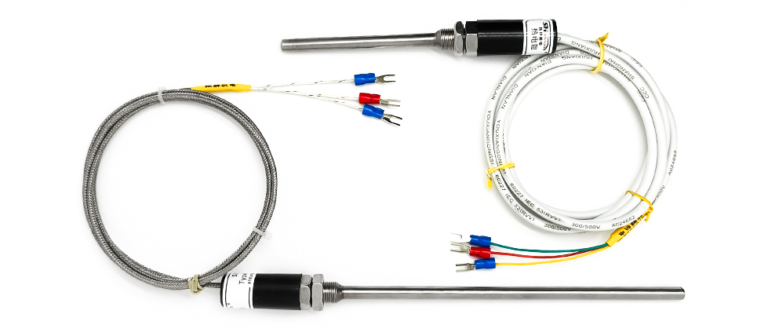
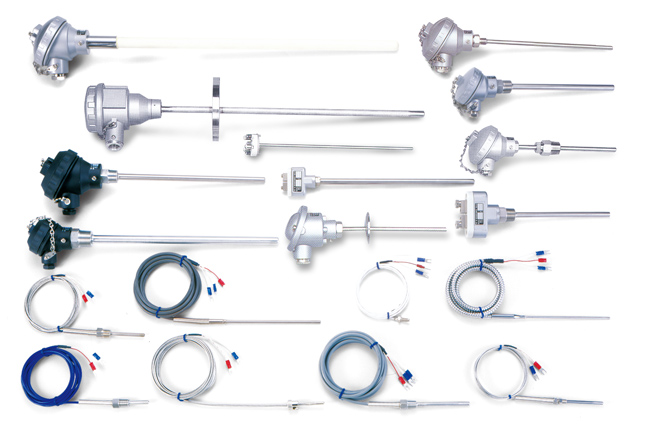
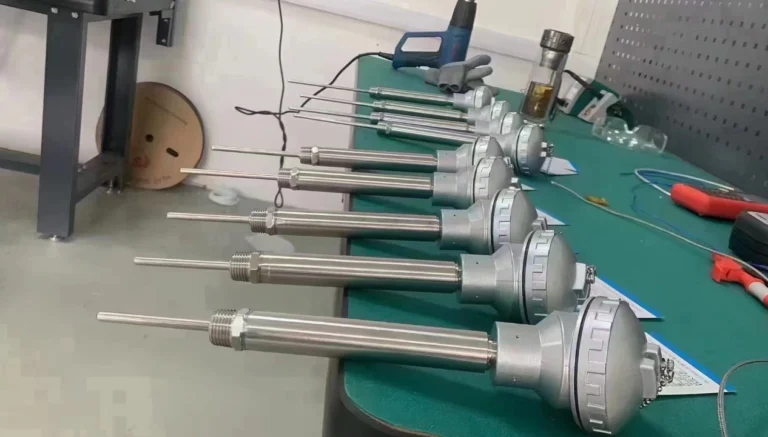
- Process and industrial loops, wide range, hazardous areas: choose a Pt100 RTD, Class A, three- or four-wire, paired with a head-mount transmitter. HMK supplies sheathed, assembled, and explosion-proof RTDs for this service.
- Furnace, boiler, and high-temperature service above 600 °C: a thermocouple, not an RTD, is the right element; see RTD vs thermocouple for that boundary.
- HVAC zone sensing, refrigeration, narrow-range OEM, fast response: a thermistor is well suited, where its narrow span and vendor-specific curve are not a constraint.
- Tight interchangeability and long-term stability: specify a Pt100 to IEC 60751:2022, three-wire, feeding a 4–20 mA transmitter.
For a new process measurement point, the default is a Class A Pt100 in a three-wire connection feeding a 4–20 mA transmitter; reserve the thermistor for narrow-range, high-volume, or fast-response duty where its limits do not bite.
Sheathed RTD (Pt100)
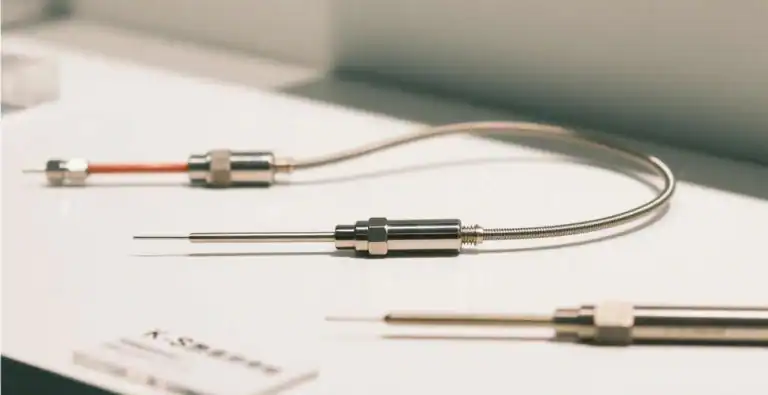
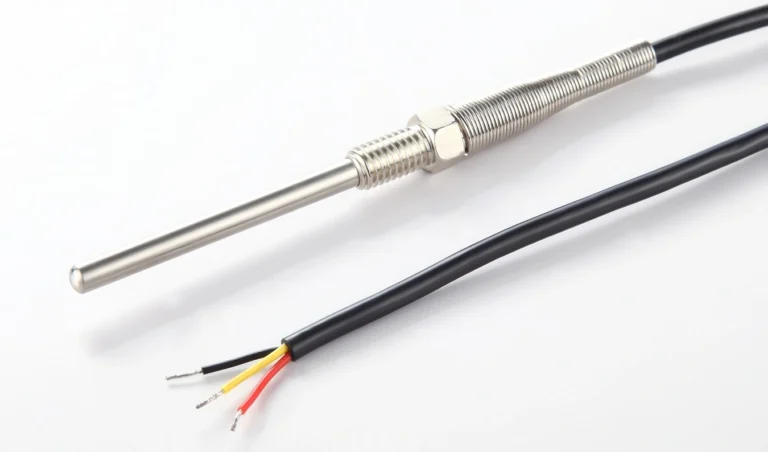
Flexible mineral-insulated Pt100 to IEC 60751, three- or four-wire, for tight bends and fast response.
View Specs →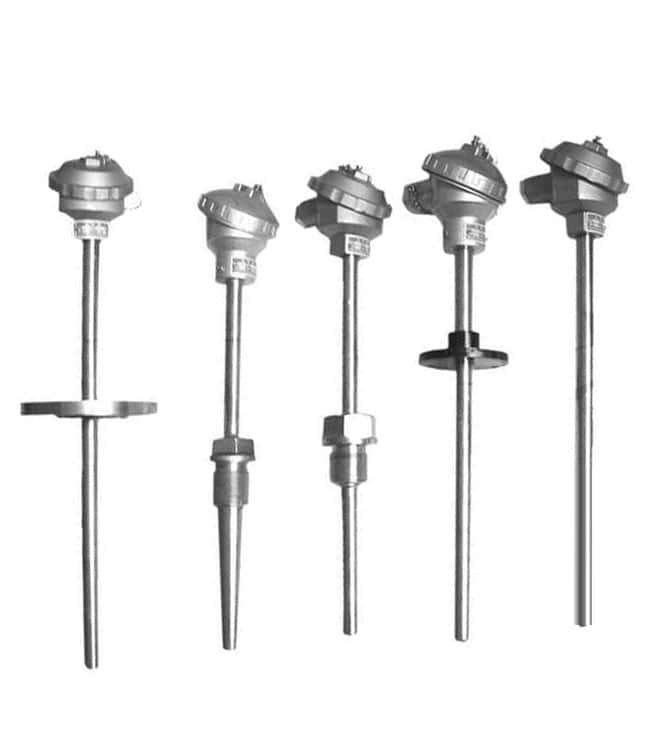
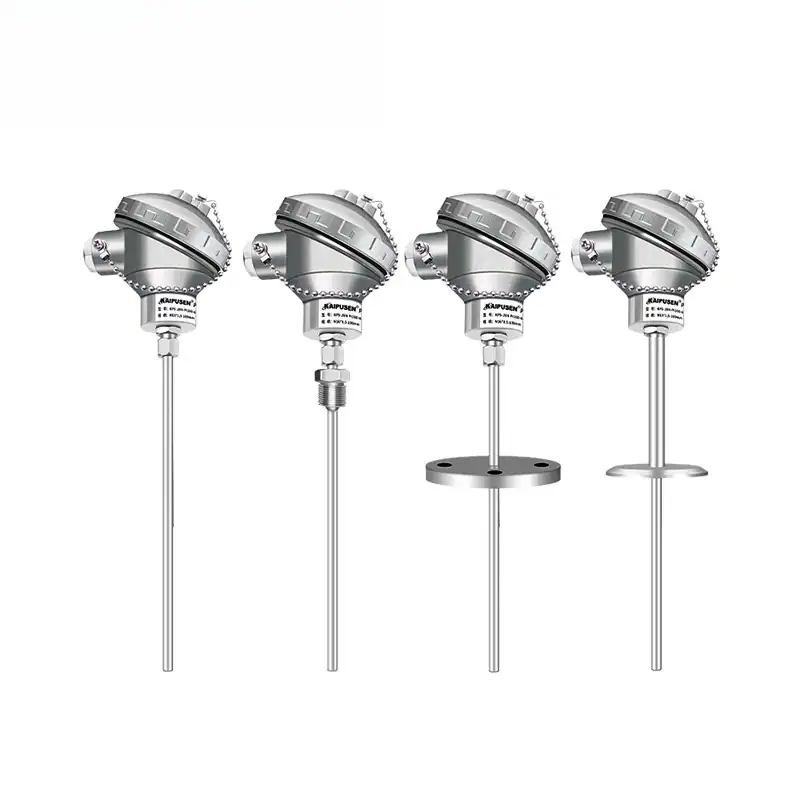
Assembled RTD (Pt100)
Thermowell-mounted Pt100 with terminal head for process pipework and vessels.
View Specs →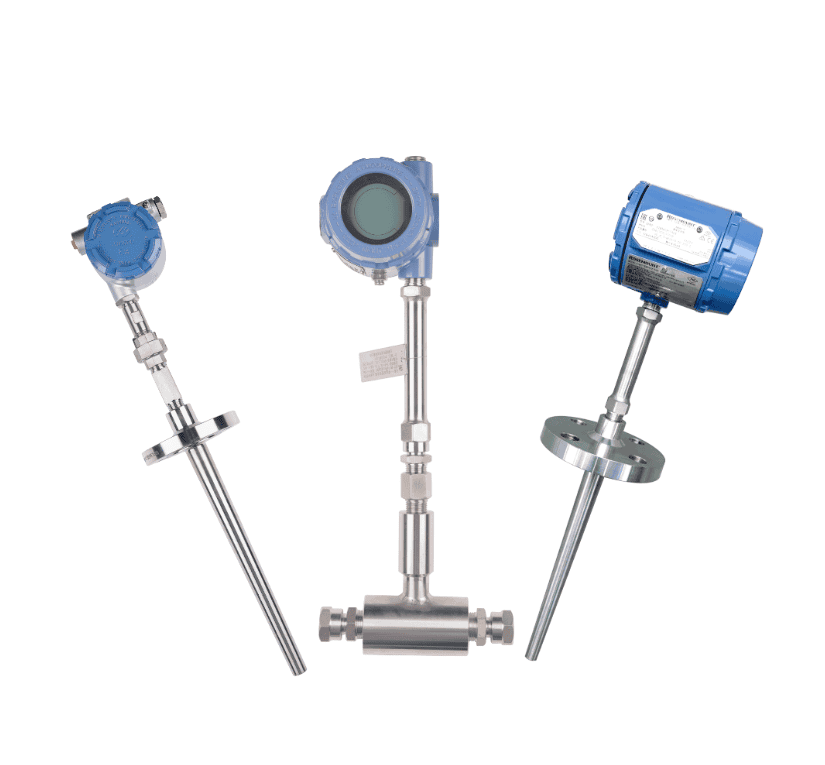
SBW Temperature Transmitter
Head-mount transmitter with native Pt100 input, linearized 4–20 mA output.
View Specs →Spec the right temperature sensor with our engineers
Send your range, accuracy, and connection. We will return a Pt100 element, class, and transmitter selection.
Request a QuoteFrequently Asked Questions
Is an RTD more accurate than a thermistor?
Over a wide range, yes. A thermistor can be more accurate than an RTD within a narrow band near room temperature because of its high sensitivity, but its accuracy collapses outside that window. A Pt100 holds a defined tolerance, Class A at ±0.15 °C at 0 °C, across its full −200 to +600 °C range.
Can a thermistor replace a Pt100?
Only if the loop accepts it. Most process transmitters have no thermistor input, and a thermistor’s vendor-specific curve will not match a Pt100 input. Replacing a Pt100 with a thermistor usually means new signal conditioning, so in plant service it is not a drop-in substitution.
Why do industrial plants use RTDs instead of thermistors?
Standardization. The Pt100 follows a fixed IEC 60751:2022 curve, so elements stay interchangeable between vendors without recalibration and every transmitter supports them. A thermistor locks the point to one supplier’s curve, which plants avoid.
What is the temperature range of an RTD vs a thermistor?
A platinum RTD covers −200 to +600 °C (−328 to +1,112 °F), with wire-wound elements to +850 °C. A common NTC thermistor covers about −50 to +150 °C (−58 to +302 °F), with specialized parts to 300 °C.
Are thermistors interchangeable like RTDs?
Not in general. RTDs are interchangeable by tolerance class under IEC 60751:2022. Thermistors interchange only within a matched product family from one manufacturer, and even then over a limited range.