How to Calibrate a Temperature Transmitter (RTD & TC)
A temperature transmitter that reads 3 °C (5.4 °F) high does not always hold a failed sensor. More often the digital trim has shifted, or the last service only re-ranged the device without trimming it. Ranging and trimming are two different operations, and confusing them is the most common reason a “calibrated” loop still disagrees with the local gauge. This guide covers both RTD-input and thermocouple-input transmitters: the source equipment, the two-point trim, the multi-point check, and the two error sources that quietly bias a calibration before the technician records a single number.
What Calibration Means for a Temperature Transmitter
Three operations are routinely called “calibration.” They are not interchangeable.
| Operation | What it changes | What it corrects | Tool |
|---|---|---|---|
| Ranging | The 4 mA and 20 mA endpoints (e.g. 0–200 °C) | Nothing about accuracy; it only scales the output | Configurator / HART |
| Sensor trim | The input stage: aligns the ADC reading to the true sensor input | Input-side drift, ADC offset and gain error | RTD decade box or mV source, or a bath + reference |
| Output (D/A) trim | The output stage: aligns the 4–20 mA DAC to the loop | Output-side error, loop and DAC drift | Precision mA meter |
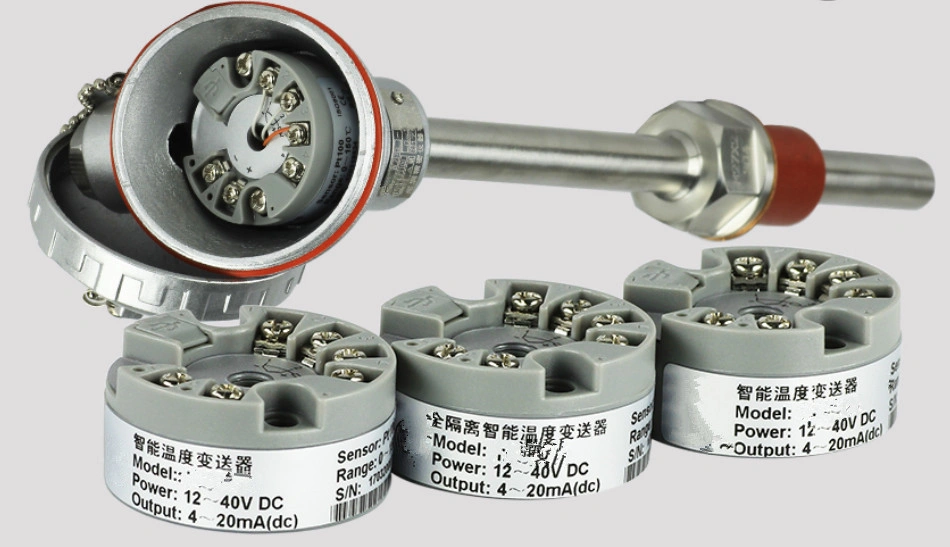
A smart transmitter such as the HM100 integrated temperature transmitter separates these. The HART configurator can re-range it without touching accuracy, run a sensor trim against a known input, and run an output trim against a reference milliammeter. An analog head-mount unit such as the SBW exposes zero and span only, so its “trim” is a combined input-plus-output adjustment set at two points. Knowing which operation a drift calls for saves an unnecessary full calibration: an output reading that is uniformly 0.05 mA low across the range is a D/A problem, not a sensor problem.
Tools and the Reference Standard
A defensible calibration needs a reference better than the transmitter under test. The working rule, set by ANSI/NCSL Z540.3, is a test uncertainty ratio (TUR) of at least 4:1: the reference uncertainty must be no larger than one quarter of the transmitter accuracy.
| Item | Role | Typical spec to look for |
|---|---|---|
| Dry-block calibrator or stirred liquid bath | Real-temperature source | Stability ≤ 0.05 °C, gradient ≤ 0.1 °C |
| Reference thermometer (Pt100) | Traceable true value | ± 0.03 to ± 0.1 °C, calibration certificate |
| RTD resistance decade box | Simulates the sensor for input checks | 0.01 Ω resolution |
| Thermocouple mV source with CJC | Simulates a thermocouple input | µV resolution, internal cold-junction compensation |
| Loop power supply + precision mA meter | Reads the 4–20 mA output | 0.01 mA resolution |
| HART communicator | Sensor and output trim on smart units | — |
The HM100 carries a ± 0.1 % accuracy spec. At a 200 °C (392 °F) span that is ± 0.2 °C, so the reference chain must stay inside ± 0.05 °C to keep 4:1. A general-purpose handheld reading ± 0.3 °C fails that test and makes the calibration unprovable, regardless of how carefully the steps are followed.
Simulation vs Real-Temperature Calibration
Two methods reach two different conclusions, and each leaves a blind spot.
Resistance or millivolt simulation injects a known electrical input straight into the transmitter terminals. It verifies the transmitter electronics only. It is fast, it needs no bath, and in our incoming acceptance testing of SBW modules we use it to screen the conditioning board before the sensor is ever attached. Its blind spot is the sensor: a simulated input cannot see RTD element drift, thermocouple inhomogeneity, or self-heating.
A real-temperature source places the actual sensor in a dry-block or bath next to a reference probe. It checks the full chain of sensor plus transmitter, which is what the process actually depends on. It is slower and bounded by the block stability. For a periodic compliance calibration, the real-temperature method is the one that counts; we treat simulation as a maintenance and fault-isolation tool, not a substitute.
Calibrating an RTD-Input Transmitter
Record an As-Found result before any adjustment, so drift between intervals is documented. Then trim.
- Isolate the loop and connect the reference milliammeter in series with the 24 V DC supply.
- Apply the low point. For 0 °C (32 °F) use an ice bath or a dry-block set point; let the block settle until drift is under 0.05 °C.
- Trim the low point to 4.000 mA.
- Apply the high point, for example 200 °C (392 °F), let it stabilize, and trim to 20.000 mA.
- Verify at 0, 25, 50, 75 and 100 % of range and record each error.
- Record an As-Left result.
The lead-wire trap sits in step 2 to 4. A Pt100 follows IEC 60751:2022 at a nominal 0.385 Ω/°C, so a two-wire connection adds the lead resistance straight onto the element and every 0.385 Ω of loop lead reads as roughly 1 °C of offset. The fix is not always to subtract that resistance. In the field on three-wire and four-wire RTD loops we calibrate in the installed configuration and do not manually deduct the lead resistance, because the transmitter front end already corrects it. A published comparison test by inspection engineers at CNOOC Technology Inspection makes the case with numbers: a 0.2 %-class transmitter calibrated directly in three- or four-wire returned a Z-score of 0.67 or lower against the |Z| ≤ 2 acceptance limit of CNAS-GL002:2018, and landed closer to the ideal value than a two-wire setup with manual lead correction. The manual correction over-compensates and never accounts for the contact resistance at each junction. Calibrate in the wiring the field uses, convert resistance with a Pt100 resistance-to-temperature table rather than by eye, and reserve manual lead subtraction for genuine two-wire installations.
Calibrating a Thermocouple-Input Transmitter
A thermocouple measures the difference between the hot junction and the cold (reference) junction, so cold-junction handling is where a thermocouple calibration is won or lost.
When simulating with a millivolt source, set the source to internal cold-junction compensation on, matched to the transmitter’s cold-junction compensation. A source feeding raw thermoelectric voltage with no CJC injects an error equal to the ambient temperature. At a 25 °C (77 °F) bench, a Type K input reads roughly 1 mV low, near 25 °C of error, with no fault in the transmitter at all. Per IEC 60584:2013 (and the matching ASTM E230 reference tables), Type K runs about 41 µV/°C near ambient, which is where that 1 mV figure comes from.
The real-temperature method places a reference thermocouple beside the working sensor in the block. Apply the low and high points, trim to 4.000 and 20.000 mA, then run the same five-point check used for the RTD. The HM100 accepts Type K, N, E, J, T, S, R and B inputs, so confirm the configured type matches the installed sensor before trimming; a transmitter set to Type K and fed a Type J sensor will calibrate cleanly and read wrong in service.
Is the Calibration Even Valid? A TUR Worked Example
A calibration is only as trustworthy as its reference margin. Build the error budget before accepting the result. Take an HM100 at ± 0.1 % of a 200 °C span, which is ± 0.2 °C. A 4:1 TUR allows a combined reference uncertainty of 0.05 °C. A reference probe at ± 0.03 °C and a dry-block stability of ± 0.04 °C combine in quadrature to about 0.05 °C, which holds 4:1. Swap in a ± 0.1 °C reference and the ratio collapses to roughly 2:1, and the calibration can no longer prove the transmitter meets spec. The HPTM189, rated ± 0.5 °C from −40 to 200 °C (−40 to 392 °F), is more forgiving and tolerates a coarser reference at the same ratio. We run this arithmetic before accepting any result; if the ratio fails, fix the reference before fixing the transmitter.
Calibration Interval and Documentation
Interval follows drift, not the calendar. A transmitter with a published stability of 0.1 % per year against a 0.2 % tolerance has headroom for a 12-month cycle; a unit on a thermal-cycling skid drifts faster and earns a shorter one. Set the first interval from the manufacturer stability figure, then let recorded As-Found drift tighten or relax it. Document each calibration with:
- Tag number, transmitter model and sensor type
- As-Found and As-Left readings at each check point
- Reference equipment IDs and certificate dates
- Calculated TUR
- Date, next-due date, and technician initials on the cal tag
HM100 vs SBW: How the Procedure Differs
The same principles apply, but the access differs.
| Aspect | HM100 (integrated, smart) | SBW (analog head-mount) |
|---|---|---|
| Input | Universal: 8 thermocouple types + Pt100 | Thermocouple or RTD, configured per unit |
| Adjustment | Separate sensor trim and output trim over HART | Combined zero and span at two points |
| Isolation | Standard, with optional HART | 2.5 kV input-to-output isolation |
| Best method | Sensor trim by simulation, output trim by mA reference, then a bath check | Two-point bath or simulator set, zero then span |
On a smart HM100, we trim the sensor and the output as two steps, then confirm with a real-temperature point. On an SBW head-mount transmitter, set zero at the low point and span at the high point and re-check, since the two interact. The 2.5 kV isolation on the SBW matters where the sensor sits on equipment at a different ground potential; it changes the installation, not the calibration steps.
Frequently Asked Questions
What instrument is used to calibrate a temperature transmitter?
A traceable temperature source (dry-block calibrator or stirred bath) with a reference thermometer for the sensor, plus a precision milliammeter and, on smart units, a HART communicator for the trim. The reference must meet a 4:1 TUR against the transmitter accuracy.
Can you calibrate a temperature transmitter with a resistance or mV simulator instead of a bath?
For electronics verification and fault isolation, yes. A decade box or mV source checks the transmitter only and cannot detect sensor drift or self-heating. A periodic compliance calibration should use a real-temperature source so the sensor is included.
Do I trim the sensor, the output, or both?
Both, on a smart transmitter. The sensor trim aligns the input to the true temperature; the output trim aligns the 4–20 mA signal to the loop. A uniform output offset across the range points to the output trim alone.
Why does a two-wire RTD calibration read high?
The lead resistance adds to the Pt100 element. At about 0.385 Ω/°C, every 0.385 Ω of lead reads as roughly 1 °C of positive offset. Use a three-wire or four-wire connection to cancel it, and do not also subtract the lead by hand.
What reference accuracy do I need?
At least four times better than the transmitter. For an HM100 at ± 0.2 °C over span, keep the combined reference uncertainty at or below 0.05 °C.
Specifying or replacing a temperature transmitter?
Tell us the sensor type, range, and process connection, and we will return a one-page recommendation with the right HMK temperature transmitter for the loop, factory-calibrated and ready to trim.