RTD Pt100 / Pt1000 Calculator
Convert between resistance and temperature for Pt100, Pt500 and Pt1000 sensors across the full −200 to +850 °C RTD range. Supports IEC 60751, JIS C1604 and US industrial standards using the Callendar–Van Dusen equation.
Quick Presets
Input
Valid range: −200 to +850 °C
Resistance
Pt100 / Pt500 / Pt1000 Reference Table
All values use the IEC 60751 curve (α = 0.003851) — the global baseline for industrial RTDs and the default coefficient used by HM Sensor temperature transmitters.
Need the accuracy grade behind these numbers? Our Pt100 Class A vs Class B guide explains the tolerance and range each class delivers across temperature.
| Temp (°C) | Pt100 (Ω) | Pt500 (Ω) | Pt1000 (Ω) | Class A (°C) | Class B (°C) |
|---|---|---|---|---|---|
| -200 | 18.520 | 92.600 | 185.201 | ±0.55 | ±1.30 |
| -100 | 60.256 | 301.279 | 602.558 | ±0.35 | ±0.80 |
| -50 | 80.306 | 401.531 | 803.063 | ±0.25 | ±0.55 |
| 0 | 100.000 | 500.000 | 1000.000 | ±0.15 | ±0.30 |
| 25 | 109.735 | 548.673 | 1097.347 | ±0.20 | ±0.42 |
| 50 | 119.397 | 596.986 | 1193.971 | ±0.25 | ±0.55 |
| 100 | 138.505 | 692.527 | 1385.055 | ±0.35 | ±0.80 |
| 150 | 157.325 | 786.626 | 1573.251 | ±0.45 | ±1.05 |
| 200 | 175.856 | 879.280 | 1758.560 | ±0.55 | ±1.30 |
| 300 | 212.051 | 1060.257 | 2120.515 | ±0.75 | ±1.80 |
| 500 | 280.978 | 1404.888 | 2809.775 | ±1.15 | ±2.80 |
| 700 | 345.284 | 1726.418 | 3452.835 | ±1.55 | ±3.80 |
| 850 | 390.481 | 1952.406 | 3904.811 | ±1.85 | ±4.55 |
How to Use This RTD Calculator
This calculator inverts the Callendar–Van Dusen equation in both directions, with Newton–Raphson iteration for sub-zero temperatures. It is useful for commissioning, calibration verification, and troubleshooting RTD loops in the field.
Step 1: Pick the sensor type — Pt100, Pt500 or Pt1000. The difference is only the nominal R₀ value; the curve shape is identical.
Step 2: Pick the standard. Default to IEC 60751 (α = 0.003851) for all modern industrial sensors and for HM Sensor HE-series temperature transmitters. Only select JIS or US if you are matching legacy hardware.
Step 3: Choose the conversion direction. Temperature → Resistance is what you need when sizing a sensor or specifying a calibration target. Resistance → Temperature is what you need when verifying a multimeter reading from a field probe.
Step 4: Enter the value. The result updates instantly. The output panel shows the converted value, the deviation from R₀, and the Class A tolerance at that temperature.
Quick Presets: Use the preset buttons to load common commissioning scenarios — ambient, boiling point, cryogenic, and high-temperature baseline values.
Callendar–Van Dusen Formula
RTD resistance is a non-linear function of temperature. All major standards describe it with the same polynomial form; only the A, B, C coefficients differ.
| Range | Equation |
|---|---|
| t ≥ 0 °C | R(t) = R₀ · (1 + A·t + B·t²) |
| t < 0 °C | R(t) = R₀ · (1 + A·t + B·t² + C·(t−100)·t³) |
Standard Coefficients
| Standard | α (°C⁻¹) | A | B | C (t < 0) |
|---|---|---|---|---|
| IEC 60751 / DIN 43760 | 0.003851 | 3.9083×10⁻³ | −5.775×10⁻⁷ | −4.183×10⁻¹² |
| JIS C1604-1981 | 0.003916 | 3.9739×10⁻³ | −5.870×10⁻⁷ | −4.400×10⁻¹² |
| US Industrial | 0.003926 | 3.9848×10⁻³ | −5.870×10⁻⁷ | −4.000×10⁻¹² |
Inverting the equation above 0 °C is a quadratic solve. Below 0 °C the cubic correction term makes analytical inversion impractical — this calculator uses Newton–Raphson iteration starting from the quadratic approximation, converging within 3–5 iterations to better than 1 × 10⁻⁷ °C precision.
RECOMMENDED PRODUCTS
Temperature Transmitters — Pt100 / Pt1000 Ready
You just converted RTD resistance to temperature by hand — these transmitters do the same conversion continuously, output 4-20mA, and ship with IEC 60751 linearization built in.
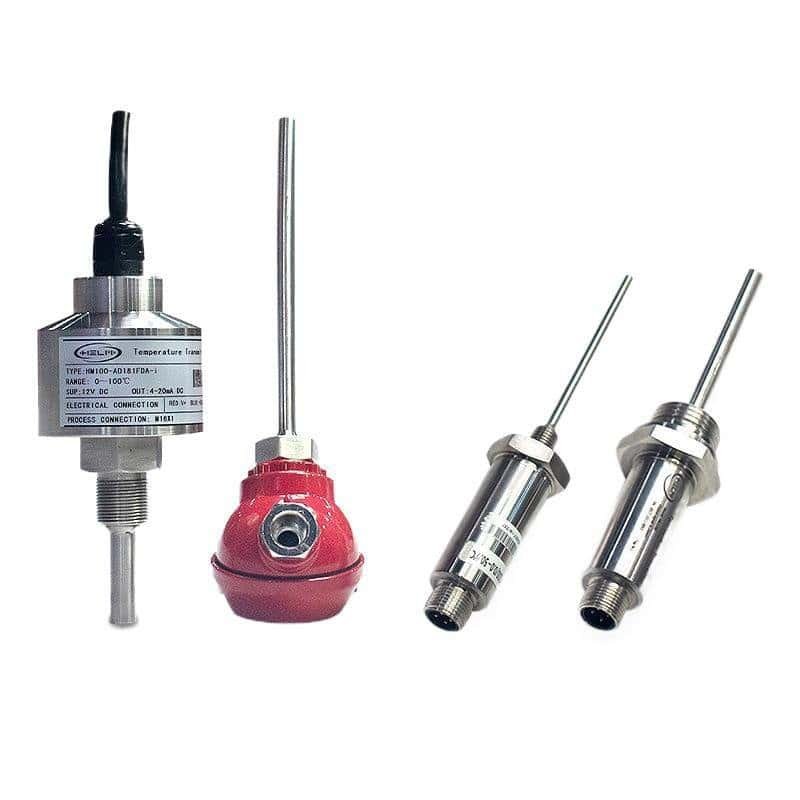
HM100 Integrated Temperature Transmitter
Universal RTD / TC input, 4-20mA output
- RTD input: Pt100 / Pt500 / Pt1000 / Cu50 (IEC 60751)
- Accuracy: ±0.1% of span, Class A or better
- Output: 4-20mA 2-wire, 10-36 VDC loop
- Options: Explosion-proof Ex d IIC T6, HART
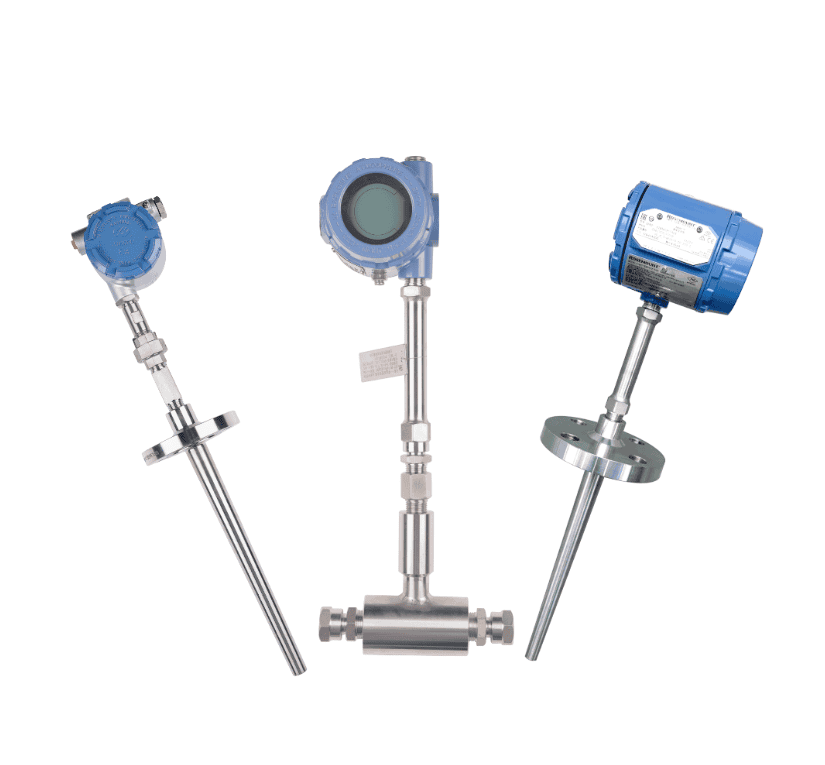
SBW Head-Mount Temperature Transmitter
Compact head-mounted Pt100 transmitter
- Mount: DIN B head inside sensor housing
- Input: Pt100 (2/3/4-wire), thermocouple options
- Output: 4-20mA 2-wire, field re-ranging available
- Use case: Pair with any RTD probe + thermowell
Frequently Asked Questions
Need Help with Your RTD / Pt100 Application?
Not sure whether to spec a Pt100 or a Pt1000? Our Pt100 vs Pt1000 guide walks through lead-wire error, self-heating, and instrument compatibility.
RTD sensors and transmitters
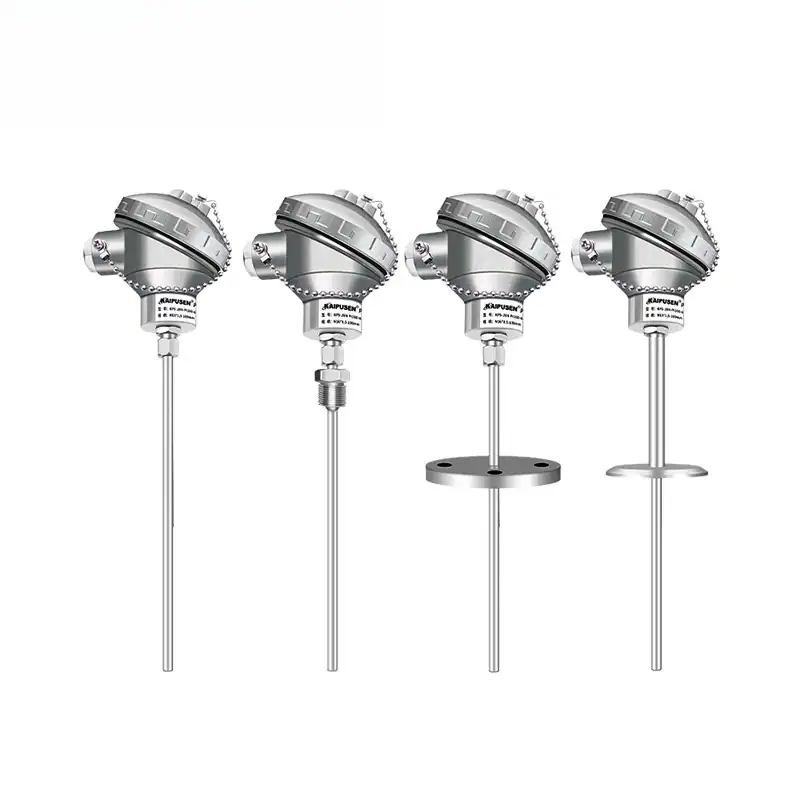
Sheathed RTD (Thermal Resistance)
Sheathed Pt100 RTD sensors for accurate mid-range temperature measurement.
View details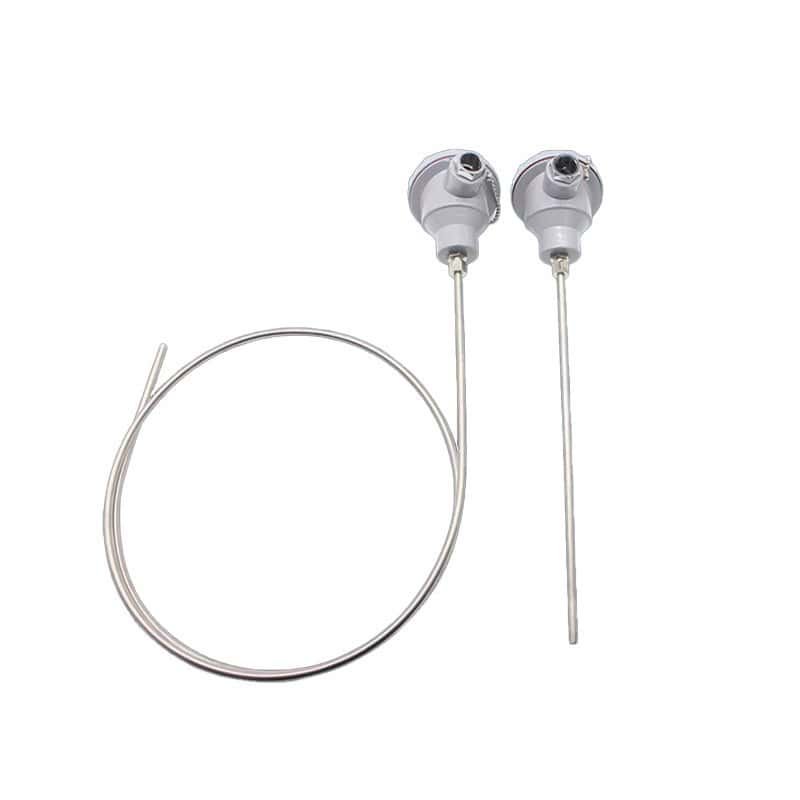
Sheathed Thermocouples
Sheathed thermocouples supplied in K, J, E, N and other calibrations.
View details
SBW Temperature Transmitter
Head-mounted temperature transmitter converting RTD or thermocouple input to 4–20 mA.
View details