Types of Temperature Sensors: An Industrial Guide
A temperature sensor is chosen by three constraints in sequence: the working range, the process atmosphere, and whether the point needs a local dial or a remote signal. Picking by “which type is most accurate” inverts that order and produces field failures. A Type T thermocouple installed above +370 °C fails; a high-accuracy Pt100 specified where the loop actually needed a powerless dial gauge wastes both cost and a wiring run.
This reference sorts the industrial temperature-sensor families by range, accuracy, and output, and maps each to where it belongs in a process plant.
Quick answer: Seven sensor families cover industrial temperature: thermocouple, RTD/Pt100, thermistor, bimetallic, gas-actuated (filled), semiconductor IC, and infrared. Process work relies mainly on thermocouples (widest range, to +1,700 °C), Pt100 RTDs (most accurate below +600 °C), and the two mechanical dial types (a reading with no power). Choose by range first, then atmosphere, then whether a local dial or a 4-20 mA signal is needed.
Seven Temperature-Sensor Families
Seven sensor families cover industrial temperature measurement. They divide into three electrical families that output a signal (thermocouple, RTD, thermistor), two mechanical families that show a local dial (bimetallic, gas-actuated), and two electronic families used mainly outside process instrumentation (semiconductor IC, infrared).
The table states the working range, accuracy, and output of each. Ranges are the practical class-valid spans, not the theoretical element envelope.
| Sensor family | Range (°C) | Range (°F) | Accuracy | Output | Local vs remote | HMK family |
|---|---|---|---|---|---|---|
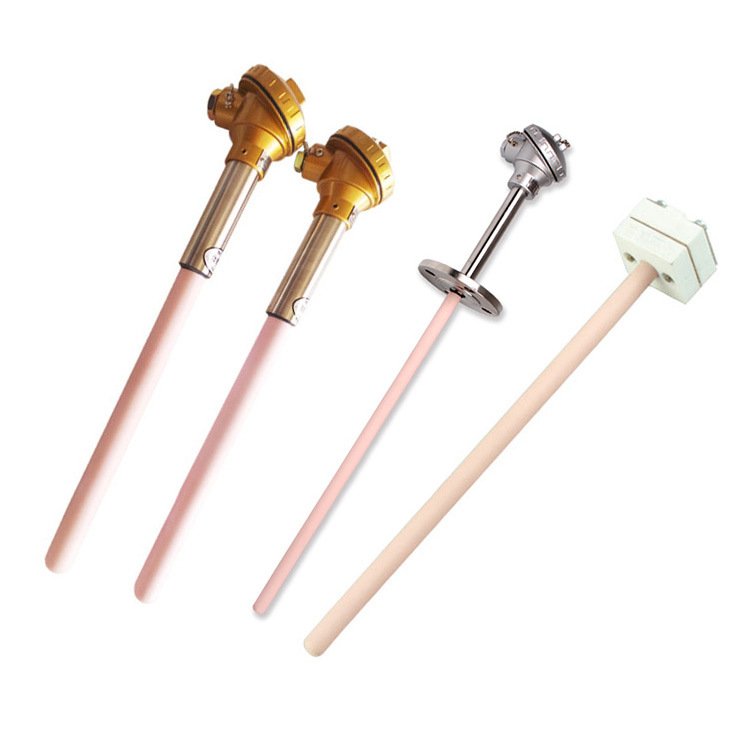
| Thermocouple (TC) | -270 to +1,700 (by type) | -454 to +3,092 | ±0.5 to ±4 °C by type/class | Millivolt (needs transmitter) | Remote (element + head) | Sheathed / assembled / Ex TC |
| RTD / Pt100 | -200 to +600 (class-valid) | -328 to +1,112 | Class A ±0.15 °C, B ±0.30 °C at 0 °C | Resistance (needs transmitter) | Remote | Sheathed / assembled / Ex RTD |
| Thermistor (NTC/PTC) | -50 to +150 (typical) | -58 to +302 | ±0.1 to ±0.5 °C in band | Resistance, nonlinear | Remote (board) | Not supplied by HMK |
| Bimetallic | -80 to +500 | -112 to +932 | Class 1.0 / 1.5 | Dial pointer, no signal | Local only | WSS / WSSX |
| Gas-actuated (filled) | -40 to +500 | -40 to +932 | Class 1.5 / 2.5 | Dial via capillary, no signal | Local, dial up to 20 m away | WTZ / WTQ |
| Semiconductor IC | -55 to +150 | -67 to +302 | ±0.5 to ±2 °C | Digital / analog | On-board | Not supplied by HMK |
| Infrared (non-contact) | -50 to +1,000 and above | -58 to +1,832 and above | ±1 to ±2 % of reading | Electronic | Non-contact | Not supplied by HMK |
Accuracy figures follow IEC 60751:2022 for RTDs and IEC 60584-1:2013 for thermocouples; mechanical dial classes follow EN 13190:2001 and JB/T 8803-1998.
Thermocouples Cover The Widest Range
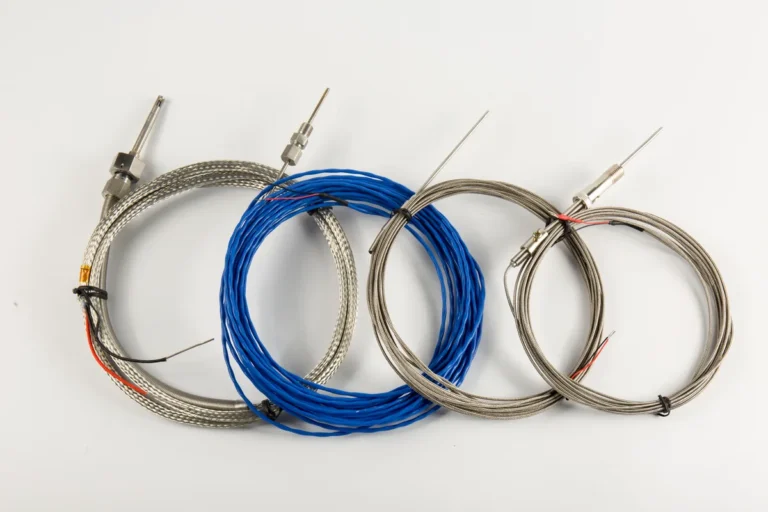
A thermocouple outputs a millivolt signal generated by two dissimilar metals joined at the measuring end. IEC 60584-1:2013 standardizes eight letter types across -270 to +1,700 °C.
Base-metal types carry most industrial work. Type K and Type N reach +1,260 °C (-200 to +1,260 °C / -328 to +2,300 °F), Type J reaches +760 °C, and Type T stops at +370 °C. Noble-metal Types S and R run 0 to +1,600 °C, and Type B reaches +1,700 °C for glass melting and sintering furnaces. Class 1 tolerance runs from ±1.5 °C on base metals to ±4 °C on Type B.
Atmosphere decides the type as much as range does. A case documented by WIKA describes “green rot” in Type K: between roughly 800 and 1,050 °C in a low-oxygen or reducing atmosphere, chromium in the positive leg oxidizes to Cr₂O₃, the thermoelectric voltage falls, and the reading drifts low. IEC 60584-1:2013 assigns Type N (Nicrosil/Nisil) to sulfur-bearing and reducing service for exactly this failure.
Because the output is millivolts, a 4-20 mA or HART loop needs a head- or DIN-rail transmitter. The thermocouple types guide gives per-type range, atmosphere, and tolerance detail, with the reference tables from NIST ITS-90.
RTDs And Pt100 Lead On Accuracy
An RTD reads temperature as the resistance of a platinum element. The Pt100 element is defined over -200 to +850 °C under IEC 60751:2022, but no tolerance class is validated to that full envelope.
Class A holds ±0.15 °C (±0.27 °F) at 0 °C and is valid -100 to +450 °C for wire-wound elements; Class B holds ±0.30 °C (±0.54 °F) and is valid -196 to +600 °C. Both tolerances widen with temperature, so the class is confirmed against the process temperature, not the element envelope.
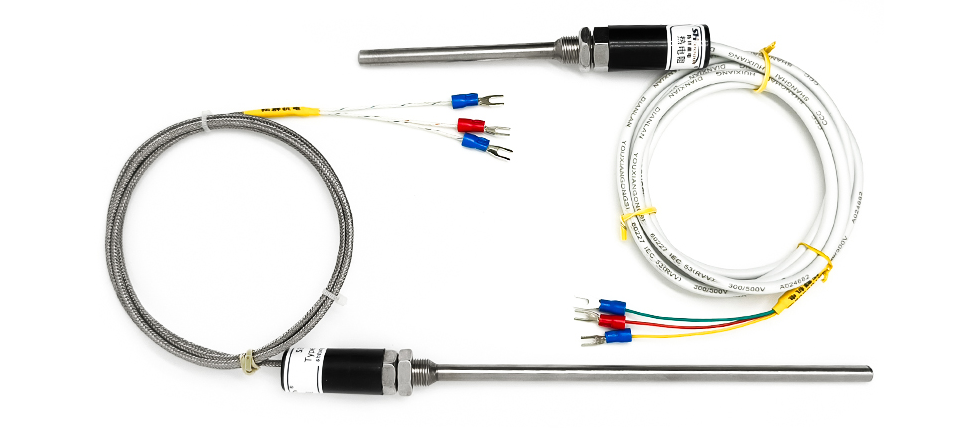
Below +600 °C a Pt100 is more accurate and more linear than a thermocouple, at higher cost and a lower ceiling. Like a thermocouple, it outputs a passive signal and needs a transmitter for a current loop. The Pt100 Class A vs Class B guide tabulates the per-class validity ranges.
Thermistors: High Sensitivity, Narrow Band
A thermistor is a metal-oxide resistor with a large, nonlinear resistance change per degree. NTC types dominate, where resistance falls as temperature rises.
The useful band is narrow, typically -50 to +150 °C, with high sensitivity and fast response inside it. That suits electronics, medical, and HVAC boards, and rules the thermistor out of wide-range process work. HMK does not supply thermistors; a process point in this band is served by a Pt100. The resistance-element comparison is set out in RTD vs thermistor.
Dial Gauges Read Without Power
Two mechanical families give a reading with no power and no signal wiring, which is the correct choice where an operator needs a dial at the pipe.
A bimetallic thermometer coils two bonded metals to move a pointer across a dial; the WSS/WSSX series covers -80 to +500 °C (-112 to +932 °F) at Class 1.0 or 1.5. A gas-actuated (filled-system) thermometer drives the dial through an inert-gas capillary, so the dial mounts up to 20 m from the stem; the WTZ/WTQ series covers -40 to +500 °C at Class 1.5 or 2.5.
Neither outputs an electrical signal. The temperature gauge types guide details the mechanism, dial sizes, and accuracy classes.
Where Semiconductor And Infrared Sensors Fit
Two electronic families sit outside process instrumentation. A semiconductor IC sensor outputs a calibrated digital or analog value over -55 to +150 °C and lives on a circuit board, not a pipe.
An infrared sensor reads surface temperature without contact from -50 to over +1,000 °C, used where the target moves, rotates, or cannot be touched. Both are valid measurement types, but neither is a contact process sensor, and HMK supplies neither. They are listed here so a plant reader rules them out deliberately rather than by omission.
From Sensing Element To Field Instrument
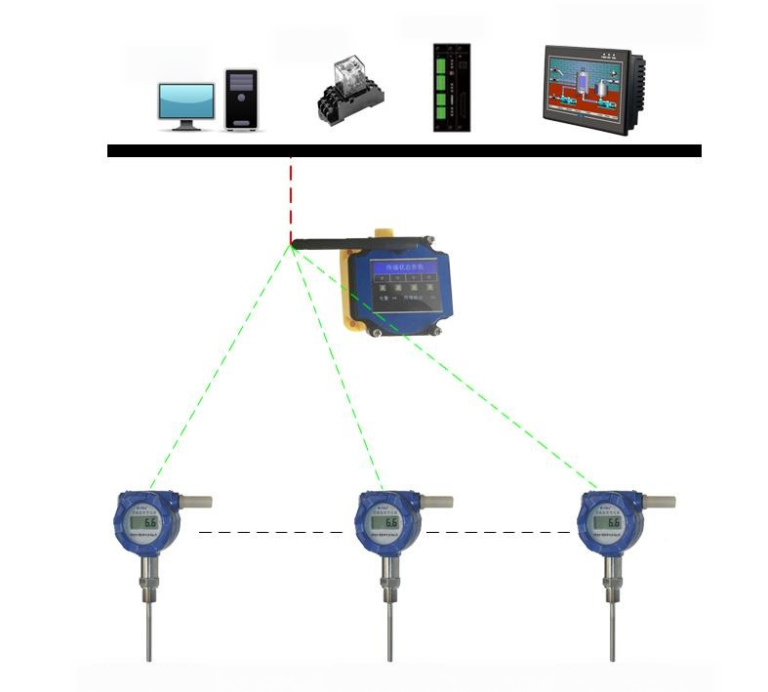
A sensor type is only half of a specification. A thermocouple or RTD element outputs millivolts or ohms and cannot reach a control system on its own. Three assembly decisions turn an element into a field instrument:
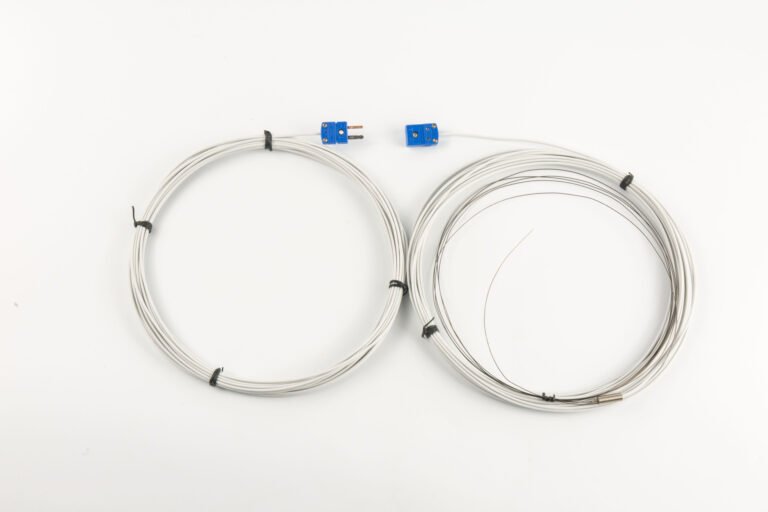
- Sheath or assembly — a mineral-insulated sheathed element bends into tight fittings, while an assembled element with a connection head suits fixed thermowell mounts.
- Thermowell — pressurized, fast-flowing, or corrosive lines need a thermowell so the element is replaceable without breaching the process.
- Transmitter and output — a head- or DIN-rail transmitter converts mV or Ω to 4-20 mA or HART, and a hazardous area requires an Ex-rated assembly.
None of this applies to a bimetallic or gas-actuated gauge, which ships as a complete instrument. The thermowell types and head-mount vs DIN-rail transmitters guides cover the assembly options.
Matching A Type To The Process
Selection follows the range, then the atmosphere, then the output need:
- Above +600 °C — a thermocouple: Type K or N to +1,260 °C, Type S, R, or B above.
- -200 to +600 °C, accuracy-critical — a Pt100, Class A or B by validity range.
- Local dial, no power — a bimetallic gauge, or a gas-actuated gauge where the dial must sit away from the stem.
- Sulfur, reducing, or vacuum atmosphere — match the thermocouple to the atmosphere: Type N for sulfur-bearing gas, Type J for reducing or vacuum service.
The how to select an industrial temperature sensor guide gives the full two-stage element-then-assembly procedure.
Temperature Sensors From HMK TECH
HMK TECH manufactures the contact and mechanical families in this reference: sheathed, assembled, and explosion-proof thermocouples and RTDs; head-mount and rail temperature transmitters; WSS/WSSX bimetallic and WTZ/WTQ gas-actuated dial thermometers; and TF-series thermowells. Element, assembly, and output are specified together, so a point is delivered as a field-ready instrument rather than a bare sensing element. The full range and selection support sit on the temperature sensors and transmitters page.
Specifying a temperature point?
Send the range, process medium, and mounting, and HMK TECH returns an element-plus-assembly configuration with the correct thermowell and output.
Request a SelectionFrequently Asked Questions
How many types of temperature sensors are there?
Seven families are used in practice: thermocouple, RTD, thermistor, bimetallic, gas-actuated (filled-system), semiconductor IC, and infrared. Industrial process work relies mainly on thermocouples and RTDs plus the two mechanical dial types.
Which temperature sensor is the most accurate?
A Pt100 RTD, Class A at ±0.15 °C at 0 °C, is the most accurate general industrial type below +600 °C. Above that ceiling, thermocouples are used because RTD classes are not validated there.
What is the difference between a thermocouple and an RTD for high-temperature service?
A thermocouple reads to +1,700 °C and costs less; a Pt100 stops around +600 °C class-valid but is more accurate and more linear below it. Above +600 °C the thermocouple is the only contact option.
Which temperature sensor works without a power supply?
Bimetallic and gas-actuated dial thermometers. Both show a local reading with no power and no signal wiring, and a gas-actuated model can place the dial up to 20 m from the measurement point.
Do all temperature sensors need a thermowell?
No. Sheathed thermocouples and RTDs on pressurized, fast, or corrosive lines need one so the element is replaceable; low-pressure or non-critical points can use a direct-immersion element. Mechanical gauges use a stem or their own well.