Steam Pressure Transmitter Selection
A steam pressure transmitter is a pressure transmitter protected from steam heat, because a saturated-steam line runs hotter than most sensors can tolerate. At 10 bar g, steam sits at about 184 °C, while many standard transmitters top out near 85–125 °C. Read the saturation temperature from the operating pressure first, then pick the protection that keeps the sensing element inside its limit: a pigtail siphon, a condensate pot, a remote diaphragm seal, or a high-temperature transmitter.
Steam looks like an easy pressure measurement and quietly destroys transmitters. The pressure range is usually modest, a few bar to a few tens of bar, but the temperature that comes with it is not. The single decision that keeps a steam pressure transmitter alive is how you break the heat path between the live steam and the sensing element. The sections below follow the order a plant engineer meets the problem: temperature first, protection method second, then range, materials, and the transmitter itself.
Steam pressure sets the temperature
For saturated steam, pressure and temperature are not independent. Every gauge pressure corresponds to a fixed saturation temperature, so the operating pressure alone tells you how hot the process connection will get. That saturation temperature, not the ambient air or a nameplate “process temperature,” is the number a transmitter has to survive. Read it straight off a steam table before you look at any datasheet.
| Saturated steam, gauge pressure | Approx. saturation temperature | Practical implication |
|---|---|---|
| 1 bar g | ~120 °C | Above most standard-transmitter limits already |
| 5 bar g | ~159 °C | Siphon or seal required |
| 10 bar g | ~184 °C | Siphon or seal required |
| 16 bar g | ~204 °C | Seal or high-temperature transmitter |
| 25 bar g | ~226 °C | Seal or high-temperature transmitter |
| 40 bar g | ~252 °C | High-temperature design territory |
Values are approximate saturation points for orientation. For an exact figure at your pressure, use the saturated steam table calculator (by pressure) or, when you know the temperature limit and need the matching pressure, the calculator by temperature.
Set that saturation temperature against the transmitter you have in mind. Many general-purpose pressure transmitters are rated for media around 85–125 °C. Even a low-pressure steam header at 5 bar g is already well past that, which is why a bare transmitter mounted straight onto a steam line fails early: the electronics and the fill fluid cook before anything reads wrong. The fix is always the same: put distance, metal, or a fluid barrier between the steam and the cell.
Saturated vs superheated steam
The protection that works depends on whether the steam is saturated or superheated, because the two behave differently at the tapping point. Saturated steam readily gives up heat and condenses, so a loop of pipe that traps condensate can form a stable water leg that blocks live steam from reaching the diaphragm. Superheated steam carries extra heat above its saturation point and resists condensing, so a simple siphon may not fill reliably and the media stays hot for longer. On superheated service you lean toward a longer cooled impulse line or a fluid-filled seal rather than trusting a condensate leg to form on its own.
This is also why “it worked on the last job” is a weak reason. A pigtail that was fine on a 6 bar g saturated header can be the wrong choice on a superheated line at the same pressure. Confirm the steam condition, not just the pressure, before you copy a protection method across measurement points.
Three thermal protection methods
Three protection methods cover almost every steam pressure measurement. They are not interchangeable; each fits a temperature band and a maintenance style.
| Method | How it protects | Best fit |
|---|---|---|
| Pigtail siphon | A coil traps condensate that forms a cool water leg between steam and diaphragm | Saturated steam, moderate pressure, simple and cheap |
| Condensate (seal) pot | A larger reservoir holds a bigger, more stable condensate volume | Higher pressures, larger lines, where a pigtail leg is marginal |
| Remote diaphragm seal + capillary | An isolating diaphragm and fill fluid physically separate steam from the cell | Superheated or high-temperature service, continuous duty, cleaner installations |
Choosing between a pigtail siphon and a condensate pot is its own decision about sizing, drop, and material, and it is worth getting right, because a mis-sized siphon reads with lag or lets steam through. That trade-off is covered in detail in the guide to pigtail siphons versus condensate pots. When steam is superheated or the point runs continuously hot, a remote diaphragm seal removes the reliance on a condensate leg entirely, at the cost of fill-fluid selection and capillary temperature effects.
Range, turndown, and stability
Size the range to the working pressure with headroom for start-up and load swings, but do not overspecify: a transmitter used across a small part of a large range gives up resolution. On steam service the more important number is long-term stability. Plants recalibrate on a schedule, and a transmitter that drifts forces the interval shorter, so a modest drift specification often beats a slightly better initial accuracy. Where the point feeds a control loop, confirm the output and protocol. A 4–20 mA loop remains the default, with digital or HART-style options where the DCS expects them.
Installation carries as much of the reliability as the transmitter. Keep impulse lines short and self-draining, mount so condensate cannot pocket against the cell, and insulate where heat pickup would otherwise stress the seal. On differential points across steam, the same thermal rules apply, and the tapping detail matters as much as the instrument. The field practice for that is covered under impulse lines for pressure and DP transmitters.
Wetted materials and connections
Steam and its condensate are not especially corrosive, so 316L stainless steel wetted parts cover most services. Specify the diaphragm and process-connection material together with the temperature: a seal fluid and diaphragm chosen for 150 °C is not the same assembly you would use near 300 °C. Match the process connection to the tapping: a threaded fitting for a small header, or a flange where the line or the seal calls for it. Confirm the seal fill fluid is rated for both the maximum temperature and any vacuum that occurs when steam collapses on shutdown.
Matching an HMK transmitter
With the protection method chosen, the transmitter selection follows the temperature band and the accuracy the loop needs.
- Saturated steam with a siphon or pot (up to ~125 °C at the cell): a precision general-purpose transmitter such as the HM22 high-accuracy transmitter (0.1% FS, low temperature drift) suits header and boiler-house points where the siphon has already dropped the temperature.
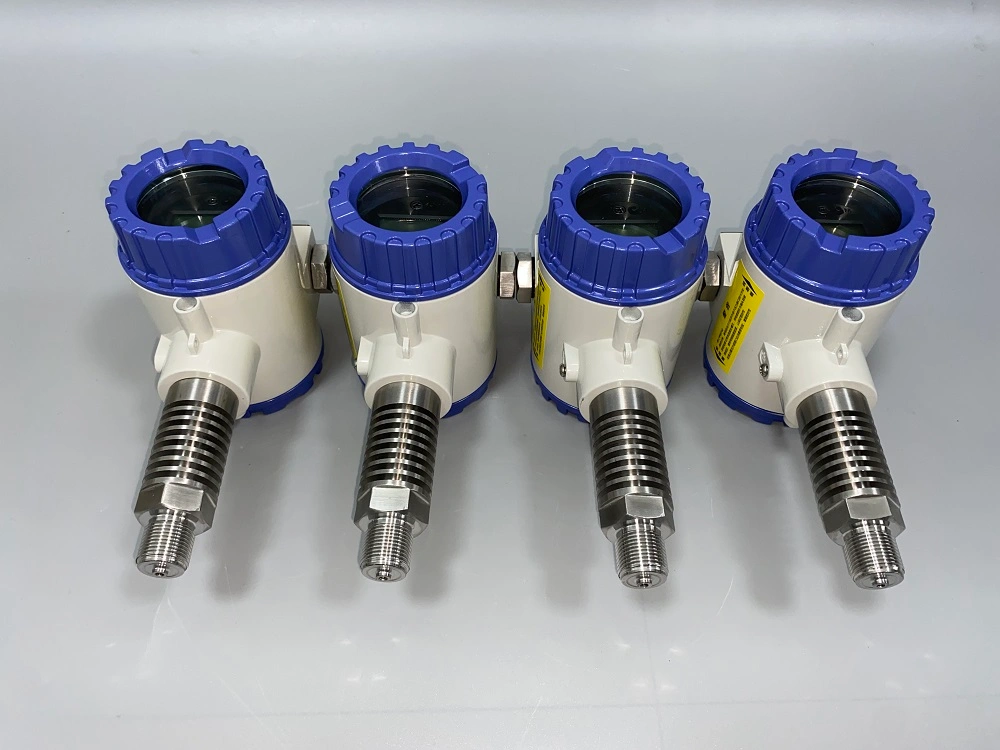
- Hot or superheated points, or where you want to shorten the cooling hardware: the HM80 high-temperature transmitter handles media up to +350 °C with a heat-pipe-cooled sensing element, reducing dependence on long impulse legs at the hottest tappings.
- Digital integration into a DCS: HMK’s digital, configurable transmitters (for example the HM29 intelligent series) give configurable range and digital output where the control system expects more than a fixed 4–20 mA signal.
- Continuous high-temperature isolation: pair any of the above with a remote diaphragm seal when a condensate leg cannot be trusted to stay stable.
Confirm the exact temperature rating, range, and connection against the product datasheet for your operating conditions before ordering; the right choice is the one whose wetted-part temperature limit clears the saturation temperature you read at the start.
Frequently asked questions
What temperature can a steam pressure transmitter handle?
The transmitter itself usually tolerates 85–125 °C at the cell; steam is hotter than that at almost any working pressure, so a siphon, condensate pot, or diaphragm seal cools the media first. High-temperature transmitters extend the direct limit; the HM80, for example, is rated to +350 °C media.
Do I always need a siphon on steam?
Almost always, unless you use a high-temperature transmitter or a remote diaphragm seal. Because saturation temperature exceeds a standard transmitter’s limit even at low pressure, some form of thermal break is the rule rather than the exception.
How do I find the temperature at my steam pressure?
Read the saturation temperature for your gauge pressure from a steam table or the saturated steam table calculator. That temperature, not the ambient, is what the transmitter and its protection must survive.
Is a pigtail siphon or a diaphragm seal better?
A pigtail siphon is simpler and cheaper for saturated steam at moderate pressure; a remote diaphragm seal is more reliable for superheated or continuously hot service because it does not rely on a condensate leg forming. The siphon-versus-pot guide covers the sizing detail.
About the author: Lin Jun (林俗), Senior Pressure Instrumentation Engineer
Lin Jun has 12+ years of hands-on experience with industrial pressure measurement in refining, petrochemical, and power generation, from steam-header and boiler-house transmitter installations to high-temperature and diaphragm-seal assemblies on hot process lines. His work covers gauge, absolute, and differential pressure transmitters, remote seals, and HART / 4–20 mA loops. China University of Petroleum, Automation Department. View Lin Jun’s full profile → Send your application brief for a sensor recommendation.