Type E Thermocouple: Range, Accuracy & Highest Output
A Type E thermocouple measures from −270 to 1,000 °C (−454 to 1,832 °F) and produces about 68 µV/°C, the highest output of any standard base-metal type. That sensitivity, with two non-magnetic legs, makes it the choice for sub-zero work, narrow spans, and measurements near magnetic fields. Check the wire colours against the thermocouple color code finder.
Its ceiling is lower than Type K, and its Chromel leg shares the same green-rot weakness in low-oxygen heat. Four things decide a Type E selection: the grade-wire range, the tolerance class at temperature, the output advantage, and the point at which Type K or Type T becomes the better choice.
What Is a Type E Thermocouple Made Of?
A Type E thermocouple pairs a positive leg of Chromel (nickel-chromium, roughly 90 % Ni / 10 % Cr) against a negative leg of Constantan (copper-nickel, about 55 % Cu / 45 % Ni). The combination produces approximately 68 µV/°C near ambient, the largest Seebeck output of the common types and about 1.7 times that of a Type K. Both alloys are non-magnetic, which removes the magnetic anomaly that affects Type K.
Type E is defined in IEC 60584:2013 and ASTM E230. It shares its positive Chromel leg with Type K, so the two behave alike in oxidizing heat; the broader family is compared in the thermocouple types overview.
Temperature Range: Grade Wire vs Extension Wire
Grade wire carries the full measuring range; extension wire only returns the signal to the instrument and is rated far lower.
| Parameter | Celsius | Fahrenheit |
|---|---|---|
| Grade wire, full range (IEC 60584:2013) | −270 to 1,000 °C | −454 to 1,832 °F |
| Practical continuous, heavy gauge | up to ~870 °C | up to ~1,600 °F |
| Useful measuring range | −200 to 900 °C | −328 to 1,652 °F |
| Extension wire (type EX) | −25 to 200 °C | −13 to 392 °F |
Type E reaches 1,000 °C on the table but is held below about 900 °C in practice; its ceiling sits under the 1,100 °C of a Type K because the higher output is traded for maximum temperature. Below 0 °C the high sensitivity makes it one of the best base-metal choices for cryogenic service. Extension cable must never see process heat; above 200 °C the EX alloy adds its own error to the signal.
How Accurate Is Type E? Class 1 vs 2
Two standards define Type E tolerance. IEC 60584:2013 uses Class 1 and Class 2; ASTM E230 uses Standard and Special. Each is a fixed value or a percentage of reading, whichever is greater.
| Standard / class | Tolerance | Valid range |
|---|---|---|
| IEC 60584:2013 Class 1 | ±1.5 °C or ±0.004·|t| | −40 to 800 °C |
| IEC 60584:2013 Class 2 | ±2.5 °C or ±0.0075·|t| | −40 to 900 °C |
| ASTM E230 Special | ±1.0 °C or ±0.4 % | 0 to 870 °C |
| ASTM E230 Standard | ±1.7 °C or ±0.5 % | 0 to 870 °C |
Worked from the IEC formulas: a Class 1 sensor holds ±1.5 °C at 300 °C, widens to ±2.4 °C at 600 °C, and reaches ±3.2 °C at 800 °C. The high output does not tighten these tolerance bands, but it does improve resolution: at 68 µV/°C the instrument resolves a smaller temperature step for a given microvolt count. Calibration against a reference, covered in temperature transmitter calibration, is the only way to tighten the as-installed figure.
The Highest Output of the Base Metals
Output, or Seebeck coefficient, is where Type E separates from the other base-metal types. The figure states the value near ambient for each.
A higher coefficient means more millivolts per degree, so a given instrument resolution corresponds to a smaller temperature step. For a transmitter resolving 1 µV, a Type E resolves about 0.015 °C against 0.024 °C for a Type K. The advantage matters where the gradient is small, where the span is narrow, or where the measurement sits below 0 °C and every other type loses output. It does not change the tolerance class, only the signal-to-noise margin behind it.
Where Type E Wins: Cryogenic and Non-Magnetic Service
Two properties decide most Type E selections. The first is its output below 0 °C: it holds more microvolts per degree than Type K through the cryogenic band, which is why laboratory and low-temperature work favors it down toward −200 °C. The second is that both legs are non-magnetic.
Type K carries a ferromagnetic Alumel leg, which produces a small but real EMF anomaly and non-linearity as it passes its magnetic transition near 150 °C; Type J carries an iron leg with the same kind of behavior. Type E has neither, so its output curve stays smooth through that region and it does not develop a magnetic signature in a strong field. In the field on induction-heating furnaces and magnet-adjacent test rigs, Type E is specified over Type K to remove the 1 to 2 °C anomaly the Alumel leg produces near that transition. The trade is the lower ceiling and the shared green-rot weakness described next.
Type E vs Type K vs Type T
The choice among these three is set by temperature ceiling, output, and atmosphere.
| Attribute | Type E | Type K | Type T |
|---|---|---|---|
| Alloys | Chromel / Constantan | Chromel / Alumel | Copper / Constantan |
| Range (grade) | −270 to 1,000 °C | −270 to 1,372 °C | −270 to 400 °C |
| Practical continuous | ~900 °C | ~1,100 °C | ~370 °C |
| Output near ambient | ~68 µV/°C | ~41 µV/°C | ~41 µV/°C |
| Magnetic legs | none | Alumel leg magnetic | none |
| Green rot risk (low-O₂ 800–1,050 °C) | yes (Chromel leg) | yes | not applicable |
| Best fit | high output, sub-zero, non-magnetic | highest ceiling, general oxidizing | moist, cryogenic, ≤370 °C |
Type E is the correct choice for the highest output up to about 900 °C and for non-magnetic service. Type K wins when the ceiling must reach 1,100 °C; the Type K thermocouple trades output for that range. Type T is the pick for moist, condensing, or very low cryogenic duty below 370 °C; the Type T thermocouple page covers that limit.
Because the Chromel leg green-rots in marginally oxidizing heat above 800 °C just as a Type K does, Type E is not a fix for that failure; the drift-resistant answer there is Type N, compared on the thermocouple types overview. Below 0 °C an RTD versus thermocouple comparison also applies where stability outweighs output.
Which Color Code Identifies Type E Wire?
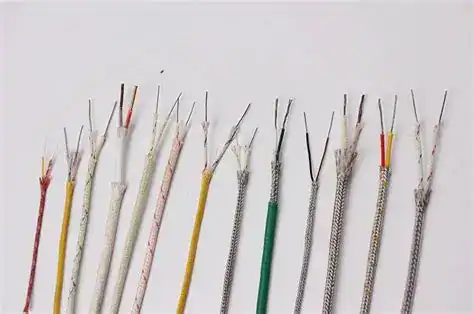
Color code identifies the type and polarity, and it differs by standard, a frequent source of miswiring.
| Standard | Positive leg | Negative leg | Overall jacket |
|---|---|---|---|
| ANSI/ASTM MC96.1 (US) | purple | red | purple |
| IEC 60584:2007 | violet | white | violet |
The reliable rules: under ANSI the negative leg is always red and Type E is the purple type; under IEC the negative leg is always white and the Type E jacket is violet. Polarity matters because a reversed junction reads a falling temperature as rising. Extension cable must be matched EX alloy; substituting copper introduces a second uncontrolled junction at the terminal.
Specifying a Type E Probe
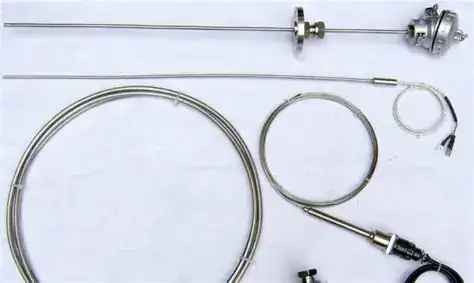
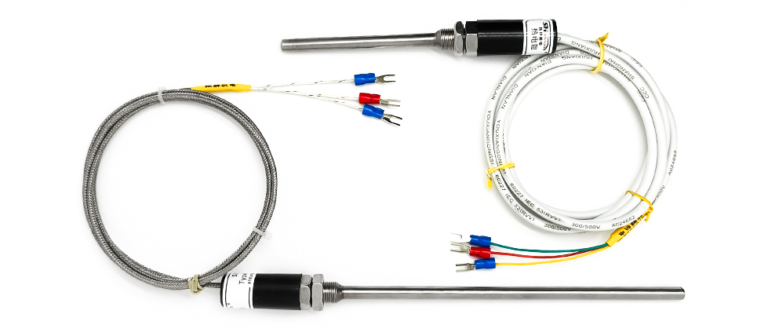
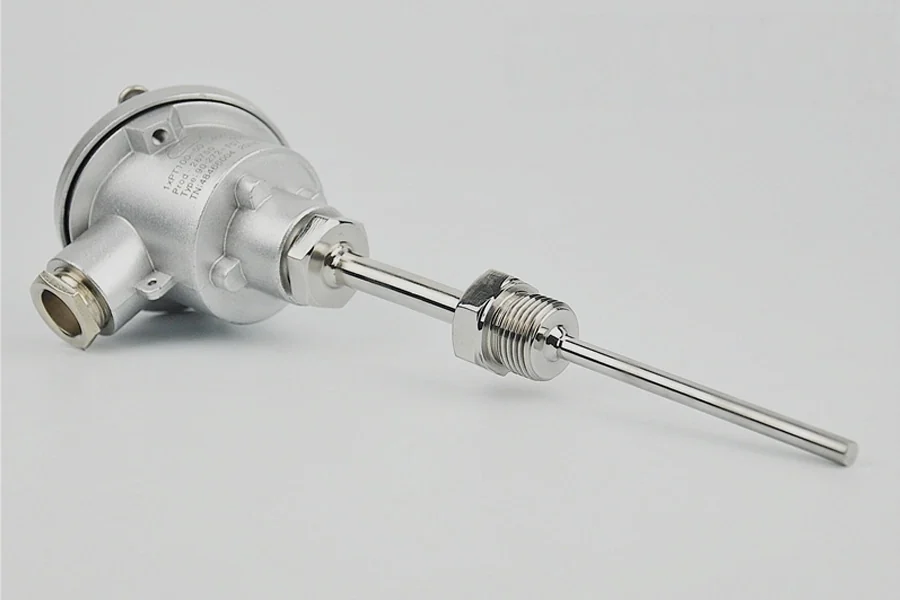
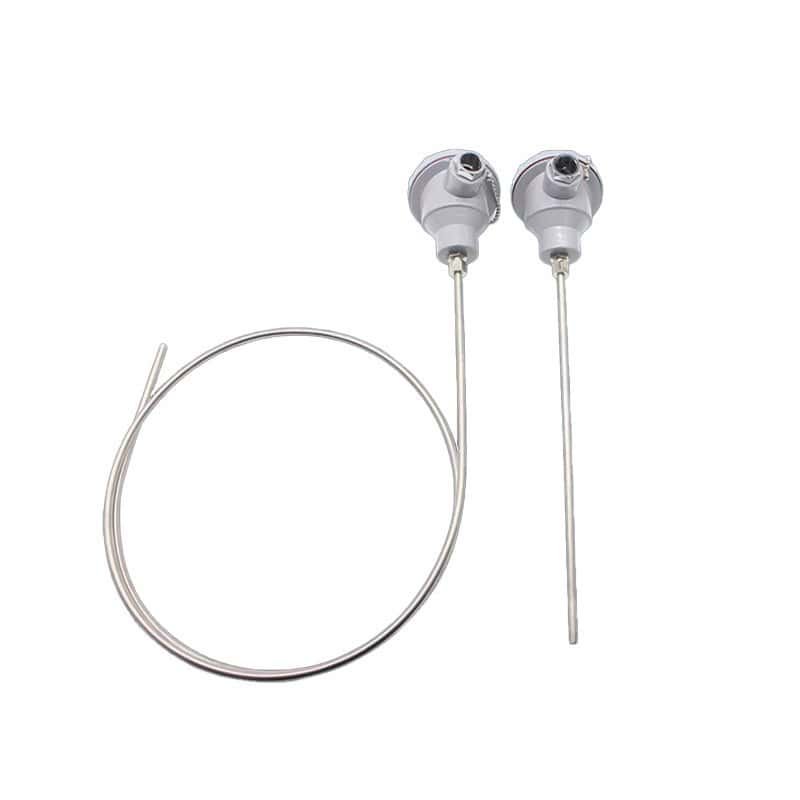
The element is specified as a construction, not as bare wire. A magnesium-oxide-insulated sheathed thermocouple gives fast response, vibration tolerance, and a gas-tight barrier that slows green rot, and it bends to route around obstructions. An assembled thermocouple adds a flanged or threaded process connection and terminal head for fixed installations. Hazardous-area service uses an explosion-proof thermocouple with a certified head.
The millivolt output is converted to 4–20 mA at the head by a transmitter such as the SBW temperature transmitter or HM100 temperature transmitter, which also performs cold-junction compensation and linearization.
- High output or narrow span, ≤900 °C, oxidizing or inert service: Type E, magnesium-oxide-insulated sheathed element.
- Measurement near magnets or induction equipment: Type E for its non-magnetic legs, where Type K’s anomaly is unacceptable.
- Cryogenic and sub-zero work toward −200 °C: Type E for output, or Type T for moist, condensing service.
- Ceiling above 900 °C: Type K to 1,100 °C, or Type N where green rot threatens stability.
- Marginal-oxygen heat above 800 °C: not Type E; its Chromel leg green-rots, so specify Type N.
Sheathed Thermocouples
Mineral-insulated Type E with fast response and a gas-tight sheath; bendable for tight routing.
View Specs →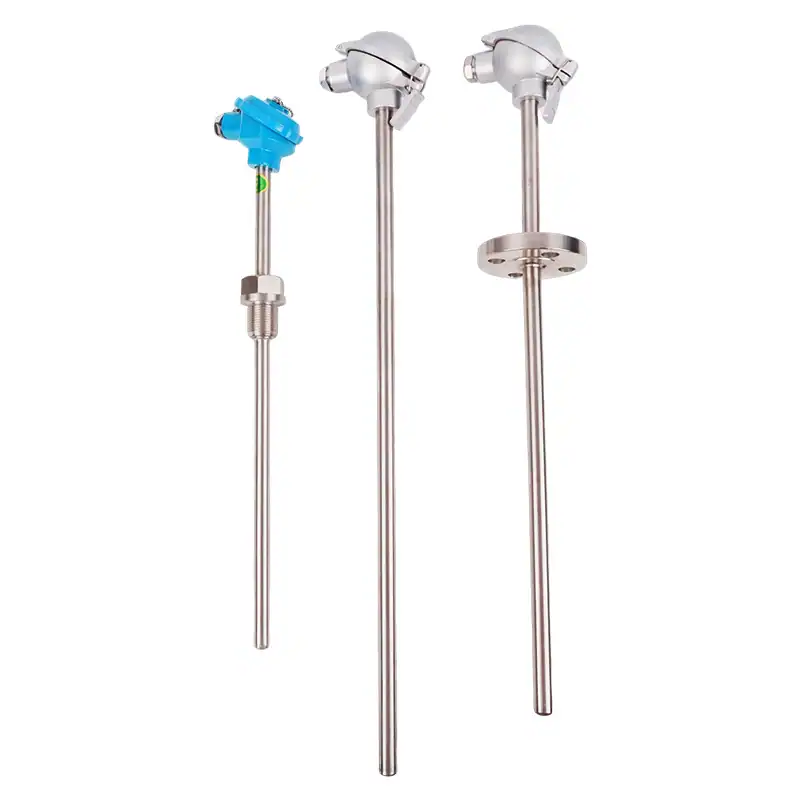
Assembled Thermocouples
Thermowell-mounted Type E with flanged or threaded process connection and terminal head.
View Specs →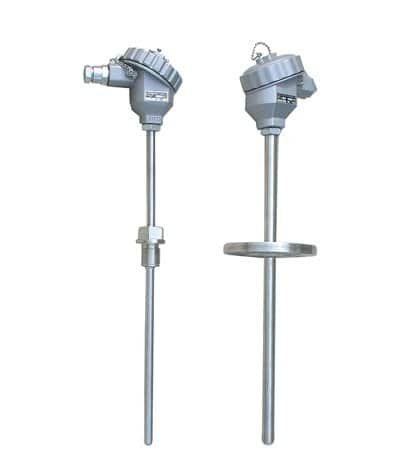
Explosion-Proof Thermocouples
NEPSI-certified Type E for hazardous areas, with flameproof head for zoned plant service.
View Specs →Spec a Type E thermocouple with our engineers
Send your temperature, span, and atmosphere. We will return a Type E or alternative element, tolerance class, sheath, and transmitter selection.
Request a QuoteHMK offers Type E in sheathed and assembled industrial thermocouple assemblies for high-output, moderate-temperature service.
Frequently Asked Questions
What is the temperature range of a Type E thermocouple?
Grade wire spans −270 to 1,000 °C (−454 to 1,832 °F) per IEC 60584:2013, with a useful range of −200 to 900 °C and practical continuous service near 870 °C.
Why does Type E have the highest output?
Its Chromel-Constantan pair produces about 68 µV/°C near ambient, roughly 1.7 times a Type K. The high Seebeck coefficient improves resolution and signal-to-noise, which is why it suits narrow spans and sub-zero work.
Is a Type E thermocouple magnetic?
No. Both legs, Chromel and Constantan, are non-magnetic, so Type E avoids the EMF anomaly that a Type K shows near 150 °C and suits measurements in magnetic fields.
What is the difference between Type E and Type K?
Type E gives higher output (68 vs 41 µV/°C) and is non-magnetic, but tops out near 900 °C; Type K reaches 1,100 °C continuous. Both share a Chromel leg and the same green-rot weakness in low-oxygen heat.
What are the Type E thermocouple wire colors?
Under ANSI/ASTM MC96.1 the positive leg is purple and the negative is red. Under IEC 60584:2007 the positive is violet and the negative is white, with a violet jacket.
Can Type E be used for cryogenic measurement?
Yes. Its high output holds better than Type K through the sub-zero band toward −200 °C, which makes it a strong base-metal choice for cryogenic and low-temperature laboratory work.