Type J Thermocouple: Range, Wire Colors & When to Use vs Type K
Type J Thermocouple in 30 Seconds
A Type J thermocouple pairs an iron positive leg with a constantan (copper-nickel) negative leg. The IEC 60584-1 recommended range is -40 °C to 750 °C, with continuous service capped near 540 °C to control iron oxidation, and a hard ceiling at the iron Curie point of 770 °C. Sensitivity is around 50 µV/°C, slightly higher than Type K.
Type J wins in reducing atmospheres (hydrogen, ammonia, vacuum) and moderate-temperature loops in plastics, food, pharma, and refining. It loses above 540 °C in oxidising air, and to Type K wherever wider range matters more than chemistry compatibility.
Iron-Constantan: Why It Wins Where K Loses
The positive leg is pure iron. The negative is constantan, roughly 55 % copper, 45 % nickel. The pair yields a Seebeck coefficient of about 50 µV/°C, versus 41 µV/°C for chromel-alumel Type K. That extra millivolt of headroom helps when the loop runs through low-cost transmitters or long cable runs.
Iron is the source of both Type J’s strengths and weaknesses. In a reducing atmosphere (hydrogen, carbon monoxide, ammonia), iron stays stable while Type K’s nickel-chromium loses chromium to “green rot”, a slow EMF drift that puts a K loop out of spec inside a year. Vacuum service follows the same logic: with no oxygen, no oxidation.
The trade-off shows above 540 °C in air. Iron oxidises to magnetite (Fe₃O₄), the EMF drifts one-sided (always reads low), and the 770 °C Curie point makes the EMF non-linear once exceeded. Calibration does not recover.
Constantan resists oxidation to about 600 °C, beyond Type J’s iron-limited range. Most field failures trace to the iron leg, not the constantan.
Temperature Range and the Curie Point Ceiling
IEC 60584-1 lists -40 °C to 750 °C as recommended. Practical field guidance:
- Continuous (oxidising air): ≤ 540 °C to control iron oxidation rate
- Short-duration: 760 °C tolerated, accepting accelerated drift
- Absolute ceiling: 770 °C — the iron Curie point, past which calibration is permanently lost
Below -40 °C Type J still reads, but sensitivity drops sharply and Type T (copper-constantan) gives better accuracy. The table below maps temperature window to conventional pick:
| Working window | First-choice TC | Reason |
|---|---|---|
| -200 to -40 °C | Type T | Better cryogenic sensitivity |
| -40 to 540 °C | Type J or Type K | J wins reducing atm; K wins oxidising |
| 540 to 1100 °C | Type K | J oxidation rate too high |
| 300 to 1200 °C (cyclic) | Type N | Resists K green-rot — see Type N thermocouple |
| 1100 to 1700 °C | Type S / R | Noble-metal cost justified |
For the full eight-type selection framework, see our thermocouple types reference.
Iron–constantan tops out near its Curie-point ceiling around 750 °C in continuous service, so Type J is a mid-temperature workhorse rather than a furnace sensor. For kiln, glass and heat-treat work well above that limit, a noble-metal Type R, S or B thermocouple is the standard step up.
Wire Color Codes — ANSI vs IEC at a Glance
Type J wiring carries a color trap on international projects: ANSI and IEC swap the positive-leg color.
| Standard | Positive leg (iron) | Negative leg (constantan) | Overall jacket | Used in |
|---|---|---|---|---|
| ANSI MC 96.1 | White | Red | Black (TC) / Grey (extension) | North America |
| IEC 60584-3 | Black | White | Black | Europe, Asia, most international |
| BS 1843 (UK legacy) | Yellow | Blue | Black | UK retrofits |
| DIN 43714 (DE legacy) | Red | Blue | Blue | German retrofits |
Field shortcut to identify the positive leg: bring a small magnet near the bare wire. Iron is ferromagnetic and pulls toward the magnet; constantan does not respond. The test does not distinguish thermocouple-grade from extension-grade — that distinction is in our extension wire vs compensating cable guide.
On project tenders, name the standard explicitly. “Type J wire, IEC color code” is unambiguous; “Type J wire, white positive” is region-dependent.
Type J vs Type K (and a Word on Type N)
For most engineers, the real decision is J versus K. Seven criteria across both, with Type N added as the K-replacement for cyclic high-temperature service:
| Criterion | Type J | Type K | Type N |
|---|---|---|---|
| Material | Iron / constantan | Chromel / alumel | Nicrosil / Nisil |
| Recommended range | -40 to 750 °C | -200 to 1260 °C | -200 to 1300 °C |
| Continuous in air | ≤ 540 °C | ≤ 1100 °C | ≤ 1200 °C |
| Sensitivity (µV/°C) | ~50 | ~41 | ~39 |
| Reducing atmosphere | Best in class | Poor (green rot) | Moderate |
| Oxidising atmosphere | Limited above 540 °C | Stable | Stable + cyclic |
| Typical cost | Lowest | Low-moderate | Moderate |
One-line rule: reducing atmosphere or sub-540 °C → Type J; oxidising or high-temperature → Type K; cyclic high-temperature with K green-rot → Type N.
A common trap: J and K connectors are physically interchangeable — same flat-blade footprint. A J probe plugged into a K transmitter (or vice versa) reads, but the EMF curves disagree by roughly 100 °C across the working range. Color-code the connectors and label the loop. For Type N specifically, see our Type N thermocouple guide. For an external industry-wide comparison across all eight TC types, TE Connectivity’s thermocouple comparison chart is a widely-cited reference.
Reducing Atmosphere: Where Type J Beats Type K
A reducing atmosphere holds gases that strip oxygen from metal lattices: hydrogen, carbon monoxide, ammonia, light hydrocarbons under partial combustion. Common locations: steam reformers, catalytic reformers, ammonia synthesis loops, hydrogenation reactors, vacuum heat-treatment chambers.
Type K’s chromium reacts preferentially. Chromium oxide forms at the grain boundaries of the chromel leg, depleting Cr and shifting the Seebeck coefficient. The drift is one-sided (reads low) and visible within months. The failure mode is named green rot for the green-tinted oxide.
Type J’s iron has no such reaction. Iron is already metallic and stays there; constantan is stable. EMF holds for years instead of months.
A Chinese refinery field case: a continuous catalytic reformer (CCR) hot stand-pipe ran about 480 °C in a hydrogen-rich recycle-gas atmosphere. The original Type K assembly drifted more than 5 % within six months, forcing a unit slowdown. The retrofit was a sheathed Type J probe in the same well. At 24 months, the J unit was still in spec with no observable drift. The site rolled the change across all reformer hot points at the next turnaround.
Vacuum service follows the same physics: with no oxygen, iron does not oxidise. Type J vacuum probes are common in semiconductor process tools, brazing furnaces, and aerospace heat-treatment chambers.
IEC 60584 Accuracy Class and EMF Reference
IEC 60584-1:2013 defines three tolerance classes for Type J. China’s GB/T 16839.1-2018 is the verbatim equivalent — same bands:
| Class | Tolerance | Range |
|---|---|---|
| Class 1 | ±1.5 °C or ±0.004·|t| (whichever larger) | -40 to 750 °C |
| Class 2 | ±2.5 °C or ±0.0075·|t| | -40 to 750 °C |
| Class 3 | ±2.5 °C or ±0.015·|t| | -200 to 40 °C (cryogenic) |
At 500 °C, Class 1 gives ±2.0 °C; Class 2 gives ±3.75 °C. Spec Class 1 for process control loops where the reading drives trim or alarm; Class 2 is acceptable for monitor-only.
EMF reference points (cold junction at 0 °C, IEC 60584-1):
| Hot junction °C | EMF (mV) |
|---|---|
| 0 | 0.000 |
| 100 | 5.269 |
| 300 | 16.327 |
| 500 | 27.393 |
| 700 | 39.132 |
For mV ↔ °C lookup with cold-junction correction, our thermocouple calculator implements the IEC 60584 polynomial. The compensation logic is in our cold junction compensation guide.
Working-grade Type J probes in China are verified to JJG 351-2017, which sets a one-year recalibration cycle and standardises calibration at 0, 100, 300, 500, and 700 °C. Internationally, the same role is played by NIST ITS-90; the U.S. test-method equivalent is ASTM E230, which supplies the temperature-EMF tables under ASTM format.
4 Field Applications Where Type J Wins
Four recurring patterns from HMK customer files:
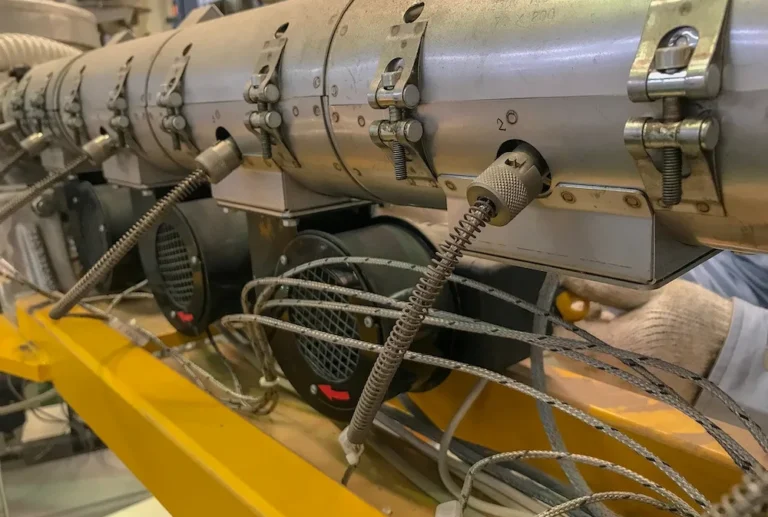
- Plastics extrusion barrel zones (180-300 °C). High sensitivity, low cost, well below the 540 °C ceiling.
- Pharma and food autoclaves (121-160 °C). Class 1 Type J in a sanitary thermowell hits accuracy spec at lower cost than Pt100 across many duplicate vessels.
- Refining reformer service (reducing atm, 400-540 °C). The CCR case above is the canonical example; same logic for fixed-bed naphtha reformers and selective hydrogenation.
- Vacuum furnaces (low to moderate temperature, < 540 °C). Bell-jar brazing, vacuum tempering, semiconductor wafer-bake.
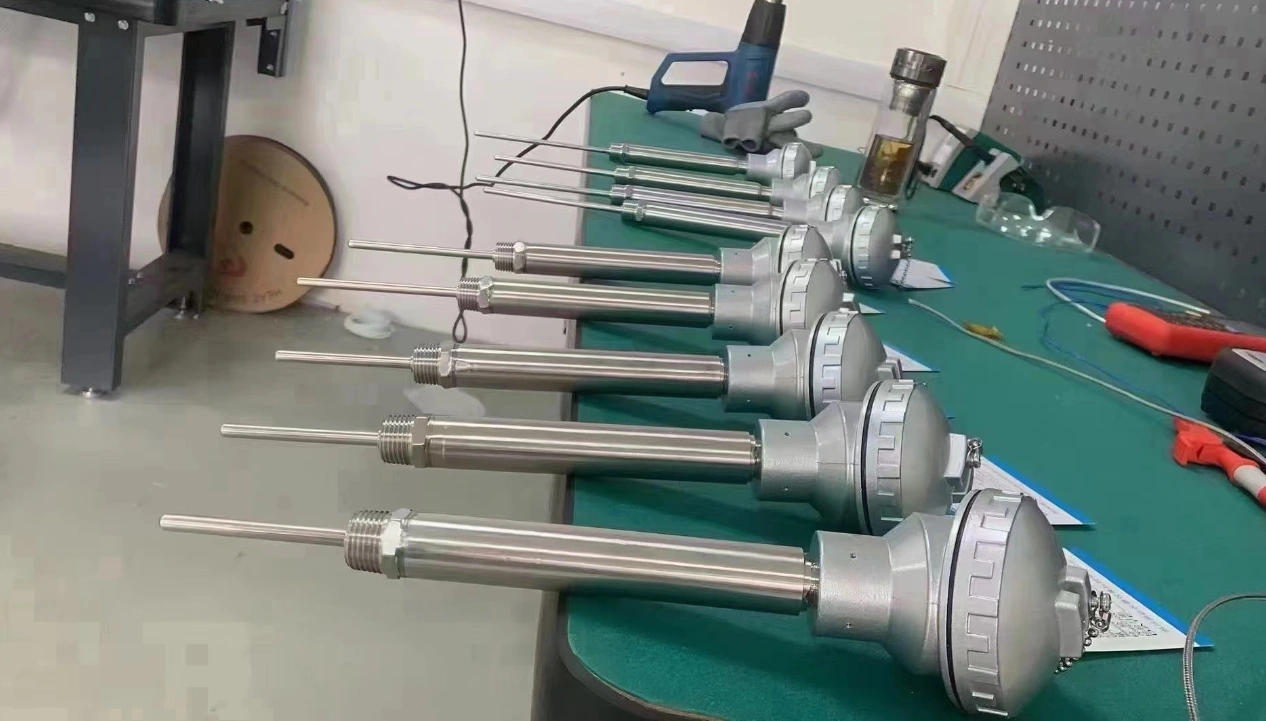
Our sheathed thermocouples line stocks Type J in 316L and Inconel 600 sheath, OD 0.5 to 6.0 mm, Class 1 tolerance, τ63 under 0.5 s for the thinnest sheaths.
Common Failure Modes for Type J
Four failures account for most in-service problems:
- Oxidation above 540 °C. Iron oxidises to magnetite. Reading drifts low and accelerates with temperature. If process temperature creeps above 540 °C, switch to K or N rather than push J past its window.
- Aging drift in long service. Grain growth in the iron leg shifts the Seebeck coefficient slowly. JJG 351-2017 sets a one-year recalibration cycle — a refinery turnaround interval lines up with that cadence.
- Sheath sealing failure in hydrogen service. Hydrogen permeates most metals over time at elevated temperature. Once H₂ reaches the constantan inside the sheath, Cu absorbs it and EMF shifts. For high-H₂ service, specify a tested hydrogen barrier or accept a shorter calibration interval.
- Wrong wire material on the extension run. Plain copper extension wire introduces a second junction at the probe head with a temperature-dependent error. Always use Type J extension wire or Type JX compensating cable. Detail in our extension wire vs compensating cable guide.
The grounded versus ungrounded junction choice applies equally to Type J. See our grounded vs ungrounded thermocouple guide.
FAQ
What is the temperature range of a Type J thermocouple?
IEC 60584-1 recommends -40 °C to 750 °C. Continuous service in oxidising air caps at about 540 °C; brief excursions to 760 °C are tolerated; 770 °C is the absolute ceiling (iron Curie point).
What color is Type J thermocouple wire?
Region-dependent. ANSI MC 96.1: positive iron is white, negative constantan is red. IEC 60584-3: positive is black, negative is white. Always specify the standard explicitly on international drawings.
Are J and K type thermocouples interchangeable?
Physically yes — same connector geometry. Electrically no — EMF curves disagree by roughly 100 °C across the working range. Mixing J and K with a wrongly configured transmitter produces a confidently wrong reading.
How do I check a Type J thermocouple with a multimeter?
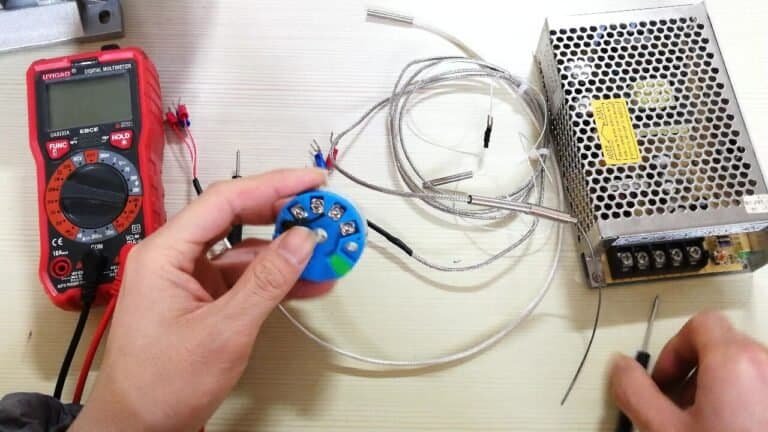
Read mV across the leads on DC, note cold-junction temperature, look up expected mV at (hot − cold) in the IEC 60584 table or our thermocouple calculator, and compare. More than ±2.5 °C off at room temperature flags recalibration.
Speccing Type J for your application? Three product anchors cover the common patterns: General use (plastics, pharma, vacuum) → Sheathed Thermocouples (MI Type K J T N E S R B). Multi-zone reactor or column → Multi-Point Thermocouples. Hazardous-area refinery service → Explosion-Proof TC/RTD with Transmitter.
For a Type J probe in sheathed or assembled form, see HMK’s industrial thermocouples.
For mV ↔ °C verification, use our thermocouple calculator (IEC 60584 polynomial, cold-junction handled). For broader thermocouple context: thermocouple types reference covers all eight types; Type N sister is the K-replacement for cyclic high-temp; RTD vs thermocouple sets the broader sensor-choice frame.