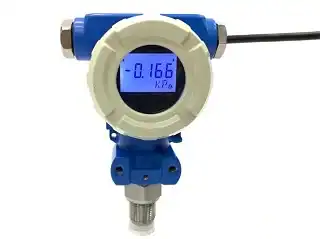
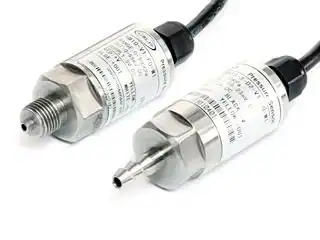
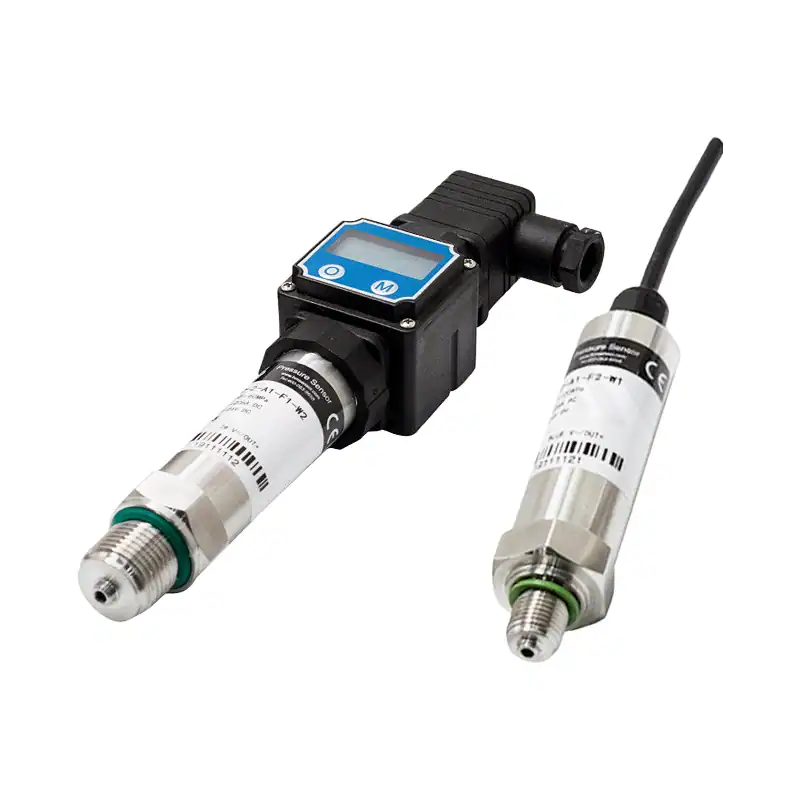
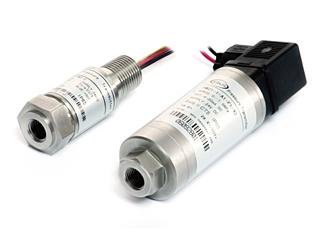
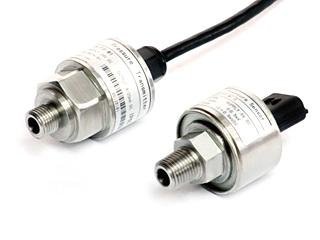
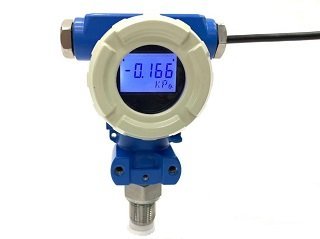
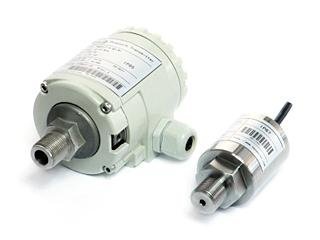
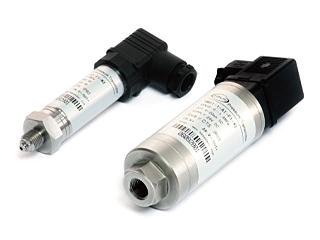
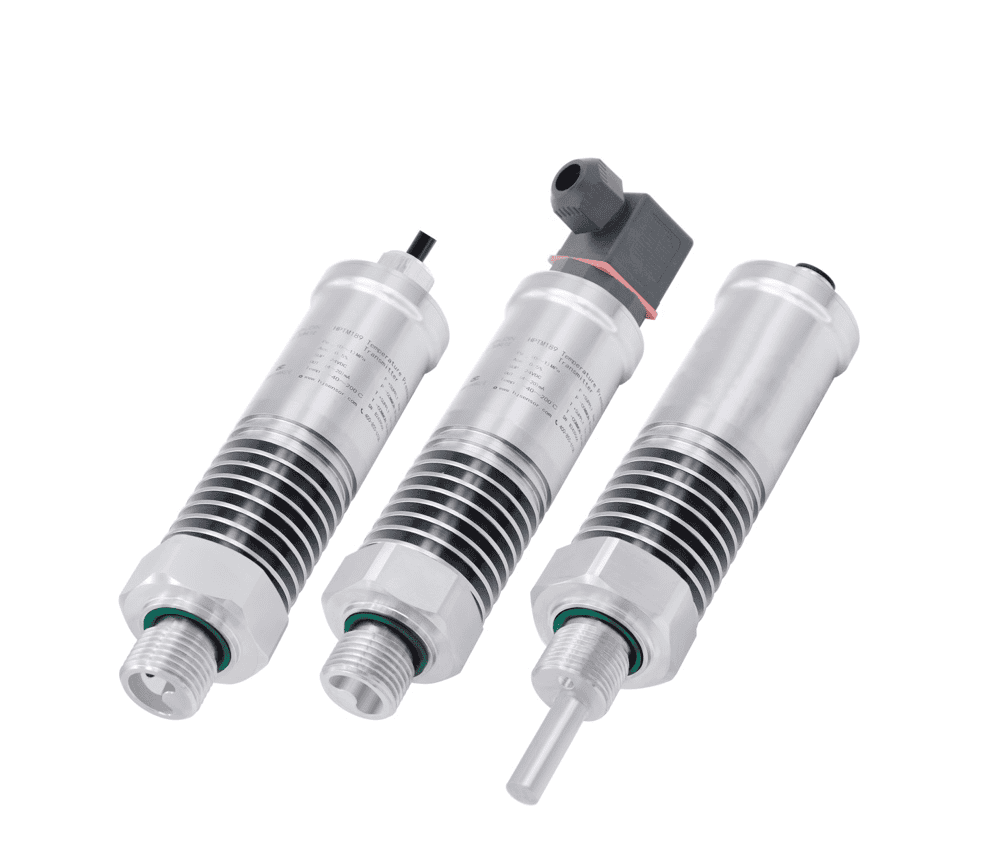
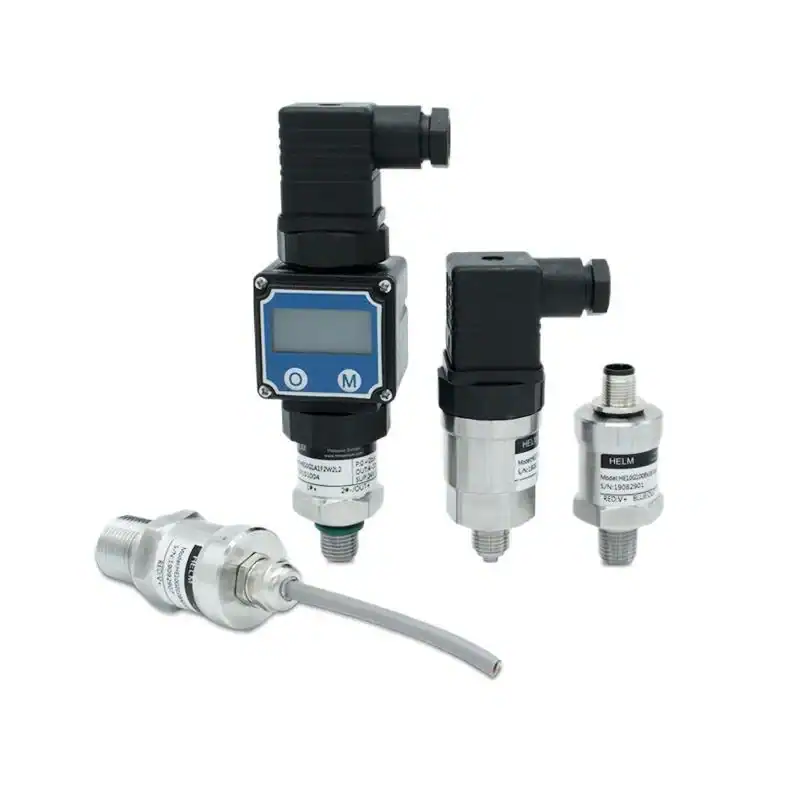
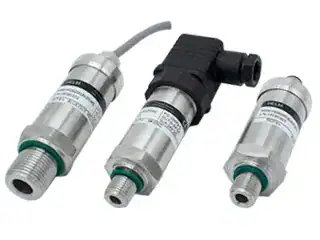
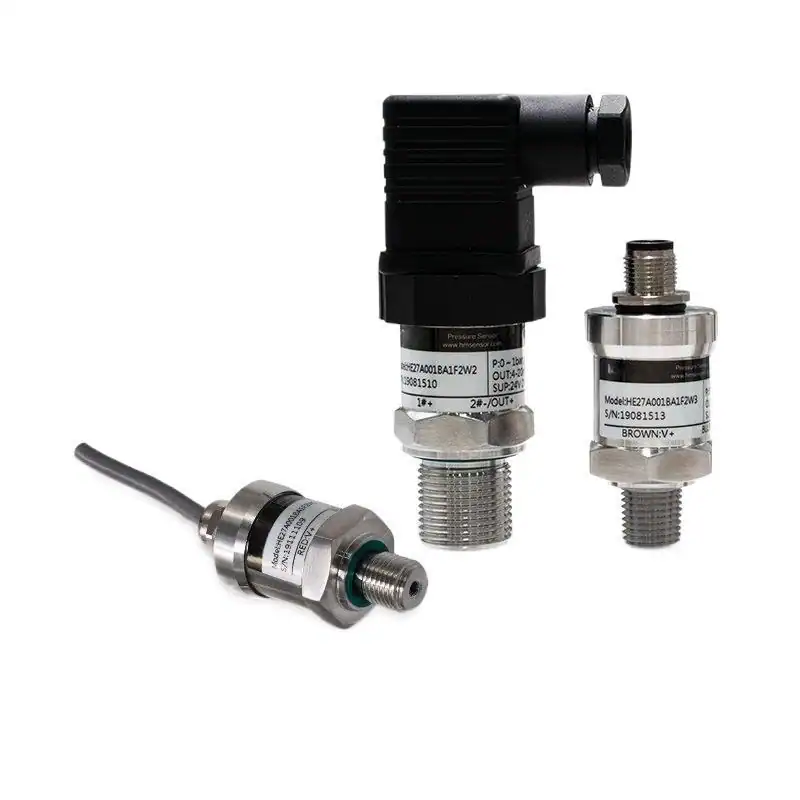
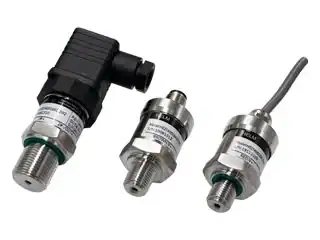
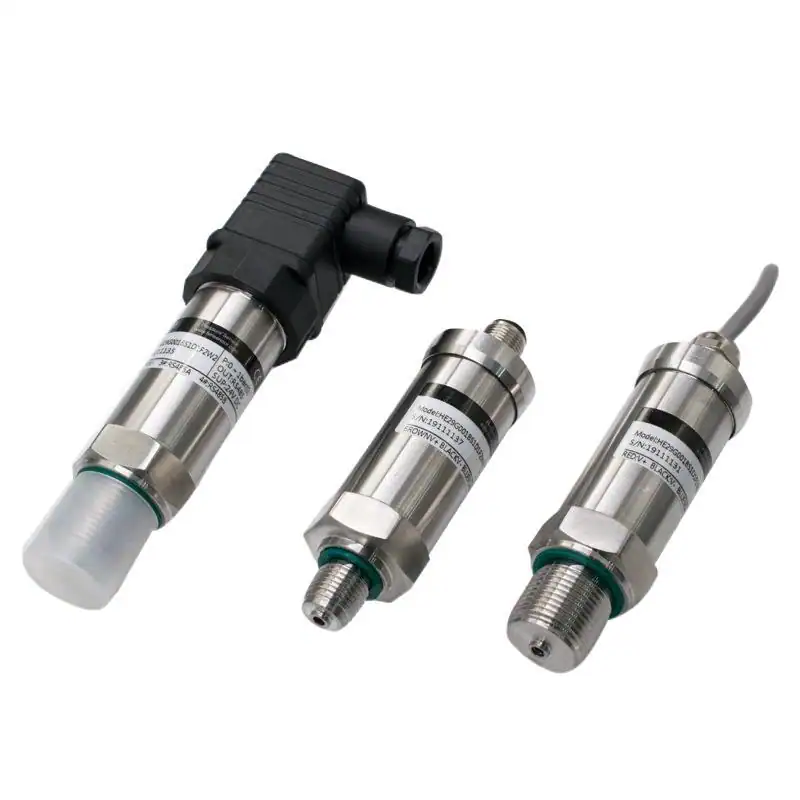
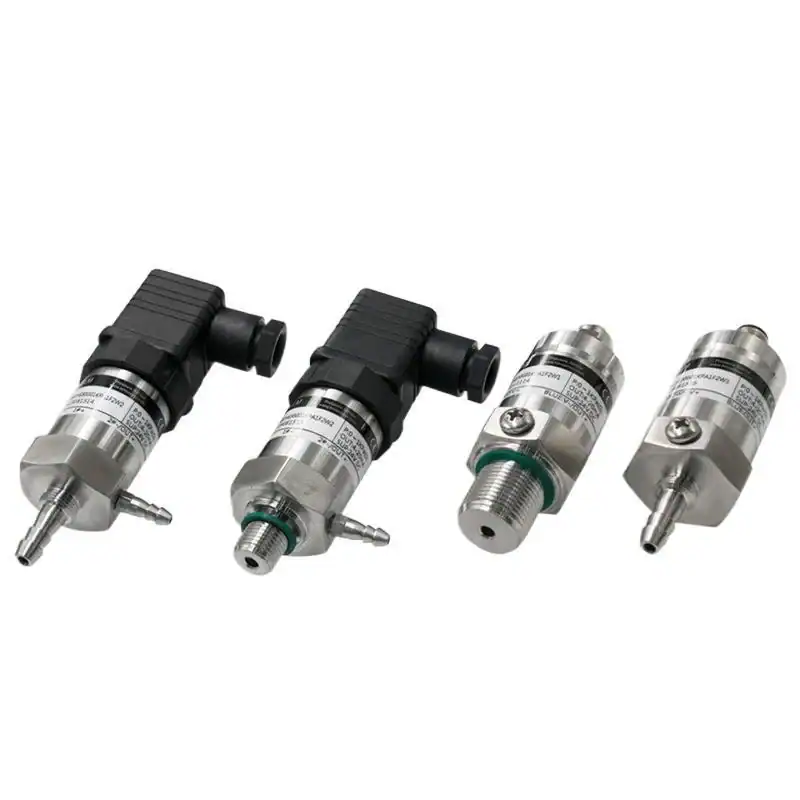
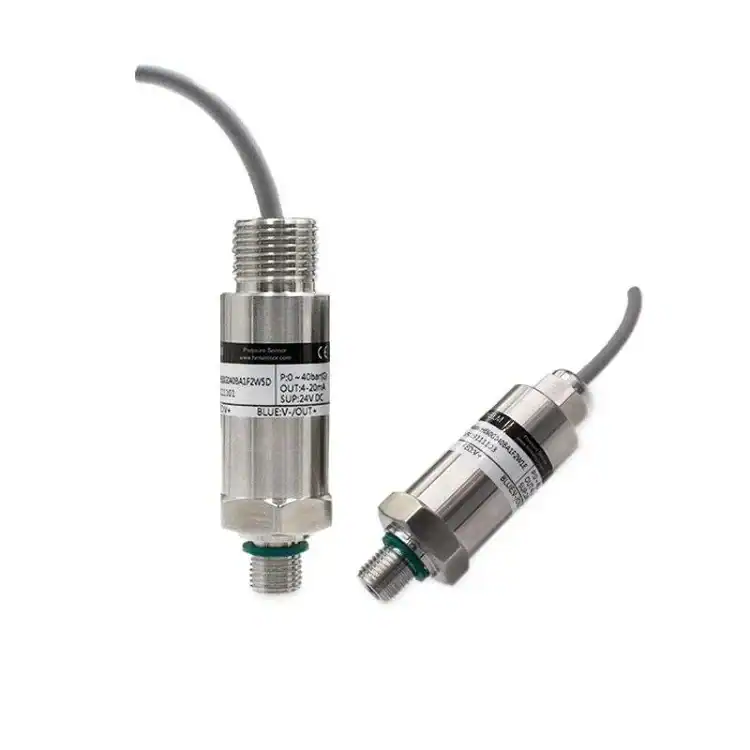
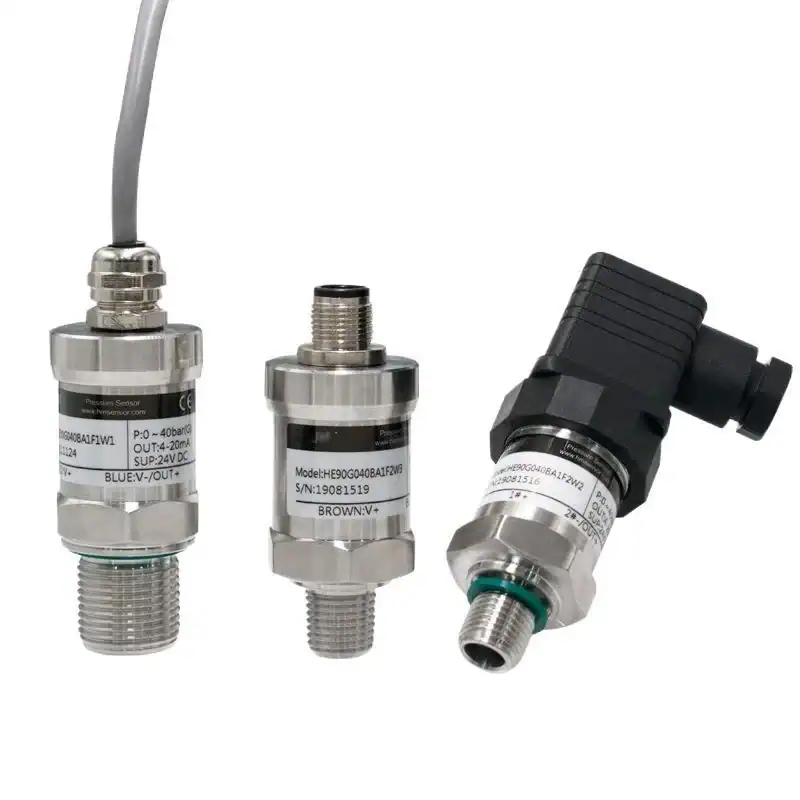
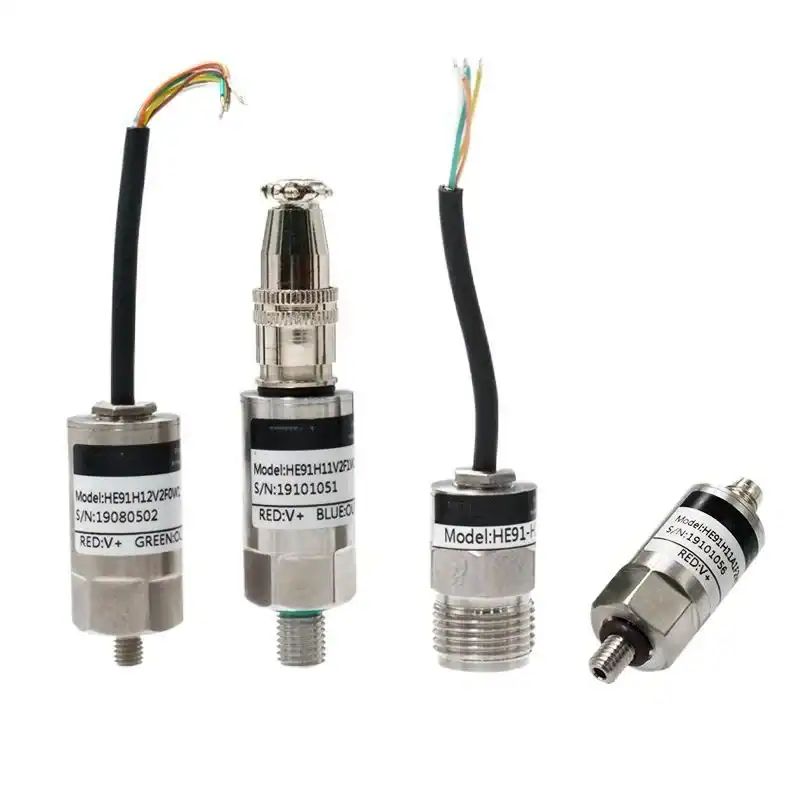
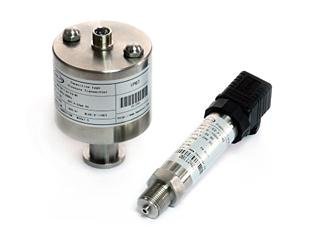
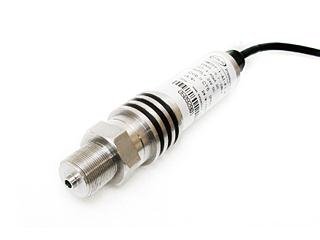
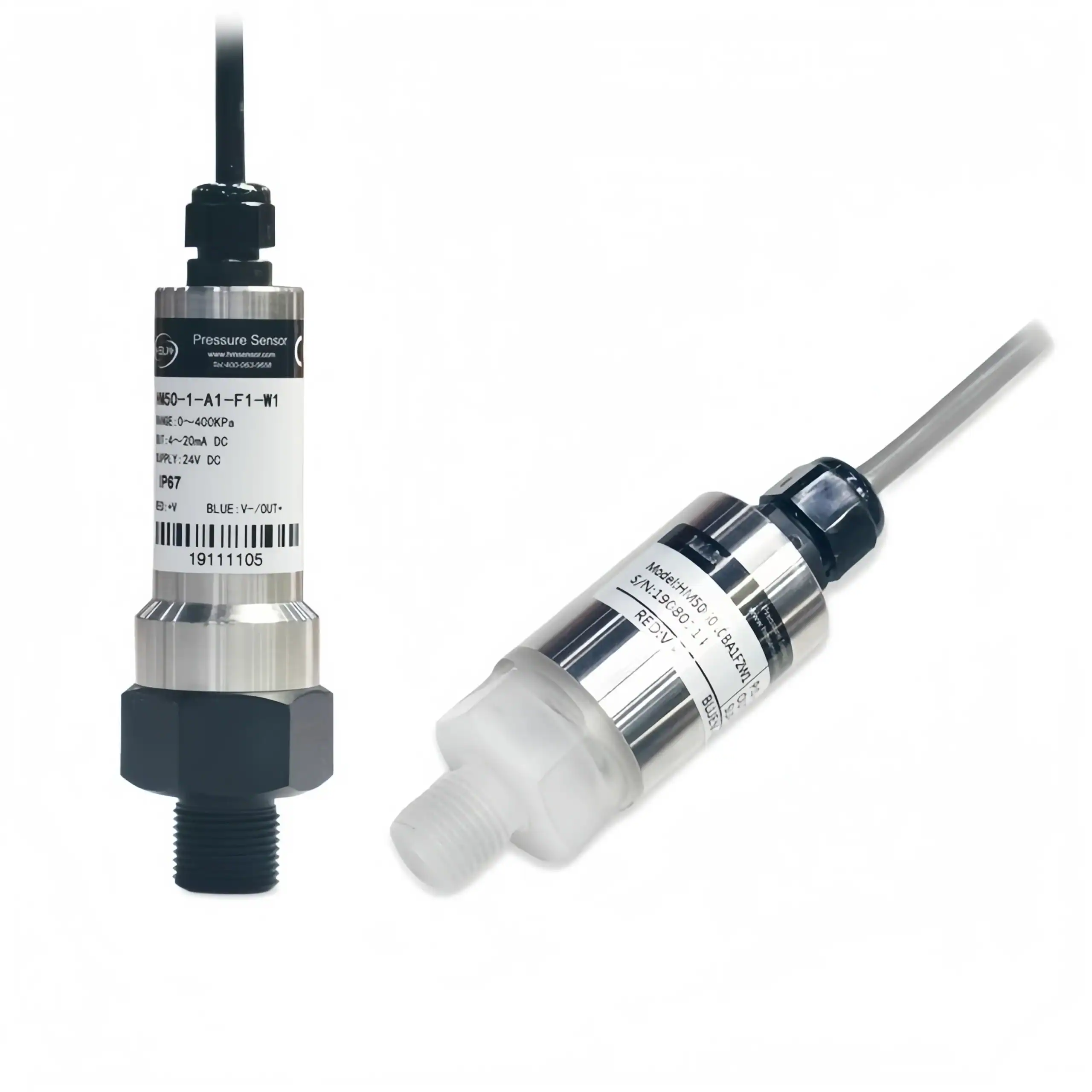
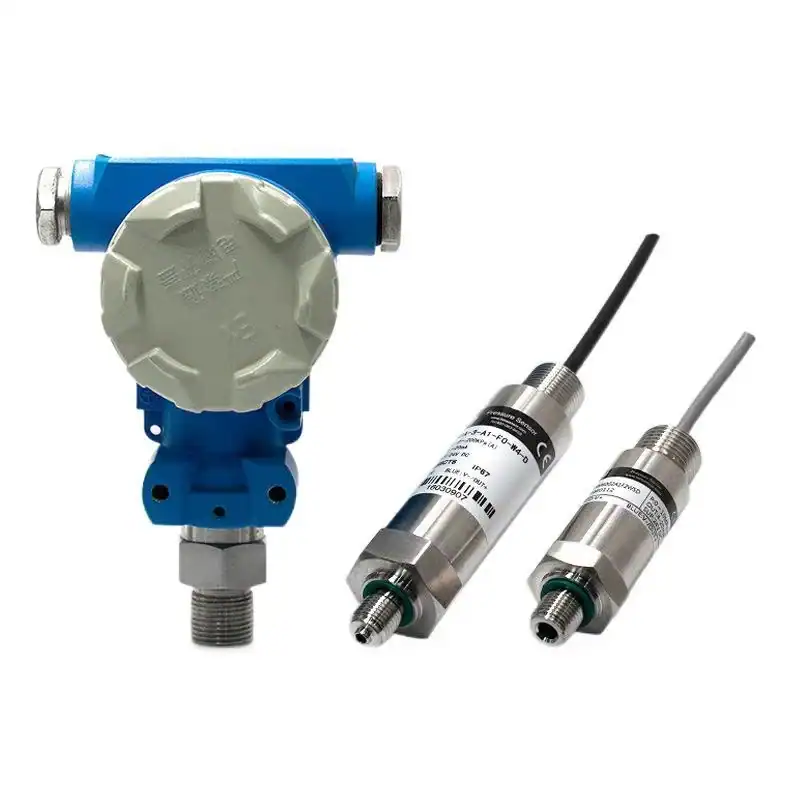
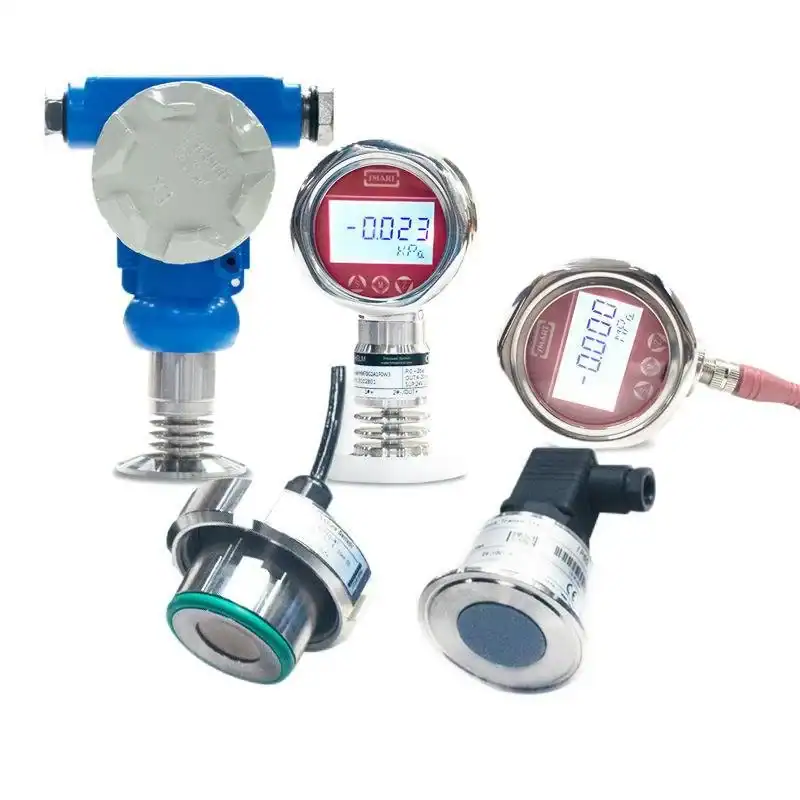
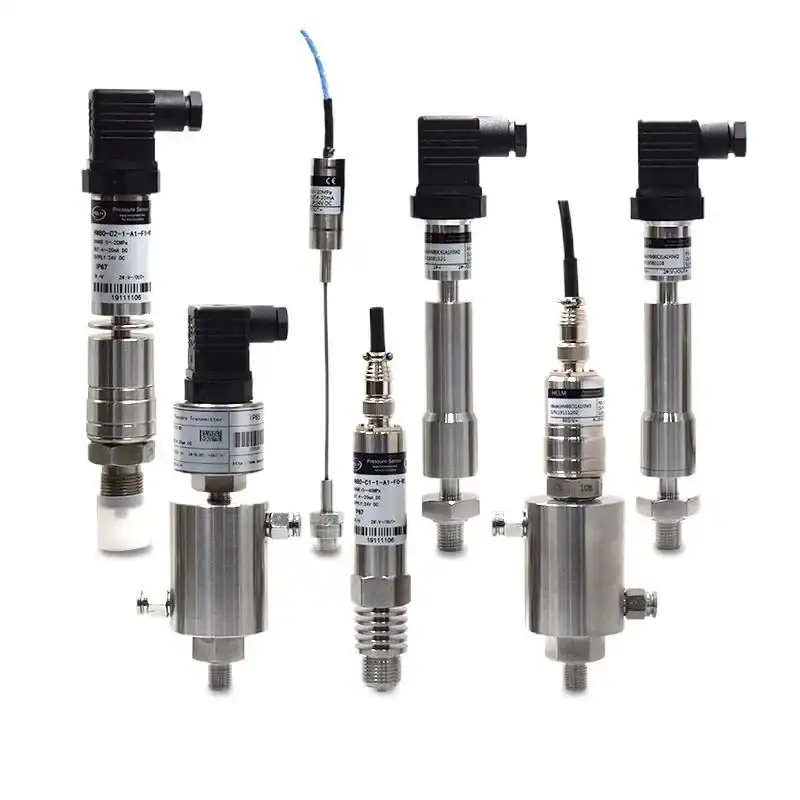
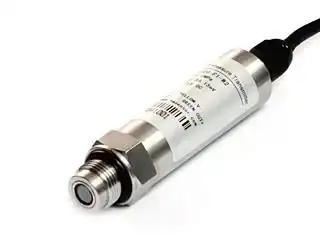
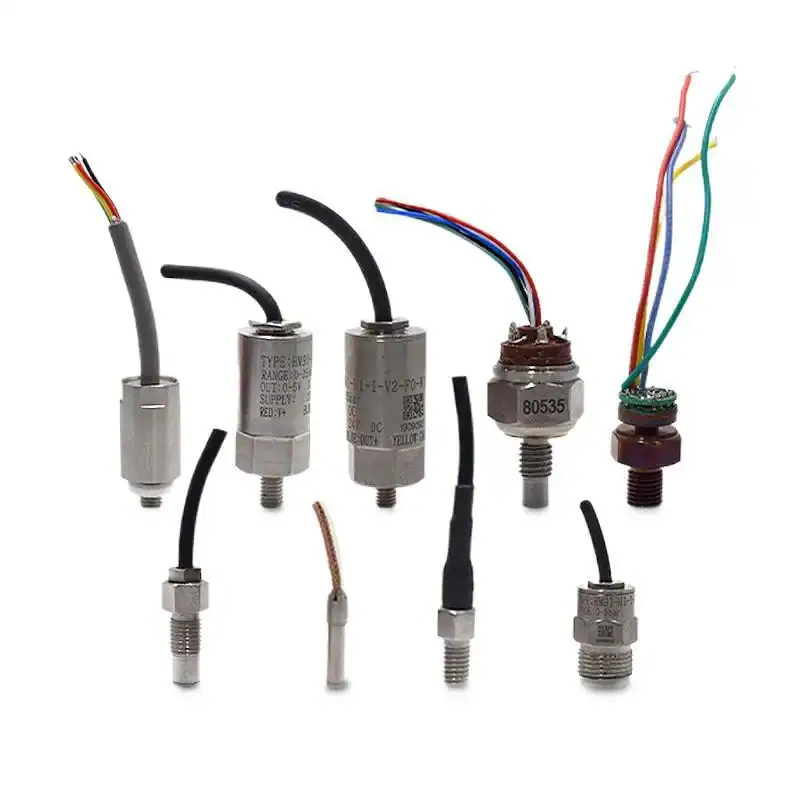
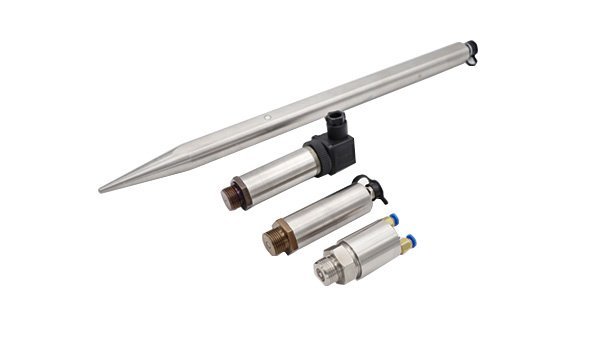
From raw mV OEM sensors to voltage-output transducers and smart HART transmitters, dynamic blast sensors to submersible level probes — 30 models featuring German sensing technology with accuracy up to ±0.075% FS, covering -100 KPa to 220 MPa.
Sensor, Transducer, or Transmitter — Which One Is on This Page?
One question settles it: what signal comes out of the device. The three terms are used loosely across the industry — TE Connectivity separates all three by output level, while Ashcroft treats sensor as the umbrella term and splits transducer (voltage) from transmitter (current). Both agree on the deciding factor: the output signal.
Term
Typical output
Where it fits
Pressure sensor
Millivolt (mV/V), ratiometric to supply
OEM integration, short cable runs
Pressure transducer
High-level voltage: 0.5–4.5 V, 1–5 V, 0–5 V
Machine-mounted, close to the controller
Pressure transmitter
4–20 mA current (2-wire); HART or RS485 digital
Plant signal runs, electrically noisy areas
Which applies to HMK models depends on the output code you order, not on the model. Of the 30 models listed below, 25 are available with both a 4–20 mA current output and a voltage output — the same part number is a transmitter when ordered with the current code and a transducer when ordered with the voltage code. HM10 is the exception: it is a pure millivolt device (100 mV full scale, typical), so it is a pressure sensor in the strict sense. HM91 states the split in its own specification — 1.5–4.5 mV/V as a sensor, 4–20 mA / 0–5 V as a transmitter. HM29 and HE29 are digital-bus only (RS485 / CAN).
If you searched for pressure transducers and landed here, this is the right page — North American purchasing commonly uses the term for the whole category. The Output line on each product card below tells you which version you are actually specifying.
Two Sensing Technologies, One Engineering Standard
Every HMK pressure sensor starts with a sensing element imported from leading European semiconductor foundries. We offer two fundamental sensing technologies — each engineered to solve different measurement problems:
The workhorse of industrial pressure measurement. Silicon strain gauge bonded to a stainless steel diaphragm with silicone oil fill. Best for high-pressure (up to 220 MPa), fast response (≤1 ms), and wide temperature range. Models: HM10, HM20, HM22, HM25, HM28, HM60, HM80, HM90, HM91 and more.
Ceramic Capacitive (Dry Cell)
99.99% alumina ceramic diaphragm forms both sensor and process seal — no oil fill required. Ideal for food, pharma, HVAC, and any application where media contamination is unacceptable. Exceptional overload tolerance (200× FS). Models: HM12, HE10, HM26, HM23Y.
Core Model Comparison
Side-by-side specifications of our five most popular models to help you select the right starting point.
European-designed sensing elements and packaged sensors. Advanced technology with multiple output options for OEM integration and specialized applications.
HE10
Compact European-designed OEM transmitter. 5 output options with modular structure for system integrators.
Choosing the right pressure measurement device depends on four primary factors. Use this guide to narrow your selection, then contact our engineering team for application-specific recommendations.
Before running through these four factors, it’s worth confirming a transmitter is the right instrument class at all. If the control loop only needs a single trip point — pump cut-off, high-pressure alarm, dry-run protection — a pressure switch is cheaper, simpler, and often safer than a 4–20 mA transmitter feeding a software comparator. Our guide on when to specify a transmitter instead of a switch covers the five decision criteria — continuous vs. binary signal, SIL integration, diagnostics, wiring topology, and industry-typical defaults — so the selection framework below is applied to the right instrument from the start.
1. Pressure Range & Type
Determine your working pressure and whether you need gauge, absolute, or vacuum measurement. Our range covers 0.5 kPa through 220 MPa. For vacuum or compound, HM20 supports -100 kPa to positive.
2. Output Signal
Raw mV for your own conditioning? HM10. 4-20mA current loop for PLC? HM20/HM25/HE10. Digital SPI/UART? HM12. HART protocol? HM29/HM3051.
3. Media Compatibility
No silicone oil contact? Choose HM12 dry ceramic. Corrosive media? HM50 with PTFE isolation. Viscous/clogging? HM23Y ceramic or flush diaphragm options. Sanitary? HM70 CIP/SIP flush mount.
4. Accuracy & Budget
Lab/calibration: HM12 (±0.075%) or HM10 (±0.1%). Standard industrial: HM20/HM25 (±0.25%). High-volume OEM: HE10 (±0.5%) for best unit cost. Dynamic research: HM90/HM91 (±0.1%).
Why Choose HMK TECH Pressure Transmitters?
Backed by German sensing technology, full international certifications, and dedicated application engineering support.
🇩🇪
German sensing technology Sensing Technology
Core sensing elements imported from German sensing technology, Germany — delivering ±0.075% FS accuracy and long-term stability rated at ±0.1% FS/year across our premium product lines.
📋
Full International Certifications
CE, RoHS, ATEX/IECEx explosion-proof, SIL 2 functional safety, IP67/IP68 ingress protection — ready for global deployment in hazardous and critical applications.
🔧
Application Engineering Support
Our engineers help you select the right model, customize pressure ranges, output signals, process connections, and materials — ensuring optimal performance for your specific application.
Frequently Asked Questions
A pressure sensor is the core sensing element that converts pressure into an electrical signal (typically mV-level). A pressure transmitter integrates the sensor with signal conditioning circuitry, amplification, and a standardized output (4-20mA, 0-5V, or digital protocols like HART). Transmitters are ready for direct connection to PLCs, DCS, and data acquisition systems. For a deeper breakdown with real selection scenarios, read our guide on the difference between a pressure sensor, transducer, and transmitter.
Our standard models offer ±0.5% FS accuracy. The HM25 and HM20 series achieve ±0.25% FS and ±0.3% FS respectively. For high-precision applications, the HM22 delivers ±0.1% FS with German sensing technology. Our top-tier HM10 OEM sensor module reaches ±0.075% FS.
For corrosive media, choose models with all-316L stainless steel wetted parts (HM20, HM25, HM29) or ceramic capacitive sensors (HM26, HM23Y) that provide excellent chemical resistance. For hygienic/sanitary applications, the HM28 features a flush diaphragm design with 3A/FDA-compliant materials and tri-clamp connections.
Yes. Most HMK TECH models support custom pressure ranges within their rated capacity. We offer multiple output options including 4-20mA (2-wire), 0-5V, 0-10V, 1-5V, RS485 Modbus, and HART protocol. Custom process connections, cable lengths, and materials are also available.
For standard configurations, we accept orders starting from 1 unit. Custom specifications (special ranges, materials, or certifications) may require a minimum of 5-10 units depending on the modification scope. Contact our sales team for specific MOQ requirements.
The HM20, HM25, HM29, HM50, HM27, and HM31 series are available with ATEX/IECEx explosion-proof certification (Ex d IIC T6 or Ex ia IIC T4/T5/T6). These are suitable for Zone 0, 1, and 2 hazardous areas in oil & gas, chemical, and petrochemical facilities.
Piezoresistive (silicon) sensors offer higher accuracy (up to ±0.075% FS) and are ideal for clean, non-corrosive media. Ceramic capacitive sensors provide superior chemical resistance, no oil-fill risk, and excellent long-term stability — making them the better choice for corrosive media, food/beverage, and applications where media compatibility is critical.
Ready to Find Your Ideal Pressure Sensor?
Our engineering team can help you select the right model for your application. Get personalized recommendations, OEM pricing, and technical support.