HM12 Series — Ceramic Capacitive Technology
HM12 Miniature Ceramic Capacitive Pressure Sensor
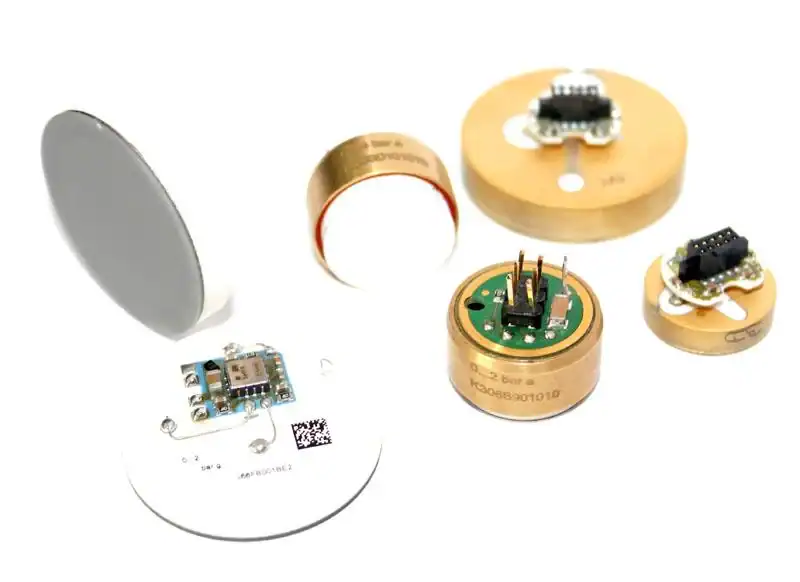
The HM12 uses a 99.99% high-purity alumina ceramic diaphragm as both the sensing element and the process isolation barrier — eliminating the silicone oil fill fluid that every diffused silicon sensor requires. This dry ceramic design delivers ±0.075% FS accuracy from 0.5 kPa to 7 MPa with overload tolerance up to 200× full scale.
Why Ceramic Capacitive? The Engineering Case Against Oil-Filled Sensors
Every diffused silicon pressure sensor uses a thin stainless steel isolation diaphragm filled with silicone oil to transmit process pressure to the silicon sensing element. The HM12 eliminates this failure mode entirely. The ceramic capacitive diaphragm IS the process-wetted surface — a 99.99% Al₂O₃ ceramic disc that measures pressure through capacitance change as the diaphragm deflects under load.
Performance matches or exceeds diffused silicon at the same price point. The HM12 achieves ±0.075% FS comprehensive accuracy with temperature coefficients of ±0.005% FS/°C typical — roughly 4× better than most diffused silicon sensors. Long-term stability of ±0.05% FS/year means extended recalibration intervals. And at overload ratings up to 200×, the ceramic diaphragm survives pressure spikes that would permanently deform a silicon-based sensor.
The 500–4500 mV ratiometric output runs from a single 5 VDC supply drawing less than 2 mA — designed for direct connection to microcontroller ADC inputs. For digital integration, the UC3 and UC7 variants provide UART or SPI interfaces with 24-bit pressure resolution and 16-bit temperature measurement.
HM12 Technical Specifications
Available Models
Key Features
200× Overload Tolerance
At low ranges (e.g., 2.5 kPa), the ceramic diaphragm withstands 200 times the full-scale pressure without permanent damage or zero shift — 100× better than typical diffused silicon sensors rated at 2× overload.
No Fill Fluid — Zero Contamination
The dry ceramic capacitive design eliminates silicone oil fill found in all piezoresistive sensors. Critical for FDA-regulated food processing, pharmaceutical manufacturing, and medical gas systems.
±0.005% FS/°C Temperature Stability
Internal temperature sensor continuously compensates for thermal effects, achieving approximately 4× better stability than diffused silicon sensors over a 60°C operating swing.
5V Ratiometric Output — Direct MCU
The 500–4500 mV output is ratiometric to the 5V supply — no instrumentation amplifier needed. Analog UC1/UC2 draw less than 2 mA; digital UC3/UC7 consume as little as 2.5 mW.
Micro-Pressure Down to 0.5 kPa
Most diffused silicon sensors bottom out at 10–20 kPa minimum range. The HM12 measures down to 0.5 kPa (~2 inches water column) with full accuracy for cleanroom and HVAC applications.
24-Bit Digital Resolution (UC3/UC7)
The UC3 and UC7 integrate a 24-bit sigma-delta ADC with UART or SPI interface, delivering 1 part in 16 million discrimination for precision laboratory and medical instruments.
OEM & Integration Applications
Food & Beverage Processing
CIP line pressure monitoring, carbonation pressure control, and sterile tank level measurement. The ceramic diaphragm’s flat, crevice-free surface resists bacterial growth and handles CIP solutions.
HVAC & Building Automation
Duct static pressure, filter differential pressure, and chiller/boiler system pressure. Micro-pressure capability (down to 0.5 kPa) covers typical 0–500 Pa range for VAV box control.
Medical Device Integration
Ventilator pressure monitoring, nebulizer flow control, infusion pump occlusion detection. Oil-free ceramic design meets ISO 10993 biocompatibility requirements with 5V/2 mA power profile.
Environmental Monitoring
Barometric pressure for weather stations, groundwater level monitoring. ±0.075% FS accuracy resolves barometric changes to better than 0.75 Pa. UC7’s 2.5 mW enables solar-powered stations.
Industrial Hydraulic & Pneumatic
Hydraulic press force monitoring, pneumatic cylinder position feedback, compressor discharge pressure. Overload tolerance and vibration resistance superior to diffused silicon in hydraulic shock environments.
Semiconductor & Cleanroom
Process gas delivery pressure control, chamber vacuum measurement. Ceramic diaphragm outgasses negligibly — critical in vacuum applications where silicone oil vapor would contaminate the process.
Ceramic Capacitive vs. Piezoresistive: When to Choose the HM12
Choose the HM12 when: your media is corrosive to stainless steel, your application prohibits fill fluid contamination, you need micro-pressure measurement below 10 kPa, or you need extreme overload protection.
Choose the HM10 when: you need pressures above 7 MPa, you need the fastest possible response time (≤1 ms), or you need raw mV output for custom signal conditioning.
HM12 Ordering Guide
Example Order Code
HM12 — UC1 — G — 0-100kPa — 1
= HM12 sensor, UC1 analog model, gauge pressure, 0-100 kPa range, ±0.075% FS accuracy
Custom pressure ranges, non-standard connections, and application-specific configurations available. Minimum order quantities may apply for custom specifications.
Related Products
HM12 Frequently Asked Questions
Ready to Eliminate Fill Fluid Risk?
Request evaluation samples or OEM production pricing for the HM12 ceramic capacitive sensor. We support custom configurations including non-standard ranges, special calibration, and modified packaging.