HE SERIES — DIGITAL COMMUNICATION TECHNOLOGY
HE29 RS485/CAN Digital Pressure Sensor
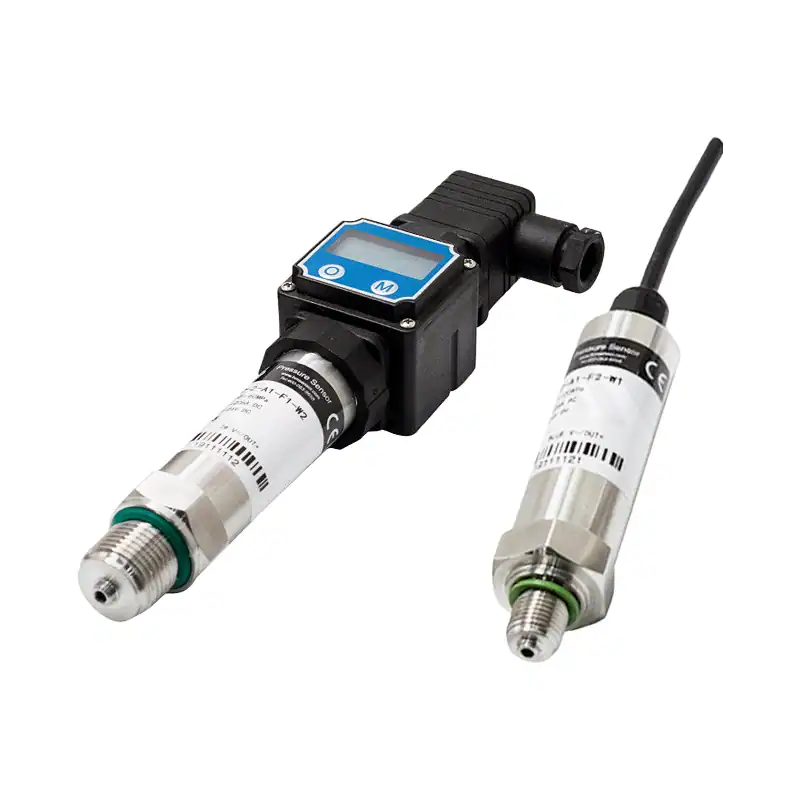
The HE29 digital pressure sensor features RS485 Modbus RTU and CAN bus communication protocols, enabling direct digital readout and multi-node networking. Designed with ultra-low power consumption (≤2 mA standby) and wide supply voltage (3.3–36 V), it is ideal for distributed pressure monitoring networks, industrial IoT, and remote data acquisition systems. For how RS485 compares with 4-20 mA and voltage outputs, see pressure transmitter output signals.
100 MPa
Max Range
±0.5%
Accuracy (FS)
RS485
Modbus RTU
IP67
Protection
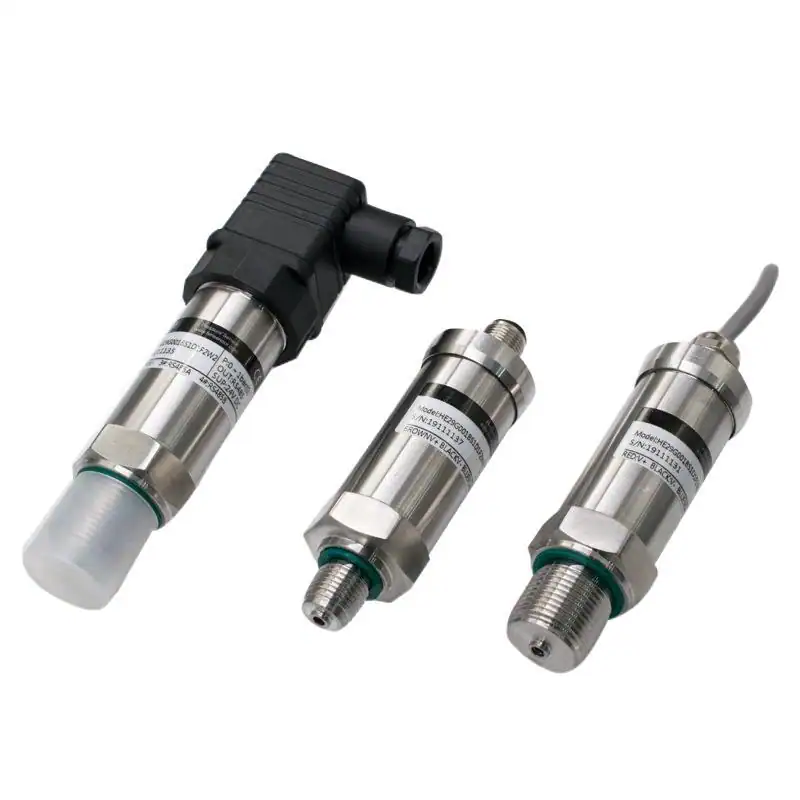
Overview
The HE29 RS485/CAN digital pressure sensor represents a new generation of smart pressure instrumentation that replaces traditional analog signals with direct digital communication. Using standard Modbus RTU protocol over RS485 or CAN bus (CANopen / J1939 / custom), multiple sensors can be networked on a single twisted-pair bus for centralized monitoring — eliminating the need for individual signal conditioning channels.
The sensor features ultra-low power consumption of ≤2 mA in standby mode with a wide supply voltage range (3.3–16 V or 12–36 V), making it compatible with battery, solar, or standard 24 VDC industrial power. With 0.01% FS digital resolution and 8–10 samples per second, it delivers precise real-time pressure data suitable for SCADA systems, PLCs, and embedded controllers.
Built with a piezoresistive silicon sensing element and all-stainless-steel isolation diaphragm, the HE29 covers pressure ranges from 10 kPa to 100 MPa. It features user-configurable communication address and baud rate, remote zero calibration capability, and full EMC compliance (EN61000-4-2/3/4/5) for reliable operation in electrically noisy industrial environments.
Specifications
| Parameter | Specification |
|---|---|
| Pressure Range | 10 kPa … 100 MPa (gauge); 1–40 bar (absolute) |
| Pressure Type | Gauge / Absolute |
| Overload Capacity | 1.5–2× rated range |
| Burst Pressure | 4× rated range |
| Output Signal | RS485 Modbus RTU / CAN (CANopen, J1939, custom) |
| Digital Resolution | 0.01% FS |
| Sampling Rate | 8–10 samples/second |
| Default Baud Rate | 9600 bps (configurable: 2400, 4800, 19200, 38400) |
| Default Address | 01 (user-configurable) |
| Response Time | ≤50 ms |
| Accuracy (typ.) | ±0.5% FS |
| Accuracy (max.) | ±1.0% FS |
| Long-Term Stability | ±0.2% FS/year (typ.), ±0.3% FS/year (max.) |
| Zero Temp. Drift | ±0.02% FS/°C (typ.), ±0.05% FS/°C (max.) |
| Span Temp. Drift | ±0.02% FS/°C (typ.), ±0.05% FS/°C (max.) |
| Media Temperature | -20°C to +85°C |
| Ambient Temperature | -20°C to +80°C |
| Compensated Range | -10°C to +60°C |
| Supply Voltage | 3.3–16 V DC or 12–36 V DC (typ. 24 V) |
| Power Consumption | ≤2 mA (standby, no communication) |
| Durability | >10 million cycles (10–90% FS) |
| Media Compatibility | Gases and liquids compatible with 316 stainless steel |
| Vibration Resistance | 10g per IEC 60068-2-6 |
| Shock Resistance | 500g / 1 ms per IEC 60068-2-27 |
| EMC Compliance | EN61000-4-2, EN61000-4-3, EN61000-4-4, EN61000-4-5 |
| Insulation Resistance | >100 MΩ @ 100 V |
| Ingress Protection | IP65 (connector) / IP67 (cable) per IEC 60529 |
| Certification | CE (EU) |
Key Features
RS485 Modbus RTU Communication
Standard Modbus RTU protocol over RS485 half-duplex bus enables direct digital pressure readout. Configurable baud rate (2400–38400 bps) and device address allow flexible multi-node networking with up to 247 devices on a single bus.
CAN Bus Support
Optional CAN bus interface supports CANopen, SAE J1939, and custom protocols for automotive, agricultural, and heavy machinery applications requiring robust, high-speed field bus communication.
Ultra-Low Power Design
Standby current of ≤2 mA enables operation from batteries or solar panels. Dual supply ranges (3.3–16 V and 12–36 V) accommodate both low-power IoT deployments and standard industrial 24 VDC systems.
Full EMC Compliance
Tested and certified to EN61000-4-2 (ESD), EN61000-4-3 (RF), EN61000-4-4 (burst), and EN61000-4-5 (surge) for reliable operation in electrically noisy industrial environments near motors, inverters, and switchgear.
Remote Zero Calibration
Built-in remote zero point calibration and fine-tuning function accessible via the digital bus, reducing maintenance time and enabling periodic recalibration without physical access to the sensor.
High Digital Resolution
0.01% FS resolution with 8–10 samples per second delivers smooth, noise-free pressure data directly in engineering units — eliminating external ADC modules and analog signal conditioning circuitry.
Applications
Smart City Water Networks
Municipal water distribution monitoring with RS485 networked sensors enables real-time leak detection, pressure zone management, and SCADA integration across thousands of measurement points.
Oil & Gas Pipeline Monitoring
Remote pipeline pressure monitoring using low-power RS485 sensors with solar or battery power, providing continuous digital data to central control rooms via RTU/gateway systems.
Building Automation & HVAC
Constant-pressure water supply, chiller systems, and HVAC monitoring with multi-sensor bus networking for intelligent building management systems (BMS).
Hydraulic & Pneumatic Control
Digital pressure feedback in hydraulic presses, injection molding machines, and pneumatic actuator systems where direct PLC communication eliminates analog signal noise.
Power Plant Monitoring
Distributed pressure monitoring across turbine systems, boiler feed water, and cooling circuits with networked digital sensors replacing individual analog transmitter loops.
Special Vehicles & Robotics
On-board pressure monitoring for industrial robots, test benches, special-purpose vehicles, and remote-controlled equipment requiring compact digital sensors with CAN bus integration.
Ordering Guide
Use the model code structure below to configure your HE29 Digital Pressure Sensor. Select options from each column to build your complete part number.
Model Code: HE29 [Pressure Type] [Range] [Output] [Supply] [Process Connection] [Electrical Connection]
Example: HE29 G 010B S1 D1 F2 W3 → HE29 Gauge, 0–10 bar, RS485 Modbus RTU, 12–36V DC, G1/4 external, M12 right-angle 1m
| Parameter | Code | Description |
|---|---|---|
| Pressure Type | G | Gauge Pressure |
| A | Absolute Pressure | |
| Range | 010K | 0–10 kPa (Gauge only) |
| 020K | 0–20 kPa (Gauge only) | |
| 035K | 0–35 kPa (Gauge only) | |
| 070K | 0–70 kPa (Gauge only) | |
| 001B | 0–1 bar | |
| 002B | 0–2 bar | |
| 004B | 0–4 bar | |
| 006B | 0–6 bar | |
| 010B | 0–10 bar | |
| 016B | 0–16 bar | |
| 025B | 0–25 bar | |
| 040B | 0–40 bar | |
| 060B | 0–60 bar (Gauge only) | |
| 100B | 0–100 bar (Gauge only) | |
| 160B | 0–160 bar (Gauge only) | |
| 250B | 0–250 bar (Gauge only) | |
| 400B | 0–400 bar (Gauge only) | |
| 600B | 0–600 bar (Gauge only) | |
| 01KB | 0–1000 bar (Gauge only) | |
| Output | S1 | RS485 Modbus RTU |
| C1 | CAN (custom protocol) | |
| C2 | CANopen | |
| Supply | D1 | 12–36 V DC (industrial) |
| D2 | 3.3–16 V DC (low-power) | |
| Process Connection | F1 | M20×1.5 external thread |
| F2 | G1/4 external thread | |
| F3 | 1/4 NPT external thread | |
| F0 | Custom (contact sales) | |
| Electrical | W1 | Cable outlet, 1 m length |
| W2 | Hirschmann DIN 43650A connector | |
| W3 | M12 right-angle connector, 1 m cable | |
| W4 | M12 straight connector, 1 m cable |
Frequently Asked Questions
Related Products
Need a Digital Pressure Monitoring Solution?
Our engineering team can help you design a complete RS485/CAN pressure monitoring network — from sensor selection and bus topology to gateway integration. We provide support for Modbus register mapping, CAN protocol configuration, and multi-sensor commissioning for volume deployments.
Our engineers typically respond within 12 business hours with detailed technical specifications and pricing.