HART vs 4-20mA: HART 7 Guide for Pressure Transmitters
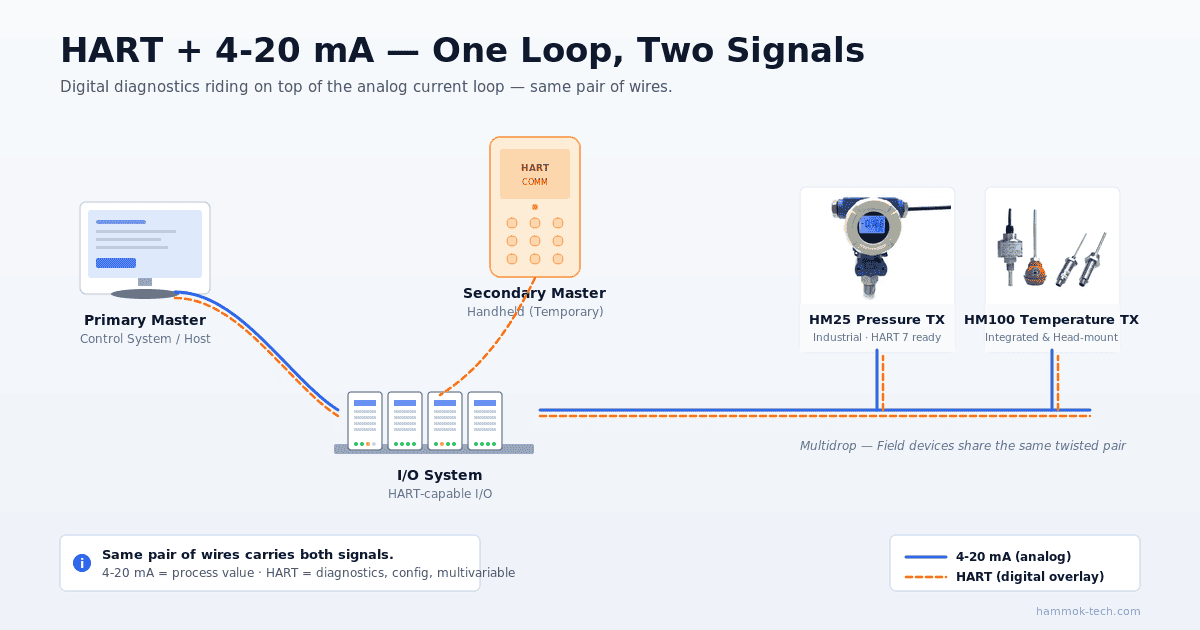
A new pressure transmitter quote lands on your desk with two prices: 4-20mA, and 4-20mA with HART. The HART version is 15–25% more. Worth it?
HART carries diagnostics digitally, but the analog current still has to report a failed device on its own: see NAMUR NE 43 fault signaling.
Related: For the wider comparison across current, voltage, and digital outputs – 4-20 mA versus 0-10 V, 1-5 V, and RS485 are compared in pressure transmitter output signals.
First, make sure a transmitter is even the right instrument for the loop — if the PLC only needs a trip signal, a switch may be all you need. We decide between a pressure switch and a transmitter first in a separate guide, then come back here to pick the protocol. If a switch is the right call, the PSH/PSL symbol on the P&ID tells the panel team how to wire its NO/NC contact. Whichever device you pick, the process-port thread family (NPT vs G/BSPP) follows the regional spec, not the protocol choice.
A HART transmitter lets you re-range in the field, but watch the turndown ratio: re-ranging too far below full span costs accuracy.
Short version: HART isn’t a replacement for 4-20mA. It’s a digital signal that rides on top of the same 4-20mA loop. The standard in use today is HART 7 (published 2007), and in 2026 you’ll struggle to buy a smart pressure transmitter that isn’t HART 7 capable.
So the question isn’t whether to upgrade. The question is whether your plant can actually use what HART 7 gives you. I’ll run through that below, with real numbers from a mid-size plant.
The 30-second answer: when HART pays off, when 4-20mA is enough
If you can’t read the whole article, decide with this.
Pay the premium when you have two or more of these:
- More than 10 transmitters in the plant
- Devices in hazardous, remote, or awkward-to-reach locations
- A DCS or asset-management system (Emerson AMS, Yokogawa PRM, Honeywell Experion) that’s already consuming HART data elsewhere
- Recalibration cycles tighter than once a year
- Predictive-maintenance work that needs device-health data
Stay with pure 4-20mA if:
- You have five loops or fewer
- The process is batch or low-criticality
- There’s no DCS or AMS software to receive the digital data
- No upgrade path is planned for the next few years
The shortcut I use: if the DCS already reads HART from other devices, you’re paying for HART whether you spec it or not. Skip the debate and say yes.
What HART actually is (a 4-20mA engineer’s shortcut)
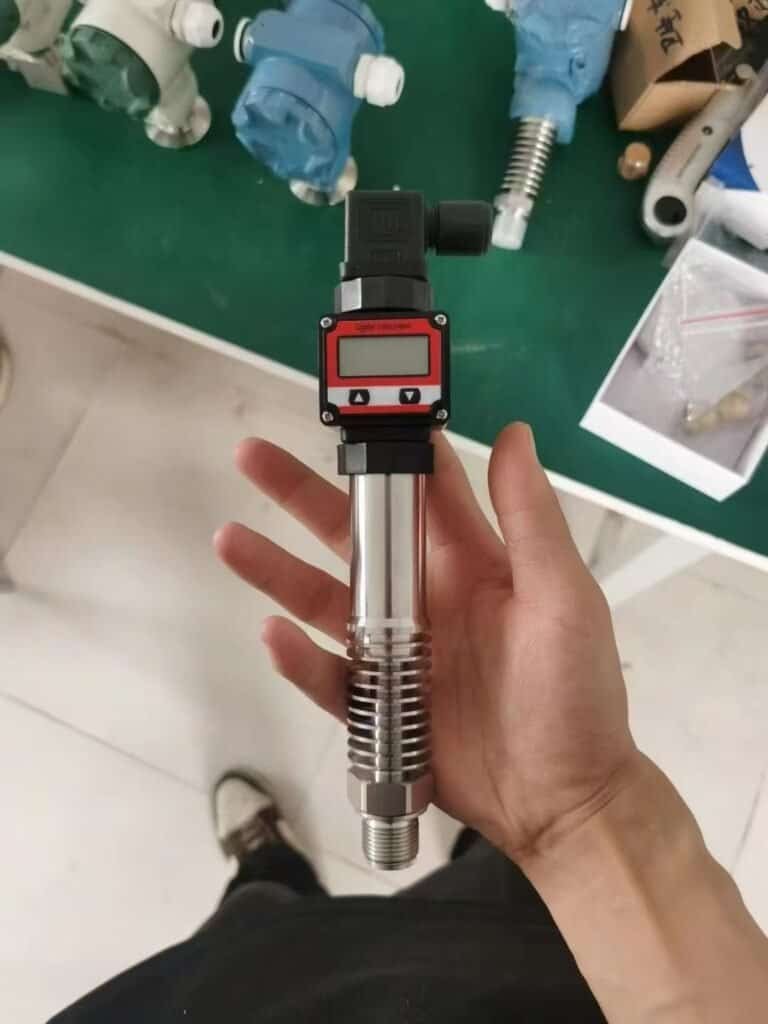
HART stands for Highway Addressable Remote Transducer. Mechanically, it’s two audio tones — 1200 Hz and 2200 Hz, Bell 202 standard — sitting on top of your 4-20mA current loop using Frequency Shift Keying.
The two tones are symmetric, so they average out to zero current. The analog 4-20mA reading going to your PLC stays untouched while the digital conversation happens underneath. Same twisted pair. Same 24 VDC power. No rewiring.
It’s a request/reply protocol. A host — DCS card, handheld communicator, laptop with a HART modem — asks a question, and the transmitter answers. Burst mode is optional: the device pushes updates every 500 ms or so without being asked.
One HART loop carries up to four process variables (primary, secondary, tertiary, quaternary) plus device tag, calibration data, and diagnostic status, all without disturbing the analog signal your AI card sees.
The version nobody talks about: HART 7 is your 2026 baseline
Most “HART vs 4-20mA” articles talk about HART as one thing. It isn’t. There have been four revisions that matter.
| Version | Year | What it brought |
|---|---|---|
| HART 5 | 1990 | The original. Addressable 0–15, PV + SV readout |
| HART 6 | 2001 | Expanded command set, basic diagnostics, long tag names |
| HART 7 | 2007 | Long-frame commands, WirelessHART, condition monitoring, 64-address multidrop, event notifications |
| HART-IP | mid-2010s | HART application layer over Ethernet. A transport extension, not a new revision |
HART 7 is the one that changed how plants use the protocol. Before 2007 diagnostics were a side feature. After 2007 they became the whole point. A plugged impulse line or a drifting sensor pushes itself up to the DCS as an event, instead of waiting to be found at the next calibration.
If you’re buying a smart pressure transmitter from any mainstream manufacturer in 2026, you’re getting HART 7 — whether the spec sheet says so or not.
Worth flagging on the RFQ: some vendors still write “HART compatible” without naming the revision. Ask for HART 7 compliant explicitly. The diagnostic commands you’ll want two years from now only work if the device supports the HART 7 command set.
HART vs 4-20mA: the side-by-side
| Feature | Pure 4-20mA | 4-20mA with HART 7 |
|---|---|---|
| Signal type | Analog only | Analog + digital FSK overlay |
| Information carried | 1 process variable | Up to 4 PVs + diagnostics + device ID |
| Wiring | 2-wire twisted pair | Same 2-wire, backward compatible |
| Configuration | Zero/span pots, local display | Handheld communicator or PC software, remote or local |
| Diagnostics | Broken-wire via live zero only | Broken-wire + device health + process anomalies |
| Calibration | Manual, on-device | Manual or remote via HART |
| Typical cost premium | Baseline | +15–25% on the transmitter |
| DCS / AMS integration | One reading per loop | Multi-variable + status flags |
| Best for | Simple loops, budget rebuilds | Complex plants, remote sites, predictive maintenance |
The row that matters most is the wiring row. A HART 7 transmitter still drives a plain 4-20mA input card as if HART weren’t there. You can buy the HART version now and keep using it as pure 4-20mA until the DCS side is ready. There’s no upgrade risk.
Decision tree: four scenarios, four different answers
New greenfield chemical or oil plant.
HART 7 across the board. Modern DCSs (DeltaV, Centum VP, Experion) ship HART-ready, AMS is in the project scope, and nobody wants to find themselves retrofitting transmitters two years in. The cost delta is small at project scale.
Twenty-year-old brownfield plant.
It depends on the DCS. If it’s under ten years old and has HART pass-through on the AI cards, go HART 7 on new transmitters — the analog side works today, the digital side lights up when AMS comes online. If the DCS is pre-2005 and not scheduled for replacement, match the existing pure 4-20mA. HART data with nowhere to go is wasted money.
Hazardous area or remote location.
HART, almost regardless of the cost sensitivity. Getting a technician into a Zone 1 area means hot-work permits, an escort, lockout procedures. That trip easily costs $500–1,500 once. Reading device status and adjusting range from the control room pays back the $50–80 device premium the first time you avoid sending someone out.
Tight-budget batch process (food, water, light utility).
Pure 4-20mA is fine. If the loop doesn’t need online reconfiguration, there’s no compliance reporting tied to diagnostics, and there’s no AMS to read the data, HART’s features sit unused. Put the saved budget into a better diaphragm or a tighter accuracy class.
ROI math: does the 15–20% premium actually pay back?
Most comparison articles say HART “often justifies” the cost and leave it there. Here’s the math for a plant I worked with: thirty pressure transmitters, one maintenance tech, HART-capable DCS already installed.
| Item | Calculation | Annual impact |
|---|---|---|
| One-time device premium | 30 × $60 | $1,800 one-time |
| Implementation cost | Existing 2-wire loops | $0 |
| Saved calibration / troubleshooting trips | 2 trips × 8 hrs × $150/hr loaded | $2,400 / yr |
| Early fault detection | 1 avoided shutdown per 3 yrs × $15K | $5,000 / yr |
| Reduced spare-parts guessing | Fewer swap-and-see replacements | ~$800 / yr |
| Payback period | $1,800 ÷ $8,200 | ~2.6 months |
Two things kill this math if you’re not careful. First, the diagnostics only pay back if an asset-management host is listening. HART with nobody reading it is a more expensive 4-20mA. Make sure your DCS vendor’s AMS module is licensed and actually configured, not “available.” Second, the avoided-shutdown line is where the payback swings most. In a continuous process where downtime is $10K an hour, the real figure is much bigger. In a utility water loop, it’s close to nothing. Run the numbers for your own site before quoting mine.
Where HART stops and Fieldbus begins
Procurement sometimes asks the reasonable question: if we’re going digital, why not go all-in on Fieldbus?
They’re different tools. HART is a digital layer on top of 4-20mA — backward compatible, swap the transmitter and you’re done. Foundation Fieldbus and Profibus PA are fully digital. They carry more devices per cable segment (up to 32 on Fieldbus H1) and support control in the field, but they need dedicated infrastructure — power conditioners, terminators, different topology. They don’t talk to an analog input card.
The split I see in practice: most plants run HART on pressure, temperature, and simple flow, and use Fieldbus only where control-heavy sections (advanced batch reactors, complex blending) justify it.
Choosing a HART 7 pressure transmitter: what to spec
The lines that actually matter on your RFQ:
- Protocol revision — require “HART 7 compliant,” not “HART” or “HART compatible”
- DD file — registered with FieldComm Group and available for your DCS/AMS platform
- Accuracy class — 0.075% of span or better for critical control; 0.2% is acceptable for utility loops
- Hazardous-area certification — ATEX, FM, or IECEx to match your area classification
- Wetted parts — 316L for clean water and common hydrocarbons; Hastelloy, tantalum, or PTFE-lined for corrosive media
- Diagnostic set — ask which HART 7 diagnostics the device actually exposes. Not every HART 7 device reports plugged-line detection or statistical monitoring
Hammok Tech’s pressure transmitter range ships HART 7 across the HM and HE series, with DD files available for major DCS and AMS platforms.
Frequently asked questions
What to do next
HART 7 isn’t an upgrade anymore. It’s what ships by default. The useful question is whether your plant is set up to read the digital side.
- DCS already HART-capable → Spec “HART 7 compliant” on the next RFQ and check the DD file is available.
- Brownfield mixed fleet → Start with transmitters in hazardous areas or high-touch loops, where the diagnostics pay back fastest.
- Not sure → Browse our HART 7 pressure transmitter line or talk to our applications team. We’ll look at your DCS setup and tell you what fits.
For HART compatibility under intrinsic-safety constraints, see the HART pass-through on Ex i loops.
Calibrating a HART transmitter adds two correction stages — Sensor Trim then D/A Trim — that analog-only units don’t have. See our DP transmitter calibration guide for the order and the gotchas that ruin a HART calibration if reversed.
Choosing a wireless transmitter? See our guide on how to choose and deploy a wireless pressure transmitter.