Gauge Pressure Formula: Calculation, Units & Engineering Worked Examples
The gauge pressure formula is P_gauge = P_abs − P_atm. It says any gauge reading equals the absolute pressure of the medium minus the local atmospheric pressure pressing back on the instrument. ASME B40.100-2022 (United States) and GB/T 17612-2008 (China) codify this same relationship. The math takes one line; the practical decisions around units, altitude, sealed-versus-vented reference, and transmitter selection are what cost real engineering hours. This guide works through all of them, with three industrial examples and the HMK SKUs that actually carry the formula in the field.
What “Gauge Pressure” Means (and the Formula in One Line)
Gauge pressure is the pressure of a medium measured relative to local atmospheric pressure, not relative to a perfect vacuum. A gauge reading of 0 means the medium sits at one atmosphere; a positive reading means the medium is above atmosphere; a negative reading (a vacuum gauge or compound gauge) means the medium is below atmosphere. The sign convention matters in low-side process work. See our guide on when gauge pressure goes negative for the boundary cases. Two adjacent quantities are worth keeping straight:
| Quantity | Reference | Notation | When you use it |
|---|---|---|---|
| Absolute pressure | Perfect vacuum | P_abs / psia / bara | Vacuum work, altitude-independent specs |
| Gauge pressure | Local atmosphere | P_gauge / psig / barg | Most industrial process control |
| Differential pressure | A second pressure tap | ΔP / psid / mbar | Flow, level, filter monitoring |
For most industrial gauges and transmitters, the “G” suffix is the default. When a datasheet omits the suffix on a single-port instrument, assume gauge, though we always verify with the manufacturer before specifying.
The three reference types are not interchangeable in spec reviews. An absolute transmitter shows a reading even when the medium is at room atmosphere; a gauge transmitter shows zero. A differential transmitter shows zero when both ports see the same pressure, regardless of what that absolute value is. Mixing the suffix on a purchase order is a common source of return-merchandise authorisations across the industry. The fix is mechanical: write the reference type in plain text next to the unit on every spec line, not just on the cover sheet.
The Core Formula and Three Equivalent Rearrangements
The base formula has three working rearrangements engineers actually use:
P_gauge = P_abs − P_atm           (1) read a gauge
P_abs   = P_gauge + P_atm         (2) back-calculate absolute from a gauge
P_gauge = ρ · g · h               (3) hydrostatic, for a column of fluid
Equation (1) is the field-instrument reading itself — a pressure gauge or transmitter already gives the gauge value, no math needed. Equation (2) is the back-calculation engineers do when a process model or a safety relief setting is expressed in absolute terms but the available reading is gauge. The atmospheric term must be the local value, not a textbook sea-level constant. We cover that in the altitude section.
Equation (3) is where the gauge formula meets fluid statics: the gauge pressure at the bottom of a vertical fluid column equals fluid density times gravity times height. This is why a manometer or a submerged level transmitter reads gauge pressure directly — the atmosphere on the open end cancels out by subtraction. A bubbler-tube level sensor, a hydrostatic level transmitter, and a U-tube manometer all derive their reading from this single equation. The same identity is what makes a wet-leg compensated differential pressure transmitter possible for vapour-service tanks.
For unit-aware conversion across the rearrangements, see our PSIA vs PSIG vs PSI cheat sheet on the suffix decode.
Three Worked Examples (Tank, Refinery, HVAC)
The same three equations cover most field calculations. The three cases below are drawn from situations our team sees regularly in commissioning reviews — a storage tank, a refinery vapour line, and an HVAC manifold. Each one uses a different rearrangement of the base formula.
Example 1 — Storage tank bottom (hydrostatic). A vertical water tank 6 m deep, sea-level atmosphere (101.325 kPa), water density 1000 kg/m³ at 4°C, g = 9.81 m/s².
- P_gauge = ρ·g·h = 1000 × 9.81 × 6 = 58.86 kPa = 8.54 psig
- P_abs = 58.86 + 101.325 = 160.18 kPa = 23.24 psia
Example 2 — Refinery vapour line in winter. Sinopec refineries operating in northern China during winter report ambient near −10°C and slightly elevated atmospheric pressure of about 102.1 kPa at low elevation (under 100 m). A vapour-line PT reads 0.65 MPa (gauge). To check the mass-balance model in absolute terms:
- P_abs = 0.65 + 0.1021 = 0.7521 MPa absolute
Now compare against the same PT reading installed at a Tibetan-plateau refinery (altitude near 3,656 m, where P_atm ≈ 66 kPa):
- P_abs = 0.65 + 0.066 = 0.716 MPa absolute
The same field reading represents a 0.036 MPa difference in absolute terms between the two sites, a 5% shift purely from altitude. The gauge reading self-corrects for atmosphere; the absolute calculation must use local P_atm. Operators who treat sea-level 101.325 kPa as a global constant introduce this same 5% bias into every model run. The reverse formula and worked examples for P_abs = P_gauge + P_atm, including hydrostatic depth and altitude-correction tables, are covered in the absolute pressure formula guide.
Example 3 — HVAC discharge manifold. A compressor discharge PI in a refrigeration plant reads 35 psig (per ASHRAE-style operating specs). The control engineer needs the absolute value for a thermodynamic property lookup on the refrigerant table:
- P_abs = 35 + 14.696 = 49.696 psia
- Or in metric: 35 psig = 2.413 barg ≈ 3.427 bara
Going the other direction (from a refrigerant-table absolute value back to what the field gauge should read) is the same arithmetic with the signs reversed. HM23 transmitters carry this kind of reading directly with refrigerant compatibility down to −40°C and EMC protection on the signal line; the HM23 spec is in the selection table below. In practice, the field PI and the absolute table values drift apart by a degree or two of saturation temperature across a season; the gauge reading is the trustworthy reference, the absolute lookup is the model.
Field procedure: For the complete HVAC duct field workflow — probe placement, acceptable TESP ranges, and instrument selection — see our How to Measure Static Pressure in HVAC guide.
Atmospheric Pressure Is Not Constant — Altitude and Weather Corrections
The “P_atm” term in the formula is not a fixed 101.325 kPa or 14.696 psi. The standard ICAO atmosphere model gives:
P_atm(h) ≈ 101.325 × (1 − h/44331)^5.2553 kPaA practical altitude reference card field engineers use when commissioning across global plants:
| Site | Altitude | Typical P_atm |
|---|---|---|
| Sea level (e.g., New York) | 0 m / 0 ft | ~101.3 kPa (14.7 psi) |
| Denver, Colorado | 1,609 m / 5,280 ft | ~83.5 kPa (12.1 psi) |
| Mexico City | 2,240 m / 7,349 ft | ~77.6 kPa (11.3 psi) |
| La Paz, Bolivia | 3,640 m / 11,942 ft | ~65.5 kPa (9.5 psi) |
Per 1,000 m of altitude gain, P_atm drops about 11.5%. Weather contributes a further ±3 kPa swing day-to-day at any given elevation. For most industrial gauge work this drift is absorbed by the vented-gauge reference design (the gauge tracks atmospheric change in real time). For absolute, sealed-gauge, or sub-100 mbar low-side process work, the drift becomes a real spec issue. We cover this in the next two sections and in our absolute vs gauge pressure guide.
A practical commissioning rule we apply with new clients: at any site above 1,000 m, list the nominal local P_atm on the project’s instrument-specification sheet. A simple barometric reading on the day of commissioning is also worth recording, because some absolute-reference instruments arrive from the factory with their reference port sealed at sea-level conditions. The mismatch creates a permanent zero offset that the operator usually blames on the diaphragm or on transport damage. Almost always, the cause is altitude.
Units and Conversions: psi, bar, kPa, MPa, mmHg, inH₂O
The formula stays the same across units, but mixed units break the arithmetic. See PSI unit explained for a primer on the PSI unit itself. A conversion card for the six common industrial units:
| From → To | psi | bar | kPa | MPa | mmHg | inH₂O |
|---|---|---|---|---|---|---|
| 1 psi | 1 | 0.0689 | 6.895 | 0.006895 | 51.715 | 27.708 |
| 1 bar | 14.504 | 1 | 100 | 0.1 | 750.06 | 401.86 |
| 1 kPa | 0.145 | 0.01 | 1 | 0.001 | 7.5006 | 4.0186 |
| 1 MPa | 145.04 | 10 | 1000 | 1 | 7500.6 | 4018.6 |
Two unit traps catch even seasoned techs: (1) “bar” versus “barg” — European vendors sometimes drop the “g” suffix on a single-port gauge instrument; (2) “kPa” versus “kPag” — Chinese P&IDs often omit the g/a suffix entirely. When in doubt, treat unsuffixed industrial gauge readings as gauge, and unsuffixed scientific or vacuum-work readings as absolute. GB/T 1226-2017 designates MPa as the preferred metric pressure unit in China, which is why most HMK datasheets lead with MPa. For an online cross-check the HMK MPa to PSI converter covers the most common conversion in one click.
A worked unit conversion through the gauge formula: a Chinese OEM datasheet lists the working pressure as 16 MPa (gauge). Converting to imperial for a North American spec review: 16 MPa = 16 × 145.04 psi = 2,320.7 psig. Adding sea-level atmosphere: 2,320.7 + 14.696 = 2,335.4 psia. The same instrument’s permissible overload at 2× full scale becomes 32 MPa = 4,641.4 psig. Our preference: keep every term in MPa throughout the calculation and convert only the final output. This is the cleanest workflow, and the one most likely to survive third-party scrutiny.
Three Common Field Pitfalls That Break the Formula
Three failure modes account for most miscalculations we see during commissioning reviews:
Pitfall 1 — Ignoring altitude in absolute back-calculations. Using sea-level 14.7 psi when the plant sits in Denver, Lhasa, or any 1,000 m+ site biases every P_abs result by 11–35%. The fix is to use a local barometer reading or the altitude reference table above.
Pitfall 2 — Confusing sealed-gauge with vented-gauge reference. A vented-gauge transmitter has a port to ambient and self-corrects for daily weather. A sealed-gauge transmitter is filled with about one atmosphere at the factory and locked. Installing a sealed-gauge unit at a high-altitude site adds a permanent offset because the factory reference no longer matches local atmosphere. The trap is covered in detail in our sealed-gauge trap guide.
Pitfall 3 — Forgetting density and temperature in hydrostatic work. Water at 4°C is 1000 kg/m³; at 60°C it falls to 983 kg/m³, a 1.7% error in the P_gauge = ρ·g·h calculation if untouched. Diesel runs around 830 kg/m³, gasoline around 720 kg/m³, and bitumen above 950 kg/m³. For high-viscosity or heated-line work, density correction belongs in the spec, not in the operator’s head.
How Pressure Transmitters Implement This Formula (HMK Selection)
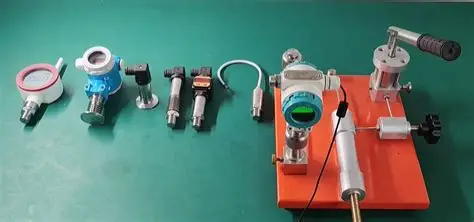
A vented-gauge transmitter implements P_gauge = P_abs − P_atm in hardware. The reference design we recommend to clients depends on operating temperature, accuracy class, and whether the installation is indoor industrial or outdoor exposed. A reference port lets ambient atmosphere reach one side of the sensing diaphragm; the process port carries the medium on the other side; the diaphragm bends in proportion to the difference, and a piezoresistive bridge or ceramic-capacitive die converts that bend into a 4–20 mA signal. For static gauge-pressure work, HMK’s main lineup maps to where you’ll use it:
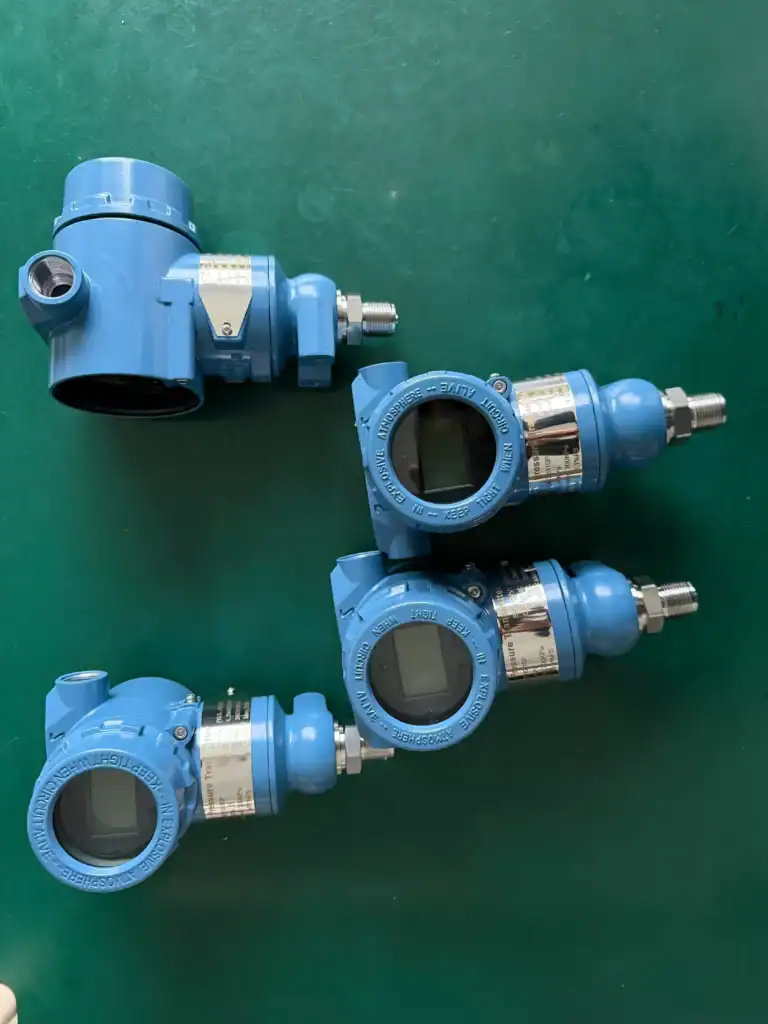
- HM20 General Purpose: vacuum to 100 MPa, ±0.25% FS, −40 to +85°C. The baseline pick for most industrial plants.
- HM22 High-Accuracy — ±0.1% FS, refinery and pharma spec compatibility.
- HM23 HVAC/R and Compressor: refrigerant-compatible, IP65/IP67, Ex ia II CT5 option, media to +125°C. The direct fit for the Example 3 HVAC case above.
- HM26 High-Temp Ceramic Capacitive: supports gauge, absolute, or compound; +125°C media. Good for corrosive chemistry.
- HM40 Digital Pressure Gauge: the 4-digit LCD/LED display shows the formula in physical form on the dial.
- HM80 High-Temperature: heat-pipe cooled, media to +350°C. The pairing for the Example 2 refinery vapour-line case.
- HE26 (ceramic-capacitive) and HE28 (sapphire, to 160 MPa) cover OEM integration.
The calibration discipline is the same across all of these. China’s JJG 52-2013 (verification regulation for spring-tube pressure and vacuum gauges) and ASME B40.100-2022 both codify the same 4:1 reference rule: the calibration master must be at least four times tighter than the device under test. For an HM22 at ±0.1% FS, the master needs ±0.025% FS or better.
For dynamic pressure events (detonation, ballistics, kHz pulse-pressure work), see the HMK CYG400 piezoresistive dynamic pressure sensor series. These sit outside the static gauge scope of this guide.
FAQ
What does P_G or P_g mean in the formula?
P_G (sometimes P_g) is the gauge pressure: the difference between the medium’s absolute pressure and the local atmosphere. It is the value most field gauges and transmitters display.
Is gauge pressure positive or negative?
Positive when the medium sits above atmospheric pressure, negative when below. A compound gauge spans both. See our note on negative gauge pressure for sign-convention edge cases.
How do you convert bar to PSIG?
Multiply the bar value by 14.5038 to get psi-equivalent, then check whether the bar reading was already “barg” (gauge) — if so, the result is psig directly. Use the MPa to PSI converter for the metric conversions.
What is the difference between PSI and PSIG?
PSI is the unit; PSIG (or “psig”) specifies gauge reference. PSIA is the same unit with absolute reference. The full decoder is in our PSIA vs PSIG vs PSI guide.
How do I calibrate a gauge pressure transmitter?
Apply a traceable reference pressure to the process port, log the transmitter output at five rising and five falling points across the span, and compare to the reference. JJG 52-2013 (China) and ASME B40.100-2022 (US) both require the reference master to be four times more accurate than the device under test.
Conclusion
The gauge pressure formula is one line of arithmetic, but the answer it gives depends on the atmosphere where the instrument sits, the units on the spec sheet, and the reference design of the transmitter hardware. Engineers who get all three right specify gauges that read accurately for years; engineers who skip any of the three see drift, offset, or outright spec mismatches in commissioning.
If you’ve worked through the examples and need to spec hardware against the formula, the HMK pressure-transmitter family maps every range and reference type covered above to a working SKU.
Author: Lin Jun, Pressure Product Engineer, HMK Tech. Reviewed 2026-05-15.