How to Choose an HVAC Differential Pressure Transmitter
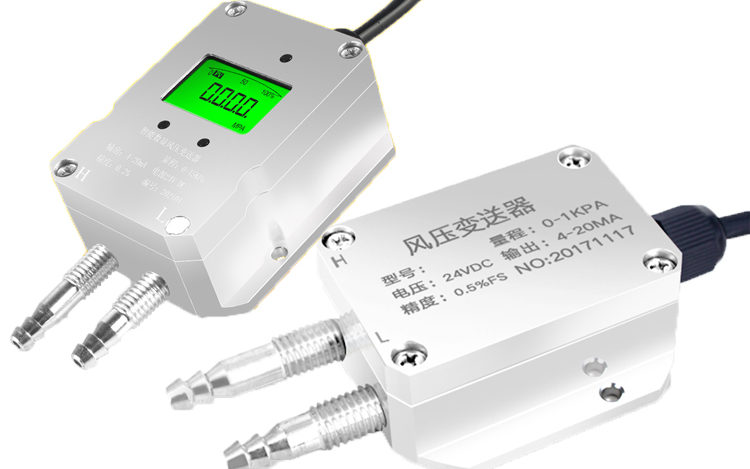
On an air-handling unit, a differential pressure transmitter does one of three very different jobs. It catches a filter as it clogs, holds duct static so the VAV boxes behave, or keeps a clean room positive against the corridor. Each job points to a different range, and sometimes a different direction and output. Pick the range off a catalogue without matching it to the job, and the signal you care about spends its life in the bottom few percent of scale, where the reading is mostly noise. This guide walks through that choice the way we would on a project: what the device measures, switch versus transmitter, how to size the range in inWC and Pa, where to mount it, and which HMK model fits.
Monitoring the pressure of a whole room, rather than a duct or a filter, is a related but distinct task covered in our room pressure monitoring guide.
When the process is hot rather than ambient building air, the cell needs cooling, a high-temperature fill, or remote seals; see our high-temperature differential pressure transmitter guide.
Quick answer: An HVAC differential pressure transmitter reads the air-side ΔP across a filter, duct, or room and outputs 4-20 mA (or a voltage) to the building automation system. Match the full scale to the job – roughly 0–500 Pa (0–2 inWC) for filters, 0–1250 Pa (0–5 inWC) for duct static, 0–125 Pa bidirectional for room pressure – size so the working ΔP lands at 60–80% of scale, and prefer 4-20 mA for long BAS runs.
What An HVAC Differential Pressure Transmitter Measures
A differential pressure (DP) transmitter reads the difference between a high-pressure port and a low-pressure port and turns it into a continuous signal, usually 4-20 mA or a voltage. That is the whole idea: not the absolute pressure at one point, but the gap between two points. In HVAC that gap is almost always small and on the air side. It runs from tens to a couple of thousand pascals, a fraction of an inch of water column up to a few inches. That is why a general process transmitter built for bar-level service is the wrong starting point.
The continuous part matters too. A transmitter gives you a number you can trend, alarm on, and feed to a control loop. If you only need an on/off flag, you may not need a transmitter at all, which is the first real decision below. For a refresher on how the sensing element produces that signal, see our note on the differential pressure transmitter working principle.
Where DP Transmitters Sit In An HVAC System
Before you size anything, it helps to know where a DP transmitter actually does its work. On one air system the same transmitter can watch a filter, a duct, and a room boundary, each across a different pair of taps. For process strainers and liquid or gas filters rather than air handlers, see filter differential pressure monitoring.
Filter status is the most common. You tap across the filter bank; as the media loads, the pressure drop climbs, and the transmitter tells you when it is time to change filters instead of guessing on a calendar. Duct static pressure keeps the supply fan and the VAV dampers coordinated, so the system delivers air without starving or over-pressurising the branches. VAV airflow uses a DP signal across a flow station or ring to regulate the box. Room and building pressurisation holds isolation rooms, clean rooms, and stairwells at the right sign and size of differential. And fume hoods and exhaust rely on face-velocity or duct DP to stay safe.
Those five look similar on a drawing, but they ask for different ranges and, in two cases, a different direction. Most catalogue pages skip that distinction, and it is what decides whether your reading is any use. If your job here is duct static specifically, our guide on how to measure static pressure in HVAC goes deeper on tap placement.
DPS Or DPT? When A Switch Is Enough
Search results for this topic mix two devices that look alike on a panel: the differential pressure switch (DPS) and the differential pressure transmitter (DPT). They are not interchangeable, and the choice should follow your control objective, not the price tag.
A switch gives you one thing: a dry contact that trips at a setpoint. It is ideal for a simple filter-dirty lamp or a fan-proving interlock, where all you want is a yes/no at one threshold. A transmitter gives you the whole curve as a 4-20 mA signal. With it you can trend filter loading week over week, drive condition-based maintenance, log duct static for energy tuning, or close a control loop. If the building automation system (BAS) is meant to modulate anything from the reading, you need a transmitter.
| DP switch (DPS) | DP transmitter (DPT) | |
|---|---|---|
| Output | Dry contact at a setpoint | Continuous 4-20 mA / voltage |
| Best suited for | Filter alarm, fan proving | Trending, energy tuning, control loops |
| What you get | One threshold | The full pressure curve |
| When to choose | On/off is all you need | The BAS modulates or logs |
In practice, we usually spec a transmitter on any point we expect to trend or control, and reserve switches for stand-alone alarms. If you want the broader comparison beyond HVAC, see pressure switch vs pressure transmitter.
Sizing The Range And The 60–80% Rule
This is where most selections go wrong. Two rules keep you out of trouble. First, size the range so your worst-case differential lands at roughly 60–80% of full scale. That keeps the working signal in the accurate part of the span and leaves headroom for a dirty filter or a transient. Second, decide whether the pressure can reverse. A clean room door or a stairwell can swing the differential negative, and a unidirectional transmitter cannot read below zero.
The table below maps each job to a sensible full-scale range. HVAC spec sheets use both inches of water column and pascals, so we list both (1 inWC ≈ 249 Pa). If you switch between them often, our inches of water column reference has the conversions.
| Application | Typical ΔP | Suggested full scale | Direction |
|---|---|---|---|
| Filter status | 80–330 Pa (0.3–1.3 inWC) | 0–500 Pa (0–2 inWC) | Unidirectional |
| Duct static | 250–750 Pa (1–3 inWC) | 0–1250 Pa (0–5 inWC) | Unidirectional |
| VAV / flow station | 50–300 Pa (0.2–1.2 inWC) | 0–500 Pa (0–2 inWC) | Unidirectional |
| Clean / isolation room | ±5–30 Pa (±0.02–0.12 inWC) | 0–125 Pa (0–0.5 inWC) | Bidirectional |
| Stairwell / building pressurisation | ±25–50 Pa (±0.1–0.2 inWC) | ±50 Pa | Bidirectional |
Two more things to check before you order. For sub-125 Pa room pressure, you should pick the highest accuracy class you can, because resolution near the bottom of the scale is what you are paying for. China’s hospital cleanroom code GB 50333-2013 sets only a 5 to 20 Pa differential between adjoining rooms of different class, so the target itself is tiny. And check the output early: many BAS controllers expect 0-10 V, while a lot of industrial transmitters offer 4-20 mA and 0-5 V. When in doubt, 4-20 mA is the safe choice. As the loop-current signal standardised in IEC 60381:1982, it is immune to voltage drop over a long cable run and reads the same at the controller as at the sensor.
Installation That Keeps The Reading Honest
A correctly sized transmitter still misreads if it is plumbed badly. Keep the impulse tubing short and away from the turbulent zone right at a fan outlet or a damper, where the static reading swings with every eddy. Connect the high and low ports the right way round – reversing them on a bidirectional point simply flips your sign, and on a unidirectional point it pins the reading at zero.
Watch the medium, too. An air-side transmitter such as the HM30 is rated for clean, dry, non-corrosive gas, so on a dusty return or a humid economiser you should add a filter or a drip leg to protect the sensing element. Finally, zero the transmitter after install with both ports open to the same pressure; a field-adjustable zero and span makes that a two-minute job. For the loop side, our 4-20 mA wiring guide covers the terminations.
Matching It To A Spec: HM30 And HE30
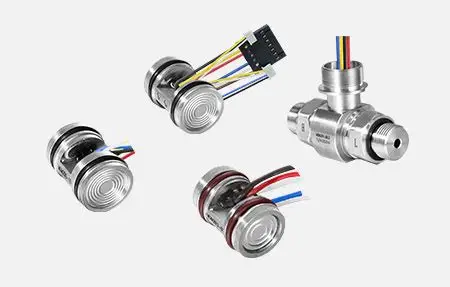
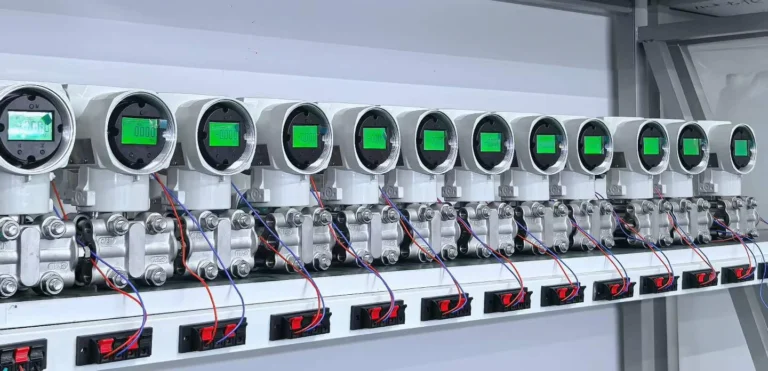
With those decisions made, here is how our own range maps onto them. The HM30 micro differential pressure transmitter spans 0-500 Pa up to 0-700 kPa full scale. It adds a negative range down to 0 to -500 Pa for bidirectional points, accuracy options of ±0.4%, ±0.25%, and ±0.1% FS, and outputs of 4-20 mA, 1-5 V, and 0-5 V. It runs on 12-36 VDC and is temperature-compensated from -10 to +55 °C. That covers filter status, duct static, VAV, and most room-pressure points directly. Two limits are worth stating plainly. Its smallest full scale is 0-500 Pa, so for a tight sub-125 Pa clean room you should lean on the ±0.1% FS class to get the resolution. And it offers 0-5 V rather than 0-10 V, so on a 0-10 V controller choose the 4-20 mA version.
- HM30 micro DP transmitter. Air-side ΔP from 0–500 Pa to 0–700 kPa, bidirectional option, ±0.1% FS class – the workhorse for filter, duct, VAV, and room points. See the HM30 page.
- HE30 wind / differential pressure sensor. Better suited to air-velocity and wind-pressure work. See the HE30 page.
- HM200D wireless DP transmitter. For filter banks you would rather monitor wirelessly, it avoids the cable run back to the panel.
In the field on cleanroom and hospital AHU work, the filter bank is the point to watch most closely. China’s cleanroom code GB 50073-2013 (clause 8.3.6) requires a DP monitor that alarms at final resistance. A medium bag filter that leaves the factory near 80-100 Pa is usually changed by about 330 Pa, which sits at roughly two-thirds of a 0-500 Pa transmitter’s scale. That is the 60-80% sweet spot, and it is why the HM30 fits this point so well. You can compare the full family on the differential pressure transmitters page.
To turn this into a BOM line:
- pick the range so your worst-case ΔP lands at 60–80% of full scale;
- call out bidirectional wherever the space can go negative;
- specify 4-20 mA unless your controller truly needs 0-10 V;
- confirm the wetted parts suit the air stream.
Room-pressure and clean-room targets follow the differentials in ISO 14644:2015 (cleanroom classification, Part 1) and local ventilation codes such as GB 50243-2016, while filter change-out points map to the loading behaviour described in ASHRAE Standard 52.2. Check those before you fix a setpoint.
Speccing a DP transmitter for an air handler?
Send us the application, the worst-case ΔP, and your controller’s input. Our team returns an HM30 or HE30 spec with the range, direction, and output already worked out.
Request a Quote Browse DP TransmittersFrequently Asked Questions
What is the difference between DPS and DPT?
A DPS is a differential pressure switch that gives a dry contact at one setpoint, ideal for a filter-dirty alarm or fan proving. A DPT is a differential pressure transmitter that gives a continuous 4-20 mA or voltage signal you can trend and control on. Choose the switch for on/off; choose the transmitter whenever the BAS needs to modulate or log.
When should I use a differential pressure transmitter instead of a switch?
Use a transmitter when you want to trend filter loading, run condition-based maintenance, tune energy use, or close a control loop. If a single yes/no threshold is genuinely all you need, a switch is cheaper and adequate.
How do you know if a differential pressure sensor is bad?
The usual signs are a reading that no longer moves with the process, a steady offset that will not zero out, a signal pinned at full scale or at zero, or noise that does not settle. Reversed high/low connections and blocked impulse tubing mimic a failed sensor, so check those first.
Does HVAC use inches of water column or pascals?
Both. US specifications lean on inWC, while much of the world uses pascals; 1 inWC is about 249 Pa. A good spec sheet states the range in both so nothing is lost in conversion.
Unidirectional or bidirectional for stairwell pressurisation?
Bidirectional. A stairwell or a door-controlled room can swing positive and negative, so a compound range such as ±50 Pa is best suited; a unidirectional unit would read zero for half the cycle.