Room Pressure Monitoring: Cleanroom & Isolation Guide
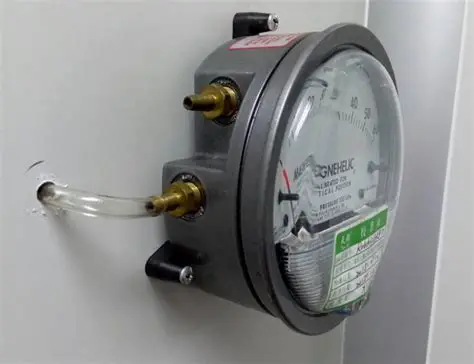
A Grade C filling room can hold a steady +15 Pa on paper and still fail an audit. Watch the display when someone opens the pass-through. The reading drops to 3 or 4 Pa, hangs there, then recovers. The fan is rarely the culprit. Most of the time the weak link is the transmitter you chose to watch that pressure, and where you tapped its reference port. Room pressure monitoring comes down to three decisions you can settle on a drawing. What differential does your standard ask for? How do the rooms cascade into each other? And which low-range transmitter reads a handful of pascals honestly? This guide works through each one so you can put a setpoint and a sensor range on the design today.
Contamination follows the pressure gradient
Room pressure is not really the point. Air direction is the point, and room pressure is how you command it. Hold a room a few pascals above its neighbour, and every leak, door crack, and duct gap pushes air outward. Nothing drifts in from the corridor. Hold it below its neighbour, and the flow reverses, so whatever is in the room stays in the room. That choice of sign is what protects either the product or the people. Everything else in this guide serves it.
What you actually measure is a differential, never an absolute. One side of the sensor sees the room. The other side, the reference, sees an adjacent space such as the corridor or the next grade of cleanroom. The number you monitor is the difference between the two. It lives between a few pascals and a few tens of pascals, a thousand times smaller than the pressures a normal process transmitter handles. That is why room pressure has its own instruments and its own selection rules.
Because the quantity is so small, two things you might ignore on a process line dominate here. One is how close your sensor range sits to the setpoint. The other is how stable the reference point is. Both come back later in this guide, and both are where most weak installations go wrong.
Pressure setpoints across ISO, GMP and ASHRAE
Before you pick an instrument, you need the target, and the target comes from the standard that governs your room. The guidance scatters across several documents, so it helps to see it side by side. Note that ISO 14644-4:2022 sets cleanroom design practice rather than a single pascal figure. The pressure numbers below come from the pharma and healthcare codes that build on it.
| Room type | Governing document | Differential | Sign |
|---|---|---|---|
| Adjacent cleanroom grades (pharma) | EU GMP Annex 1 (2022) | ≥10 Pa (≈0.04 in w.c.); commonly 10–15 Pa | Positive to the cleaner side |
| Airborne infection isolation (AII) | ASHRAE 170-2021 / CDC | Min −2.5 Pa (−0.01 in w.c.); often −5 to −12.5 Pa | Negative to the corridor |
| Protective environment (PE) | ASHRAE 170-2021 | Min +2.5 Pa (+0.01 in w.c.) | Positive to the corridor |
| Hazardous drug compounding | USP <800> | Negative 2.5–7.5 Pa (0.01–0.03 in w.c.) | Negative (containment) |
| Sterile compounding buffer room | USP <797> | Positive to the anteroom | Positive |
Two points save arguments later. First, EU GMP Annex 1 calls 10 Pa a guidance value. You may design to a different figure if a risk assessment justifies it. You then have to monitor the critical differentials continuously rather than spot-checking them.
Second, the healthcare figures look tiny next to the pharma ones. A −2.5 Pa (−0.01 in w.c.) isolation room holds a target the size of the sensor error on many transmitters. That is why instrument choice matters so much in the next sections, and it is why the US CDC isolation guidance pairs a pressure target with continuous monitoring. For the sign convention behind a below-zero reading, our note on negative pressure gauge applications goes deeper.
Designing the room-to-room pressure cascade
A single room rarely stands alone. Classified suites are built as a cascade. Each space sits one step above, or below, the next, so leakage always runs the protective way through the chain. You design the steps, not just the end room.
Take a common positive-pressure gowning sequence. The unclassified corridor sits at 0 Pa as the reference. The gowning room holds +15 Pa (+0.06 in w.c.) relative to the corridor. The cleanroom core beyond it holds a further +15 Pa relative to the gowning room, which puts it at +30 Pa relative to the corridor. Any leak now runs core to gowning to corridor, carrying particles away from the product at every step. A negative containment suite is the mirror image. The core sits lowest, and each airlock steps up toward the outside, so contamination is always drawn inward.
Two design habits keep the cascade honest. Decide, for every transmitter, whether it reads against the immediate neighbour or against a common corridor reference. A reading of +15 Pa against the gowning room and +30 Pa against the corridor can describe the same door. Confusing the two mis-sets your alarms.
Then leave headroom. A cascade built at only the minimum step has nothing left when a door opens or a filter loads. Most designers give each critical door a comfortable margin above the standard’s floor. For the duct static and filter differentials that feed these rooms, which are a different measurement, see the HVAC differential pressure transmitter guide.
Negative isolation rooms versus positive protective rooms
The hardest part of a room-pressure spec is often the sign, and getting it wrong is dangerous rather than merely inaccurate. Ask one question. Are you protecting the room from the world, or the world from the room?
| What you protect | Room sign | Example rooms |
|---|---|---|
| The room from the world | Positive | Protective environment (PE) room; USP <797> sterile buffer room |
| The world from the room | Negative | Airborne infection isolation (AII); USP <800> hazardous-drug room |
When you protect the room, you go positive. A protective environment room for an immunocompromised patient holds above its surroundings, so clean air always flows outward. When you protect the world from the room, you go negative. An isolation room for a tuberculosis patient holds below its surroundings, so contaminated air is drawn in and exhausted rather than reaching the corridor. Some suites need both signs in sequence through an anteroom, and those layouts are where a clear cascade drawing earns its keep.
The instrument does not care about the clinical reason, but you should, because the sign sets the range you order and the direction your alarm watches. A bidirectional transmitter that reads both ways around zero is often the safe choice where an anteroom can swing.
Choosing a transmitter for near-zero pressure
Selection is where most room-pressure loops go wrong. The most common mistake is fitting a transmitter whose range dwarfs the setpoint. A dedicated room monitor typically runs a span of ±12.5 Pa (±0.05 in w.c.) or ±25 Pa (±0.1 in w.c.) for a reason. At those spans a few pascals is a healthy part of full scale, so the reading stays precise and stable. Put a wide-range unit on the same job and the physics turns against you.
The reason is that a data sheet quotes accuracy as a percent of full scale, but your room lives in pascals, so you have to convert. Work it against a 15 Pa setpoint.
| Transmitter range | Accuracy class | Error in Pa | As % of a 15 Pa reading |
|---|---|---|---|
| ±100 Pa | ±1% FS | ±1 Pa | ~7% |
| 0–500 Pa | ±0.4% FS | ±2 Pa | ~13% |
| 0–500 Pa | ±0.1% FS option | ±0.5 Pa | ~3% |
The lesson reads straight off the table. Judge accuracy in pascals at your setpoint, not in percent on the box, and keep the range as close to the setpoint as the product family allows.
Range and accuracy settled, three smaller choices finish the spec. Pick a bidirectional span if the room could sit either side of zero. Choose the output your monitor or building system expects, most often a 4–20 mA loop for a hard-wired point. And favour a transmitter with a field-adjustable zero, because at these pressures you will re-zero it, and you want a screwdriver task rather than a trip to the bench. Our low-pressure transducer guide covers what counts as low pressure and which sensing technology suits it.
Reference-port placement and alarm response
A perfect transmitter reads nonsense if its two ports see the wrong pressures. Put the room port where the room air is calm, away from a supply diffuser jet or a return grille. A few pascals of velocity pressure off a nearby jet is the same size as your whole setpoint. The reference port matters even more. Run its tube to a genuinely stable space, the corridor or the adjacent room, away from doors and traffic. A reference tapped into a busy, gusty spot makes a healthy room look like it is failing.
Alarming is the other half. Set the alarm at the standard’s floor with a sensible deadband, then add a short time delay so a normal door opening does not trip it. The delay is a balance. It runs long enough to ride out a door cycle of a few seconds, and short enough to catch a real loss of pressure quickly. Where the code calls for continuous monitoring of a critical differential, as EU GMP Annex 1 does, the transmitter feeds a logging monitor rather than a periodic manual check. The alarm strategy then becomes part of the qualified design.
Field failures: doors, stack effect, and drift
Rooms that pass at commissioning still drift out of specification in service, and the causes repeat. Knowing them tells you what to design against.
The everyday one is the door. Open a door in a cascade, and the differential across it collapses toward zero for a few seconds, then recovers when the door shuts. That is normal physics, not a fault, and it is what the alarm delay above is for.
The quieter one is the stack effect. In a multi-storey building, warm air rising through the structure sets up its own vertical pressure gradient, which can add to or fight your HVAC cascade. In the field on multi-storey cleanrooms, we have watched a room that balanced perfectly in winter slip below its alarm the following summer, once the warm-weather stack reversed.
The third cause is the instrument itself. Thermal zero drift is quoted per degree, and it scales with range. At 0.02% of full scale per °C, a ±100 Pa sensor drifts about 0.02 Pa/°C, while a 0–500 Pa sensor drifts about 0.1 Pa/°C. A 10 °C swing in a plant room then moves that wider sensor’s zero by a full pascal, nearly half of a −2.5 Pa isolation target. The defence is the same each time. Keep the range close to the setpoint, choose a low-drift sensor, and re-zero on a schedule.
Room-pressure transmitters from HMK TECH
With the engineering settled, here is where our own range fits, and where it does not. For most cleanroom and GMP room-pressure work at ±10 to ±60 Pa, the closest fit is the HE30 wind and differential pressure sensor. It reaches down to a ±100 Pa bidirectional span, with 0.5 Pa resolution and a ±1% accuracy class on its low ranges. A 15 to 30 Pa cascade then sits in a sensible part of full scale rather than lost at the bottom.
Where you want a loop-powered field transmitter with an adjustable zero and span, the HM30 micro differential pressure transmitter covers 0–500 Pa upward. It carries a ±0.1% accuracy option and a 4–20 mA output, which suits a larger cascade or a higher room differential. For a retrofit where running conduit to each room is the obstacle, the HM200D wireless differential pressure transmitter reports the same measurement over a LoRa link.
Two honest boundaries go with that. A dedicated ±12.5 Pa room monitor still holds the resolution edge for the tightest airborne-infection isolation rooms at −2.5 Pa, and we would not claim otherwise. Our sweet spot is the pharma and cleanroom cascade band of roughly ±10 to ±60 Pa, where a low-range transmitter is both accurate and rugged. The second boundary is scope. What we supply is the sensing transmitter, the element that reads the differential and outputs a signal. The wall display with its visual and audible alarm is a separate panel, and you specify the two together.
Before you commit a room-pressure point to the drawing, confirm these three:
- Setpoint: take the differential and its sign from the standard that governs the room (GMP Annex 1, ASHRAE 170, or USP 797/800), and put it on the drawing.
- Range: pick a transmitter whose span sits close to the setpoint, within about ten times it, and read the accuracy in pascals rather than as a percent of full scale.
- Reference and alarm: run the reference tube to a stable adjacent space, and set an alarm delay that rides out a normal door cycle.
Tell us the room type, the setpoint from your standard, and whether you need a wired or wireless point, and we can match the range and output to it. You can start from the differential pressure transmitter range, or send the duty straight to our engineers.
Specifying a room-pressure monitoring point?
Send us the room type and the setpoint from your standard, and our engineers will match the range, accuracy, and output to your cleanroom or isolation-room duty.
Request a QuoteBrowse DP TransmittersFrequently Asked Questions
What is a room pressure monitor, and is it the same as a differential pressure transmitter?
They work together but are not the same thing. The transmitter is the sensing element. It reads the differential between the room and a reference space and outputs a signal. The monitor is the wall panel that displays that value and raises the visual or audible alarm. In a room-pressure loop you specify both, and the transmitter you choose sets the accuracy of the reading.
How do you measure the pressure inside a room?
You measure a differential, not an absolute pressure. One port of a low-range transmitter is open to the room, and you tube the reference port to a stable adjacent space such as the corridor. The transmitter reads the few pascals of difference between them and sends it to a monitor. Placing that reference tube in a calm location matters as much as the sensor itself.
What differential pressure does a cleanroom need between grades?
EU GMP Annex 1 gives a guidance value of at least 10 Pa (about 0.04 in w.c.) between adjacent grades, and most facilities design to 10–15 Pa for headroom. Because it is a guidance value, you may justify a different figure by risk assessment, but you then have to monitor the critical differentials continuously.
Should an isolation room be positive or negative pressure?
It depends on what you are protecting. An airborne infection isolation room is negative, so contaminated air is drawn in and exhausted rather than reaching the corridor. A protective environment room for an immunocompromised patient is positive, so clean air always flows outward. Hazardous-drug rooms under USP <800> are negative, while sterile compounding under USP <797> is positive.
How often should a room-pressure transmitter be re-zeroed?
At these low ranges, thermal drift and long-term zero shift form a real part of the reading, so re-zero on a schedule rather than assuming the factory zero holds forever. Commissioning and each periodic requalification are the usual points. A transmitter with a field-adjustable zero turns that into a quick screwdriver task instead of a trip to the bench.