How to Choose a Pressure Transmitter for Marine and Offshore Service
When you spec a transmitter for a ship, a jetty, or an offshore platform, the pressure range is usually the easy part. The harder question is how the instrument survives the sea around that range. Salt spray on an open deck, standing water in a bilge, permanent immersion in a ballast tank, and chloride attack on a wetted diaphragm are four different problems, and a single “marine” data sheet rarely tells you which one it was built for.
This guide sorts the decision the way we would on a project review: fix the environment first, then let it drive the material, the ingress protection, and the approvals you need.
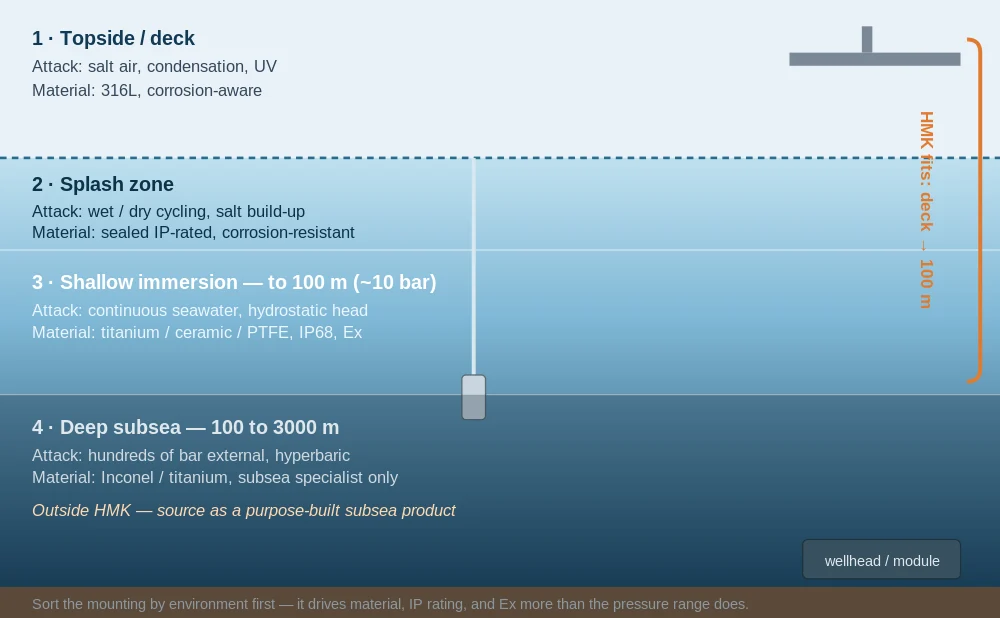
Marine and offshore service is really four environments
Before you compare products, place the measurement point in one of four zones. Each zone changes the material and sealing answer more than the pressure range does.
| Zone | Typical points | What attacks the instrument | Realistic supplier class |
|---|---|---|---|
| Topside / deck | Deck hydraulics, air receivers, fuel/oil lines | Salt-laden air, condensation, UV | General industrial, corrosion-aware |
| Splash zone | Waterline hull penetrations, jetty risers, wash-down | Wet/dry cycling that concentrates salt | Sealed IP-rated, corrosion-resistant |
| Shallow immersion (≤100 m) | Ballast/cargo tanks, sea chests, bilge, coastal level | Continuous seawater, hydrostatic head | Submersible, titanium/ceramic/PTFE |
| Deep subsea (100–3,000 m) | Seabed wellheads, risers, control modules | Hundreds of bar external, hyperbaric | Subsea specialist only |
Topside and deck mountings see salt air and daily condensation, but they are not submerged. Splash-zone points get wetted and dried in cycles, and that cycling concentrates salt in a way that is often harder on an enclosure than steady immersion.
Shallow immersion is the work most people mean by “marine level”: tanks, sea chests, bilges, and harbour level, from about a metre to roughly 100 metres of water. Deep subsea is a separate discipline. There the housing itself carries hundreds of bar of external pressure, and the connectors are qualified for hyperbaric service.
That last zone is where vendor language needs care. A transmitter built for true subsea work is typically a 3,000-metre, Inconel-and-titanium instrument with secondary pressure containment. It is a purpose-built product family, not a coating you add to a deck transmitter. If your point sits on the seabed, size it as a subsea instrument from the start — for zones one through three, the rest of this guide applies.
Where 316L stops being enough in seawater
316L stainless is the default wetted material for industrial transmitters, and on a dry deck it is usually fine. In seawater it has a ceiling. The metric that predicts that ceiling is the Pitting Resistance Equivalent Number, PREN ≈ %Cr + 3.3 %Mo + 16 %N. Standard 316/316L sits in the mid-20s, which is why it is usually described as having only limited suitability for continuous seawater, and why alloys above roughly PREN 40 are preferred once chloride and warmth climb together.
Chloride also drives stress-corrosion cracking, and susceptibility rises with temperature. Published work puts the practical threshold near 55 °C at about 500 ppm chloride, and warm seawater plus tensile stress makes fine cracks more likely (see this study on 316L SCC in seawater).
The practical reading for a wetted diaphragm is a short ladder.
| Service condition | Reasonable wetted material |
|---|---|
| Cool, aerated, intermittently wetted deck | 316L stainless |
| Continuous or warm seawater, crevice-prone fittings | Titanium, or ceramic (Al₂O₃) |
| Aggressive / chloride-plus-acid streams | Hastelloy, PTFE/PFA-coated, or tantalum |
We are not alone in reaching for these metals. Marine transmitter families across the market land on the same shortlist: titanium, ceramic, Hastelloy, Monel, or tantalum for the wetted parts, with fluoroelastomer or PTFE seals behind them. Once the service is continuous seawater, the market moves off plain 316L.
For genuinely aggressive or crystallising media, a diaphragm-isolated element is safer than an exposed one. That is the same reasoning we walk through in the flush-mount transducer guide.
Ingress protection and cable entry decide submerged reliability
For any wetted or submerged mount, the enclosure and the cable matter as much as the sensing element, and an IP68 mark alone does not settle it. Under IEC 60529:2013, IP68 means suitable for continuous immersion under conditions the manufacturer defines. It fixes no universal depth. One IP68 product may be verified to 2 metres and another to far more, so read the stated depth and duration, not just the two digits.
The failure mode to design against is moisture ingress. It is the dominant cause of submersible-transmitter death, and we see it more than any sensor fault.
In the field, the failure usually runs in a sequence. First the diaphragm pits and lets the fill fluid weep out. Then the cable connector corrodes and the signal turns intermittent. Finally condensation collects in the electronics cavity until the board shorts.
Water gets in by two paths: through the seal between cable and body, and down the inside of the cable from its termination in air. Good submerged designs answer both. Look for a cable gland with double O-rings or potting at the sensor, plus a water-resistant jacket such as polyurethane. For a vented-gauge reference, add a micro-bore vent tube, protected at the surface by a hydrophobic filter so humidity cannot wick back down.
If your point stays under water, treat the cable termination box as part of the instrument and keep it dry and sealed. That one habit prevents most field returns.
Hazardous-area marine installs need corrosion and Ex together
Offshore platforms and many vessel spaces are classified hazardous areas, so a marine transmitter there has to satisfy two constraints at once. It must resist the seawater environment, and it must carry an explosion-protection method suitable for the zone.
The two are independent. A titanium wetted part does nothing for gas ignition risk, and an Ex housing does nothing for chloride pitting, so confirm both on the data sheet rather than assume one implies the other.
In practice you choose between two explosion-protection methods. Intrinsic safety (Ex ia, IEC 60079-11:2023) limits the energy into the field device and suits Zone 0 and Zone 1 loops. Flameproof protection (Ex d, IEC 60079-1:2014) instead contains any ignition inside the enclosure.
HMK’s submersible HM21 body, for example, is rated IP68 with Ex ia IIC T5, pairing immersion sealing with an intrinsically safe method. For flameproof needs, the HM60 explosion-proof transmitter and HE60 explosion-proof sensor take the Ex d route. Match the protection method to the area classification your electrical engineer assigned, then check that the wetted material still fits the seawater exposure from the section above.
Shallow-immersion level and depth up to 100 metres
Most marine pressure points a general-purpose supplier can genuinely serve are shallow-immersion level and depth measurements: ballast and cargo tank level, sea-chest and bilge level, draught, and coastal or harbour monitoring.
In the field on a ship, ballast, bilge and fire-water lines often share one seawater main, so a single transmitter can meet condensation, splash and salt crystallisation at once. That is the exact combination a sealed, corrosion-resistant, double-diaphragm build is meant to survive.
The requirement is a corrosion-suitable wetted part, a genuinely sealed IP68 body, and a hydrostatic range that matches the water column. A few bar covers most tanks, and about 10 bar covers 100 metres of water. A submersible transmitter reads that hydrostatic head and converts it to level or depth, and since each 10 metres of seawater adds roughly 1 bar, the range you pick is really the deepest water column you expect to see.
HMK’s fit for this band is the HM21R anti-corrosive submersible transmitter. It uses a titanium-alloy flat diaphragm with a PTFE/PFA-coated probe for acids, alkalis, and chloride-bearing water, in ranges from 0–1 m up to 0–100 m at ±0.1% FS on a 4–20 mA output. Where lightning is a risk on exposed coastal cabling, the HM21F lightning-protected version adds surge protection, and the full family sits on the submersible level transmitter page.
Some points need a corrosion-resistant gauge or absolute reading rather than hydrostatic level. For those, the HM50 anti-corrosive transmitter reads ±0.25% FS over a −20 to +85 °C media range, and the titanium-sapphire HM28 covers higher pressures with a corrosion-resistant diaphragm.
Where HMK marine transmitters fit best
Part of specifying well is being honest about limits, so here are ours. HMK builds pressure and level transmitters that suit topside, splash-zone, and shallow-immersion marine service to about 100 metres. That means corrosion-resistant titanium, ceramic, and PTFE/PFA wetted options, sealed IP68 submersible bodies, and Ex ia or Ex d protection for hazardous marine areas.
What HMK does not offer is a deep-subsea, seabed-rated instrument, and it does not hold marine classification-society type approval. Those are deliberate limits, not oversights.
Two things follow. If your measurement sits on the seabed at hundreds of metres, or the pressure housing itself must survive hyperbaric external pressure, that is specialist territory, and you should source it as a subsea product family from the start.
And if your project requires a specific classification-society approval from DNV, Lloyd’s Register, ABS, Bureau Veritas, ClassNK, or CCS, treat that as a documented certificate you must verify per society. A genuinely marine-approved transmitter carries a named class approval, such as a DNV mutual-recognition certificate, and that is the certificate to ask for by name. Full multi-society approval is a 12-to-24-month, six-figure undertaking per product family, and it is not implied by the word “marine” on a brochure. The roles of the ship classification societies are a useful primer.
For everything from the deck down to a 100-metre ballast tank, tell us the zone, the media temperature, and the area classification, and we can put a material-and-Ex combination on your BOM. Start on the pressure transmitter range, or contact us for a marine selection.
One aside avoids a common mismatch. HMK’s CYG1413 underwater free-field transmitter is a 20–100 MPa, 450–1000 kHz instrument for underwater-explosion (UNDEX) shock-wave testing. It is a research and test device, not a process or level transmitter for marine plant.
Frequently asked questions
What material should a seawater pressure transmitter use?
For continuous or warm seawater, choose titanium, ceramic (Al₂O₃), or Hastelloy over 316L. Standard 316L has a PREN in the mid-20s and becomes vulnerable to chloride pitting and stress-corrosion cracking above about 55 °C at seawater chloride levels, so keep it to cool, intermittently wetted deck service.
Is an IP68 rating enough for permanent immersion?
Not by itself. IP68 confirms continuous immersion is possible but leaves depth and duration to the manufacturer, so check the stated metres and hours. For permanent immersion, the cable seal and the surface termination matter as much as the enclosure, because moisture ingress through the cable is the most common submersible failure.
Can HMK measure pressure on the seabed (true subsea)?
No. HMK covers topside, splash-zone, and shallow-immersion service to about 100 metres. Seabed and hyperbaric subsea measurement needs a purpose-built subsea instrument with a pressure-containing housing and qualified connectors, which is a specialist product class.
Do marine pressure transmitters need classification-society approval?
Only if your project or class notation requires it. Approval from DNV, Lloyd’s Register, ABS, Bureau Veritas, ClassNK, or CCS is a specific documented certificate, so verify it per society rather than relying on the general term “marine”. It is a lengthy and costly qualification per product family.
Titanium or 316L for marine service?
Use 316L where exposure is cool, aerated, and intermittent. Move to titanium where the wetted part sees continuous seawater, warmer temperature, or crevice-prone geometry. Titanium’s much higher pitting and chloride-SCC resistance is why marine transmitter families across the market offer it as the seawater option.