Type T Thermocouple: Range, Accuracy & Where It Wins
Below 0 °C is where a Type K thermocouple quietly drops out of its accuracy class. The Type T thermocouple, a copper–constantan pair, holds a ±0.5 °C Class 1 tolerance through +125 °C and repeats to within ±0.1 °C down to -200 °C, where Type K no longer carries a Class 1 rating. That low-temperature stability makes Type T the default for cryogenic work, ultra-low freezers, and food and pharmaceutical cold chains. The trade-off sits at the top of the range: the copper leg oxidises in air above roughly 300 °C, which caps continuous service at 350 °C (662 °F).
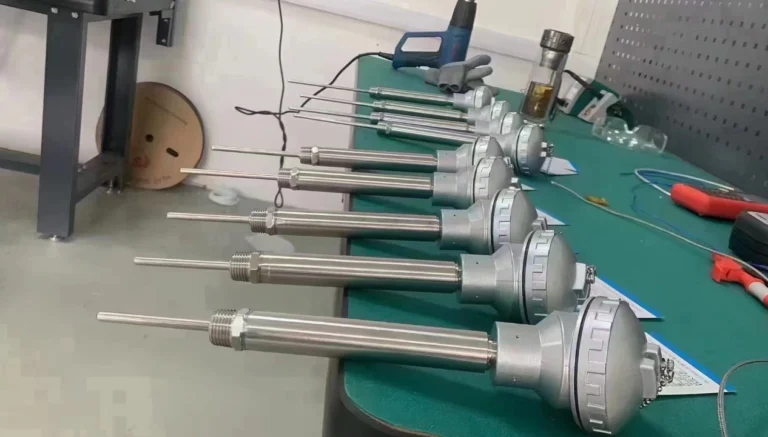
For ready-made Type T assemblies, browse HMK industrial thermocouples.
Quick answer: Type T is a copper–constantan thermocouple rated -200 to +350 °C (-328 to +662 °F), with a special tolerance of ±0.5 °C. It is the preferred sensor for sub-zero, cryogenic, and moist or condensing service. Above 350 °C, switch to Type K, J, or N.
What a Type T Thermocouple Is
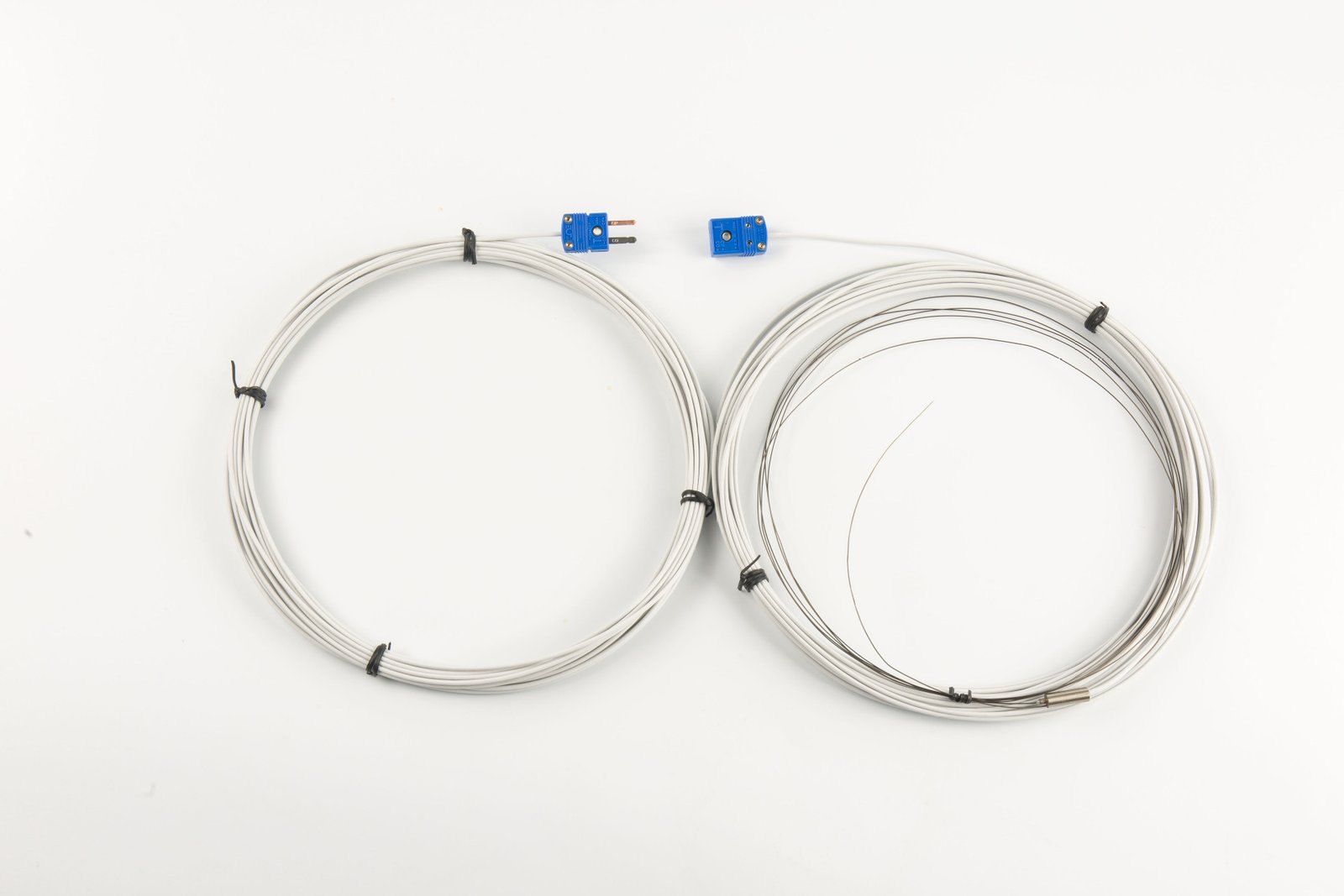
A Type T thermocouple pairs a copper positive leg with a constantan (copper–nickel) negative leg. That pairing resists moisture and condensation, another reason refrigeration and humid sub-zero points favour it over base-metal types that corrode. Color codes identify polarity in the field: under ANSI MC96.1 the positive leg is blue, the negative red, and the jacket blue; under IEC 60584:2013 Part 3 the positive leg is brown, the negative white, and the jacket brown. The blue jacket flags it instantly under the US system: among the common base-metal types, only Type T carries a blue overall sheath.
Temperature Range and Accuracy Classes
IEC 60584:2013 defines the Type T tolerances, adopted in China as GB/T 16839-2018. Three classes partition the range, and the sub-zero band falls only under Class 3.
| Class | Tolerance (whichever is greater) | Valid range |
|---|---|---|
| Class 1 | ±0.5 °C or ±0.004·|t| | -40 to +125 °C |
| Class 2 | ±1.0 °C or ±0.0075·|t| | -40 to +350 °C |
| Class 3 | ±1.0 °C or ±0.015·|t| | -200 to +40 °C |
Repeatability between -200 and 200 °C runs near ±0.1 °C, the figure that matters for laboratory and reference duty. Output EMF, with the reference junction at 0 °C, follows the ITS-90 scale per IEC 60584:2013.
| Temperature | EMF (mV) |
|---|---|
| -200 °C (-328 °F) | -5.603 |
| -100 °C (-148 °F) | -3.379 |
| 0 °C (32 °F) | 0.000 |
| 100 °C (212 °F) | 4.279 |
| 200 °C (392 °F) | 9.288 |
| 350 °C (662 °F) | 17.819 |
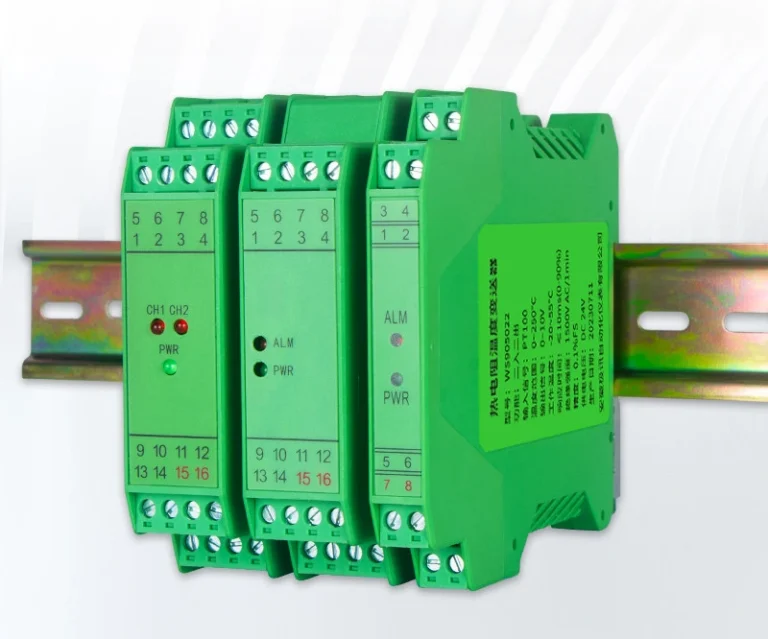
Sensitivity near room temperature averages about 43 µV/°C, edging out Type K’s 41 µV/°C and staying stable through the sub-zero band. A transmitter linearised as Type T per IEC 60584:2013 tracks the curve directly; a generic millivolt card does not, because the slope changes across the range.
Where Type T Wins
Four application families drive most Type T selection. Each one starts from a sub-zero or moisture condition that rules out the higher-temperature base-metal types.
- Cryogenics and ultra-low freezers. Down to -200 °C (-328 °F) Type T keeps its accuracy class, while Type K drops to its Class 3 floor. For -80 °C freezers and liquid-gas service, a special-tolerance Type T is the standard spec.
- Food and pharmaceutical cold chain. Freeze-dryer shelves, blast freezers, and cold rooms combine sub-zero temperature with high humidity. The copper–constantan pair shrugs off the condensation-driven corrosion that degrades Type J and bare Type K. A thin sheath gives the fast response that shelf-temperature points need.
- Laboratory and reference measurement. The ±0.1 °C repeatability carries calibration baths, environmental chambers, and research rigs where resolution, not range, sets the limit.
- HVAC-R and low-temperature process. Chiller loops, heat-pump evaporators, and refrigeration test stands sit inside Type T’s -40 to +120 °C sweet spot, where Class 1 ±0.5 °C applies directly.
Type T vs Type K, J and E Below 0 °C
The real question is rarely Type T or nothing. It is which base-metal type to spec for a point below 0 °C. Three attributes settle it: sub-zero accuracy class, sensitivity, and upper limit.
| Attribute | Type T | Type K | Type J | Type E |
|---|---|---|---|---|
| Range | -200 to +350 °C | -200 to +1260 °C | 0 to +760 °C | -200 to +900 °C |
| Sub-zero accuracy | Class 1 to -40, Class 3 to -200 °C | Class 3 only below -40 °C | Not rated below 0 °C | Class 1 to -40, Class 3 to -200 °C |
| Sensitivity (near 0 °C) | ~43 µV/°C | ~41 µV/°C | ~51 µV/°C | ~68 µV/°C |
| Moisture resistance | High (copper leg) | Moderate | Low (iron leg rusts) | Moderate |
| Upper continuous limit | 350 °C | 1260 °C | 760 °C | 900 °C |
Type J drops out first: its iron leg carries no rating below 0 °C and rusts in condensing service. Of the three that remain, Type E delivers the highest resolution and wins when a sub-zero point needs maximum signal per degree. Type T takes the point when moisture, condensation, or a tight ±0.5 °C tolerance dominates, which describes most cold-chain and refrigeration work. The handover upward is firm: above 350 °C the copper leg oxidises, and Type K or N owns the point. For the full range chart, see the thermocouple type comparison, and for high-temperature cyclic duty compare Type N.
Limits and Failure Modes
Three constraints decide whether a Type T installation holds calibration.
Oxidation above 350 °C. Copper oxidises in air past roughly 300 °C and shifts the Seebeck output. Continuous service caps at 350 °C (662 °F); the element tolerates brief excursions but not repeated ones. A point that also sees high temperature needs a different type.
Stem conduction error. Copper conducts heat well, so a Type T probe drains heat along its sheath faster than a nickel-alloy type and pulls the junction toward ambient on short immersion. In the field on freeze-dryer shelf qualifications, HMK engineers have measured a short-immersed Type T probe reading 2 to 3 °C high until immersion reached ten times the sheath outside diameter plus the sensing length. That 10× rule keeps the junction in the process and out of the thermal gradient.
Moisture ingress in mineral-insulated cable. Cold-chain cycling can pull moisture into an MI sheath through a failing seal, which drops insulation resistance and adds error. A hermetically sealed cold-end and periodic insulation-resistance checks prevent it.
Junction grounding. An ungrounded junction suits electrically noisy cryostats and chambers, isolating the element from sheath-borne common-mode noise at the cost of slightly slower response. Choose a grounded junction only where response time outranks isolation; the grounded vs ungrounded thermocouple guide works through the trade.
Selecting an HMK Type T Thermocouple
At HMK we supply Type T as an element option across the thermocouple range, not as a separate line, so it ships in whatever mechanical form the point demands. In our catalogue the graduation code for copper–constantan is WRCK for sheathed elements and the WRC series for assembled units, both built to IEC 60584:2013 and GB/T 18404-2001 and verified to ASTM E230 reference tables.
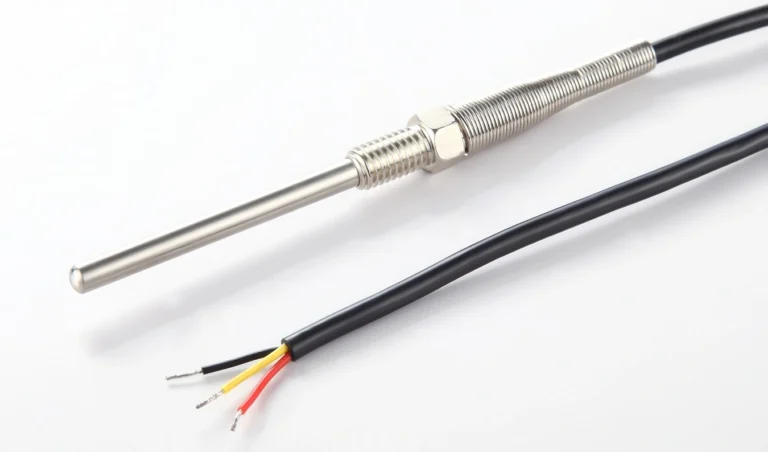
- Sheathed Type T (WRCK). Mineral-insulated cable in Ø2 to Ø8 mm, 1Cr18Ni9Ti (304-grade) sheath, grounded, ungrounded, or isolated junction, -200 to +350 °C. Thin-diameter options give the fast response that shelf- and surface-temperature points need. See sheathed thermocouples.
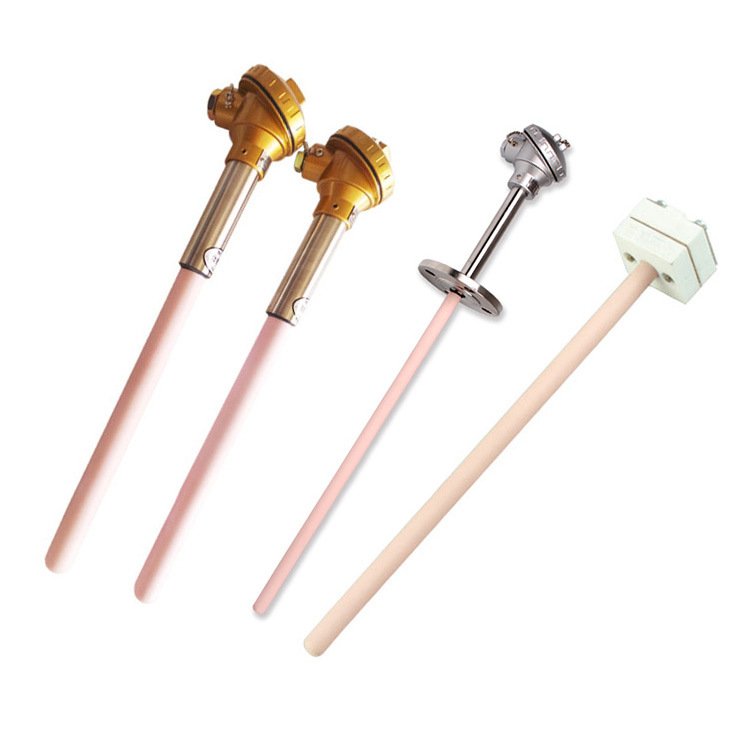
- Assembled Type T with thermowell (WRC). Fixed or flanged process connection (NPT, G-thread, or ASME B16.5-2020 flange) for tank, line, and chamber installation where the element must come out under process. See assembled thermocouples.
- Explosion-proof and multi-point. Ex d versions cover Zone 1 and Zone 2 cold-process areas, and multi-point Type T probes profile stratified storage and freeze-dryer chambers.
We factory-verify every Type T element against an ice-point reference and a working comparison standard, and we issue a test report with each shipment. When a point also reads above 350 °C, our temperature team compares it against Type N and the full thermocouple type chart before settling the spec.
Need a Type T thermocouple for a sub-zero point?
Send us the temperature range, sheath size, and junction style. Our temperature team returns a WRCK or WRC spec with a test report.
Request a Quote Browse ThermocouplesFrequently Asked Questions
What is the difference between a Type T and a Type K thermocouple?
Type T (copper–constantan) covers -200 to 350 °C and holds a ±0.5 °C special tolerance with strong sub-zero and moisture performance. Type K (chromel–alumel) reaches 1260 °C but carries no Class 1 rating below -40 °C. Use Type T below 0 °C and in condensing service; use Type K when the point exceeds 350 °C.
What is the maximum temperature for a Type T thermocouple?
350 °C (662 °F) continuous. The copper leg oxidises in air above about 300 °C, so the element chemistry sets the ceiling, not the sheath.
What are the Type T thermocouple color codes?
Under ANSI MC96.1 the positive leg is blue, the negative red, and the jacket blue. Under IEC 60584:2013 Part 3 the positive leg is brown, the negative white, and the jacket brown.
Is Type T good for cryogenic temperatures?
Yes. It carries a rating to -200 °C (-328 °F) with ±0.1 °C repeatability and serves as a standard cryogenic and ultra-low-freezer choice. For maximum signal resolution sub-zero, Type E is the alternative.
Standard or special tolerance Type T: which should you order?
Order special tolerance (±0.5 °C) for cold-chain, laboratory, and calibration points where the reading drives a release decision. Standard tolerance (±1.0 °C) covers general refrigeration monitoring.