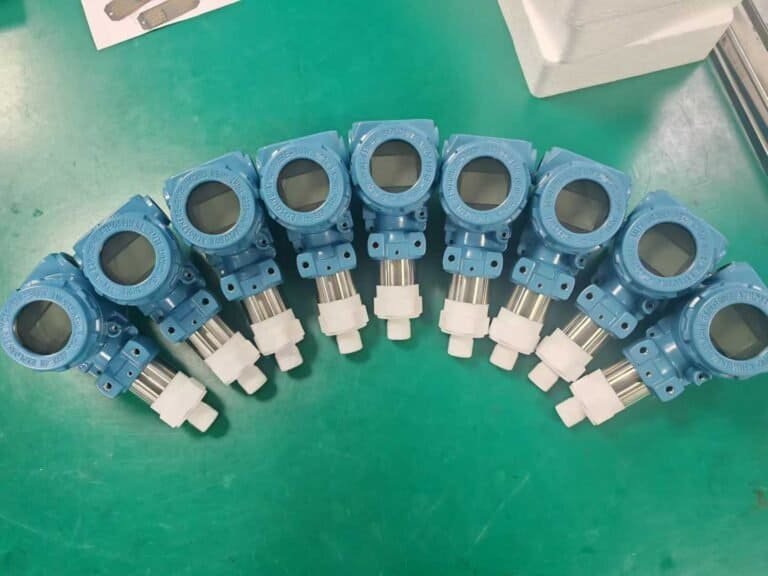
Pressure Transmitters for Corrosive Chemicals
A pressure transmitter on corrosive chemical service fails at whichever wetted surface the process attacks first, and that is rarely the electronics. If you are writing the material line of a datasheet for acid, caustic, or solvent duty, the question to settle is not which transmitter is best. It is which combination of diaphragm, seals, and housing survives your specific medium at your specific concentration and temperature.
This guide works through that decision in the order a specification is actually written.
The three corrosion failure paths
A transmitter in chemical service has three separate corrosion paths, and each does its damage differently.
- The isolation diaphragm is the thinnest wetted part, often 25 to 100 microns. Pitting that would be cosmetic on a pipe wall perforates it, and the reading drifts before the leak is visible.
- Elastomer seals and O-rings swell or embrittle in solvents and oxidisers long before the metal shows damage. A failed O-ring lets process fluid reach the sensing cell from the side.
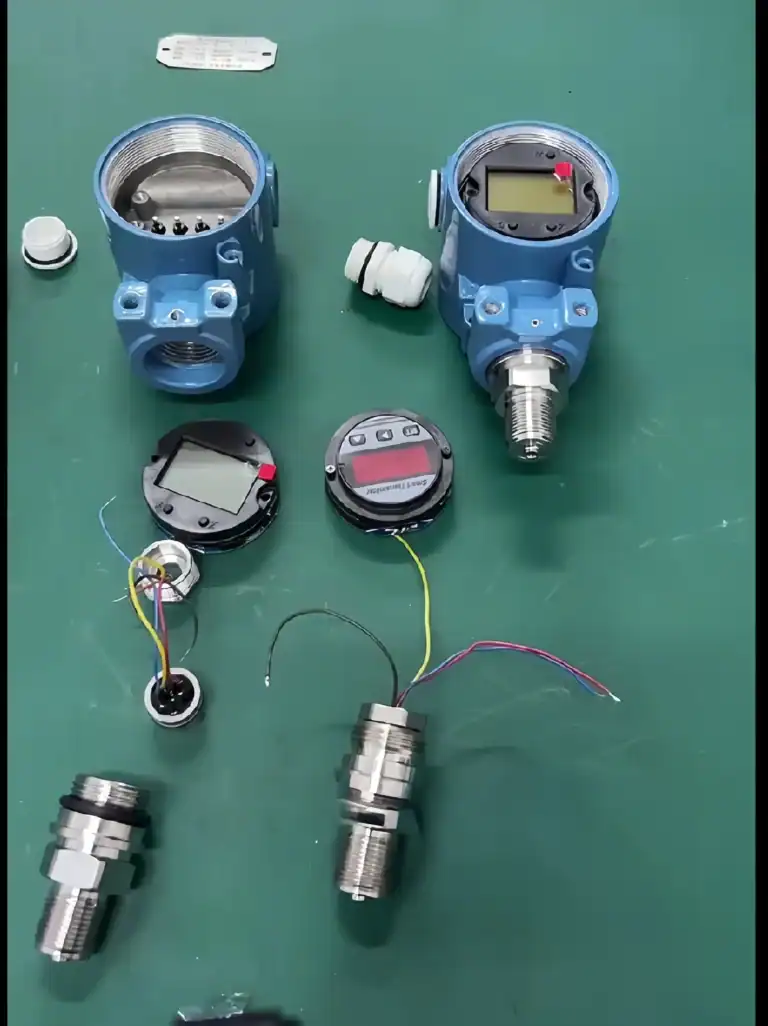
- The housing and cable entry corrode from splash and vapour rather than immersion. Acid fumes attack terminals and wiring, so an instrument can fail electrically while its wetted parts are still sound.
You can estimate an alloy’s pitting resistance from its PREN value, calculated as %Cr + 3.3×%Mo + 16×%N. 316L to ASTM A240 sits near 24; Hastelloy C-276 exceeds 50. The gap explains why a diaphragm that lasts years in one chloride stream lasts weeks in another.
Each path needs its own line in the specification: one decision for the diaphragm material, one for the seal compound, and one for the housing.
Media chemistry sets the choice
Material selection starts with three facts about the medium, i.e. what it is, how strong it is, and how hot it runs. If any of the three is missing, the material call is a guess.
Concentration is the least intuitive of the three. Sulphuric acid is oxidising when concentrated but reducing at low and intermediate strengths, so stainless steels resist it at the two ends of the curve and corrode fastest in the middle. A steel that survives 96% acid at room temperature can fail in the same line after the acid absorbs moisture and dilutes itself; the British Stainless Steel Association (BSSA) warns of exactly this self-dilution attack at the liquid line of open vessels.
Temperature moves every boundary. 316L that tolerates 22% sulphuric acid at room temperature holds that rating only to about 40°C, and by 60°C the acceptable concentration has fallen to roughly 5%, per the BSSA selection guidance built on Outokumpu isocorrosion data at the 0.1 mm/year criterion. Impurities shift boundaries too: chlorides in sulphuric acid can liberate HCl and make the mixture far more aggressive than either acid alone.
The practical rule: specify materials against the worst credible combination of concentration and temperature, not the nameplate values.
Wetted materials by chemical family
The table below summarises where each common wetted material holds and where it fails, at the 0.1 mm/year isocorrosion criterion generally used as the acceptable-service boundary. Verify borderline cells against the manufacturer’s isocorrosion chart for your exact conditions.
| Medium | 316L stainless | Hastelloy C-276 | Tantalum | Ceramic (Al₂O₃) | PTFE / PVDF wetted |
|---|---|---|---|---|---|
| Hydrochloric acid | Not suitable at any strength | Good; degrades with oxidising impurities (Fe³⁺, O₂) | Inert, all concentrations below 150°C | Good | Good |
| Sulphuric acid | Only ≤22% at RT or >90% at RT; fails mid-range | Good to moderate strength and temperature | Inert, all concentrations below 150°C | Good | Good |
| Nitric acid | Good (oxidising acid passivates Cr) | Adequate; Cr content governs | Resists up to 98% at 100°C | Good | Good (PVDF limited in fuming grades) |
| Hydrofluoric acid | Not suitable | Limited | Not suitable | Not suitable | The workable choice |
| Hot concentrated caustic | Fair to moderate temperature | Good | Not suitable | Not suitable | Good within temperature limits |
| Chloride brines, seawater | Pitting risk (PREN ≈24) | Good | Inert | Good | Good |
Specifications routinely miss three points in this table:
- 316L and sulphuric acid follow a concentration curve. Can 316L handle sulphuric acid? At room temperature up to about 22%, or above roughly 90%, yes; between those bounds the corrosion rate is unacceptable, and heat closes the safe windows quickly.
- Hastelloy is not a universal upgrade. The high-molybdenum grades resist pure reducing acids well, yet deteriorate rapidly when oxidising ions such as ferric are present. A recycled or contaminated acid stream is a different medium from the pure one on the datasheet.
- Tantalum, glass, and ceramic share the same two enemies. All three are attacked by hydrofluoric acid and by strong hot alkalis. If your process contains fluorides, none of the three premium sensing materials applies, and the specification moves to PTFE- or PVDF-wetted designs.
For sour hydrocarbon streams containing H₂S, material selection follows NACE MR0175 rather than general corrosion tables; that case is covered separately in the NACE MR0175 material selection guide.
Ceramic diaphragms: strengths and limits
A ceramic diaphragm is 96 to 99.9% aluminium oxide, fired as a single part. It has no passive film to break down, which is why it shrugs off chloride pitting that destroys stainless diaphragms, and it takes abrasion from slurries far better than any 100-micron metal foil.
The limits are chemical, and they are sharp. Aqueous hydrofluoric acid corrodes alumina, faster at lower ceramic purity, because HF preferentially dissolves the glassy grain-boundary phase (Mikeska, Journal of the American Ceramic Society, 1999). Alumina is also amphoteric, so hot concentrated caustic attacks it from the alkaline side. A ceramic cell that gives years of service in ferric chloride, for example, can be etched in weeks by a fluoride-bearing pickling bath.
There is a mechanical limit as well: ceramic is brittle, so water hammer and sharp overpressure spikes are harder on it than on a welded metal diaphragm. On spike-prone lines a pressure snubber in front of the cell is cheap insurance.
If the medium is chloride-rich, abrasive, or mixed acid without fluorides, ceramic is usually the economical answer, and it is the sensing element HMK uses in the HM12 and HE26 capacitive cells. If fluorides or hot caustic are present, take ceramic off the list along with tantalum.
Direct tantalum versus fill-fluid isolation
For media that defeat both stainless and ceramic, the specification usually forks into two architectures.
| Direct tantalum diaphragm | Diaphragm seal + fill fluid | |
|---|---|---|
| Sensing path | Tantalum foil drives the piezoresistive cell directly | Remote seal transmits pressure through silicone or fluorinated oil |
| Response time | Milliseconds (HM50: under 3 ms) | Slower; capillary length adds lag |
| Temperature effect | No fill fluid, so no fill-induced drift | Fill fluid expands with temperature; head and drift errors need correction |
| Contamination risk | None from the instrument | Seal rupture releases fill fluid into the process |
| Media temperature | Limited by the transmitter body (HM50: −20 to 85°C) | Capillary distance allows hot processes |
| Fluorides / hot caustic | Not suitable (tantalum limit) | Depends on seal wetted material; same table applies |
Tantalum covers the widest acid envelope of any diaphragm metal. It is inert to sulphuric and hydrochloric acid at all concentrations below 150°C, resists nitric acid to 98% strength at 100°C, and its corrosion behaviour is often compared to glass, per Tantaline corrosion data. A direct tantalum diaphragm therefore covers most strong-acid duties with no fill fluid to leak, no oil to drift with temperature, and a response fast enough for dosing-pump pulsation.
The fill-fluid route wins in two cases. If the process runs hotter than the transmitter body allows, a remote seal with capillary puts distance between them; the same logic as high-temperature service, covered in the high-temperature DP guide. And if the connection must be flushed, crevice-free, or flanged for a crystallising medium, the seal geometry matters more than the sensing cell behind it. How to specify that seal, including fill-fluid choice and temperature corrections, is a topic of its own: see the diaphragm seal guide.
One boundary is easy to miss: hydrogen permeates tantalum, and above roughly 250°C tantalum absorbs it and forms brittle hydride phases. For hydrogen-bearing service the material logic is different, as explained in the hydrogen pressure transducer guide.
Range, overload and temperature limits
Range selection follows the usual rule: place normal operating pressure at 30 to 70% of span, so the transmitter has resolution at the working point and headroom above it.
Chemical duty adds two adjustments. First, check the overload figure, because dosing pumps and quick-closing valves produce spikes the process design never mentions; the HM50 tolerates 200% of full scale. Second, treat the media temperature rating as a hard limit. A tantalum diaphragm may be inert to boiling acid, but the transmitter behind it is rated −20 to 85°C wetted; above that, move to a remote-seal architecture.
Accuracy is the last number to fix. ±0.25% FS is typical for anti-corrosive designs, and a long-term stability figure (0.1 to 0.2% FS per year for the HM50) matters more than headline accuracy in a plant where every removal for recalibration means breaking into an acid line.
Housing and connections that survive
After the wetted path, the next thing chemical plants lose is the outside of the instrument. Acid vapour, washdown, and salt-laden air corrode housings, cable glands, and terminals.
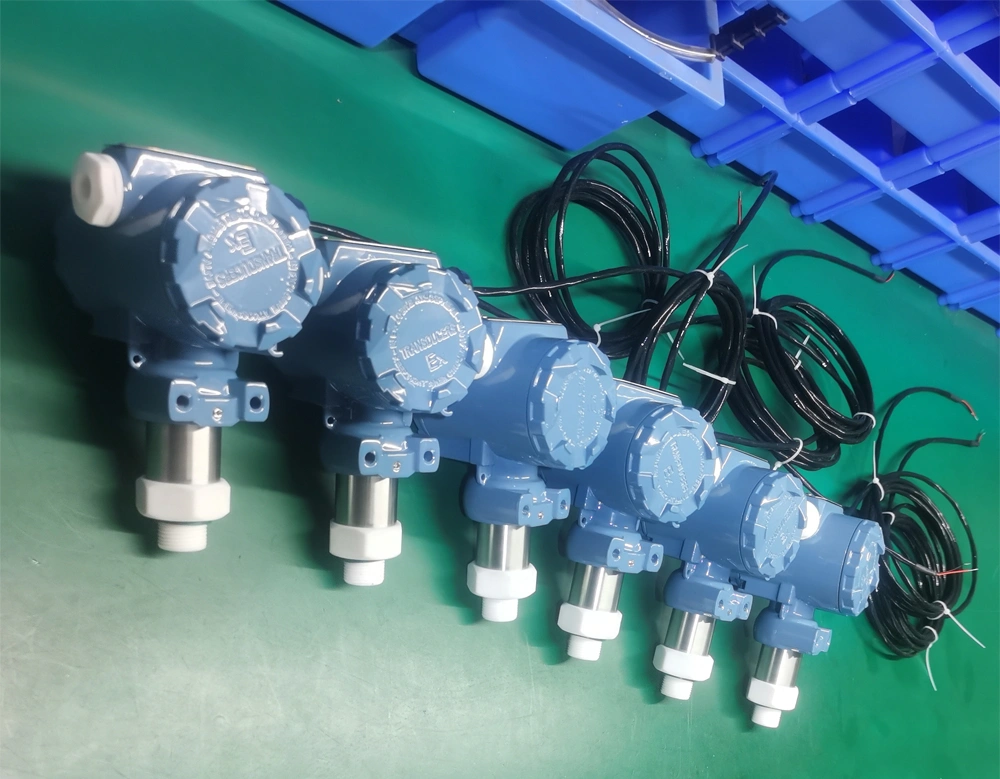
- Housing material: where splash and fumes are constant, a PVC, PTFE, or titanium-alloy housing outlasts painted aluminium. The HM50 offers all three.
- Ingress rating: IP65 to IEC 60529:2013 handles spray; specify IP67 or better where hose-down or flooding of the mounting area is credible.
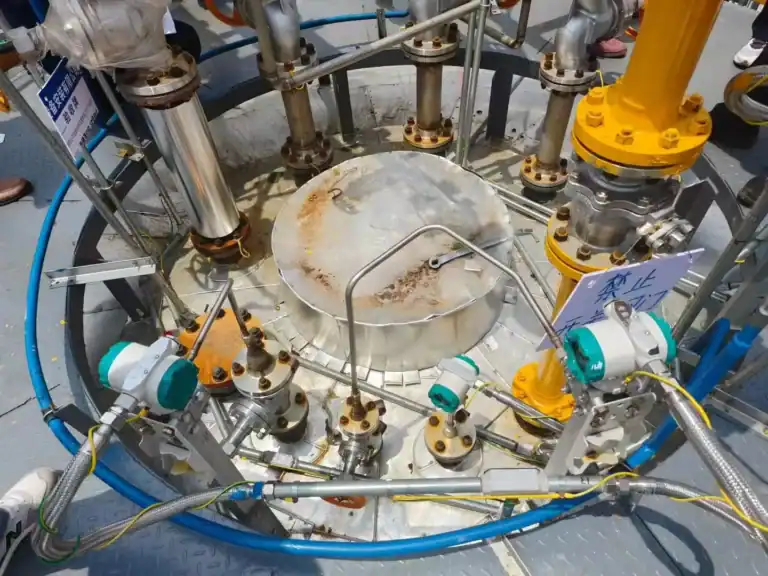
- Process connection: for media that crystallise or carry solids, a flanged or flush connection avoids the dead leg that a threaded port creates. In a case published by Qinghai Soda Ash calcination-plant engineers (yunrun.com.cn), alkali powder solidified inside impulse lines until measurement stopped, and periodic flushing became routine maintenance. Connection geometry decides how often that happens; threaded M20 or G1/4 remains fine for clean liquids and gases.
- Cable routing: route the cable entry downward and keep glands off the vapour plume; fumes travel up.
If the same plant also needs level measurement in corrosive tanks, the identical material logic applies to hydrostatic sensors; the anti-corrosive version in that family is the HM21R submersible level transmitter.
Anti-corrosive transmitters by HMK TECH
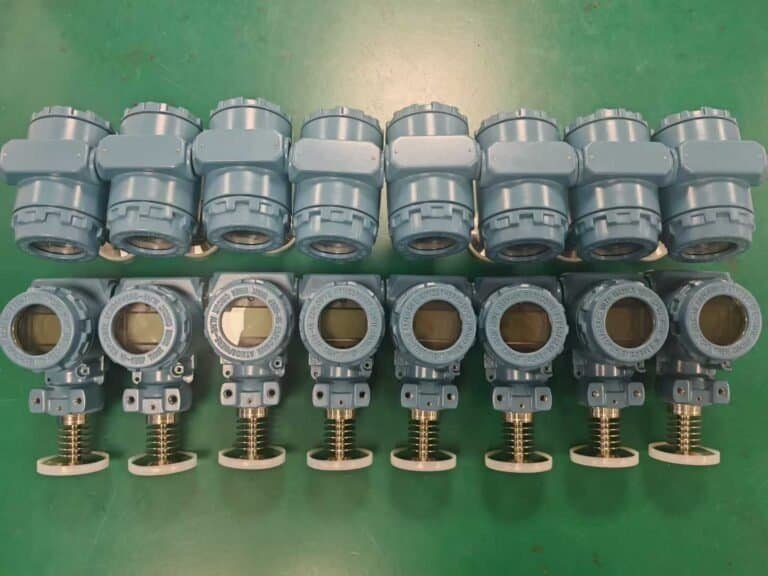
The HM50 anti-corrosive pressure transmitter is HMK’s dedicated instrument for this service. It uses a direct tantalum diaphragm with no fill fluid. Ranges run from 0–5 kPa spans up to 60 MPa, including vacuum to −100 kPa, with 200% FS overload capacity, ±0.25% FS typical accuracy, and response under 3 ms. Housing options are PVC, titanium alloy, or PTFE; output is 4-20 mA or voltage; wetted media temperature is −20 to 85°C.
For chloride and abrasive duties where tantalum is more than the job needs, the ceramic-cell HM12 and HE26 cover gauge ranges at lower cost, and the wider selection is on the pressure sensors and transmitters page. If your medium is unusual, send the composition, concentration, and temperature with your enquiry; our engineers check the material call against compatibility data before proposing a model.
Frequently Asked Questions
What is the best diaphragm material for hydrochloric acid?
Tantalum is inert to hydrochloric acid at all concentrations below 150°C, which makes it the reference choice. Ceramic and PTFE-wetted designs also serve well; 316L is unsuitable at any strength because HCl destroys its passive layer.
Can 316L stainless steel be used with sulphuric acid?
Only at the ends of the concentration curve: dilute at room temperature, or above roughly 90% at room temperature. Battery-strength acid near 35% sits squarely in the attack zone, which is why the BSSA advises against 316 for prolonged battery-acid contact. In the middle range, specify a higher alloy, tantalum, or a lined design.
What chemicals attack ceramic pressure sensors?
Hydrofluoric acid and fluoride-bearing mixtures corrode aluminium-oxide ceramic, and hot concentrated caustic attacks it as well. In most other acids, chlorides, and abrasive media, ceramic is among the most durable diaphragm materials available.
When is a diaphragm seal necessary for corrosive media?
Choose a remote diaphragm seal when the process is hotter than the transmitter’s wetted-temperature rating, or when the connection must be flush and crevice-free for a crystallising medium. For most acid duties within temperature limits, a direct tantalum or ceramic diaphragm is simpler, faster, and removes the fill-fluid risk.
Are plastic-housing pressure transmitters durable enough for chemical plants?
For corrosion, plastic housings such as PVC or PTFE often outlast metal ones because acid vapour cannot attack them. Their limits are mechanical and thermal rather than chemical, so check impact exposure and ambient temperature, and specify a titanium housing where both chemistry and mechanical abuse are severe.