Pressure Snubber Selection: Types, Sizing & When to Use One
A pressure gauge that keeps failing on a reciprocating pump is rarely a bad gauge. It is a pressure-spike problem. The pump, a fast-acting valve, or a compressor sends a sharp pressure wave down the line, and the sensing element takes the hit again and again until it drifts or ruptures. A pressure snubber is the cheapest part that fixes this, but only if you match it to the service. Pick the wrong type and it clogs; pick the wrong rating and it does nothing.
A snubber slows the pressure, it does not change it
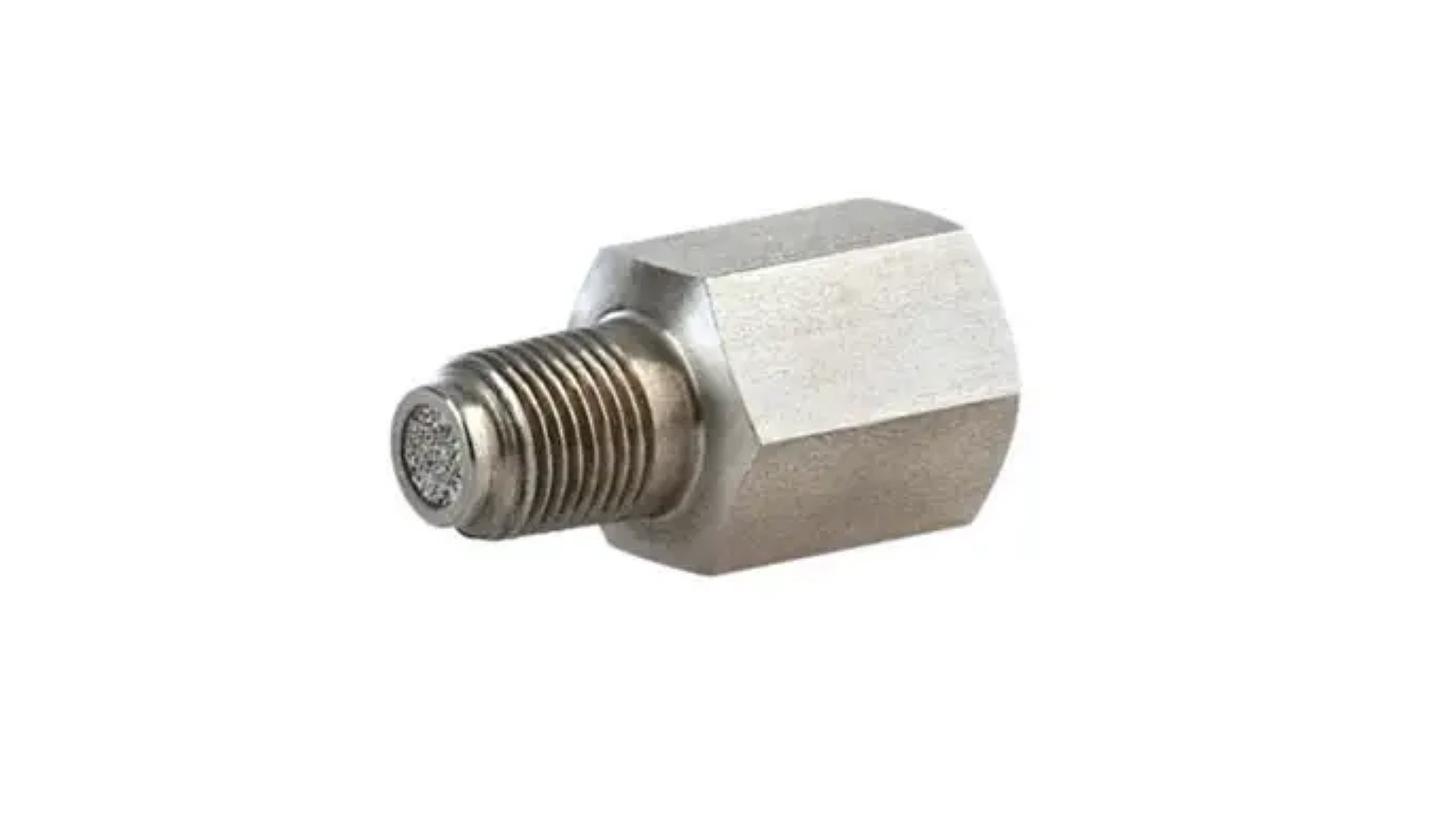
A pressure snubber is a small fitting that goes between the process and your gauge or transmitter. Inside is a flow restriction, either a porous metal disc or a moving piston, that limits how fast fluid can pass through. When a spike arrives, the restriction delays it, so the sensing element sees a gentler rise instead of a hammer blow. The steady, quasi-static pressure still passes through unchanged, so your reading stays correct. It filters out only the fast transients.
Where do those transients come from? Usually a sudden change in flow. Shutting a valve quickly, starting a pump, or the ripple of a reciprocating pump or compressor all launch a pressure wave that travels down the pipe. The wave can briefly reach a peak far above your working pressure.
In one worked example published by Power & Motion Tech, a 10 bar hydraulic line running at 3.6 L/min produced an 11.2 bar surge the instant a valve closed. That is the pressure your gauge actually feels, not the 10 bar on the nameplate.
This failure mode is easy to miss, because the spike leaves no visible trace. In a water-treatment pump system documented by Ashcroft, mechanical gauges were reading off zero within about three years, far short of their expected life, yet showed no pointer flutter to blame pulsation or vibration. A site audit fitted a max pointer, a drag needle that records the highest pressure the gauge reaches, and it logged excursions well past the gauge full-scale range. A teardown of the returned gauges confirmed a deformed Bourdon tube and worn gears.
The spikes came from pump start-up and shutdown, the same water-hammer transients a snubber is meant to soften. On a pulsating pump or compressor line I spec a snubber ahead of the gauge as a matter of course, because the spike that kills a gauge rarely announces itself as a shaking needle.
If you want to picture the part, it looks like a short hex nipple with a threaded port on each end. The diagram below shows the two common internals and what they do to the pressure trace.
Porous disc, piston, and adjustable-needle types
Three designs cover almost every application, and they trade cost against how well they handle dirt and how finely you can tune them.
| Type | How it works | Self-cleaning | Tunable | Best for |
|---|---|---|---|---|
| Porous disc (filter) | Sintered metal disc spreads and slows the flow | No, can clog | No (fixed) | Clean fluids and gases, low cost |
| Piston | A fast pressure rise pushes a free piston toward the orifice | Yes | Yes (swap piston size) | Oil and hydraulic spikes |
| Adjustable needle | A needle valve, often with a ball check, throttles the flow | Partly | Yes (turn the needle) | Continuous pulsation, changing duty |
The porous disc is the cheapest and the simplest. Its weakness is dirt: if the medium carries particles or tends to gel, the disc blocks, your reading drifts, and you have to pull the snubber and flush it. The piston type is more forgiving because the moving piston tends to clear itself, and you can change the damping by fitting a different piston. The adjustable needle gives you the finest control, since you can throttle it in the field until the needle stops swinging.
Matching snubber type to media and pulsation source
This is the step most buyers skip, and it is where the wrong choice usually happens. Do not choose on price alone. Choose on what your medium is and where the pulsation comes from.
| Service | Recommended type | Why |
|---|---|---|
| Clean hydraulic oil, valve spikes | Piston | Self-cleaning, handles sharp spikes, tunable |
| Viscous, crystallizing, or particle-laden media | Adjustable needle, or a diaphragm seal | A porous disc will clog; keep the process out of a fixed mesh |
| Quick-opening valve, water hammer | Piston or ball-check | A momentary surge needs a fast passive block, not just a throttle |
| Reciprocating pump or compressor, continuous ripple | Adjustable needle | You can tune out steady pulsation without over-damping |
| Clean gas, mild pulsation | Porous disc | Cheapest option that will not clog on clean gas |
If your medium is dirty and you also need to isolate it, a snubber alone is the wrong answer. In that case put a diaphragm seal on the process and let the snubber, if you still need one, sit on the clean side. On a triplex-pump discharge line, a self-cleaning piston type is almost always the right first pick, because the spikes are sharp and the oil is clean enough that a fixed disc would only add a clogging risk.
In hydraulic systems built to ISO 4413:2010, every component has to withstand the pressures the system can actually generate, and the gauge on the line is no exception; the snubber is what keeps a standard gauge inside that limit.
Sizing for the spike, not the steady pressure
The number that matters is the peak the line can reach, not the pressure you normally read. The least expensive snubbers are often rated to only about 1,000 psi, and ratings run up to roughly 20,000 psi depending on size and material. If your working pressure is 1,000 psi but a closing valve drives the spike to 1,800 psi, a 1,000 psi snubber is the wrong part. Check the transient, then choose a rating with headroom above it.
Remember what a snubber does and does not do: it slows the rise, but it does not cap the peak. Where the event is a true overpressure surge rather than fast pulsation, pair the gauge with an internal overload stop or a pressure-limiting valve, as the water-treatment plant above ultimately did. A mechanical gauge usually has an internal overload stop around 130 percent of full scale, so a 0 to 60 psi gauge should not see much above 78 psi.
A few practical points come up on every order. Snubbers fall under ASME B40.100, the standard covering pressure gauges and their attachments, so a reputable snubber lists its pressure rating and wetted material the same way a gauge does. Buyers ask whether a snubber has a flow coefficient you can calculate; in practice you size by the damping you need, not by a published Cv, and you tune a piston or needle type in the field.
Material follows the medium: brass for water and air, 316 stainless for corrosives and for anything that must stay clean. Thread is usually 1/4 or 1/2 inch NPT, cut to ASME B1.20.1, to match the gauge. For potable water or food service, confirm the wetted parts are lead-free before you commit.
Snubber, liquid-fill, and electronic damping do different jobs
These three often get lumped together. They are not the same job, and the difference tells you which one to reach for, or whether you need more than one.
| Method | What it protects | What it does not do |
|---|---|---|
| Liquid-filled gauge | Steadies the needle against vibration | Does not block a pressure spike from reaching the element |
| Pressure snubber | Blocks spikes and pulsation from the element | Mechanical, can clog; slows the response |
| Electronic damping (transmitter) | Smooths the output signal in software | Protects the reading, not the sensing element itself |
If your problem is a jittery needle on a clean line, a liquid-filled gauge is enough. If spikes are destroying the element itself, you need a snubber. You can still add a liquid-filled gauge on top for a rock-steady reading. Electronic damping on a transmitter cleans up the 4-20 mA signal, but it will not save a diaphragm that spikes are pounding past its overpressure limit. Add mechanical protection first, then smooth the signal second. If a gauge is already misbehaving, our guide on why a pressure gauge fluctuates walks through the symptoms.
When a snubber is the wrong tool
A snubber has one real disadvantage, and it follows directly from how it works: by slowing the pressure down, it also slows the sensor response. That is fine when you only want a stable reading. It is a problem when the pulsation is the thing you are trying to measure. If you are diagnosing pump ripple, analyzing water hammer, or logging a fast cyclic load, a snubber will hide the very signal you need.
In that case, do not damp the pressure. Measure it. A dynamic pressure sensor is built for fast transients, and this is where you switch from protection to measurement. HMK HM90 dynamic pressure transmitter and HE90 pulsating pressure sensor are made for pulsating service, and the CYG400 dynamic sensor, with a natural frequency in the hundreds of kilohertz, captures the fast transients a static gauge cannot.
For a line that both spikes hard and must survive shock, a high-shock unit such as the HE10, rated to 500 g, is a better base than a standard transmitter behind a snubber. So before you order, ask yourself one thing: do you want to protect the instrument, or watch the pulsation? That answer tells you which one to buy.
Installing and keeping a snubber working
Fit the snubber directly between the process tap and the gauge or transmitter, with the gauge downstream. A vertical orientation drains better and traps less dirt. After that, the only maintenance is watching for clogging. If a porous disc snubber starts reading low or slow, pull it and flush it from the gauge side with a solvent, then refit it. On dirty service, choose a type you can take apart and clean rather than a sealed disc, so a blocked snubber is a five-minute job instead of a new part. If you are also running long impulse lines to the transmitter, the same spike logic applies there; see our guide on impulse lines for pressure and DP transmitters.
- Clean oil, sharp valve spikes: a self-cleaning piston snubber rated above your measured peak.
- Dirty, viscous, or crystallizing media: an adjustable needle type, or a diaphragm seal with the snubber on the clean side.
- Reading still dances after the snubber: add a liquid-filled gauge on top for a steady needle.
- You need to see the pulsation, not hide it: drop the snubber and measure it with a dynamic sensor instead.
A short guide to matching sensors to service is on our pressure sensors and transmitters page, and if a gauge is already misbehaving, start with our pressure transducer troubleshooting field guide.
Pressure transmitters and gauges from HMK TECH
A snubber only earns its keep in front of a real instrument. The kind it protects is a transmitter like HMK’s diffused-silicon HM20 — rated for up to 2× overload, a 4–20 mA or voltage output, and vacuum-to-100 MPa ranges with an Ex ia option — on the hydraulic, pump and compressor lines where pulsation is worst. For local indication, HMK’s digital gauges and pressure switches sit behind the same snubber. Match the snubber’s port and material to whichever you choose, so the damping guards the sensor without hiding the reading you need.
Frequently Asked Questions
What is the purpose of a pressure snubber?
Its purpose is to protect a pressure gauge or transmitter from spikes and pulsation. It slows the rate at which pressure reaches the instrument, so sharp transients are filtered out while the true steady pressure still passes through and reads correctly.
How does a pressure snubber work?
It puts a flow restriction, either a porous disc or a moving piston, between the process and the instrument. The restriction delays fast pressure changes as fluid takes time to pass it, so the sensing element sees a gentle rise instead of a hammer blow.
What are the disadvantages of using a snubber?
It slows the sensor response, so it must not be used when you actually want to measure fast pulsation. A porous disc type can also clog on dirty or gelling media, which makes the reading drift until the snubber is cleaned or replaced.
Do I still need a snubber if I already have a liquid-filled gauge?
Often yes. A liquid-filled gauge steadies the needle against vibration, but it does not block a spike from reaching the sensing element. On spike-prone lines you may need both: the snubber to protect the element, the fill to steady the reading.
Can a pressure snubber be cleaned if it gets clogged?
Yes for most types. A porous disc can be pulled and flushed from the gauge side with a solvent, and adjustable or piston types can often be disassembled. On dirty service, choose a cleanable type rather than a sealed disc.
Are stainless-steel snubbers lead-free and safe for potable water?
Stainless snubbers are the usual choice for clean and potable service, but confirm the specific part is lead-free before you install it on drinking-water systems, since some brass-bodied units are not.
Spec a pressure instrument that survives your line
Tell us the medium, the spike, and whether you need to protect or measure the pulsation, and we will map it to the right HMK transmitter or dynamic sensor.
Request a Quote Browse Pressure Products