Thermocouple Types Explained: K, J, T, E, N, S, R, B Comparison & Selection Guide
You need to replace a thermocouple — or spec one for a new line — and the catalog shows eight letters. K, J, T, E, N, S, R, B. Each has a different alloy pair, a different temperature ceiling, and a different set of environments where it thrives or fails.
Thermocouples are one of several sensor families; for how they compare with RTDs, thermistors, and mechanical gauges, see the temperature sensor types guide.
Ready to spec hardware? Browse HMK industrial thermocouples and the full temperature sensors and transmitters range.
Most thermocouple-type references list those eight letters with temperature ranges and stop there. That is not enough to make a real decision. Choosing the right type is a three-variable problem: temperature range first, then atmosphere compatibility, then accuracy class. Get the sequence wrong and you end up with a Type K degrading in a sulfur-rich furnace — or a Type T failing in a process that runs above 400°C.
Below: the comparison table you came here for, followed by a three-step selection filter and the wire color codes to identify what is already installed.
Base Metal vs Noble Metal — The Two Families
Eight standard types, two families. The split is simple: what are the wires made of?
Base metal — Types K, J, T, E, and N — nickel, chromium, iron, copper, constantan in various pairings. These handle most industrial work below 1,260°C and account for roughly 90% of thermocouple installations. Commodity pricing.
Noble metal — Types S, R, and B — platinum and platinum-rhodium. They go where base metals melt: above 1,400°C, and they double as calibration references in labs. The penalty is price — expect 10–50× the cost of a comparable base metal assembly.
Rule of thumb: if your continuous process temperature stays below 1,200°C, start with base metals. Go noble only when the temperature forces you.
Thermocouple Types Comparison Chart
All eight ANSI/ASTM types in one table. Scan the ranges and atmospheres here, then use the selection framework below to narrow your pick.
| Type | Alloy (+/−) | Range (°C) | Range (°F) | Class 1 Tolerance | Best Atmosphere | Common Applications |
|---|---|---|---|---|---|---|
| K | Chromel / Alumel | −200 to +1,260 | −328 to +2,300 | ±1.5°C or ±0.4% | Oxidizing, inert | General process, kilns, exhaust gas, food processing |
| J | Iron / Constantan | −210 to +760 | −346 to +1,400 | ±1.5°C or ±0.4% | Reducing, vacuum | Heat treating, plastics, older industrial equipment |
| T | Copper / Constantan | −200 to +370 | −328 to +700 | ±0.5°C or ±0.4% | Oxidizing, reducing, inert | Cryogenics, food, HVAC, environmental monitoring |
| E | Chromel / Constantan | −200 to +900 | −328 to +1,650 | ±1.5°C or ±0.4% | Oxidizing, inert | Cryogenics, power generation, low-to-moderate temp |
| N | Nicrosil / Nisil | −200 to +1,260 | −328 to +2,300 | ±1.5°C or ±0.4% | Oxidizing, inert, sulfur-containing | Furnaces, heat treatment, replacing K in harsh service |
| S | Pt-10%Rh / Pt | 0 to +1,600 | +32 to +2,912 | ±1.0°C or ±[1+0.003(t−1100)]°C | Oxidizing, inert | Laboratory reference, glass, semiconductor |
| R | Pt-13%Rh / Pt | 0 to +1,600 | +32 to +2,912 | ±1.0°C or ±[1+0.003(t−1100)]°C | Oxidizing, inert | Industrial high-temp, continuous casting, steel |
| B | Pt-6%Rh / Pt-30%Rh | +250 to +1,700 | +482 to +3,092 | ±4°C (600–1,700°C) | Oxidizing, inert | Glass melting, sintering, very high temp furnaces |
Type-by-type notes:
Type K — the workhorse. Broadest useful range among base metals, handles oxidizing atmospheres (air) without complaint. The catch: “green rot.” In reducing or low-oxygen gas between 800°C and 1,050°C, the Chromel leg undergoes selective oxidation and drifts badly. Keep K out of sulfur and reducing environments.
Type J — iron positive leg, so it actually thrives where K fails: reducing atmospheres and vacuum. You pay for that with a lower ceiling (760°C continuous) and shorter life at elevated temps because iron rusts. Still widely installed in legacy plastics and heat-treatment lines. See our Type J thermocouple deep-dive for the iron-constantan material, IEC 60584 EMF reference points, and the full vs-K decision matrix.
Type T — tightest accuracy of any base metal: ±0.5°C Class 1 tolerance. The copper leg gives rock-solid stability down to −200°C, which is why T dominates cryogenics, food cold chain, and pharmaceutical monitoring. Ceiling is only 370°C — the lowest of the group.
Type E — highest thermoelectric output per degree of any standard type (68 µV/°C at 0°C), so the signal-to-noise ratio at moderate temperatures is hard to beat. Runs clean in oxidizing and inert gas. Good cryogenic performer alongside T.
Type N — think of it as “K without the drama.” Same temperature range, but Nicrosil/Nisil alloys shrug off the sulfur attack and short-range ordering that eat K over time. Plants that were burning through K thermocouples every few months in heat-treatment furnaces often see 2–3× longer life after switching to N.
Type S — the international calibration reference from 0°C to 1,600°C. Platinum construction means excellent stability, but the output is low (~10 µV/°C), so you need clean signal conditioning. Mostly labs and semiconductor crystal growth.
Type R — slightly higher output than S (13% rhodium vs 10%) and more at home on the factory floor: continuous casting, steel processing, glass.
Type B — highest temp ceiling at 1,700°C. Odd property: output is nearly zero below 50°C, so cold junction compensation errors basically disappear — handy in glass-melting and sintering furnaces. Cannot read anything below about 250°C.
The Three-Step Selection Framework
Don’t read through all eight types hoping one “feels right.” Run these three filters in order — each one knocks out options until one or two survive.
Step 1 — Temperature Range (Binary Filter)
The hardest constraint comes first. If a type’s continuous limit doesn’t cover your peak process temperature with margin, cross it off — no matter what else it offers.
| Your Continuous Temp | Candidates |
|---|---|
| Below −40°C (cryogenic) | T, E, K, N |
| −40°C to +370°C | T, E, J, K, N |
| +370°C to +760°C | E, J, K, N |
| +760°C to +1,260°C | K, N |
| Above +1,260°C | S, R, B (noble metals only) |
Step 2 — Atmosphere Compatibility (Elimination Filter)
Temperature doesn’t tell the whole story. The gas sitting around your thermocouple assembly decides how long the wire actually lasts.
| Atmosphere | Safe Types | Avoid |
|---|---|---|
| Oxidizing (air, O₂-rich) | K, N, E, T, S, R, B | J (iron oxidizes rapidly) |
| Reducing / vacuum | J, T | K (green rot), N |
| Sulfur-containing | N, J, T | K (sulfur attacks Chromel) |
| Inert (N₂, Ar) | All base metals | — |
Two traps we see again and again:
- Type K in reducing or sulfur gas — the single most common thermocouple misapplication in the field. K’s Chromel leg is vulnerable to preferential oxidation (“green rot”) in low-oxygen conditions and corrodes fast in sulfur-bearing gas. If sulfur is in the picture, spec Type N.
- Type J above 760°C continuous — the iron leg oxidizes fast above this temperature, cutting life to weeks or days. If you need reducing-atmosphere coverage above 760°C, pair a sheathed thermocouple with a protective metal sheath over Type N wire.
Step 3 — Accuracy Class (Confirmation)
Steps 1 and 2 should leave you with one or two candidates. Now check whether the accuracy actually meets your loop tolerance.
IEC 60584 defines two tolerance classes:
| Type | Class 1 (tighter) | Class 2 (standard) |
|---|---|---|
| K, J, N, E | ±1.5°C or ±0.4% | ±2.5°C or ±0.75% |
| T | ±0.5°C or ±0.4% | ±1.0°C or ±0.75% |
| S, R | ±1.0°C (0–1,100°C) | ±1.5°C (0–1,100°C) |
| B | ±4°C (600–1,700°C) | Not defined |
If your loop lives with ±2.5°C — and most general process control does — Class 2 of any surviving candidate is fine. Need ±0.5°C at moderate temps? Type T, Class 1 wire.
Bottom line: about 90% of the time, this framework puts you on Type K (oxidizing, moderate to high temp) or Type N (same range, better where sulfur or long-term stability matters). Low temp or tight accuracy? Type T. Above 1,260°C? S, R, or B — S for the lab, R for the factory, B for the extreme end. After picking the type, the next decision is grounded vs ungrounded junction, which controls response time and loop isolation.
Wire Color Codes — ANSI vs IEC at a Glance
No documentation on the installed thermocouple? The wire insulation color tells you the type — assuming you know whether the site follows ANSI (North America) or IEC (Europe, most of Asia).
| Type | ANSI Positive | ANSI Negative | IEC Positive | IEC Negative |
|---|---|---|---|---|
| K | Yellow | Red | Green | White |
| J | White | Red | Black | White |
| T | Blue | Red | Brown | White |
| E | Purple | Red | Violet | White |
| N | Orange | Red | Pink | White |
| S | Black | Red | Orange | White |
| R | Black | Red | Orange | White |
| B | Gray | Red | — | — |
The quick memory rule: ANSI negative is always red. In the IEC system, the positive wire color identifies the type and the negative is always white.
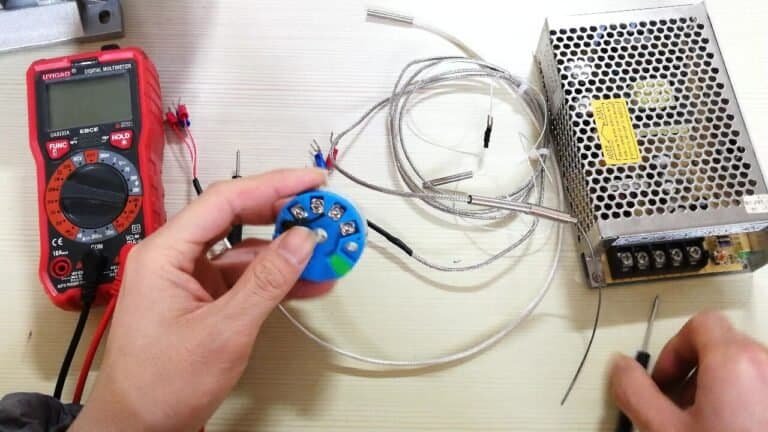
Colors don’t match either standard? Someone probably rewired with generic cable instead of proper KX or compensating cable. Put a multimeter across the junction at a known temperature — each type produces a different millivolt output, which nails the identification. More detail in our temperature sensor selection guide.
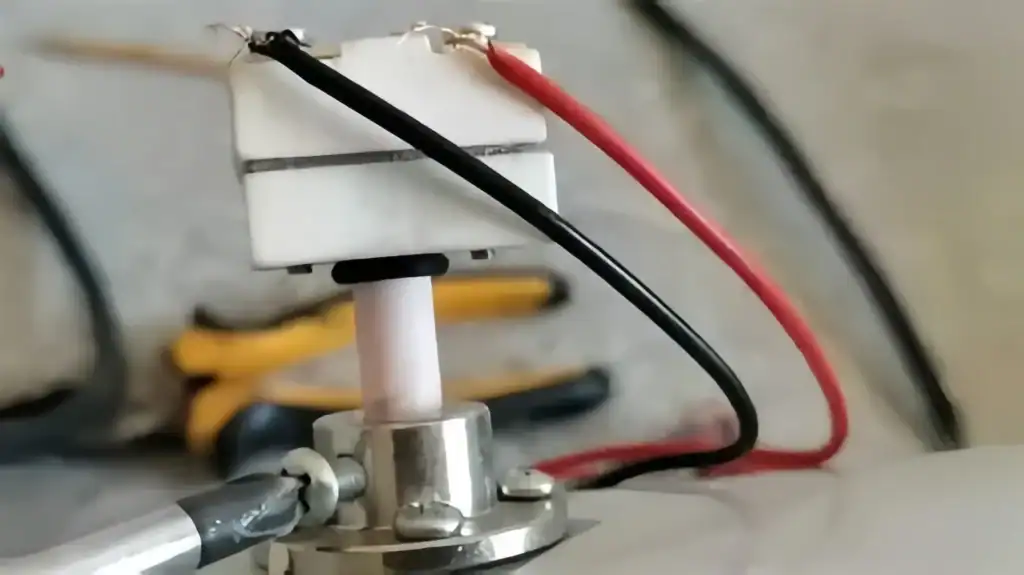
Thermocouples cover the high-temperature end of the range, but they are not always the right pick. For a breakdown of when an RTD makes more sense than a thermocouple — below 500°C, where accuracy and long-term stability matter — see our dedicated comparison.
Frequently Asked Questions
Need Thermocouple Assemblies for Your Process?
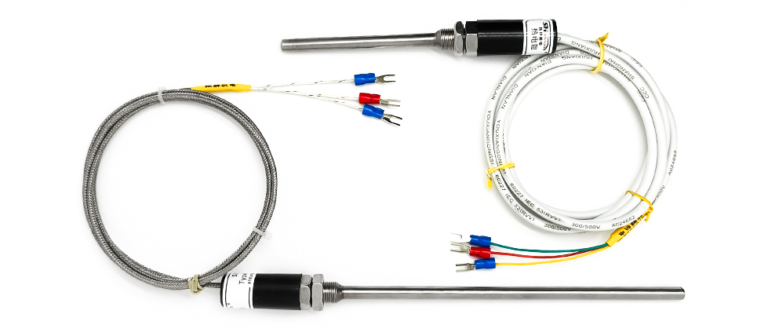
HMK-TECH supplies industrial thermocouple assemblies with Type K, J, T, E, N, S, R, and B elements — including sheathed thermocouples for corrosive or high-pressure environments and explosion-proof assemblies for hazardous area classification (Ex d, Ex ia).
Not sure which type, sheath material, or connection head fits your process? Send us the application details — we spec it and quote it.
About the Author — Ye Dong (叶东), Temperature Product Engineer
With over 40 years of industrial instrumentation experience, Ye Dong holds the rank of Professor-Level Senior Engineer (教授级高级工程师). Before leading HMK-TECH’s temperature product line, he served as Deputy Chief Engineer at both the Beijing Design Institute of China Petrochemical Group (Sinopec) and Sinopec Engineering Construction Co., Ltd., where he designed instrumentation and automation systems for major refinery and chemical plant projects. His expertise spans thermocouples, RTDs, and transmitter technologies. Fushun Petroleum Institute, Department of Automation, 1982. View Ye Dong’s full profile → Send your application brief for a sensor recommendation.
Related reading: For the broader temperature-gauge primer covering definition, sensing types, and selection criteria, see Temperature Gauge: Definition, 5 Types, and Selection Guide.