Cryogenic Pressure Measurement: How to Spec a Transmitter That Survives the Cold
Cryogenic service turns the usual pressure problem on its head, because the temperature, not the pressure, is what decides whether your instrument survives. Liquefied natural gas sits near −162 °C, liquid nitrogen at −196 °C, liquid hydrogen at −253 °C, and liquid helium at −269 °C, all far below the cold limit of an ordinary process transmitter. The pressures themselves are often modest, a few bar of ullage over the liquid, yet a sensor built for ambient service will read that pressure for a while and then drift, stiffen, and lie. This guide walks the temperature-first logic so you can settle a cryogenic pressure point on your data sheet with confidence.
Why a standard transmitter cannot sit on a cryogenic line
Start with a number that governs everything else. A standard industrial pressure transmitter carries a media-temperature rating of roughly −40 to +85 °C, and even a rugged high-range cell reaches only about −65 °C at the wetted end. Every cryogen you are likely to meet is a hundred degrees or more below that floor. Bolt an ambient cell straight onto a cold tap and you are running the sensing element far outside the range where its accuracy class means anything.
The gap is not marginal. Every cryogen you might meet sits far below that −65 °C floor:
| Cryogen | Boils at (approx.) |
|---|---|
| LNG (methane) | −162 °C |
| Liquid oxygen | −183 °C |
| Liquid nitrogen | −196 °C |
| Liquid hydrogen | −253 °C |
| Liquid helium | −269 °C |
Two failures follow. First, the metals and the fill fluid contract as they chill, and the contraction is not uniform across the cell, so the zero shifts and the span narrows before any permanent damage appears. Second, the silicone oil that couples most sensors to the process thickens as it cools and eventually gels, which slows the response and, near its pour point, stops the reading tracking the process at all. In the field on LNG and liquid-nitrogen tanks, a transmitter bolted to a cold tap reads correctly at commissioning. Then it walks off zero over the following hours, as the impulse leg chills down and the fill stiffens.
The lesson is not that cryogenic pressure is unmeasurable. It is that you cannot let the sensing element reach cryogenic temperature and expect a calibrated reading. That single constraint splits into the two design routes below.
Two ways to measure cryogenic pressure: sensor or standoff
There are two honest paths, and most search results show you products from only one of them without naming the choice. Pick the route before you pick a part number.
| Route | How it copes with the cold | Best fit | Watch-out |
|---|---|---|---|
| Specialty cold-rated transducer | One-piece stainless cell and special diaphragm qualified to −196 °C or below | Test benches, aerospace, tight-space tank taps | Higher unit cost; range fixed per model |
| Standard transmitter plus thermal standoff | A siphon, adapter, or impulse leg lets the process warm toward the sensor’s range | Plant tanks, LNG terminals, retrofit points | Needs correct standoff length and orientation |
| Remote diaphragm seal on a capillary | Seal takes the cold; a non-freezing fill carries pressure to a warm transmitter | Vacuum-jacketed lines, hard-to-reach taps | Fill fluid must suit the low temperature |
The specialty route buys simplicity: one cold-rated part, immersed directly, rated as low as −260 °C by makers who build for liquid helium and liquid hydrogen. The standoff route buys flexibility and a lower cost. Here you keep an ordinary transmitter and put distance between it and the cold. A pressure siphon or adapter does one job: it raises the process temperature at the diaphragm into the transmitter’s operating band. The idea goes back decades, and NASA documented a cryogenic pressure transducer built around a warm-standoff diaphragm. It is the same principle as the pressure snubber and siphon you already use on steam, turned to the cold end. A dead-leg of tube mounted so the trapped gas column faces the transmitter does the same work on a tank ullage reading.
Fill fluid and remote seals in the cryogenic range
The remote diaphragm seal deserves its own note, because it is where cryogenic jobs are won and lost. A seal isolates a warm transmitter from the cold process and pipes the pressure to it through a capillary filled with an incompressible fluid. That works only while the fill fluid stays liquid. Standard silicone fills gel well before −100 °C, so a seal filled for ambient service freezes solid on a cryogenic line and the reading dies.
Two things fix it. Specify a low-temperature fill fluid rated below your coldest process point, or keep the seal itself out of the deepest cold and let a gas-filled or self-purging leg bridge the gap. Either way you accept the trade every seal brings: a fill fluid adds a temperature error and slows the response, and the colder the service the more that error matters. The full reasoning on membrane material, capillary length, and the error a fill introduces is in the diaphragm seal selection guide; on cryogenic service you simply weight the fill-fluid freeze point above everything else.
Wetted-material selection from LNG to liquid helium
Cold does not only threaten the electronics. It changes the metal that touches the process. Many steels that are tough at room temperature turn brittle as they chill, and a diaphragm that cracks at −196 °C fails without warning.
| Material | At cryogenic temperature | Cold wetted part? |
|---|---|---|
| 316L austenitic stainless | Face-centred-cubic lattice stays ductile to −269 °C | Yes — preferred |
| Ferritic / martensitic steel | Loses impact toughness; can crack | No |
| 17-4PH precipitation-hardened | Embrittles as it cools | No — a high-strength, moderate-temperature grade |
The rule is crystal structure. Austenitic stainless such as 316L keeps its face-centred-cubic lattice down to liquid-helium temperature and stays ductile. That is why cryogenic vessels, and the ISO and ASME codes that govern them, lean on austenitic grades, and why the NIST cryogenic materials database tracks their low-temperature toughness. Ferritic and martensitic steels, and precipitation-hardened grades like 17-4PH, lose impact toughness as they cool and should stay off a cryogenic wetted part. Material selection pulls in opposite directions at the two temperature extremes, which is why the high-temperature transducer guide reaches a different answer.
Liquid hydrogen carries a second hazard on top of the cold. At −253 °C it is both a cryogen and hydrogen, so the diaphragm has to resist embrittlement and low-temperature permeation at once. The material logic there is its own subject, covered in the hydrogen pressure transducer guide; for every other cryogen, ductility at temperature is the governing test.
Reading pressure in a two-phase cryogenic tank
A cryogenic tank almost always holds liquid under its own boiling vapour, so the pressure you read is not a single clean number. It is the saturation pressure of the cryogen at its temperature, plus the head of the liquid column if your tap sits below the surface. Move the temperature a few degrees and the vapour pressure moves with it along the substance’s saturation curve.
That has two practical consequences. A pressure reading alone cannot tell you level. To get level you separate the vapour pressure from the hydrostatic head, the same differential trick used in DP level measurement, run here across a very cold leg. And a pressure that rises with no inflow is usually heat leak boiling the liquid, not a blocked vent, so read the trend against the saturation data for the cryogen before you chase a fault. Cryogenic pressure sits above the atmosphere, unlike a vacuum measurement below it, so the two problems do not share a sensor even though both live at the edges of the range.
Range and proof pressure by cryogen
With the temperature route settled, size the range to the application rather than to the coldest headline number.
| Application | Typical pressure band | Notes |
|---|---|---|
| LNG storage and receiving tanks | 1 to 10 bar ullage | Low pressure over deep cold; standoff or seal |
| Liquid-nitrogen and liquid-oxygen dewars | A few bar | Self-pressurising; watch the saturation trend |
| Liquid-hydrogen fuelling and pumps | 350 to 700 bar | High pressure and cold together; HM28 class |
| Liquid-helium and research cryostats | Sub-bar to a few bar | Extreme cold, small spans, tight accuracy |
Two rules keep you safe once the band is set. Size the proof rating to at least twice the working pressure, because cryogenic pumps and fast valves throw pulses that a marginal cell will not survive. Then set the calibrated span around the normal operating point, not at the top of the sensor, so the accuracy class holds where you actually work. A high-pressure liquid-hydrogen fuelling reading and a low-pressure LNG ullage reading are different instruments, not one part stretched across both.
Cryogenic pressure transmitters from HMK TECH
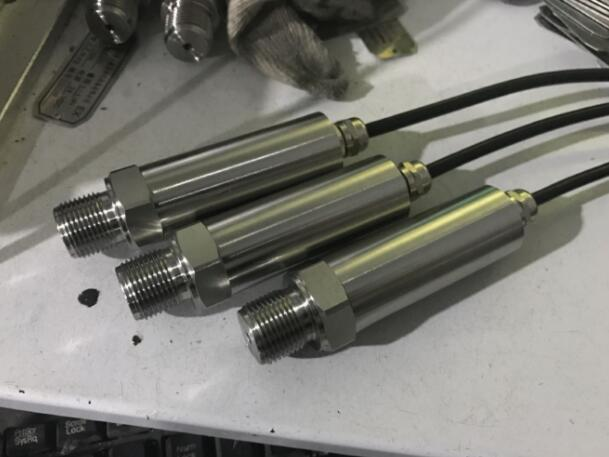
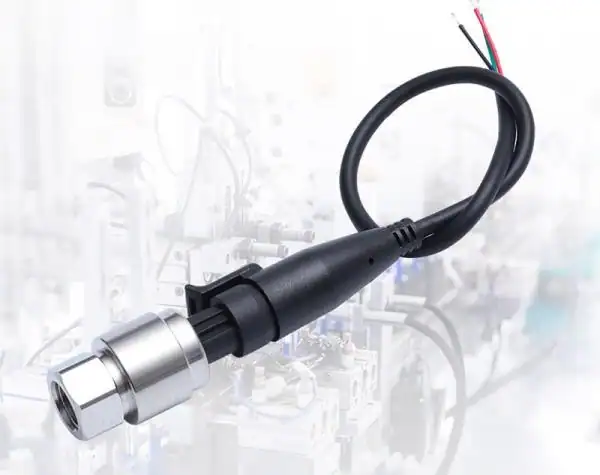
HMK covers cryogenic pressure on both routes. For the standoff route, a standard HMK transmitter rated to about −65 °C sits behind a pressure siphon, an impulse leg, or a remote diaphragm seal with a low-temperature fill, and reads the tank while the sensing element stays in its rated band. For the direct route, HMK custom-builds cold-rated cryogenic sensors down to about −252 °C, which reaches liquid natural gas, liquid nitrogen and liquid hydrogen.
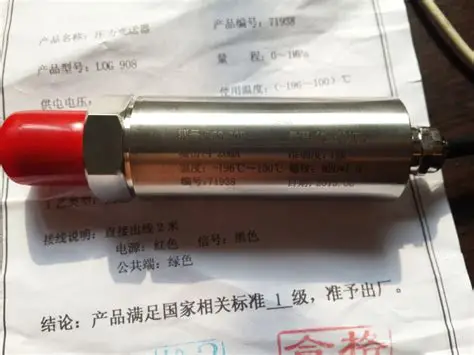
A delivered job shows the form that takes. For a liquid-hydrogen application, HMK built a sensor to this specification:
- Pressure range: 0 to 150 barg
- Media temperature: −210 to +125 °C
- Accuracy: ±0.25 percent
- Output: three-wire, 0 to 5 V
- Process connection: 1/4 NPT male
- Protection: IP67
- Cable: three metres
- Supplied with: calibration certificate
Where high pressure and deep cold meet at a fuelling pump, the HM28 sapphire transmitter reaches 260 MPa at 0.1 percent full-scale, and where the cryogen is flammable, as LNG and hydrogen are, the intrinsically-safe and explosion-proof options carry the IEC-based hazardous-area rating the zone needs.
Two honest boundaries stay. Liquid helium at −269 °C sits below the −252 °C custom floor and is a specialist-only job. And the exact fill fluid, wetted material, and qualified build should be fixed with our engineers against your cryogen and pressure rather than read off a catalogue line. Tell us the cryogen, the pressure band, and how close the tap sits to the cold, and we can match the build. Start from the pressure transmitter range or send the duty to our engineers.
Specifying pressure for a cryogenic line?
Send us the cryogen, the pressure band, and how close the tap sits to the cold, and our engineers will match the route, fill fluid, and material — standard transmitter with a standoff, or a custom cold-rated build to −252 °C.
Request a QuoteBrowse Pressure TransmittersFrequently Asked Questions
Can a standard pressure transducer measure cryogenic pressure?
Not directly. A standard transmitter is rated to about −40 to −65 °C at the wetted end, and every common cryogen is far colder, so the fill fluid gels and the zero drifts. You measure cryogenic pressure either with a specialty cold-rated transducer or, more often, with a standard transmitter kept warm behind a pressure siphon, an impulse leg, or a remote seal with a low-temperature fill.
What temperature can a cryogenic pressure transducer handle?
Specialty cryogenic transducers are built and qualified for the cold, commonly to −196 °C for liquid nitrogen and down to around −260 °C for the coldest work. HMK custom-builds cold-rated cryogenic sensors to about −252 °C for liquid-hydrogen service, and has delivered one with a 0 to 150 barg range at ±0.25 percent. A standard transmitter behind a thermal standoff never sees that cold itself; the standoff raises the temperature at the diaphragm into the sensor’s rated band.
How do you measure pressure in an LNG or liquid-nitrogen tank?
Keep the sensing element out of the deepest cold. Mount a transmitter behind a pressure siphon or a dead-leg impulse line, or use a remote diaphragm seal with a fill fluid rated below your process temperature. Read the ullage pressure against the cryogen’s saturation curve, and if you need level, take a differential measurement rather than a single pressure.
What material should a cryogenic pressure sensor’s wetted parts be?
Austenitic stainless such as 316L, because it stays ductile down to liquid-helium temperature. Avoid ferritic and martensitic steels and precipitation-hardened grades like 17-4PH on the cold wetted part, since they lose impact toughness as they chill and can crack without warning.
Why does the pressure in a sealed cryogenic tank keep rising?
Heat leaking into the tank boils a little of the liquid, which raises the vapour pressure along the cryogen’s saturation curve. A slow pressure rise with no inflow is usually normal self-pressurising, not a blocked vent, so read the trend against the saturation curve before treating it as a fault.