Absolute Pressure Formula: Equation, Worked Examples & Sensor Selection
The absolute pressure formula is P_abs = P_gauge + P_atm. Three letters of arithmetic, and yet it’s the single equation that decides whether you spec an absolute transmitter or a gauge one, whether your saturated-steam table actually matches your field reading, and whether a process at 3,500 m elevation gives you the answer you expect. This article walks through the formula, three industrial worked examples (one spec-sheet conversion, one hydrostatic column, one altitude correction), the unit traps that bite in spec reviews, and how the calculation maps onto real HMK sensor reference types. The companion article on /gauge-pressure-formula/ handles the inverse case.
Three Pressure Formulas Engineers Actually Use
A working spec engineer carries three pressure formulas in their head, not one. They are not interchangeable, and Google’s own “People also ask” entry for absolute pressure surfaces this exact question. Here are the three, with the absolute pressure formula being the focus of this article:
General pressure       P = F / A                  (force per unit area)
Hydrostatic column     P = ρ · g · h              (depth into a fluid)
Absolute reference     P_abs = P_gauge + P_atm    (zero at perfect vacuum)
For a static fluid open to atmosphere, the third formula combines with the second into a useful one-liner: P_abs = P_atm + ρ·g·h. That’s the formula a submerged absolute sensor at the bottom of an open tank actually computes.
| Quantity | Reference zero | Notation | Where it matters |
|---|---|---|---|
| Absolute pressure | Perfect vacuum (0 Pa abs) | P_abs / psia / bara / kPa abs | Vacuum systems, thermodynamic tables, altitude-independent metering |
| Gauge pressure | Local atmosphere | P_gauge / psig / barg | Most industrial process control loops |
| Atmospheric pressure | (the reference itself) | P_atm | The correction term in the formula; varies with weather and altitude |
In SI units, P_atm at standard sea-level conditions is 101.325 kPa. In imperial, it is 14.696 psia. Process control rarely uses Pa directly; the working units are kPa, MPa, bar, mbar, and psi. We tabulate every cross-conversion in H2-6.
Worked Example A: Spec-Sheet Conversion (P_gauge → P_abs)
The first worked example is the conversion an instrument engineer does several times a day: a process value arrives in gauge units; the receiving model, spec line, or vendor datasheet wants absolute. The arithmetic is one addition, but the choice of P_atm depends on the site. We use sea-level 101.325 kPa here; H2-4 covers the altitude-correction case.
| Process input | P_gauge | + P_atm (sea level) | P_abs |
|---|---|---|---|
| Car-tire example | 34 psig | 14.696 psia | 48.696 psia |
| Refinery boiler steam header | 1.5 MPa(g) | 0.101325 MPa | 1.601 MPa abs |
| HVAC supply duct, low-pressure | 0.5 inWC(g) | 407.19 inWC | 407.69 inWC abs |
Two practical notes. First, the tire case is the textbook number every reader has seen, included only to anchor the arithmetic. The boiler and HVAC cases are where engineers actually file calculations. Second, the suffix on each unit matters: psig is gauge, psia is absolute, and the bare psi is ambiguous on a spec sheet. See /psia-vs-psig-vs-psi/ for the suffix-decode cheat sheet. Boiler engineers who plug a 1.5 MPa value into a saturated-steam table without checking gauge-versus-absolute will land at the wrong saturation temperature by roughly 1.5°C, small, but enough to skew a heat-balance closure.
Worked Example B: Hydrostatic Depth (ρgh + P_atm)
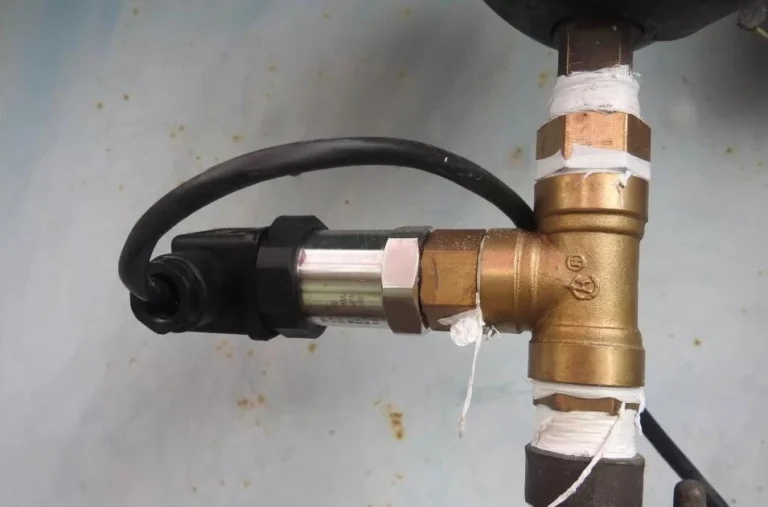
The second worked example is the hydrostatic-column case: what an absolute pressure sensor sees at the bottom of an open tank or a body of water. The combined formula is P_abs = P_atm + ρ·g·h. We use ρ for the fluid density at process temperature, g = 9.80665 m/s² standard gravity, and h for the vertical depth from the free surface.
Primary example: freshwater pool, 30 m deep. Density of freshwater at 20°C is 998 kg/m³; sea-level P_atm = 101.325 kPa.
ρ·g·h = 998 × 9.80665 × 30 = 293.6 kPa
P_abs = 101.325 + 293.6 = 394.9 kPa abs (≈ 57.3 psia)
Secondary cases. A diver at 12 m depth in seawater (ρ ≈ 1025 kg/m³, salinity-adjusted) sees P_abs ≈ 101.3 + 120.6 = 221.9 kPa abs. A methanol storage tank with a sensor 8 m below the free surface (ρ ≈ 792 kg/m³ at 15°C) reads P_abs ≈ 101.3 + 62.1 = 163.4 kPa abs. Notice that the same physical depth gives a very different reading depending on density; temperature and composition both enter through ρ. A water tank that warms from 4°C to 60°C sees ρ drop from 1000 to 983 kg/m³, a 1.7% shift in the ρ·g·h term that a precision custody-transfer level loop must compensate for.
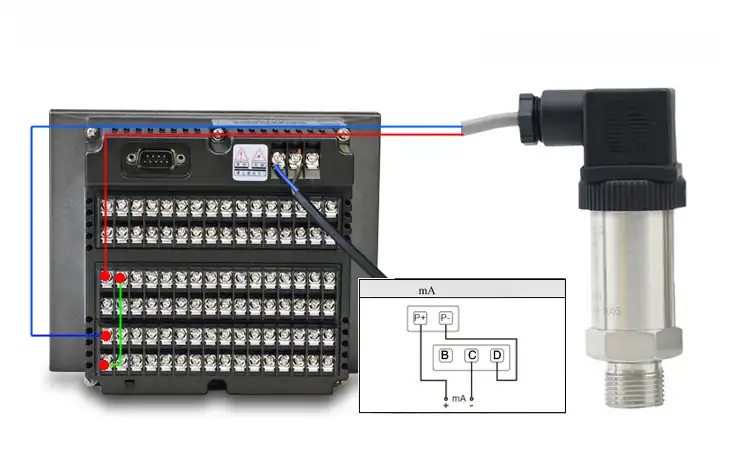
The submerged sensor itself reads the full P_abs, not ρ·g·h alone. The atmospheric pressure presses on the free surface, and that pressure propagates down the column. This is the practical reason absolute pressure transmitters such as the HMK HM27 use a sealed vacuum reference cavity: they measure the medium against a true zero, then your control system subtracts P_atm if you need a gauge equivalent.
Absolute readings are often quoted in millimetres of mercury rather than psi. The mmHg to psi converter and its reverse apply this formula directly, including the step of adding local atmospheric pressure to a gauge value.
Which P_atm Should You Plug In?
P_atm is not a constant. The ISA Standard Atmosphere 1976 sea-level value is 101.325 kPa = 14.696 psia = 1013.25 mbar, and most spec calculations default to that number. In reality, the local P_atm at a process site drifts with altitude and weather. A 1,000 m gain in elevation drops P_atm by roughly 11.5 kPa. Weather alone moves P_atm ±3 kPa within a typical storm cycle. Both effects matter when you’re working at the low-end of an absolute range, such as a vacuum system below 50 kPa abs.
| Site context | Elevation | P_atm (typical) | Δ vs sea level |
|---|---|---|---|
| Sea-level coastal plant | 0 m | 101.3 kPa | (reference) |
| Mid-altitude refinery | 500 m | ~95.5 kPa | −5.8 kPa |
| High-plain industrial park | 1,500 m | ~84.6 kPa | −16.7 kPa |
| High-altitude site (e.g. Andean copper smelter) | 3,000 m | ~70.1 kPa | −31.2 kPa |
National calibration regimes recognise this directly. China’s JJG 52-2013 calibration regulation tabulates the working P_atm at major calibration laboratories, with Lhasa at roughly 64.9 kPa, Lanzhou at 84.6 kPa, and Beijing at 100.8 kPa: an 18 kPa working spread across one country’s lab network. The equivalent global picture would put La Paz, Bolivia in the same low-P_atm tier. Plugging a sea-level 14.696 psia into an absolute calculation at a 1,500 m site introduces a 2.4 psi bias, quietly, every loop, every shift.
When You Actually Need an Absolute Pressure Sensor
The absolute pressure formula is most useful when it points you toward the right sensor reference type in the first place. Five process scenarios call for an absolute transmitter, not a gauge one:
- Vacuum systems operating below 50 kPa abs: distillation column overheads, freeze-drying chambers, vacuum furnace processes, leak-detection rigs. A gauge transmitter at very low absolute pressures reads near full negative scale and loses resolution.
- Altitude-independent metering: fiscal custody transfer of natural gas, aircraft altimetry, weather station reference barometers. The reading must not shift when atmosphere does.
- Thermodynamic state variables: saturated steam tables, refrigerant Clausius–Clapeyron calculations, boiling-point look-ups. All thermodynamic tables are tabulated in absolute pressure.
- Saturated process gas at elevated altitude: vapour pressure depends on the absolute reference, not the local barometric reading.
- Compound vacuum-positive ranges: for example −0.1 to +0.5 MPa where the negative side must read true vacuum at full scale.
Five corresponding cases where gauge is correct and absolute would be over-engineering: car or truck tires, plant compressed-air headers, hydraulic line monitoring, pneumatic-cylinder ram pressure, generic process gauges on a positive-pressure line.
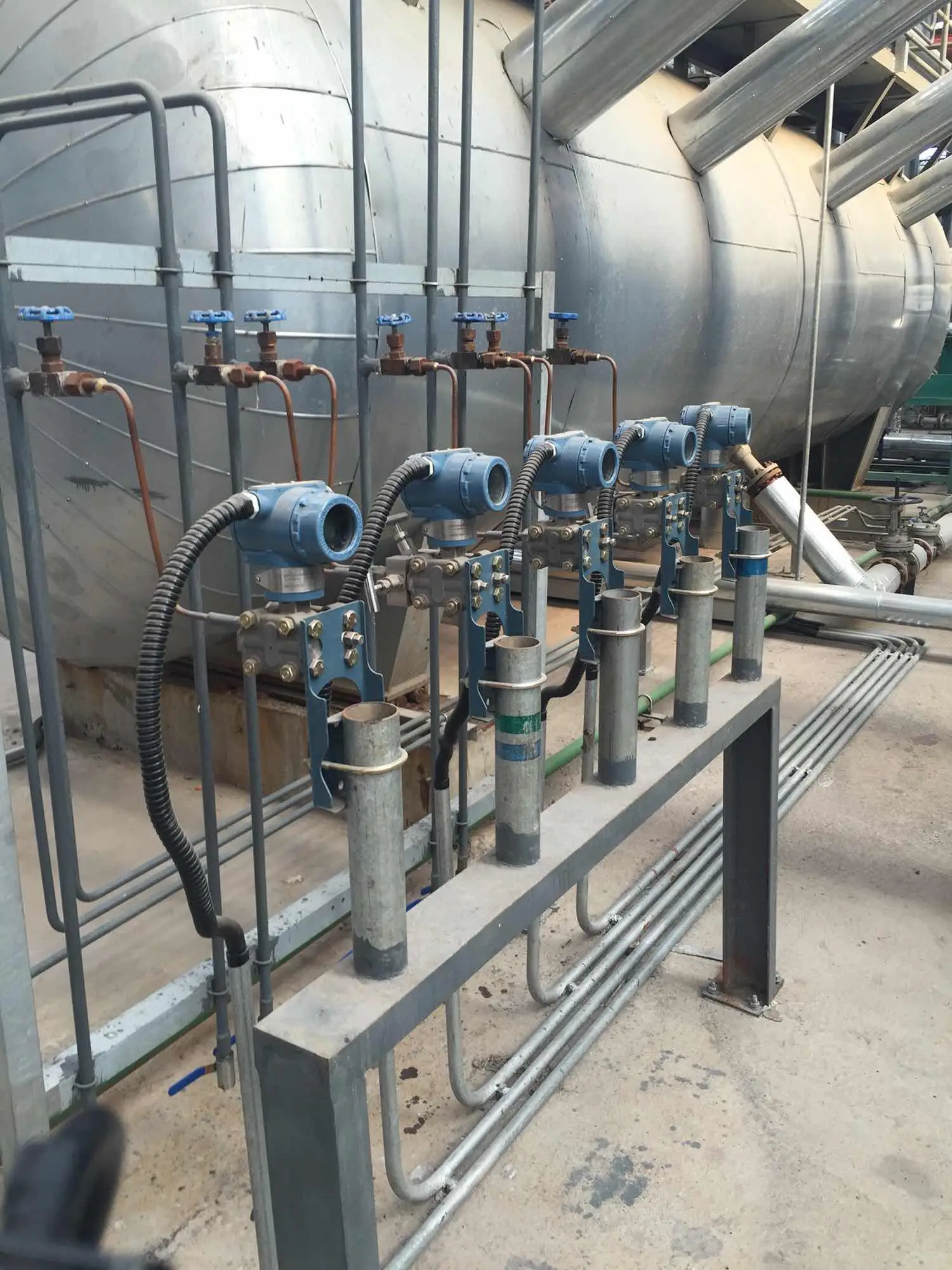
For absolute pressure measurement, HMK manufactures three SKUs that map directly to the formula above:
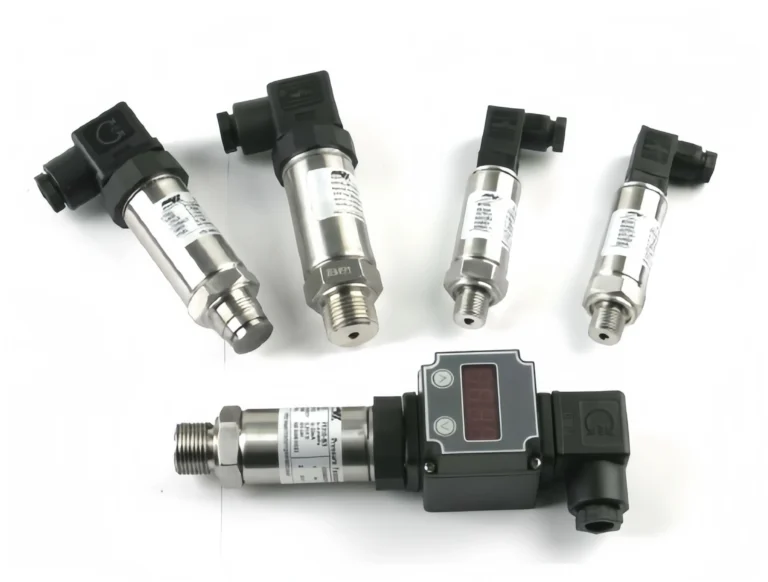
- HM27 Vacuum & Absolute Pressure Transmitter: primary anchor for this article. 0.02 Pa resolution with ±0.1% FS accuracy, ranges from 0.02 Pa to 1 MPa abs, available as HM27A silicon absolute or HM27CA capacitive-membrane absolute.
- HE27 Vacuum & Absolute Pressure Sensor: silicon thin-film variable-capacitance design, compound vacuum and positive range from −100 kPa to 3.5 MPa, ±0.5% FS accuracy, used as an OEM-embeddable variant for system integrators.
- HPTM189 Integrated Temperature & Pressure Transmitter: dual-variable device, ±0.5% FS pressure accuracy (±0.2% FS option), pressure ranges to 40 MPa gauge or 10 MPa absolute, with a front-mounted PT100 or PT1000 element; useful when one tap must serve both a thermodynamic model and a process loop.
Selecting between absolute and gauge is itself a layer above this article: /absolute-pressure-vs-gauge-pressure/ covers the 95/5 decision rule and the sealed-gauge trap.
Unit Conversions Inside the Formula
Every term in P_abs = P_gauge + P_atm must be in the same units before you add. Use this table for the working conversions. The PSI as a pressure unit overview explains what each PSI value actually represents.
| From | To | Multiply by |
|---|---|---|
| 1 Pa | psi | 1.450 × 10⁻⁴ |
| 1 kPa | psi | 0.14504 |
| 1 MPa | psi | 145.04 |
| 1 bar | psi | 14.504 |
| 1 mbar | Pa | 100 |
| 1 atm | kPa | 101.325 |
| 1 atm | psi | 14.696 |
| 1 mmHg (Torr) | Pa | 133.322 |
| 1 inHg | kPa | 3.3864 |
| 1 inH₂O | Pa | 248.84 |
| 1 Torr | mbar | 1.333 |
Three traps to watch. First, the psi/psia/psig suffix is non-optional on a spec sheet; see /psia-vs-psig-vs-psi/. Second, bar(a) and barg are distinct in datasheets even though the spoken word is the same. Third, mmHg and Torr historically encode a vacuum reference (absolute), not a gauge value, and are almost never used for positive-pressure work. For interactive conversion, see /tools/psi-to-bar/.
Common Mistakes Engineers Make Using the Formula
Four recurring mistakes show up in commissioning reviews. Each one is mechanical, not conceptual:
- Plugging P_gauge directly into an absolute spec line. Result: the spec is short by exactly one atmosphere (14.696 psi or 101.325 kPa). Especially common when a steam table value is paste-copied into a transmitter datasheet without unit check.
- Using sea-level 14.696 psia at a high-altitude site. At 1,500 m elevation the real local P_atm is ~12.3 psia. A vacuum reading near full scale shifts by 2.4 psi, quietly biasing every loop on the site.
- Ignoring temperature’s effect on ρ in the hydrostatic case. Water density drops 1.7% from 4°C to 60°C; methanol drops 3% over the same range. A precision level loop using P_abs = P_atm + ρgh must compensate.
- Skipping the traceability chain. An absolute pressure reference is only as good as the standard it was calibrated against. Pressure metrology in the US traces to NIST; in China, to the NIM; in the EU and UK, to PTB and NPL respectively.
Four standards that govern the absolute pressure formula in industrial practice (all opened in a new tab, all rel="nofollow" with strikethrough override per HMK style):
- ASME PTC 19.2 Pressure Measurement: the US authority for instrument selection and calculation in process industries.
- ISO 80000-4 Quantities and units, Mechanics: the international definition of the pressure quantity P and its SI unit Pa.
- NIST SP 1294 Guidelines for Pressure Calibration: the US national-laboratory calibration framework.
- GB/T 1226-2017 General-purpose pressure gauges: the corresponding Chinese national standard with explicit absolute, gauge, and vacuum classifications. See also
/can-gauge-pressure-be-negative/for the vacuum and compound-reference cases.
Quick-Reference Tear-Sheet
For a desk-side cheat sheet, this is the absolute pressure formula reduced to its working forms:
General        P_abs = P_gauge + P_atm
Hydrostatic    P_abs = P_atm + ρ·g·h
Reverse        P_gauge = P_abs − P_atm
Standard atm P_atm = 101.325 kPa = 14.696 psia = 1013.25 mbarFive-second decision tree in text form for accessibility:
- Working at < 50 kPa abs? → Absolute (HM27 / HE27)
- Need the reading independent of weather and altitude? → Absolute
- Feeding a thermodynamic table (saturated steam, refrigerant cycle)? → Absolute
- Standard positive-pressure process control loop? → Gauge
- Compound vacuum-positive span? → Absolute compound or vacuum-rated gauge
For an interactive unit conversion before quoting, /tools/psi-to-bar/ handles the common cross-walks; for sensor selection, the HM27 product page shows the full range and accuracy matrix.
FAQ
How do you find absolute pressure?
Add the local atmospheric pressure to the gauge reading: P_abs = P_gauge + P_atm. For a static fluid column open to atmosphere, use P_abs = P_atm + ρ·g·h. Both forms give the same answer for the same physical point.
Is 1 atm the same as 1 bar?
Not exactly. 1 atm = 1.01325 bar = 14.696 psia. Many spec sheets approximate “1 atm ≈ 1 bar,” which introduces a 1.3% bias. For precision absolute-pressure work, use 101.325 kPa, not 100 kPa.
Is atmospheric pressure 14.7 psia or psig?
14.696 psia (absolute). In gauge units, atmospheric pressure is 0 psig by definition: the gauge reference is atmospheric, so atmosphere itself reads zero. See /psia-vs-psig-vs-psi/ for the full suffix decode.
What are the three formulas of pressure?
The three working formulas are: general pressure P = F/A; hydrostatic pressure P = ρ·g·h; and the absolute reference equation P_abs = P_gauge + P_atm. They are not interchangeable, and choosing the correct one is half the engineering.
Can absolute pressure be negative?
No. Absolute pressure has a hard zero at perfect vacuum (0 Pa abs). A gauge can read negative (that is a vacuum gauge or compound gauge showing pressure below atmosphere), but the absolute value remains positive. See /can-gauge-pressure-be-negative/.
Do I need an absolute pressure transmitter for my application?
Yes if you are working below 50 kPa abs, doing altitude-independent metering, feeding a thermodynamic table, or covering a compound vacuum-positive span. Otherwise a gauge transmitter is correct and cheaper to integrate. The HMK HM27 line covers the absolute and vacuum range; request a quote with your range, process medium, and mounting style for a same-week response.
Sourcing an Absolute Pressure Transmitter?
The HMK HM27 Vacuum & Absolute Pressure Transmitter delivers 0.02 Pa resolution and ±0.1% FS accuracy across ranges from 0.02 Pa to 1 MPa absolute, available as HM27A silicon-absolute or HM27CA capacitive-membrane absolute, with standard ISO calibration certification. Request a quote with your range, process medium, and mounting style, and the engineering team responds within one working day.