How to Select a Sanitary Pressure Transmitter for CIP/SIP Lines
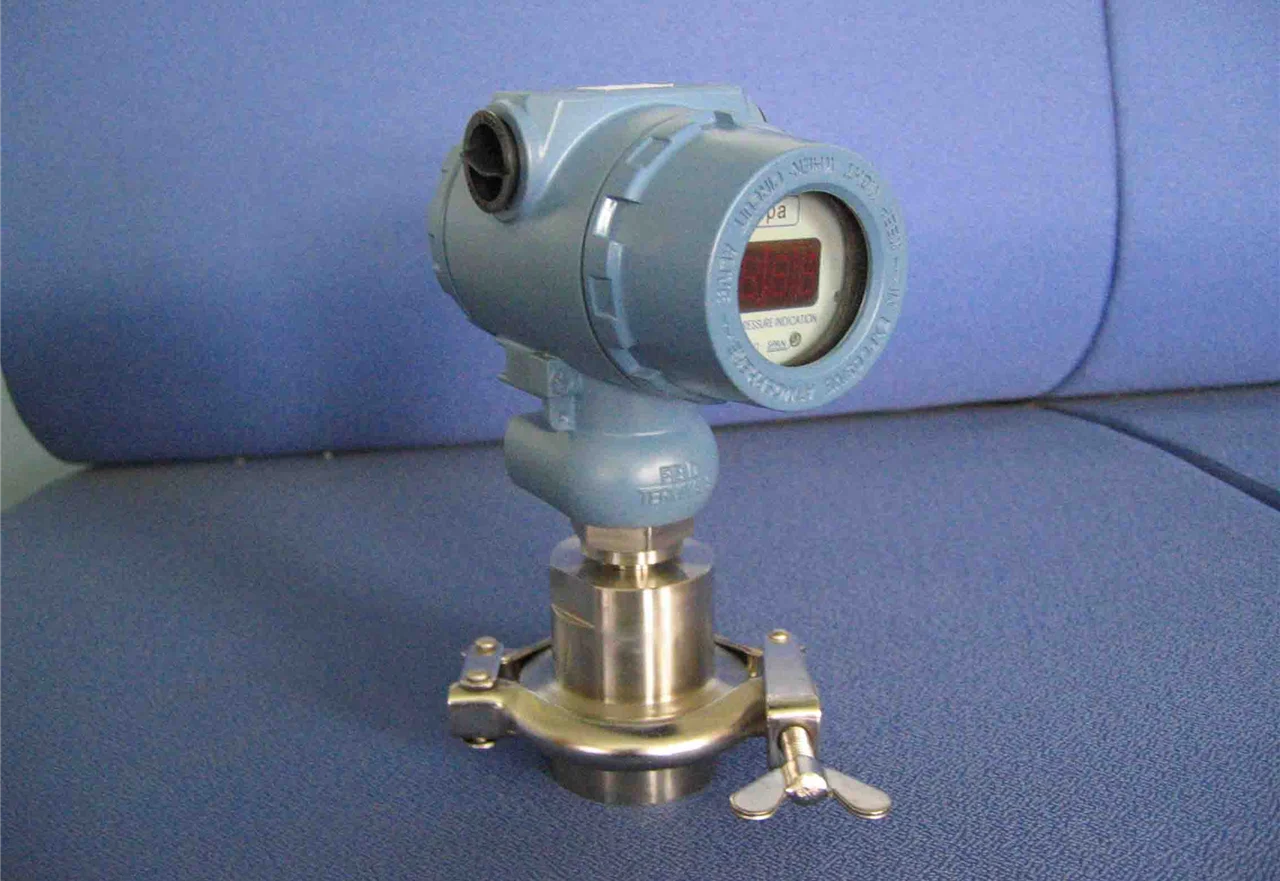
A sanitary pressure transmitter is judged on something an ordinary transmitter never has to worry about: whether it can be kept clean. It still has to measure pressure accurately, but it must also never become the spot in your line where product collects and bacteria grow between batches. That second requirement is where I see most selection mistakes get made. A buyer compares accuracy and range, picks the cheapest unit that meets them, and only later finds out the connection traps product, or that the housing cannot survive a steam cycle.
The flat, flush diaphragm that makes a transmitter cleanable is covered in depth in our flush mount pressure transducer selection guide.
This guide walks through the decisions that actually matter on a clean-in-place (CIP) or sterilize-in-place (SIP) line: the wetted construction, the process connection, the surface finish and which hygienic standard applies, and the temperature limit that quietly disqualifies a lot of otherwise good transmitters. The aim is that by the end you can put a connection type, a finish, and a temperature rating on your bill of materials with reasons behind each one.
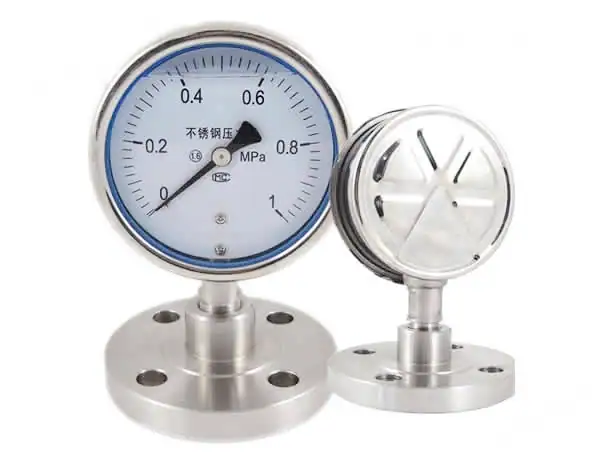
Sanitary service relies on a flush diaphragm seal; our diaphragm seal pressure transmitter guide covers membrane materials, fill fluids, and flush-versus-remote mounting.
What Makes a Pressure Transmitter “Sanitary”
A sanitary pressure transmitter is one whose wetted design has no place for product to collect and whose surfaces can be cleaned in place without disassembly. The defining feature is a flush, or front-flush, diaphragm. The sensing diaphragm sits level with the inner wall of the pipe or vessel, so there is no pressure port, no dead leg, and no internal cavity where milk, juice, or fermentation broth can sit between batches.
Compare that with a standard industrial transmitter. If you ask where the process touches the sensor on a general-purpose unit, the answer is usually “down inside a 1/4-inch or 1/2-inch threaded port.” That port is a dead leg. On a water line it is harmless. On a dairy line it is a crevice that a CIP flow cannot reliably scour, and it is exactly what a swab test will fail. The sanitary version removes the cavity by bringing the diaphragm to the surface, and it replaces the threaded port with a connection that can be cleaned or quickly removed.
The wetted materials change too. Sanitary wetted parts are normally 316L stainless steel, chosen for its low carbon content and corrosion resistance, and any elastomer seal that touches product should be a food-grade material compliant with FDA 21 CFR 177 or equivalent. If a transmitter does not state its wetted materials clearly, treat that as a reason to keep looking.
Sanitary vs Standard Industrial Transmitters
Set the two side by side and the difference is not about accuracy at all. A good sanitary transmitter and a good industrial transmitter can both hold ±0.25% of full scale. The differences are all about what happens to the wetted side between batches.
| Attribute | Standard industrial | Sanitary |
|---|---|---|
| Process interface | Threaded port / internal cavity | Flush (front-flush) diaphragm, no cavity |
| Process connection | NPT, G-thread, flange | Tri-Clamp, DIN 11851, Varivent, aseptic |
| Wetted material | Various stainless, brass | 316L, food-grade elastomers |
| Surface finish | As-machined, often Ra > 1.6 µm | Polished, Ra ≤ 0.8 µm, often electropolished |
| Cleaning | Removed and cleaned manually | Cleaned in place (CIP) and sterilized (SIP) |
If your line is cleaned in place, the right-hand column is not optional. A transmitter from the left-hand column will measure pressure fine and fail your hygiene audit.
Choosing the Process Connection
The process connection is the decision buyers get wrong most often, because it is driven as much by what your plant already standardizes on as by engineering. If you choose a connection your CIP skids and gasket inventory do not match, you create a maintenance headache even if the transmitter itself is good.
There are four families worth knowing. A Tri-Clamp connection, defined dimensionally by ISO 2852:1993 and the related ASME-BPE ferrule sizes, uses a gasket held between two ferrules by a clamp. It tears down in seconds for inspection and is the default across North American dairy, food, and beverage plants. A DIN 11851 connection is a threaded union common in older European dairy installations; it is durable, but the thread sits outside the product path and the slotted nut can trap dirt, so newer lines tend to favor clamp and aseptic styles. A Varivent connection, originally from GEA, is an inline flange-style hygienic fitting popular in European brewing and large process lines. An aseptic connection such as DIN 11864 is what you specify when the process is genuinely sterile and you need a metal-to-metal seal with a defined, crevice-free gasket groove.
I have seen what getting this wrong costs. On a dairy line I reviewed, a threaded DIN 11851 union passed every visual inspection but kept failing the swab test, because product had worked its way into the thread and survived the clean. The fix was to standardize the instrument taps on Tri-Clamp. So how do you choose? If your plant is a North American food or dairy site, default to Tri-Clamp, because your existing gaskets, clamps, and CIP procedures are almost certainly built around it. If you are in a European dairy with an installed base of threaded fittings, DIN 11851 keeps you consistent with the rest of the line. If the process is sterile pharmaceutical or aseptic filling, step up to a DIN 11864 aseptic connection and do not compromise. The transmitter you buy should offer the connection your line already speaks.
Surface Finish and the Three Hygienic Standards
Hygienic design is measured, not claimed, and the number that measures it is surface roughness, written as Ra. A wetted surface that is too rough holds a biofilm that cleaning cannot remove. As a practical floor, a product-contact surface should be polished to Ra ≤ 0.8 µm (about 32 µin). For pharmaceutical and bioprocess service the requirement tightens to Ra ≤ 0.5 µm (about 20 µin), and the surface is usually electropolished so that even the fine peaks a mechanical polish leaves behind are removed.
Three standards come up in sanitary specifications, and they are not interchangeable, so it is worth knowing what each one actually governs. 3-A Sanitary Standards is a US system focused on dairy and food equipment; a 3-A symbol on a device is a certification that its design meets the hygienic criteria in the relevant 3-A number. EHEDG, the European Hygienic Engineering and Design Group, publishes design guidelines and, importantly, test protocols that prove a component can be cleaned in place; an EHEDG certificate means the cleanability was demonstrated, not just designed. ASME-BPE is the US bioprocessing equipment standard, and it is the one that defines the dimensional and surface-finish tables (the SF designations) that pharmaceutical buyers cite.
If your quality team requires a certified device, ask the manufacturer for the specific certificate, not a general statement that a unit is “hygienic.” Plenty of transmitters are built with sanitary construction, a flush 316L diaphragm and a Tri-Clamp connection, without carrying a formal 3-A or EHEDG certification. That construction is correct and cleanable for most food and beverage CIP duty. Whether the lack of a certificate matters is a question only your QA system can answer, and it is better to ask it now than during an audit.
CIP/SIP Temperature: The Rating Buyers Overlook
The spec that trips up the most buyers here is not the process temperature you measure day to day. It is the cleaning temperature. A CIP cycle typically circulates caustic and acid solutions at 80 to 90 °C. An SIP cycle, or a pure-steam sterilization, drives the surface to 121 to 140 °C and sometimes higher.
Now look at the medium-temperature rating of a typical flush sanitary transmitter. Many, including units built on a standard ceramic or 316L flush diaphragm, are rated for a medium temperature in the region of −20 to +85 °C. Read that against an 85 to 90 °C CIP cycle and you are already at the edge. Read it against a 130 °C SIP cycle and you are well past it. The transmitter will not necessarily fail on the first cycle, but the electronics behind the diaphragm are not built to sit at steam temperature, and repeated excursions shorten their life.
There is also a measurement consequence you should plan for. A transmitter with a zero temperature drift of ±0.02% of full scale per °C will shift its zero by roughly ±1.2% of full scale across a 60 °C swing from ambient to a hot CIP. If you watch the reading during a clean, do not trust it; the number is being pulled by temperature, not by a real pressure change.
So how do you handle SIP? If the high temperature is only a brief excursion during cleaning and the process itself runs cool, a transmitter rated to about +85 °C with good thermal recovery is often acceptable, provided you do not rely on its reading mid-cycle. If the process or the sterilization holds high temperature continuously, you have moved out of the standard sanitary transmitter’s range. At that point you specify a higher-temperature design, a cooling element or standoff, or a remote diaphragm seal that puts distance between the hot process and the electronics. The methods, ranges, and trade-offs for hot service are covered in our high-temperature pressure measurement guide, and the same cooling logic applies on a sanitary line.
Flush Diaphragm and the Low-Range Trade-Off
The flush diaphragm that makes a transmitter cleanable also carries a cost, and that cost shows up at low ranges. A flush metal diaphragm welded to the process flange is stiffer and more constrained than the small isolated diaphragm inside an industrial port, so it produces less deflection for the same pressure. On a 0 to 1 MPa range this is invisible. On a very low range, say a few kPa for tank-level or low-pressure vessel duty, the flush diaphragm’s stiffness and its sensitivity to temperature become a larger share of the reading.
If your service is genuinely low range, you have two good options. You can choose a larger-diameter flush diaphragm, which deflects more and recovers thermal errors better, or you can move to a remote diaphragm seal that lets you size the seal independently of the transmitter body. Both keep the wetted side sanitary. What you should not do is force a small flush diaphragm onto a low range and then fight the resulting zero drift in the field.
A Selection Matrix for a Sanitary Line
Put the decisions together and they sort themselves by application. Read each row of the table below as a sentence: this application calls for this connection, this temperature handling, and this finish.
| Application | Connection | Temperature handling | Accuracy / finish |
|---|---|---|---|
| CIP tank or vessel pressure | Tri-Clamp | +85 °C rating, no reading mid-CIP | ±0.25% FS, Ra ≤ 0.8 µm |
| Filling / transfer line pressure | Tri-Clamp | +85 °C rating | ±0.25% FS, Ra ≤ 0.8 µm |
| Aseptic / continuous SIP | Aseptic (DIN 11864) | High-temp design or remote seal | ±0.1% FS, Ra ≤ 0.5 µm, electropolished |
| Hygienic tank level (low range) | Tri-Clamp, larger diaphragm or remote seal | +85 °C rating | ±0.25% FS, larger flush diaphragm |
Each row stands on its own. If you run a standard food or dairy CIP line, the first two rows describe the great majority of duty, and a Tri-Clamp flush transmitter rated to +85 °C is the workhorse.
Where the HMK HM70 Fits
So where does our own transmitter land against everything above? TheHM70 sanitary flat-membrane transmitter uses a flush 316L stainless diaphragm with no internal cavity and offers a Tri-Clamp process connection, or an M30×1.5 sanitary thread. It provides a 4-20 mA output with a typical accuracy of ±0.25% of full scale, tightened to ±0.1% as an option. Its medium-temperature rating is −20 to +85 °C, which places it squarely in CIP-duty sanitary pressure and level service.
Two honest limits follow from that. First, the HM70 is built with sanitary construction but does not carry a formal 3-A or EHEDG certificate. If your QA system requires a certified device, treat the HM70 as a construction match and confirm whether a certificate is mandatory for your audit. Second, the +85 °C rating means continuous SIP or hot-process duty is outside its standard window; for that service the right path is a higher-temperature design or a remote diaphragm seal rather than a standard flush unit. For clean food, dairy, and beverage CIP lines measuring pressure or hydrostatic level, it is a straightforward fit.
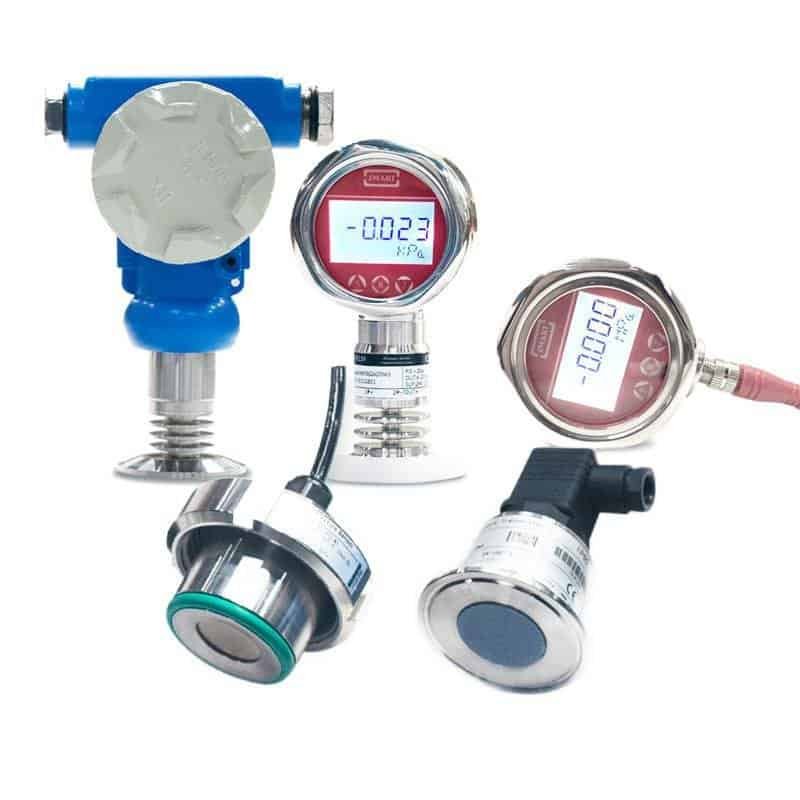
HM70 Sanitary Flat-Membrane Transmitter
Flush 316L diaphragm, Tri-Clamp or M30×1.5 connection, ±0.25% FS (±0.1% option), −20 to +85 °C. Built for CIP-duty sanitary pressure and level.
Frequently Asked Questions
How is a sanitary pressure transmitter different from a standard one?
A sanitary transmitter uses a flush diaphragm with no internal cavity and a cleanable hygienic connection, so a CIP or SIP cycle can reach every wetted surface. A standard transmitter has a threaded port that traps product and fails hygiene swabs, even though its accuracy may be identical.
Should I choose a Tri-Clamp or a DIN 11851 connection?
Match what your plant already uses. Tri-Clamp (ISO 2852:1993) is the default in North American food and dairy plants and tears down fast for inspection. DIN 11851 is common in older European dairy lines. For sterile pharmaceutical duty, step up to an aseptic DIN 11864 connection.
What temperature can a sanitary pressure transmitter handle during CIP/SIP?
Many flush sanitary transmitters are rated for a medium temperature around −20 to +85 °C, which covers an 80 to 90 °C CIP cycle but not a 121 to 140 °C SIP or pure-steam cycle. For continuous high temperature, specify a higher-temperature design, a cooling standoff, or a remote diaphragm seal.
Do I need a 3-A or EHEDG certified transmitter?
Only your quality system can decide. 3-A certifies dairy and food hygienic design in the US, while EHEDG certifies that a component was tested and proven cleanable. Many transmitters are built with correct sanitary construction without holding either certificate, which is acceptable for much food and beverage CIP duty but should be confirmed if your audit requires certification.
Why does the diaphragm have to be flush?
A flush diaphragm sits level with the pipe wall so there is no dead leg or cavity where product can collect between batches. Any recess behind a threaded port is a crevice that cleaning solutions cannot reliably scour, which is the root cause of most hygiene failures on pressure instruments.
Putting It on the Bill of Materials
For a standard food or dairy CIP line, the defensible specification is a flush 316L sanitary transmitter with a Tri-Clamp connection, a surface finish of Ra ≤ 0.8 µm, an accuracy of ±0.25% of full scale, and a medium-temperature rating to +85 °C. Note one caveat beside it: do not trust the reading during the hot part of a clean. Move to an aseptic connection, an electropolished Ra ≤ 0.5 µm finish, and a high-temperature or remote-seal design only when the process is genuinely sterile or runs hot continuously. Decide the connection from what your plant already stocks, decide the temperature handling from your CIP and SIP profile, and confirm certification only against what your audit actually requires. If you want help matching a range and connection to a specific line, send the duty to our team through the request form, and you can see the rest of the family on the pressure transmitter range page.
Specifying a sanitary pressure transmitter for a CIP or SIP line?
Send us the line conditions — connection standard, CIP and SIP temperatures, range, and whether you need a certified device — and we will return a one-page recommendation with the right HM70 configuration or the right alternative.