Bimetallic, Filled & Gas-Actuated Temperature Gauges Explained
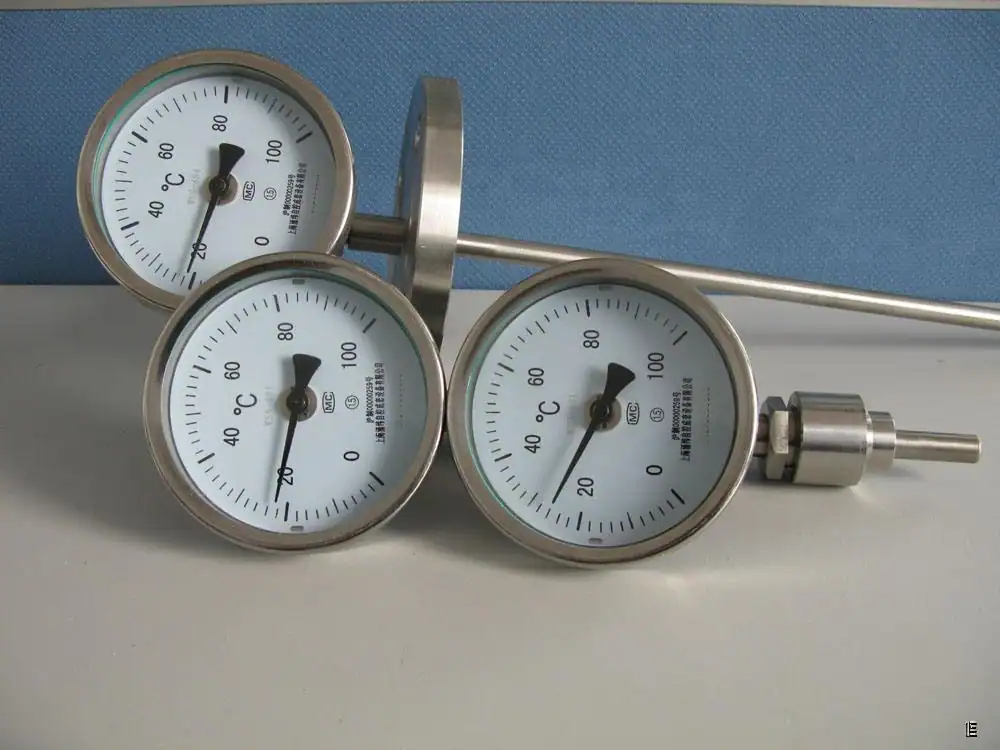
A dial thermometer looks simple from the front: a pointer sweeps a scale and you read a number. Inside that case, three different mechanisms can be doing the work, and each one has a different temperature range, response time, and price tag. Bimetallic strips run the bottom shelf, gas-actuated systems run the top, and liquid-filled sits in the middle. This guide walks through all three, then maps each onto the applications they were built for.
What a Bimetallic Temperature Gauge Is (and How It Differs from Filled-System)
A bimetallic temperature gauge is a dial-indicating thermometer whose sensing element is a coiled strip made from two metals with different thermal expansion coefficients. When the stem warms, the strip uncoils, and the rotation drives a pointer across a calibrated scale. There is no liquid, no gas, no electrical signal — just metal flexing against metal. Filled-system thermometers do the same job using a sealed capillary connecting a bulb to a bourdon tube; gas-actuated systems are filled with inert gas instead of liquid. All three end up at the same dial, but the path the heat takes is what changes their accuracy, range, and field maintenance profile. For a wider tour of how dial thermometers fit alongside thermocouples, RTDs, and digital readouts, see our temperature gauge definition and 5-type guide.
How a Bimetallic Strip Translates Heat into Dial Rotation
The trick is the differential expansion coefficient. Pair brass (about 19 µm/m·K) with invar (about 1.2 µm/m·K) and you have a strip that bends predictably when the temperature changes, because one side stretches roughly fifteen times more than the other for the same temperature rise. Coil that strip into a helix inside the stem and the linear bending becomes rotational, which is what the pointer shaft needs.
Two design parameters set the gauge personality. Strip length sets sensitivity: a longer helix gives you more dial movement per degree of temperature change, which is why longer-stem industrial gauges run finer scales than the compact pocket thermometers used for food service. Strip material pair sets temperature range: most industrial bimetallic gauges stop around 500 °C because the bonding between the two metals starts to creep at higher temperatures, and the rest position no longer returns to zero after the gauge cools.
Filled-System (Liquid-Filled) Mechanism: When a Capillary and Bulb Drive the Pointer
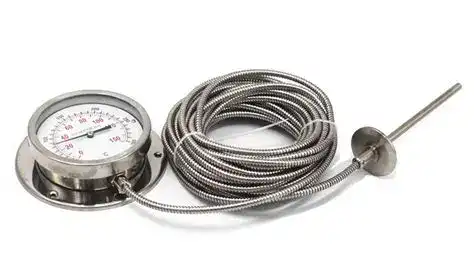
Filled-system dial thermometers use a sealed bulb, a capillary, and a bourdon tube as one continuous pressure container. The bulb sits in the process; as it warms, the liquid inside expands; the expansion travels down the capillary; the bourdon tube uncurls; the linkage moves the pointer. Common fill fluids include mercury (legacy installations only — newer designs use xylene or silicone oils for the same reason refineries are quietly retiring the old mercury bulbs). Liquid-filled systems handle the same -100 °C to +700 °C envelope per EN 13190 that gas-actuated does, but they are slower to respond because the liquid has to physically expand the same volume the bourdon tube needs to deflect.
Gas-Actuated Mechanism: Inert Gas, Pressure Translation, and Faster Response
A gas-actuated dial thermometer swaps the liquid for an inert gas, usually nitrogen. The bulb still goes into the process, the capillary still connects to a bourdon tube, but the working fluid is now a compressible gas obeying the ideal gas law. The pressure rise per degree is steeper and the thermal mass is lower, so the gauge moves faster — typical response times are 30 to 60 seconds for a 90 percent step, against 60 to 120 seconds for a liquid-filled equivalent. The trade-off is that gas-actuated gauges are more sensitive to ambient temperature drift along the capillary, which is why long-capillary installations specify the cross-ambient compensation option as a hard requirement.
Accuracy Classes and Temperature Range: ASME B40.200 / EN 13190 / GB Cross-walk
Three standards govern dial-thermometer accuracy in the great majority of plants we work with. The U.S. side is ASME B40.200-2008 (R2013), which consolidated the older B40.3 (bimetallic), B40.4 (filled-system), and B40.8 (liquid-in-glass) standards into one document. The European side is EN 13190:2001 (Dial thermometers), which defines Class 1 and Class 2 accuracy and applies to nominal dial sizes from NS 40 to NS 160 and to temperature spans from -100 °C to +700 °C. The Chinese verification regulation for bimetallic specifically is JJG 226-2001, distinct from the older liquid-in-glass JJG 130 — a detail that catches buyers who order the wrong calibration certificate from a third-party lab.
| Standard | Accuracy class | Typical span | Notes |
|---|---|---|---|
| ASME B40.200-2008 (R2013) | Class 1, 2A, 2B, 3 | Bimetallic typical -50 to +500 °C | U.S. consolidation of B40.3/4/8 |
| EN 13190:2001 | Class 1 (NS ≥ 63), Class 2 (NS ≥ 40) | -100 to +700 °C | EU dial thermometer scope |
| JJG 226-2001 | ±1.0% / ±1.5% / ±2.5% FS | -80 to +500 °C (typical industrial) | China bimetallic verification |
Calibration cadence under all three is roughly the same: yearly, against a reference standard traceable to a national metrology institute (NIST in the U.S., NIM in China, PTB in Germany, et al.). Field experience: gauges that sit on saturated steam lines drift faster than gauges on ambient process water, so the maintenance schedule should be set by service severity, not the nameplate alone. The parallel accuracy-class ladder on the pressure side is laid out in our pressure gauge accuracy class guide.
Stem Material, Process Connection, and IP Rating: How Specs Map to Application
The dial is the user-facing surface; the stem is where the failures live. For corrosive process media we default to 316 stainless steel stems, with 304 reserved for utility loops where the cost difference matters. Stem diameter typically lands at 6, 8, or 10 mm; longer stems get more bimetallic strip and so more sensitivity, while shorter stems install more easily on a packed instrument rack. Process connections most commonly seen on industrial bimetallic gauges include M20×1.5, M27×2, and NPT 1/4, 1/2, or 3/4. IP rating runs from IP55 for indoor instrument racks up to IP66/67 for outdoor or wash-down installations. The companion exercise on the pressure side, working a dial face line by line, is in our pressure gauge reading guide.
Our WSS Series industrial bimetallic thermometers are what these spec rules look like in practice: dial diameters of 60, 100, and 150 mm; Class 1.0 and Class 1.5 accuracy; -80 °C to +500 °C span; M20×1.5 / M27×2 / NPT 1/4 to 3/4 connections; bottom, back, and universal mount orientations; and an electric-contact WSSX variant that adds relay-based upper/lower limit alarms for use cases where a transmitter would be overkill but a passive dial leaves the operator without warning.
3-Mechanism Selection Table: Bimetallic vs Filled-Liquid vs Gas-Actuated
| Mechanism | Range | Accuracy | Response time | Cost tier | Best fit |
|---|---|---|---|---|---|
| Bimetallic | -80 to +500 °C | Class 1.0 to 1.5 | 30 to 40 s | $ | HVAC, boiler ambient, oil-and-gas wellhead, food service |
| Filled (liquid) | -100 to +700 °C | Class 1 | 60 to 120 s | $$ | Steam header, refinery furnace skin, low-vibration high-temp |
| Gas-actuated | -200 to +700 °C | Class 1 | 30 to 60 s | $$$ | Cryogenic loops, high-vibration installations, long capillary runs |
The pattern most field engineers settle on: bimetallic for the local read-out on a budget; liquid-filled when the process is too hot for bimetallic but does not need fast response; gas-actuated when the process is too cold for bimetallic or when speed matters. HMK builds bimetallic in volume because that band covers the majority of HVAC, food-process, and oil-and-gas dial-gauge demand; for filled-system requirements at the edges of the table, contact our sales team for cross-referenced sourcing.
Where Each Mechanism Wins: HVAC, Food Process, Steam, Oil & Gas
HVAC and boiler rooms lean almost entirely on bimetallic. The range (0 to 200 °C for chilled-water and boiler-feed-water lines), the accuracy demand (Class 1.5 is fine when the loop tolerance is already ±2 °C), and the maintenance preference (no fill fluid to leak) all point the same way.
Food and beverage process is another large bimetallic market, with the caveat that the stem material must be 316L and the connection sanitary tri-clamp. Range typically -40 to +150 °C for chilled lines and pasteurization, with Class 1.0 accuracy specified to satisfy in-house QA audits.
Steam headers are where filled-system starts to win on range. Saturated steam at 100 bar runs 311 °C; superheated headers reach 540 °C. Bimetallic can read up to 500 °C but the drift accelerates above 400 °C in field service; a filled-system or gas-actuated gauge is the better choice if the operator walks past the gauge daily.
Oil and gas wellhead and refinery skin temperatures vary widely. Wellhead Christmas trees normally take a bimetallic; refinery furnace tube skin reads above 600 °C and goes to thermocouple-driven transmitters rather than mechanical dials at all. Between those two ends, filled and gas-actuated dial gauges fill the gap. When that transmitter is drawn on a P&ID, the bubble convention is decoded in our pressure transmitter symbol guide.
Mechanical Gauge or Temperature Transmitter? When Each Wins
A dial thermometer answers one question on the spot: what does this point read right now? It draws no power, never depends on a control loop, and survives most field abuse. A temperature transmitter answers a different question: what is this point reading continuously, and what should the DCS or PLC do about it? On a typical refinery or food plant, field-mounted dial thermometers far outnumber the transmitters on control loops — mechanical reads dominate the population, but transmitters dominate the loop architecture. For the analogous decision tree on the pressure side, see our pressure transmitter types pillar.
Frequently Asked Questions
What is the typical temperature range of a bimetallic thermometer?
Industrial bimetallic dial thermometers cover roughly -80 °C to +500 °C. Below -80 °C the strip stops moving linearly; above 500 °C the bond between the two metals begins to creep and the gauge stops returning to zero after cooling.
How accurate is a bimetallic temperature gauge?
Class 1.0 (±1.0 percent of span) and Class 1.5 (±1.5 percent of span) are the two industrial accuracy classes most commonly delivered. Class 1.0 is the default for QA-audited food and pharma loops; Class 1.5 is the standard for HVAC and general utility.
Bimetallic vs liquid-filled: which is more accurate?
For the same nominal dial size, a high-quality filled-system gauge edges out bimetallic at the top of the range (above 300 °C) because the bimetallic strip starts to drift earlier. Below 300 °C the two are effectively tied, and bimetallic wins on price and maintenance.
Can a bimetallic gauge be used in steam service?
Yes for saturated steam below 300 °C; above that, prefer filled-system or gas-actuated to avoid the drift-creep behavior at the top of the bimetallic range. The stem must be 316 SS and the connection rated for the line pressure regardless of mechanism.
How often should a dial thermometer be calibrated?
Every 12 months as a default, accelerated to 6 months for severe service (saturated steam, vibration, ambient cycling outdoor installations). Calibration certificate should reference ASME B40.200, EN 13190, or JJG 226 depending on the procurement standard your QA is auditing.
See also: a thermowell wake frequency check — the bench-to-publication six-step workflow.
Bimetallic, filled, and gas-actuated dial thermometers each have their natural home: pick by the temperature range, the response-time tolerance, and the maintenance budget, in that order. For the HVAC, boiler, food-process, and oil-and-gas dial-gauge band that bimetallic handles best, see our WSS Series industrial bimetallic thermometers or contact our engineering team for help spec’ing a gauge against your process drawing.