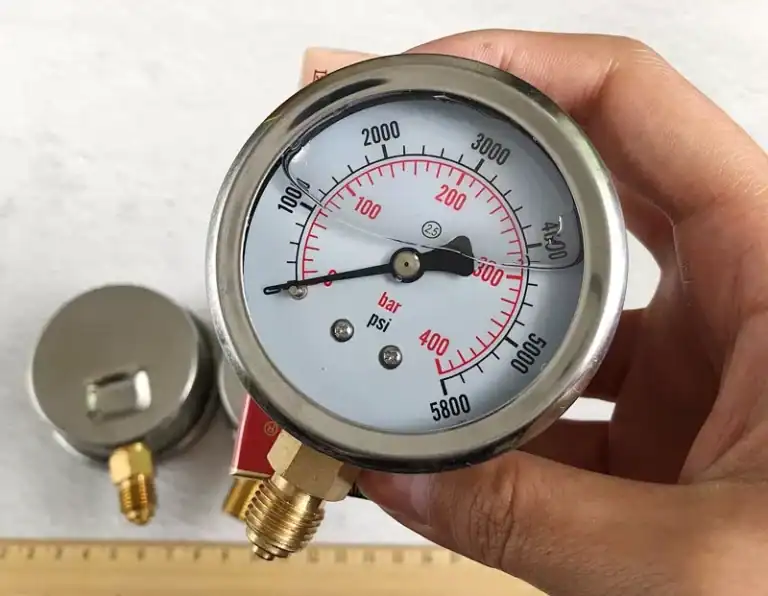
How to Read a Pressure Gauge: A Field Engineer’s Guide

The first time I watched a junior tech write down “0.6 MPa” off a gauge that was actually showing 0.6 bar, I realized something most reading guides skip: the hardest part of reading a pressure gauge isn’t the math. It’s noticing the moments when the dial is quietly lying to you. A misread red scale. A needle that never quite returns to zero. A Class 2.5 dial that the spec sheet says is “fine” but is silently 4 small divisions out near the edges. This guide walks through how I read industrial pressure gauges on plant rounds: the 3-step method, the dial math, the dual-scale and tell-tale traps, the accuracy classes that govern what your reading actually means, and when it’s time to retire the mechanical dial and put in a digital gauge.
If you are stepping up from mechanical dial gauges to electronic transmitters, the new spec to learn is temperature drift. Our guide to pressure sensor temperature compensation walks through TZS, TSS and the +/- %FS/°C number you will see on the datasheet. When that transmitter shows up on a P&ID, the bubble convention is decoded in our PT, PIT, PDT symbol guide. The dial-thermometer side of the same workflow is covered in our bimetallic, filled, and gas-actuated temperature gauge guide.
Knowing where to look on the dial is half the job; the other half is knowing what is doing the moving inside the case. See the 12 parts of a pressure gauge and what they do for the anatomy primer.
The 3-Step Field Method to Read Any Pressure Gauge
Every reading I take on a plant round runs through the same three steps. Skip any of them and the number you write in the log is a guess.
Step 1. Confirm the unit before you confirm the value. Industrial gauges in Asia and Europe are usually labeled MPa or bar; North American gauges default to PSI; HVAC and low-pressure work often shows kPa or inches of water column. Read the unit text on the dial face before you look at the needle. The suffix letter (A, G, or D) matters even more than the unit itself; the PSI suffix decoder walks through what each one means in practice.
Step 2. Work out what one small division is worth. Don’t trust the printed numbers alone; do the math. The next section covers this in detail.
Step 3. Read the needle head-on. Move your eye so the needle and its mirror image (if the dial has a mirror band) line up. Off-axis viewing introduces a parallax error large enough on a 100 mm dial to push a Class 1.6 gauge outside its rated tolerance.
If you only remember one habit from this guide, make it Step 3. It is the single most common cause of “the gauge reads wrong” tickets I close on site.
Decode the Dial: Major, Minor and Minimum Increment
The numbers printed on the dial are only the major divisions. The reading you actually need usually falls between two of them, on a small unmarked tick: the minor division. Two minutes spent computing what one tick is worth saves you from logging numbers that round in the wrong direction.
The math is unchanged across every gauge ever made:
Minor division value = (gap between two adjacent major numbers) ÷ (number of small ticks in that gap)
Two field examples I work with weekly:
Example 1. A 0–60 PSI compressed-air gauge. Between 20 PSI and 40 PSI you count ten small ticks. (40 − 20) ÷ 10 = 2 PSI per small tick. A needle sitting three ticks past 20 reads 26 PSI, not “about 25.”
Example 2. A 0–10 MPa hydraulic gauge. Between 4 MPa and 6 MPa there are ten ticks. (6 − 4) ÷ 10 = 0.2 MPa per small tick. A needle one tick past 6 is 6.2 MPa, not 6, and on a press-cylinder loop, that 0.2 MPa difference is what your overpressure interlock cares about.
Two habits to keep:
- Recompute the minor value on every new gauge you read; different ranges and tick counts change the math.
- Need to convert between PSI / bar / kPa / MPa on the fly? Use our pressure unit converter instead of headline math under a flashlight at 2 a.m.
Accuracy Classes: What Grade B, Class 1.6, and “3-2-3” Actually Mean
The accuracy class printed on the dial face (often a small “1.6” or “Cl. 2.5” near the manufacturer name) tells you the maximum allowable error as a percentage of full scale. (For traceability to a national reference, see the NIST pressure and vacuum metrology program, which underwrites the calibration chain most US labs work back to.) For a 0–10 MPa Class 1.6 gauge, ±1.6% of 10 MPa = ±0.16 MPa at any reading; at 1 MPa, that is a 16% relative error, even though the gauge is “in spec.”
Three standard families govern these labels in the field:
| Standard | Common Designation | Typical Tolerance (% of full scale) |
|---|---|---|
| ASME B40.100-2022 (US, supersedes B40.1) | Grade 4A / 3A / 2A / 1A or A / B / C / D | ±0.1 / ±0.25 / ±0.5 / ±1.0 / ±2.0 / ±3.0 / ±5.0 |
| EN 837-1 (Europe) | Class 0.1 / 0.25 / 0.6 / 1.0 / 1.6 / 2.5 / 4.0 | Class number = ±% of full scale |
| GB/T 1226-2017 (China) | Class 0.4 / 0.6 / 1.0 / 1.6 / 2.5 / 4.0 | Class number = ±% of full scale |
The “3-2-3” rule. Older ASME-grade gauges are sometimes marked “3-2-3%”. This is not a defect; it codifies what every Bourdon-tube gauge actually does mechanically: the middle 50% of the scale arc is the most linear (±2%), while the first and last quarters tolerate ±3%. The practical takeaway: specify your gauge so the normal operating pressure sits between 25% and 75% of full scale. Sizing a 0–25 MPa gauge for a process that runs at 5 MPa is the standard mistake. It pushes the working point into the dial-edge zone where error is largest.
A dial-diameter rule also applies under GB/T 1226-2017 (and is mirrored in EN 837-1): a 40–60 mm dial is only certified to Class 1.6 or worse, because the printed scale resolution physically cannot resolve a tighter reading. If you want Class 1.0 or better, you need at least a 100 mm dial, or a digital readout (covered later in this guide). For more on accuracy budgets across pressure instrumentation, see our pressure transmitter types overview.
Dual-Scale and Two-Needle Gauges: The Two Most Common Misreads
A dial-mounted Bourdon gauge frequently carries two scales: typically MPa or bar in black on the outer ring, and PSI in red on the inner ring. The convention is consistent enough that most engineers stop checking which is which. That habit is exactly where wrong numbers come from.
Field test, Q2 2025. Before a plant operator-training session for 64 maintenance technicians, I ran a single-question pre-test (“What does this gauge read?”) using a 0–10 MPa / 0–1,450 PSI dial-mounted gauge with the needle parked at 4 MPa. Eight of the 64 wrote down 580 PSI. They had read off the red PSI ring while assuming MPa was being asked. That is a 12.5% (1-in-8) misread rate among working technicians on a calm desk, no glove, no flashlight, no pressure spike on the line. That is the calm-desk baseline, not a shift-floor number.
The fix is a one-second discipline: always say the unit out loud before the number when you log a dual-scale reading.
Two-needle gauges add a second trap. The slim, often red, secondary needle is one of two types:
- A set pointer, which the user manually parks at a setpoint to mark a target (no measurement value).
- A drag or tell-tale pointer, which is pushed by the live needle and stays at the highest pressure seen since the last reset (useful for catching transient spikes).
Confusing the two is how an operator concludes “the system pressure is fine” while the tell-tale is quietly flagging a 1.4× spike from last shift. If you work with vacuum or compound dials, the misread risk doubles; see our vacuum gauge guide for the negative-pressure version of the same trap.
Five Reading Errors That Make Your Number Wrong
After the unit and the scale, the number you write down is still vulnerable to five distinct error sources. Each one has a one-second field check.
- Parallax. Eye not square to the dial. Check: if the dial has a mirror band, line up the needle with its mirror; if not, rotate your head until the needle’s tip and root are co-linear vertically.
- Zero offset. With the line isolated and vented, the needle should sit on zero. If it’s high, the Bourdon tube has yielded under overload; if low, the link or sector gear has shifted. Per JJG 52-2013 (the verification regulation widely used in Asia for elastic-element gauges), zero verification is required at 20 ± 5 °C, which is why a gauge that “reads zero fine in the workshop” can sit a division off after 20 minutes outdoors at 0 °C in winter. Cold weather is not gauge failure; it is a temperature offset.
- Hysteresis. The reading you get rising through 5 MPa differs from the reading at the same pressure when descending. Always tap the dial gently before logging; the tap dislodges the linkage friction that creates hysteresis.
- Permanent deformation. A Bourdon tube run repeatedly near full scale slowly loses its spring constant. The needle drifts low at the operating point and high near zero. Once permanent deformation sets in, recalibration only postpones the failure rather than fixing it. (The next section has the field data on how often this happens.)
- Vibration averaging. A pulsating reading is not a single number; it is a band. Use a snubber, a damped (glycerin-filled) gauge, or a valve manifold for DP service, and log the band centerline rather than guessing the peak.
Why Dial-Edge Readings Drift Over Time
If the gauge passed bench calibration last quarter and the operating pressure hasn’t changed, why does this morning’s reading sit half a division off the same point you logged in October? The answer is almost always Bourdon-tube fatigue.
A Bourdon tube is a thin-walled C- or helical spring tube that translates pressure into a fraction of a millimetre of tip motion. Run it near full scale repeatedly (the way a 0–25 MPa gauge sized for a 22 MPa hydraulic press inevitably gets used), and the metal slowly work-hardens. The spring constant slowly drops over thousands of duty cycles. The needle settles low at the working point and reads high near zero, creating the classic dial-edge drift signature.
How often does this happen in service? A 2024 internal survey by a Sinopec refining division across 1,500 installed Bourdon-tube gauges found roughly 23% had drifted beyond Class 2.5 tolerance, and almost all of the affected units had been spec’d with full scale set just 10–15% above operating pressure. The fix on that site was straightforward: gauges replaced with a digital readout and a 4–20 mA output (the working principle is covered in our pressure transmitter working principle guide) saw no drift-related failures reported over the following twelve months.
When to Upgrade from a Mechanical Dial Gauge to a Digital Gauge
If a Bourdon-tube dial gauge has served the same loop reliably for years, why replace it? The case is rarely about catastrophic failure. It is about quiet error you can’t catch by eye.
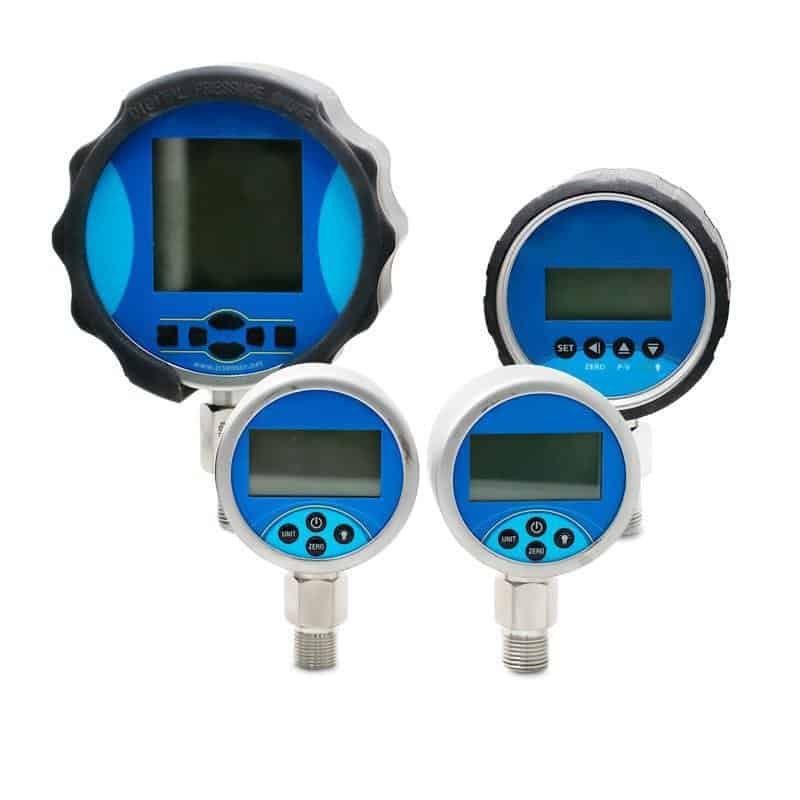
A bench comparison we ran on a Class 1.6 Bourdon dial gauge versus an HM40 digital gauge over a 25 → 55 °C ambient ramp (a normal summer-shift swing in an outdoor enclosure) found the Bourdon reading drifted ±1.6% of full scale purely from temperature; the HM40 held ±0.25% FS. On a 0–1.6 MPa loop, that is the difference between ±25 kPa and ±4 kPa of thermal noise sitting on top of your reading.
A short decision tree:
- Dial diameter < 100 mm and Class > 2.5 in service? Upgrade. The gauge cannot meet a tighter accuracy budget regardless of recalibration.
- Outdoor or unconditioned location with seasonal swings? Upgrade. Thermal drift will dominate any mechanical class.
- Need 4–20 mA, HART, or wireless telemetry to a control room or IoT platform? A mechanical dial cannot supply it.
Three HMK options matched to those triggers:
- HM40 electronic pressure gauge with display: drop-in panel-mount replacement for a mechanical dial; same form factor, digital readout.
- HM200E wireless digital pressure gauge: when you also need remote logging without running cable.
- HM22 high-accuracy pressure transmitter: when the loop justifies a 4–20 mA transmitter and a separate display, not a gauge.
Quick Reference: Reading by Application
The 3-step method holds across every industrial pressure gauge, but each application has its own habitual mistake. The shorthand below covers the seven service classes that drive most search-traffic to “how to read [X] pressure gauge” queries.
| Application | Typical full-scale range | What to watch on the dial | Most common reading mistake |
|---|---|---|---|
| Compressed air / instrument air | 0 – 10 bar | Dual PSI / bar scale, sometimes kPa | Reading the wrong color ring |
| Hydraulic oil / lube oil | 0 – 25 MPa | Pulsation damping, max-pointer | Logging the spike instead of the band centerline |
| Water mains / pump discharge | 0 – 10 bar | Water-hammer transients, snubber needed | Recording a transient peak as steady state |
| Vacuum or compound (negative gauge) | −1 to 0 bar (or −100 to 0 kPa) | Gauge vs absolute reference | Logging −0.6 bar as 0.6 bar (sign error) |
| HVAC / refrigerant | 0 – 30 bar | Refrigerant-specific saturation-temperature scales | Reading an R-22 scale on an R-410A line |
| Boiler / steam | 0 – 25 bar | Siphon (pigtail) required upstream | Direct-mount damage from steam, then “weird” readings |
| Differential / filter ΔP | 0 – 1 bar | Zero check before each round | Forgetting to zero the gauge first |
For the broader product-fit context across all of these services, see our pressure switches and gauges category overview and the dedicated absolute-vs-gauge-pressure explainer for the vacuum/compound row.
Frequently Asked Questions
Should the needle stay in the green zone?
The green zone on consumer-style gauges (boilers, fire extinguishers) marks safe operating range. On industrial gauges there is no green zone; the safe band is whatever your process design specifies. Refer to the loop datasheet, not the dial color.
Why does my gauge read 0 when there is pressure?
Three usual suspects, in order: closed isolation valve, blocked impulse line (a frozen winter line is the classic), or a Bourdon tube that has yielded under overload and lost its return spring. Tap and isolate to diagnose; if the needle stays at zero with the line confirmed live, the gauge is failed.
How do I know if my gauge is in PSI or bar?
Read the unit text on the dial face. It is always printed in small letters next to the manufacturer name or under the major-number ring. If a gauge has two scales, the unit shown for each ring is printed at one of the cardinal positions (12, 3, 6, or 9 o’clock).
Can a pressure gauge read negative?
Yes. A vacuum gauge or compound gauge reads below atmospheric, typically down to −1 bar (−100 kPa). The international classification of the underlying pressure ranges follows IEC 60770-1 for transmitters and the EN 837 family for mechanical gauges. See our absolute vs gauge pressure explainer for the reference-point difference.
How often should I recalibrate a pressure gauge?
Industry convention is every 12 months for general service, every 6 months for safety-critical or custody-transfer loops, and immediately after any over-range event. Check the next calibration tag before reading. The competence of the lab doing the work is governed internationally by ISO/IEC 17025; ask your provider for their accreditation scope before signing the work order.
Before Your Next Plant Round
Three habits, in the order you’ll need them, are what separate a reliable reading from “is that 0.6 MPa or 0.6 bar?” First, call the unit out loud before you read the number; it sounds basic, and it prevents most misreads on dual-scale dials. Second, recompute one minor division if you’ve never read that particular gauge before. Tick spacing changes more than people expect. Third, glance at the accuracy class on the dial face, so the number you log carries a known tolerance with it.
None of this requires new equipment. The upgrade conversation in the previous section only matters once your reading is otherwise clean. If a Class 1.6 dial reads consistently off after you’ve ruled out parallax, zero offset, and hysteresis, that is when the case for a digital gauge becomes a measurement decision rather than a budget one. Until then, the cheapest and most accurate instrument in the loop is a careful pair of eyes, a head-on view, and ten seconds of dial math before the number goes in the log.
Related reading: If your gauge is electric (sender-driven or digital LCD) rather than mechanical, the wiring and accuracy specifics live in our electric oil pressure gauge guide.
Related troubleshooting: if the needle dances mid-shift instead of giving a clean reading, run the decision tree in Oil Pressure Gauge Fluctuating: 5 Causes and Field Fixes before condemning the gauge.
When a gauge dial shows “Cl 1.6” or “Grade A”, that is the accuracy class: maximum permitted error as a percent of full scale. For what the number means and how to pick the right one, see Pressure Gauge Accuracy Class.
See also: the vacuum-side measurement procedure for the bench-to-publication six-step workflow.
Next step: Send your spec sheet for a model recommendation in 24 h. Get in touch →
Related reading: When you move from a mechanical gauge to a transducer, the industry decides which model fits. See pressure transducer applications by industry.