Low Pressure Transducer Guide: HVAC, Cleanroom & OEM
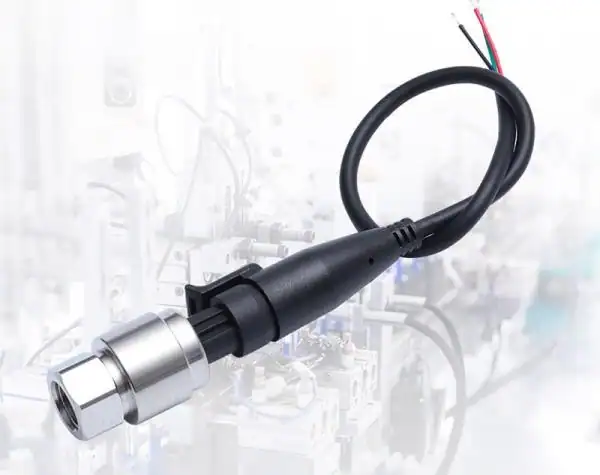
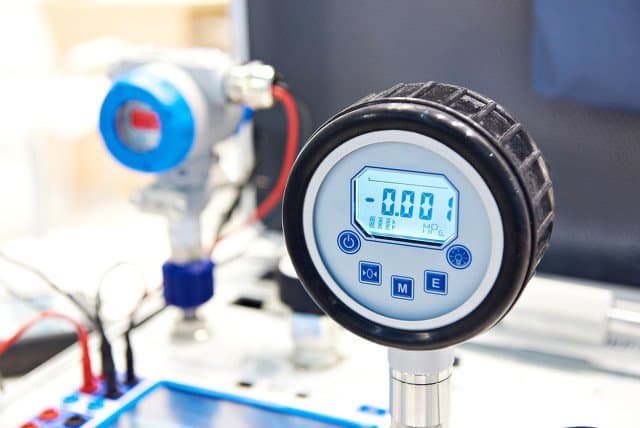
A general-purpose 0–1 MPa transmitter does not behave the same way at 50 Pa as it does at 500 kPa. Below 10 kPa the failure modes are different, the spec sheet lies in different ways, and the technology you pick stops being a preference and becomes a hard constraint.
For the narrower task of holding a cleanroom or isolation room at a few pascals, see our guide to room pressure monitoring.
This guide is for engineers spec’ing a low pressure transducer for industrial process, HVAC, or cleanroom service — not automotive fuel-rail, oil, or TPMS sensors. We cover what counts as “low pressure,” which sensing technology survives ultra-low ranges, the six specs that actually decide accuracy in the field, and a by-application matrix that maps HMK products to specific pressure regimes.
If you skipped to the matrix, jump to the selection matrix. If your sensor reads non-zero with no pressure applied, the field failures section is the one.
What Counts as Low Pressure in Industrial Sensing
There is no ISO clause that draws a hard line, but instrumentation engineers usually treat anything at or below 10 kPa (1.45 psi, ~100 mbar) as a low-pressure regime. Below 1 kPa you are in the “ultra-low” zone, where capacitive sensing dominates and the cost of a wrong choice climbs fast.
The unit you read on the datasheet often hints at the application:
| Unit | Typical use | Equivalent in Pa |
|---|---|---|
| Pa | Cleanroom DP, gas leak test, fume hoods | 1 Pa = 1 Pa |
| mbar | EU process, food & beverage, vacuum-adjacent | 1 mbar = 100 Pa |
| inWC (inches water column) | North American HVAC, filter ΔP, draft | 1 inWC ≈ 249 Pa |
| inHg | Vacuum, condenser monitoring | 1 inHg ≈ 3,386 Pa |
| psi | Pneumatic low side, low-end gauge | 1 psi ≈ 6,895 Pa |
A 0–500 Pa sensor and a 0–2 inWC sensor cover almost the same range, but a North American HVAC contractor will only buy the one labelled “inWC.” A European OEM will only spec the mbar version. Get the units right and a fair share of selection complaints disappear.
One more split matters: gauge vs differential vs sealed gauge. Sealed-gauge units track the trapped reference cell against changing barometric pressure, and at 0–500 Pa that drift can swallow your full scale. Use true gauge or true differential below 10 kPa — never sealed.
Where Low-Pressure Transducers Earn Their Keep
Low-pressure transducers do work that high-pressure sensors can’t see at all. A few representative applications and the ranges they live in:
- HVAC duct static & VAV control — 0–500 Pa or 0–2 inWC. The output drives variable-frequency drives on supply fans; lag in the loop costs energy every minute.
- Filter ΔP monitoring — 0–1 kPa. The transducer alarms when the filter loads up. False alarms (zero drift) cost service truck rolls; missed alarms cost equipment.
- Cleanroom differential pressure (ISO 14644-4) — 0–125 Pa positive between adjacent classes. A 5 Pa drift is 4% of the alarm window; that’s enough to trigger nuisance alarms or, worse, mask a door-leak event.
- Fume hood face velocity — 0–250 Pa, sometimes derived from face-velocity inverse calculation. Lab safety committees audit these.
- Combustion draft & flue gas — 0–500 Pa, often negative. Boiler safety interlocks read these.
- Natural gas leak & lab gas distribution — 0–50 Pa. The detection limit is the diaphragm noise floor, not the regulator.
- Medical ventilators, CPAP, anesthesia — 0–10 kPa. These ride on type-tested sensors; the engineering challenge is repeatability over millions of cycles.
- Fuel-cell stack ΔP — 0–50 kPa, low end of the range. Anode/cathode ΔP control protects the membrane.
Field procedure cross-link: For technicians who need the step-by-step duct manometer procedure — probe placement, acceptable TESP ranges, and device class selection — see our How to Measure Static Pressure in HVAC field guide.
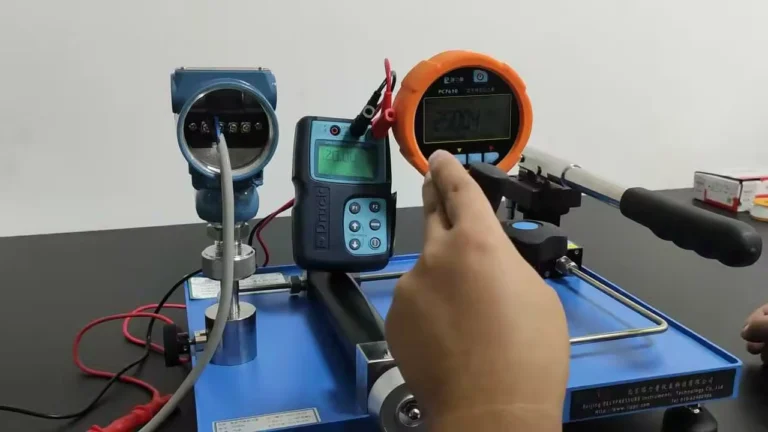
A 2024 retrofit at a Sinopec refinery in China is instructive: 48 HVAC duct static points were swapped from imported 0–1 kPa transmitters to domestic non-oil-filled silicon piezoresistive units. Annual recalibration count fell from twice a year to once a year, and average outage time per calibration dropped from four hours to two — without changing the loop wiring, just the device.
Sensing Technologies at the Low End
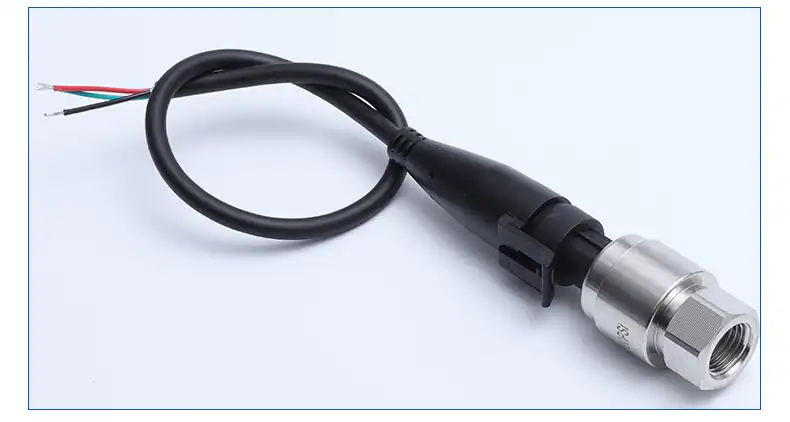
At 0–10 kPa, the sensing technology dictates accuracy and stability more than the transmitter brand does. Three families dominate:
| Technology | Lowest practical range | Long-term zero drift | Temp coefficient (typ.) | Notes |
|---|---|---|---|---|
| Oil-filled piezoresistive | ~5 kPa | ±0.3% FS / yr | 0.02% FS / °C | Oil column produces 5–10 Pa orientation-dependent offset; disqualified below 1 kPa |
| Non-oil-filled silicon piezoresistive | 100 Pa | ±0.2% FS / yr | 0.01% FS / °C | HE30 uses this approach; works because no liquid mass loads the diaphragm |
| Capacitive (MEMS or thin-film) | 25 Pa | ±0.1% FS / yr | <0.005% FS / °C | Best at ultra-low; signal conditioning more complex; cost penalty under volume |
Why oil-filled piezo loses below 1 kPa. The oil fill that protects the sensor at high pressures becomes the dominant error source at low ranges. Tip the transmitter 90° and gravity acts on the diaphragm — for a 250 Pa sensor that’s 5–10 Pa of zero shift, or 2–4% of full scale, before you even apply a process pressure.
Why capacitive wins ultra-low. A capacitive cell measures a tiny gap change between plates. At 50 Pa full scale, the diaphragm only needs to deflect a few hundred nanometers, and capacitive readouts resolve that linearly. Piezoresistive bridges at the same scale work hard against thermal noise on the bridge itself.
Why “non-oil” piezoresistive bridges the gap. The HE30 family uses a high-stability silicon piezoresistive element with no oil fill, accuracy specified at ±1% FS for ranges ≤250 Pa and a minimum resolution near 0.5 Pa. It loses to a top-end capacitive cell on cleanroom critical control, but it costs a fraction of one and ships in HVAC volume.
A common selection mistake: ordering an oil-filled industrial gauge transmitter for a 0–1 kPa filter ΔP application because the catalog says it goes that low. It does, technically. It just doesn’t stay accurate after a service truck remounts it sideways.
The Six Specs That Decide Accuracy Below 10 kPa
Below 10 kPa, the spec sheet hides more than it shows. These six checks separate a transducer that holds calibration from one that drifts you into trouble.
1. Range overshoot rule. Pick a sensor where your normal operating point sits between 25% and 80% of full scale. A 0–10 kPa unit reading 200 Pa runs at 2% of FS — accuracy class doesn’t apply at that signal level. Conversely, a 0–250 Pa unit pegged at 240 Pa is at risk of overpressure damage from any spike.
2. Total Error Band (TEB) beats FS Accuracy. “±1% FS” on the front of the datasheet usually means accuracy at 25 °C, after zero & span trim. The number that matters in service is TEB = accuracy + zero shift + span shift + temperature error + long-term stability, all stacked. A TEB of ±2% FS on a 0–500 Pa unit is ±10 Pa — at a cleanroom alarm threshold of 12 Pa, you have no margin.
3. Output choice at low pressure. A 4–20 mA loop has 16 mA of usable span. On a 0–250 Pa sensor that’s 16 µA per Pa. A 0–10 V output gives the receiver more granularity but only if the receiver ADC has enough bits — a 12-bit input wastes 0–10 V back to 16 mA’s resolution.
4. Reference type. Already covered above, but worth repeating: never sealed gauge below 10 kPa. Use true gauge (vented to atmosphere) or true differential. See our explainer on absolute vs gauge pressure for the trap.
5. Mounting orientation. Flip the diaphragm and watch the zero shift. Vendors who specify “horizontal mount” in fine print are flagging exactly this. Always match the test orientation in the calibration certificate to the field orientation.
6. Calibration cadence. Chinese metrology regulation JJG 882-2019 mandates a 6-month calibration interval for pressure transmitters of ≤10 kPa range, vs. the 12-month default for general process transmitters. The reason is field-measured: zero offset on low-range diaphragms creeps to ±0.3% FS within six months of service. Plan the cadence into the maintenance budget at spec time, not after the first nuisance alarm.
Field Failure Modes Unique to Low-Pressure Service
Most “the sensor is broken” calls below 10 kPa are not broken sensors. They are zero offset, orientation, moisture, or vibration — and they are predictable.
Zero offset that grows with temperature. A 0–250 Pa transmitter typically specifies ±0.5% FS zero shift per 10 °C. In a Jiangsu semiconductor cleanroom logged on a Chinese industrial automation forum in 2024, an imported 0–50 Pa DP transmitter accumulated ±5 Pa zero drift over 30 days at 75% RH — 10% of full scale. The same site swapped to a domestic non-oil-filled silicon piezoresistive transmitter and the drift settled at ±0.8 Pa. The temperature alone wasn’t unusual; the combination of low range + high humidity + oil-filled cell was.
Diaphragm sag with orientation. At ranges below 500 Pa, the diaphragm is thin enough that gravity matters. Mount horizontal vs vertical, and read 3–8 Pa of static offset. Match the mount in service to the mount on the calibration bench.
Moisture in the impulse line. A drop of condensate in a 0–500 Pa DP line can shift zero by 25 Pa. Slope impulse lines at 1:12 minimum, install drip pots, and on humid HVAC retrofits assume condensation will form even if the design says otherwise.
Vibration from supply fans. Chinese national standard GB/T 28474.1-2012 specifies vibration class 1 limits (±0.5% FS additional uncertainty under 10–55 Hz, 1g). Small VFD-driven supply fans hit 25–40 Hz and pass that energy straight through duct walls into the transducer. Use a soft mount or a longer impulse tube to decouple.
A real HMK number. In a 90-day continuous run at a Chinese CDC P2 lab, an HE30 set to 0–250 Pa logged a cumulative zero offset of +1.4 Pa. That is 0.56% FS at 250 Pa range, or 0.14% FS if you size for 1 kPa range. The lesson is in the second number: oversizing the range buys back accuracy.
Selection Matrix by Application
Match the application to the regime first, then to the technology, then to a part:
| Application | Typical range | Required accuracy | Recommended tech | HMK match |
|---|---|---|---|---|
| HVAC duct static / VAV | 0–500 Pa | ±2% FS | Non-oil silicon piezo or capacitive | HE30 |
| Cleanroom DP (ISO 14644) | 0–125 Pa | ±1% FS | Capacitive | HE30 (custom) |
| Filter ΔP monitor | 0–1 kPa | ±2% FS | Silicon piezo | HE30 / HM30 |
| Fume hood face-velocity | 0–250 Pa | ±1.5% FS | Capacitive | HE30 |
| Combustion draft / flue | 0–500 Pa, may be negative | ±2% FS | Silicon piezo | HE30 |
| Pneumatic low side / compressed air | 0–10 bar low end | ±0.5% | Diffused-Si piezo | HE10 / HE24 |
| OEM embedded (ventilator, fuel cell) | 0–20 kPa | ±0.25% TEB | Diffused-Si piezo or ceramic-cap | HE10 / HE26 |
| Micro-DP process / hydro level | 500 Pa – 700 kPa | ±0.5% FS | Silicon piezo DP | HM30 |
If your range sits at the boundary between two rows, size the larger sensor — cheaper drift, harder to overpressure, and a calibrated sweet spot in the 25–80% band.
HMK Low-Pressure Lineup at a Glance
Six HMK products cover the low-pressure regime end to end. Each links to the full spec page:
- HE30 Wind & Differential Pressure Sensor — 100 Pa to 100 kPa, ±1% FS at ≤250 Pa, non-oil-filled silicon piezoresistive, IP65. Default pick for HVAC duct static, cleanroom DP, filter monitoring, fume hood.
- HM30 Micro Differential Pressure Transmitter — 500 Pa to 700 kPa DP, the workhorse for filter ΔP, hydrostatic level on shallow tanks, and process gas DP.
- HE10 Diffused Silicon Pressure Transmitter — 0–20 kPa to 0–600 bar, five output options, IP67. The OEM-channel choice when you need ±0.1% accuracy or HART.
- HE24 Micro-Fused Pressure Sensor — micro-fused stainless cell, compact form factor for embedded low-pressure designs.
- HE26 Ceramic Capacitive Pressure Sensor — ceramic capacitive cell for corrosive low-pressure media (sanitary, chemical).
- HM91 Micro Pressure Sensor — 2.54 mm diameter sensing element, 10 kPa to 60 MPa, for embedded designs at the high end of “low” pressure.
For HVAC and cleanroom retrofits the HE30 is almost always the starting point. For OEM volume the choice runs HE10 → HE24 → HE26 depending on media and form factor. For broader context, see our category page on pressure sensors & transmitters and the dedicated differential pressure transmitter catalog.
FAQ
Below 10 kPa you spec the technology first, the range second, and the brand third. The HMK low-pressure lineup spans 100 Pa to 60 MPa with six product families that have been deployed in Sinopec HVAC retrofits, Chinese CDC cleanrooms, and OEM volume designs. Talk to an HMK engineer if you want a specific spec mapped to your loop.
Need a specific low-pressure transducer matched to your loop? Talk to an HMK pressure engineer — share your range, accuracy, mount and media, and we will reply with a recommended part and a calibration cadence.
Once you’ve selected the right low pressure transducer, the next step is calibration. See our DP transmitter calibration guide — 5-point Up & Down procedure, HART vs analog correction order, and the JJG 882-2019 interval rule for low-range service.
For ranges below 10 kPa, the JJG 882-2019 6-month interval makes the manifold choice load-bearing. See our valve manifold for DP transmitter guide — why low-range DP almost always needs a 5-valve manifold for in-place calibration.