Pressure Transmitter Output Signals: 4-20mA vs 0-10V vs RS485
The output you specify on a pressure transmitter decides four practical things: how far the signal can travel, how well it survives electrical noise, whether a broken wire shows up as an alarm, and what your controller is able to read. Almost every transmitter offers one of three families: a 4-20 mA current loop, a voltage output such as 0-10 V or 1-5 V, or a digital output such as RS485. This guide defines each one, shows where it wins, and maps the choice to an HMK part.
Setting those 4-20 mA endpoints is a different job from verifying them: our pressure transmitter calibration guide walks the five-point procedure and what each point should read in milliamps.
Quick answer: Choose 4-20 mA for long or electrically noisy runs, because the current holds its value over distance and a live zero flags a broken wire. Choose 1-5 V when you want a voltage output but still need fault detection, and 0-10 V / 0.5-4.5 V only for short, clean, or OEM connections. Choose RS485 when several transmitters share one bus or feed a data system.
The Three Output Families
A pressure transmitter converts pressure into an electrical signal in one of three forms. A current output sends 4-20 mA, where 4 mA represents the bottom of the range and 20 mA the top. A voltage output sends 0-10 V, 1-5 V, 0-5 V, or a ratiometric 0.5-4.5 V across the same span. A digital output such as RS485 sends the reading as data on a serial bus rather than as an analog level.
The families are not freely interchangeable, because each behaves differently over distance and noise. The rest of this guide works through that behaviour so you can match the output to the installation rather than to habit.
4-20 mA: The Industrial Default
The 4-20 mA current loop is the default in process plants for one reason: the signal is a current, and a current is the same at every point in a series loop. Cable resistance, terminal resistance, and small voltage variations along the run do not change it, so the reading at the controller equals the reading at the transmitter whether the cable is 5 metres or 500. A voltage output cannot make that claim, because wire resistance drops part of the voltage before it reaches the receiver. In the field on long instrument-cable runs we have watched a 0-10 V reading sit several percent low from wire resistance alone, while a 4-20 mA loop on the same cable tray held its value.
Two more properties make it the safe choice. The signal has a live zero: 4 mA is the bottom of the range, so 0 mA is not a valid reading and tells you the loop is broken. A snapped wire or a failed transmitter shows up immediately instead of hiding as a plausible zero. And a 4-20 mA transmitter can be loop-powered, drawing its operating current from the same two wires that carry the signal, which keeps the wiring to a simple pair.
If your run is longer than roughly fifteen metres, or it passes near variable-frequency drives, motors, or contactors, specify 4-20 mA. It is also the right output when the range is large and you want the resolution spread cleanly across the loop. For the terminations themselves, our 4-20 mA wiring guide covers two-, three-, and four-wire connections.
Voltage Outputs, And The 0-10 V Blind Spot
A voltage output makes sense on short, quiet runs. It feeds many controller and data-acquisition cards directly without a sense resistor, it is often cheaper to integrate, and a ratiometric 0.5-4.5 V output is convenient in OEM equipment where the output tracks the supply rail. If your transmitter sits within a metre or two of the controller in a clean cabinet, a voltage output is simpler.
The trap is 0-10 V. Because 0 V is the bottom of its range, a reading of 0 V is ambiguous: it could be a real zero pressure or it could be a dead transmitter. You lose the wire-break detection that a current loop gives you for free. Over a long cable the same output also drifts, because the resistance of the wire drops part of the voltage and the receiver reads low.
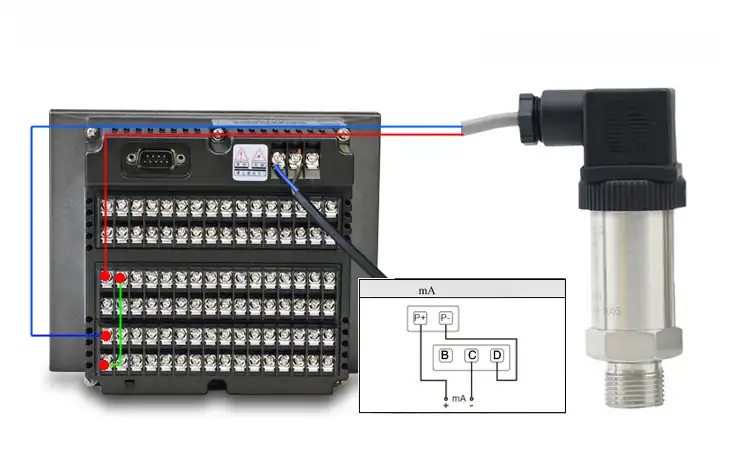
This is where 1-5 V is worth knowing. It is the voltage equivalent of 4-20 mA, with 1 V as a live zero, so a reading of 0 V again signals a fault rather than a pressure. If you want a voltage output but still want fault detection, choose 1-5 V over 0-10 V. A 4-20 mA loop dropped across a 250 Ω resistor produces exactly 1-5 V, which is why a current transmitter and a 1-5 V input can be matched with a single resistor. Voltage outputs use a three-wire connection: two for power and one for signal, sharing a common.
RS485 And Digital, When A Bus Wins
A digital output such as RS485 carries the reading as data on a serial bus, usually with the Modbus RTU protocol. Two things make it attractive. It is multi-drop: many transmitters share one twisted pair, each with its own address, so a line of sensors needs one bus instead of one cable run per device. And there is no analog-to-digital conversion loss in the field, which suits modern acquisition systems and industrial IoT, where local sensors report to a central hub or to the cloud.
There is a third route that keeps the analog signal and adds digital data on the same two wires: see how HART and smart transmitters compare with a plain 4-20 mA unit.
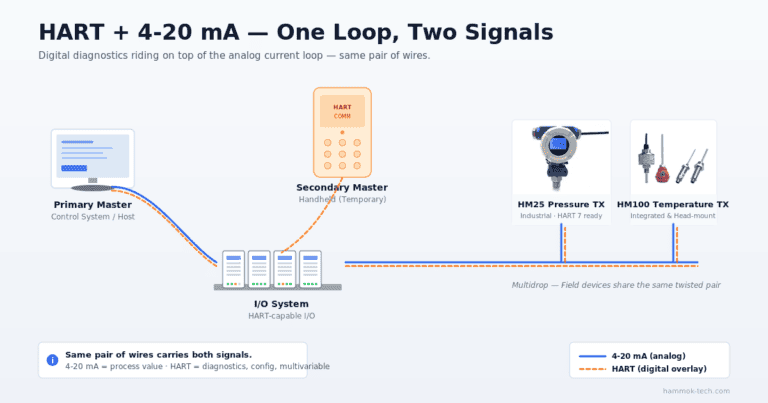
Reach for RS485 when you have several pressure points to gather, when you want register-level data rather than a single value, or when the system is built around a fieldbus. HART is a related case: it overlays digital data on top of a 4-20 mA loop, so you keep the analog signal and add configuration and diagnostics on the same wires. For the analog-versus-HART trade specifically, see our note on HART vs 4-20 mA, and for cable-free points the wireless pressure transmitter guide.
| Output | Type | Wiring | Long cable | Fault detect | Best for |
|---|---|---|---|---|---|
| 4-20 mA | Current, analog | 2-wire (loop) or 4-wire | Excellent | Yes (live zero) | Process plants, long or noisy runs |
| 1-5 V | Voltage, analog | 3-wire | Fair | Yes (live zero) | Short runs needing fault detection |
| 0-10 V / 0-5 V | Voltage, analog | 3-wire | Poor | No | Short, clean runs; direct card input |
| 0.5-4.5 V | Ratiometric voltage | 3-wire | Poor | No | OEM equipment, close coupling |
| RS485 (Modbus) | Digital | 2-wire bus | Good | Yes (comms timeout) | Multi-sensor, IoT, SCADA |
Matching It To An HMK Spec
HMK transmitters carry the output as an order option, so the same pressure element ships with whichever signal the installation needs. The HM30 and the general-purpose range offer 4-20 mA, 1-5 V, 0-5 V, and 0.5-4.5 V, which covers the analog cases above. For a digital bus, the HE29 RS485/CAN sensor puts the reading straight onto Modbus. The HM10 provides an uncompensated millivolt output for OEM builders who do their own conditioning at close range, the HM29 adds HART for configuration over the loop, and the HM200 wireless range removes the signal cable altogether.
Two honest notes on the spec. We supply 0-5 V and 1-5 V rather than 0-10 V, so if a controller truly needs 0-10 V, plan a scaler or pick the 4-20 mA version and a 250 Ω input. And the millivolt output is only for short OEM wiring, because it has none of the noise immunity of a loop. You can compare the full range on the pressure sensors and transmitters page. Analog signal levels follow IEC 60381:1982 and the fault thresholds follow NAMUR NE43, while the current-loop fundamentals are documented by NI and ISA-50.1.
The fault bands themselves, and what Emerson, Endress+Hauser and Yokogawa actually implement, are covered in NAMUR NE 43 fault signaling.
- specify 4-20 mA when the cable exceeds about fifteen metres or runs near drives and motors;
- choose 1-5 V when you want a voltage output but still need a broken wire to show up;
- keep 0-10 V or 0.5-4.5 V for short, clean, or OEM connections;
- choose RS485 when several transmitters share a bus or feed a data system.
Not sure which output to spec?
Send us the cable length, the controller input, and how many points you are gathering. Our team returns a transmitter with the right output already configured.
Request a Quote Browse Pressure TransmittersFrequently Asked Questions
Is 4-20 mA better than 0-10 V?
For industrial use, usually yes. A current loop holds its accuracy over long and noisy cable and signals a broken wire through its live zero, while 0-10 V drifts over distance and cannot tell a real zero from a fault. Choose 0-10 V only for short runs in a clean cabinet where simple integration matters more.
Can I convert a 4-20 mA output to a voltage?
Yes. Drop the loop current across a precision resistor: 250 Ω gives 1-5 V and 500 Ω gives 2-10 V. This is how a 4-20 mA transmitter feeds a voltage input, and it keeps the live-zero fault detection of the loop.
What is a 1-5 V output?
It is the voltage equivalent of 4-20 mA, with 1 V as a live zero. A reading of 0 V then means a fault rather than zero pressure, so 1-5 V gives a voltage signal the same broken-wire detection a current loop has.
Which output should I use for a long cable?
4-20 mA. The current is constant along the loop, so a run of hundreds of metres reads the same at the controller as at the sensor. A voltage output loses accuracy to wire resistance over the same distance.
RS485 or 4-20 mA: which output should you choose?
Use 4-20 mA for a single point feeding a controller input. Use RS485 when several transmitters share one bus, when you want digital register data, or when the system is built around Modbus and an acquisition hub.
When the output is present but the value is plainly wrong, the question shifts from signal type to fault. Our pressure transducer troubleshooting guide works through that by symptom.