Precision Pressure Sensor: Where the 0.1 % FS Line Is Real
Quick Answer
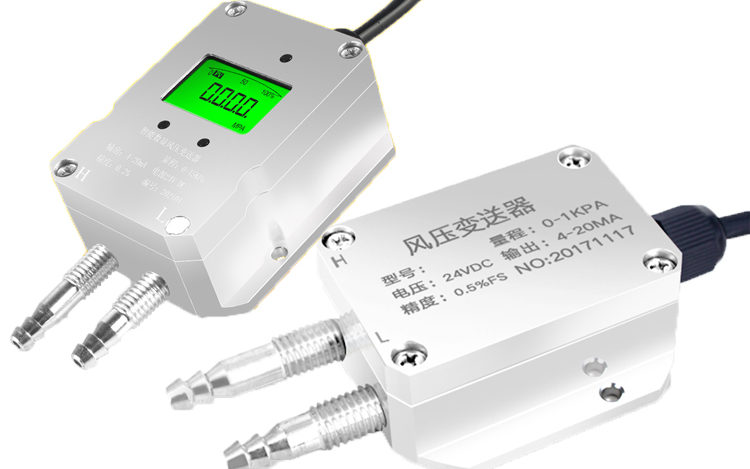
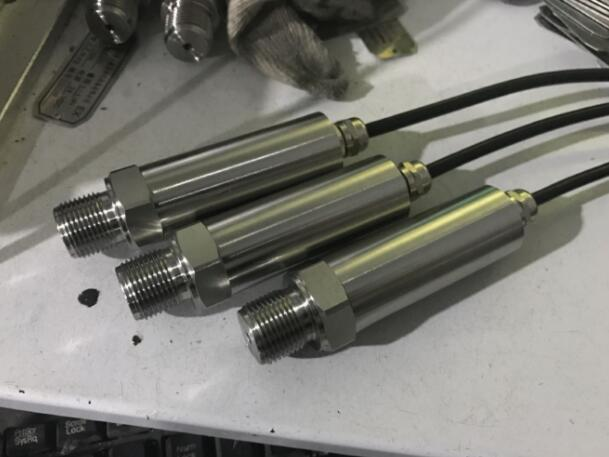
A precision pressure sensor is one rated at 0.1 % FS overall accuracy or better, the threshold both JJG 49-2013 and ASME B40.100-2013 use. Below that line a sensor is standard grade, no matter what the marketing says. For HMK that line is the HM22 (general precision), HM28 (sapphire for extreme service), and HM3051 (precision DP).
The word “precision” sits at the top of a thousand pressure sensor product pages. On a real spec sheet it points at a much narrower set of numbers. A general-purpose transmitter rated 0.5 % FS is not a precision sensor. A unit rated 0.25 % FS is competent, but still standard grade. The bar that engineers and the Chinese metrology code JJG 49-2013 draw for a true precision pressure sensor sits at 0.1 % FS overall accuracy, with thermal and cyclic terms held to the same bound.
When the process also runs hot, the right sensor technology decides whether that accuracy survives — see our high temperature pressure transducer guide.
What follows is the line that separates precision from standard, where the four spec numbers (BFSL, TEB, thermal coefficients, long-term drift) actually live, and the three HMK products that meet a real 0.1 % FS specification. We have specified that line on hundreds of refinery critical loops over 35 years of process instrumentation design, where 0.25 % was not enough and 0.05 % was a waste of budget.
Even a precise sensor loses accuracy if you run it at a high turndown ratio, so size the range to keep your duty near full span.
What “Precision” Means on a Spec Sheet
“Precision” is not a marketing adjective. The Chinese metrology code JJG 49-2013 Verification Regulation of Precision Pressure Gauges reserves the term for three accuracy classes only: 0.05, 0.1, and 0.16 % FS. Anything below that the same regulation calls a general-purpose gauge.
The U.S. line sits at the same place. ISA practice and ASME B40.100-2013 use 0.1 % FS to separate laboratory and process control grades from generic industrial sensors.
So the first question on any “precision pressure sensor” data sheet is simple: what is the published overall accuracy in % FS over the compensated temperature range? Above 0.1 % FS the unit is not a precision instrument in any standards-anchored sense. It may still be the right choice for your application. Call it standard grade and price it accordingly.
For the rest of this guide we use 0.1 % FS as the line. HMK’s HM22, HM28, and HM3051 sit on it. The HM21 submersible, HM23 HVAC, and most general-purpose transmitters in the same catalog sit above it. Both halves of the catalog earn their keep; the buyer’s job is to put the right device on the right loop.
Reading Accuracy: BFSL vs TEB
Most English data sheets lead with one accuracy number and bury another.
The headline is usually BFSL accuracy: deviation from a best-fit straight line, measured at reference temperature (typically +25 °C), at the centre of the pressure range, on a fresh sensor. The buried number is Total Error Band (TEB): worst-case deviation across the full pressure span and the full compensated temperature range, with pressure non-linearity, hysteresis, thermal effects on offset and span, and long-term repeatability all rolled into one figure.
BFSL flatters the catalogue. TEB is what your loop actually sees. Vendors who publish both side-by-side usually show TEB at two to three times the BFSL figure. A 0.1 % FS BFSL unit can post 0.3 % FS TEB once temperature drift is rolled in.
JJG 882-2019, the Chinese verification regulation for pressure transmitters, does not recognise BFSL. The procedure tests at multiple reference temperatures across the compensated band and folds the worst-case deviation into the declared accuracy. When you compare a HMK transmitter spec to a Western brand quoting BFSL only, convert to the same reference before deciding.
The Accuracy Grade Ladder
Five accuracy bands cover every commercial pressure sensor on the market. The ladder below maps each band to the GB/T 1226-2017 grade for general pressure gauges, the typical JJG verification interval, and the HMK product that lands on it.
The cost curve across the ladder is not linear. The jump from standard to industrial precision pays for itself on any control loop that runs an optimiser; the jump from precision to metering only pays back where measurement is the deliverable. Past metering, the price climb gets steep enough that most refinery design specifications stop at 0.1 % FS and leave lab grade to the calibration room.
What Makes a Sensor a Precision Sensor
Four physical traits decide whether a sensor can hold 0.1 % FS in real service. A vendor selling precision will publish all four on the same data sheet.
1. Tight thermal coefficients
Uncompensated piezoresistive silicon cells drift on the order of 0.01 to 0.03 % FS per °C, sometimes more. Active compensation pulls that down sharply.
HM22 uses a German compensated chip with ±0.01 % FS / °C typical drift, which holds the worst case under 0.5 % across a 50 °C swing. HM28’s mono-crystalline sapphire on titanium has no silicon-glass bond to creep, so accuracy stays at 0.1 % FS from −65 to +200 °C without active compensation at all.
2. Low hysteresis and high repeatability
Hysteresis is the gap between rising and falling readings at the same pressure. Silicon strain-gauge ~0.05 % FS. Ceramic capacitive ~0.02 %. Sapphire effectively zero.
For cyclic test stands and pulsation-rich service, sapphire is the only element that holds 0.1 % through a million cycles. Silicon-glass bonded cells drift up the hysteresis curve as the bond ages.
3. Long-term drift held under control
HM22 specifies long-term stability at ≤ 0.1 % FS per year. In the field we see standard 0.5 % FS transmitters drift several tenths of a percent FS each year, sometimes more under thermal cycling.
The arithmetic matters. Calibrate annually and a precision unit holds its spec; let the cycle slip to two years on a standard unit and the worst-case error stacks high enough that the loop drops out of useful control.
4. An output stage that does not eat the precision
A 0.1 % FS element behind a 12-bit ADC and a 0.2 % 4-20 mA loop conversion is still a 0.2 % sensor by the time the signal reaches the DCS.
Precision transmitters carry 16-bit or 24-bit conversion plus a HART or RS485 digital path that bypasses the analogue conversion step. HM22 and HM3051 both publish that digital path.
When 0.1 % FS Is Worth the Premium
Precision is not free. The buyer’s job is to put the budget where it returns value. Four application classes consistently justify a 0.1 % FS sensor.
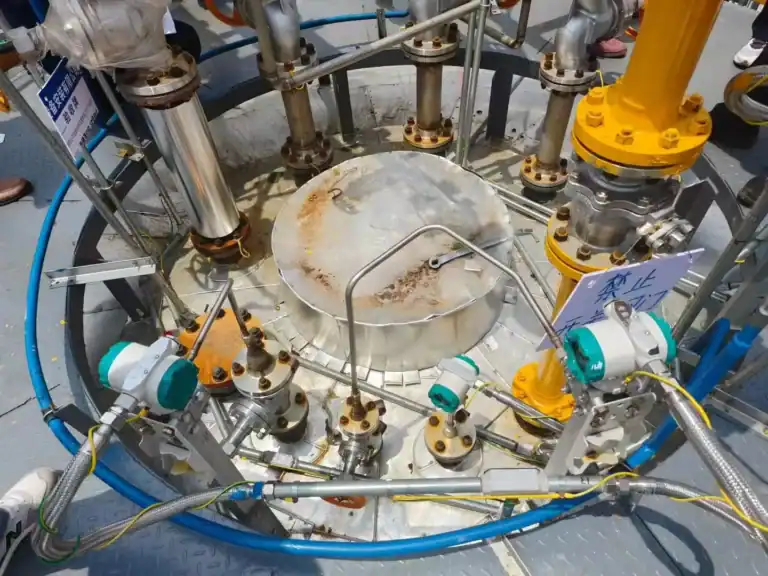
DCS critical loops and APC. On the refinery process designs we have worked, we have specified 0.1 % FS transmitters on distillation column reflux drums, FCC riser tops, hydrocracker reactor inlets, and any pressure that an Advanced Process Control layer manipulates. An APC supervisor moves setpoints by fractions of a kPa to capture yield; measurement noise at 0.5 % FS erodes the optimisation curve. On a 200 kPa column overhead, a 0.5 % FS sensor returns ±1.0 kPa of noise; a 0.1 % FS sensor returns ±0.2 kPa.
Aerospace and engine test stands. A 1000 psi fuel rail at 0.1 % FS measures to ±1 psi, which a flight readiness review accepts. The same fixture at 0.25 % FS measures to ±2.5 psi, which it does not. Sapphire elements (HM28) appear on combustion and turbine inlet pressure because the fixtures run hot and cold across the day.
Medical devices. Standards like IEC 80601-2-12 for ventilators and IEC 60601-2-24 for infusion pumps set tight device-level accuracy budgets. To leave room for tubing, signal conditioning, and software, the pressure sensor itself usually has to land at 0.1 % FS. Medical OEMs buy with per-shipment calibration certificates.
Calibration standards. A device that calibrates another sensor must be 4× more accurate. To verify a 0.25 % FS transmitter you need a 0.0625 % FS standard, in practice a 0.05 % FS lab unit. JJG 49-2013 and the TUR (test uncertainty ratio) rule embedded in JJG 882-2019 enforce this hierarchy. If your in-house lab calibrates field transmitters, you are buying metering-grade or lab-grade, not industrial precision.
Do not over-spend in the other direction. A water-tank level loop, an HVAC duct static reading, a compressed-air supply gauge sit in the 0.5 to 1.0 % FS world. Putting a 0.1 % FS sensor on a level loop where the tank wall itself is 2 % out of plumb buys you nothing. The HM21 submersible handles those services at the right price.
Pick the Right HMK Precision Sensor in 30 Seconds
Three HMK product lines hold the 0.1 % FS spec. The choice between them is decided by the service, not the accuracy spec, which is identical.
HMK Precision Product Family: Spec Comparison
| Product | Element | Accuracy | Thermal | Range | Best for |
|---|---|---|---|---|---|
| HM22 | German diffused-silicon chip | ±0.1 % FS overall | ±0.01 % FS / °C typical | −100 kPa to 100 MPa | General-purpose precision, DCS critical loops, lab benches |
| HM28 | Sapphire SOS on titanium | ±0.1 % FS overall | zero hysteresis, no creep | up to 260 MPa, −65 to +200 °C | Hot, cyclic, corrosive, hydraulic test, downhole |
| HM3051 | Capacitive DP cell | ±0.1 % FS overall | compensated, 100:1 turndown | DP spans to 10 MPa | Sealed-tank level, orifice flow, custody-grade DP |
Each carries a German-traceable calibration certificate, output options that include 4-20 mA, HART, and digital protocols where appropriate, and stainless-steel wetted parts in 316L by default with Hastelloy C-276 and tantalum upgrades for severe service. The full pressure sensors and transmitters range sits behind the three precision products for applications where 0.25 % FS is the right answer.
Calibration Cadence and Traceability
A precision sensor that is not on a calibration program is not a precision sensor for long. Two Chinese metrology codes set the cadence and the equipment hierarchy.
JJG 49-2013 fixes the verification interval for a precision pressure gauge at one year, with the test done at +20 ± 2 °C after 24 h of settling. JJG 882-2019 sets the same one-year interval for transmitters at 0.25 % FS or better, and two years for standard 0.5 % FS units.
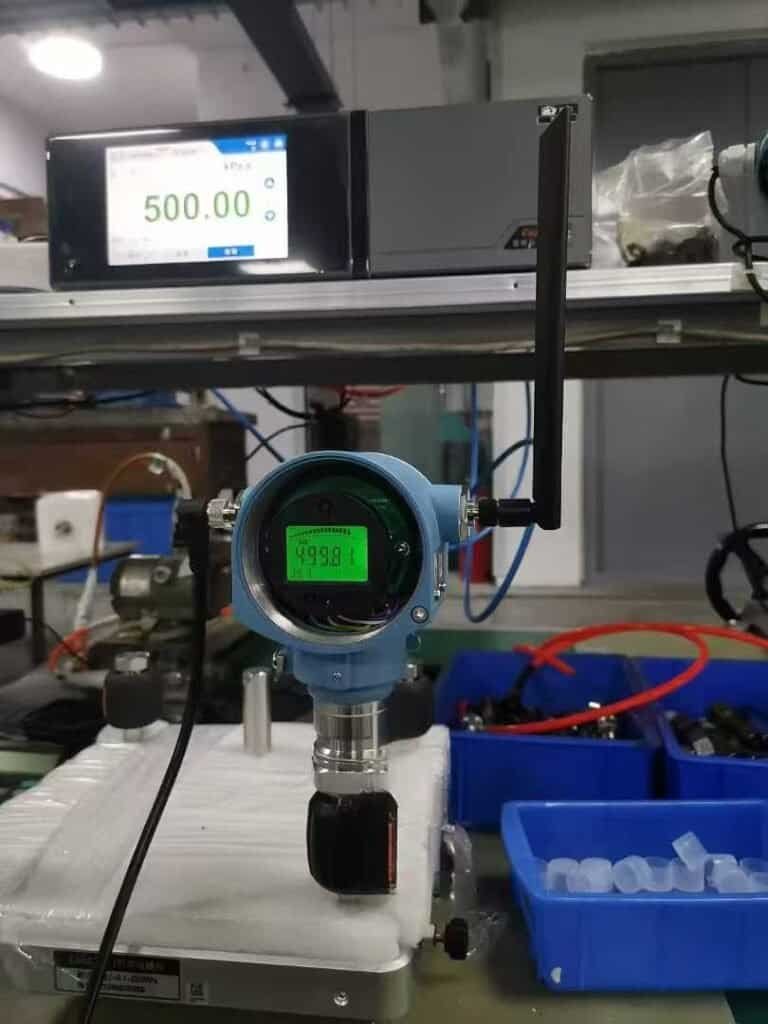
Both regulations enforce the Test Uncertainty Ratio (TUR) rule: the reference standard must be at least 4× more accurate than the device under test. Calibrating a 0.1 % FS sensor requires a 0.025 % FS reference, which in practice means a digital pressure controller traceable through the national metrology institute (NIM in China, NIST in the United States) under ISO/IEC 17025 accreditation.
The HMK DP transmitter calibration guide walks the five-point procedure that we use to satisfy JJG 882-2019. The single-port HM22 follows the same up-and-down five-point flow, with the additional thermal cycle that JJG 49-2013 layers on for precision-class units.
Frequently Asked Questions
Is a precision pressure sensor the same as a high accuracy pressure sensor?
In trade catalogues yes, in the metrology codes no. Both phrases point at the same class of product, accuracy at or below 0.1 % FS. JJG 49-2013 prefers “precision pressure gauge” and reserves it for the 0.05, 0.1, and 0.16 % FS classes. Western data sheets use “high accuracy” and “precision” interchangeably. Read the published % FS number rather than the trade label.
What does ±0.1 % FS mean on a 25 MPa sensor?
The error is fixed at ±25 kPa across the full pressure range, not 0.1 % of the live reading. At 25 MPa the sensor reads 25 MPa ±25 kPa. At 2.5 MPa it still reads with ±25 kPa, which is 1 % of the live value. Precision sensors are most useful when the operating point sits in the upper half of the range, between 50 and 90 % of full scale.
Why is BFSL friendlier than TEB on a data sheet?
BFSL is taken at reference temperature, on a fresh part, in the mid-range. It excludes thermal drift, hysteresis, long-term drift, and end-of-range non-linearity. TEB rolls all of those into one number. A vendor who publishes both is showing the worst face honestly; a vendor who publishes only BFSL is keeping the worst face off the cover. Compare BFSL to BFSL or TEB to TEB, never one against the other.
How often must a precision pressure sensor be calibrated?
JJG 49-2013 mandates a one-year cycle for any precision pressure gauge at 0.05, 0.1, or 0.16 % FS. JJG 882-2019 sets the same one-year interval for transmitters at 0.25 % FS or better. Custody transfer and fiscal metering services often run six-month intervals by contract. The calibrating standard itself needs a higher-tier interval, typically six months, with traceability to the national metrology institute.
Can a precision sensor be used outside its compensated temperature range?
Mechanically yes, the sensor survives the wider operating range printed on the data sheet. Functionally the accuracy spec is void the moment the temperature leaves the compensated band. A 0.1 % FS unit run 30 °C outside its compensated range can drift to 0.5 % FS or worse. For a wider temperature window at 0.1 % FS, the HM28 sapphire element holds precision from −65 to +200 °C, and HM22 with the optional cooling element reaches +150 °C process media.
Recommended HMK Products
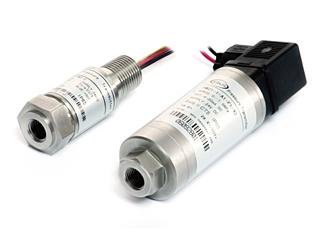
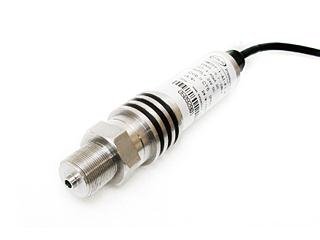
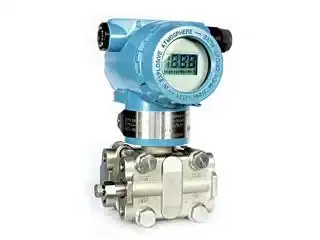
Three precision-grade products from the HMK catalog, each on the 0.1 % FS line.
Standards and References
The accuracy classes and the verification cadence in this guide follow JJG 49-2013 Verification Regulation of Precision Pressure Gauges and JJG 882-2019 Verification Regulation of Pressure Transmitters. The general industrial gauge ladder follows GB/T 1226-2017 General Pressure Gauges. The U.S. reference for the same set of grades is ASME B40.100-2013 Pressure Gauges and Gauge Attachments. For traceability and TUR practice, see NIST Pressure Metrology and the ISO/IEC 17025 calibration laboratory standard. Medical device pressure measurement accuracy budgets are set by IEC 80601-2-12 for ventilators and IEC 60601-2-24 for infusion pumps.
Related tool: Before trusting a headline figure, run your range through the turndown & accuracy calculator to see what turndown does to the installed accuracy.