Valve Manifold for DP Transmitter: 2/3/5-Valve Decision
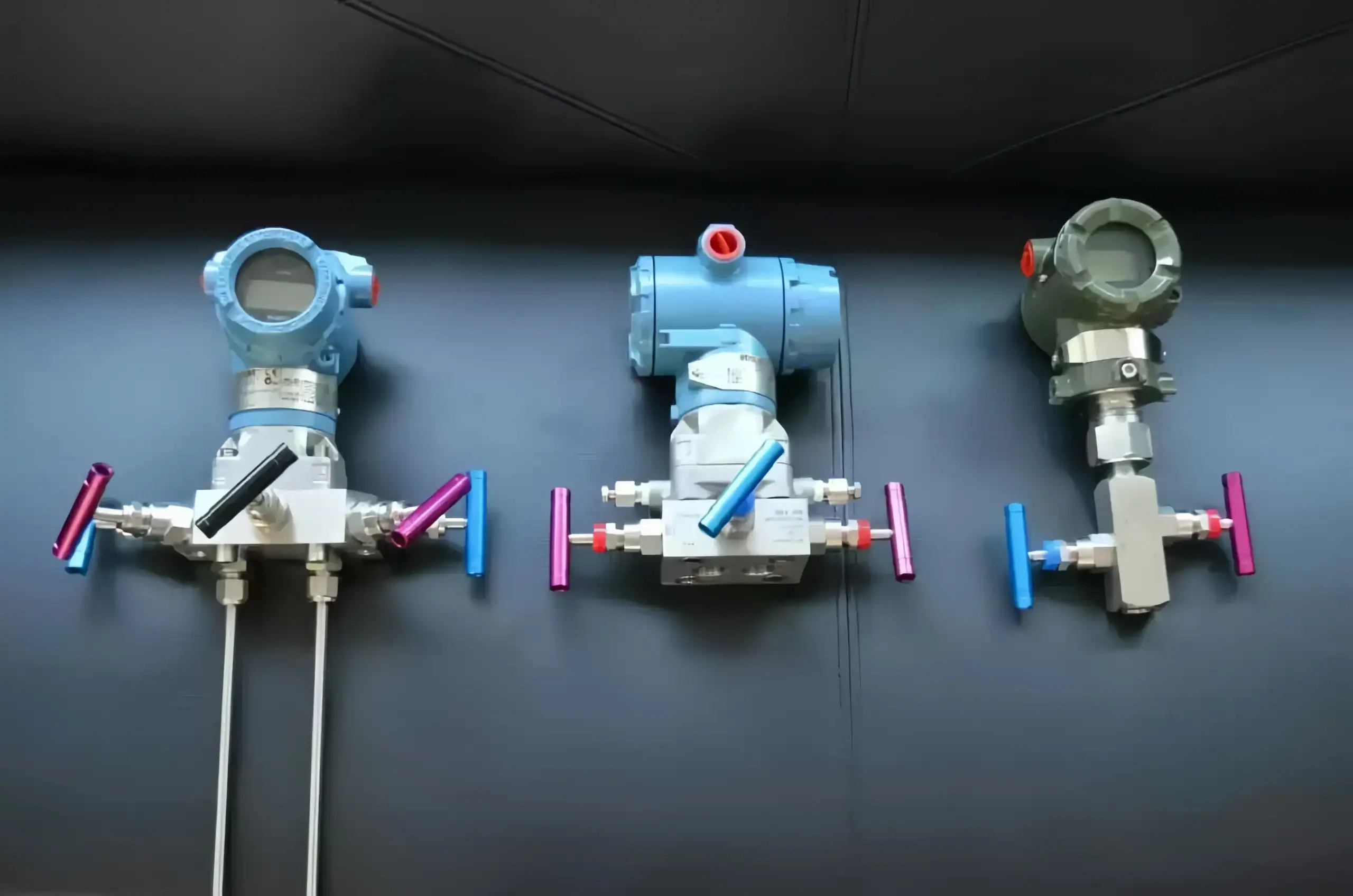
The cheapest line on a DP transmitter quote often hides the costliest decision: 2-valve vs 3-valve vs 5-valve manifold can change your calibration cycle by 2.5×. A wrong manifold pick means either an extra hour every six months for the rest of the transmitter’s life — or a blown diaphragm at first commissioning.
Related: the manifold sits between the impulse lines and the cell — see impulse lines for pressure & DP transmitters for routing and venting.
This guide compares the three manifold types, gives you a decision tree, walks the four operational sequences, and tells you which HMK DP transmitter pairs with which manifold. If calibration is your next step, see the DP transmitter calibration guide.
What a Manifold Does on a DP Transmitter
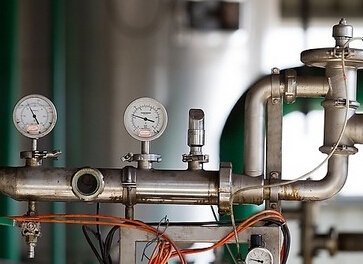
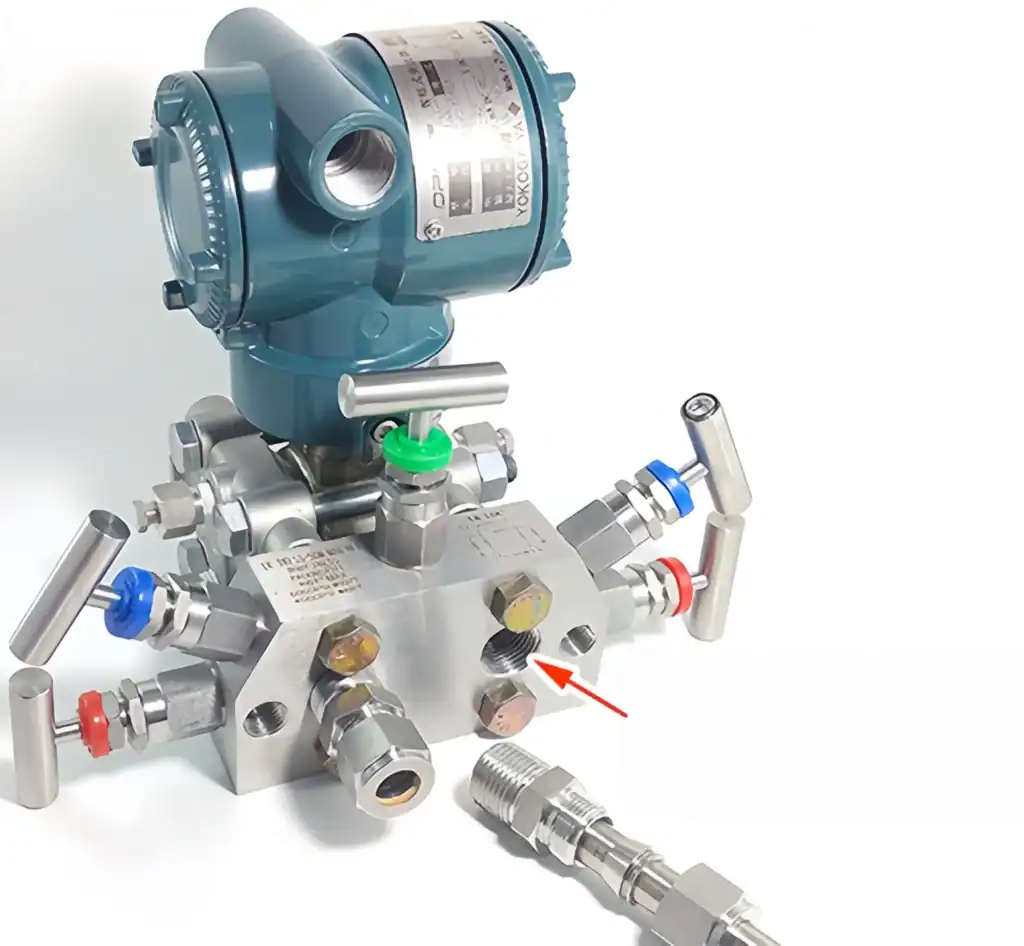
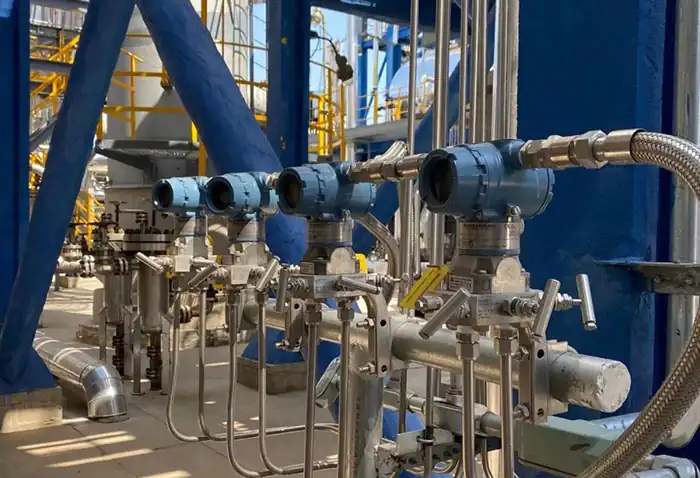
A manifold is the small block of valves that sits between the process impulse lines and the DP transmitter. It exists to do three things:
- Isolate the transmitter from the process — block valves shut off high and low side independently
- Equalize pressure across both sides of the diaphragm — the equalize valve cross-connects HP and LP for safe commissioning and zero-checks
- Vent (bleed) trapped fluid or air from each side independently — bleed valves let you purge or sample without removing the transmitter
These three actions are what separate the manifold types. 2-valve does only isolate. 3-valve adds equalize. 5-valve adds two independent bleed valves on top.
Why this matters: the equalize valve is non-negotiable on a DP transmitter. Without it, opening one block valve before the other puts full process pressure on a single side of a diaphragm rated for differential — the diaphragm blows on first commissioning. Skipping the equalize step is the #2 cause of warranty returns on DP units. See the DP working principle for what’s actually behind that diaphragm.
2-Valve vs 3-Valve vs 5-Valve Comparison Matrix
Side-by-side at the level a procurement engineer needs:
| 2-valve | 3-valve | 5-valve | |
|---|---|---|---|
| Valves | 2 block | 2 block + 1 equalize | 2 block + 1 equalize + 2 bleed |
| DP service? | No — disqualified | Yes — most common | Yes — high-end |
| In-place full calibration? | No | Partial (zero only) | Yes (5-point Up & Down) |
| CIP / SIP compatible? | No | Marginal | Required by GMP |
| Bench cal removal needed? | Yes | Often | Rare |
| Standard reference | IEC 61518 | IEC 61518 / GB/T 21465 series III | IEC 61518 / GB/T 21465 series V |
| Relative cost | + | ++ | +++ |
| Calibration cycle time | n/a (off-line) | ~4 hours typical | ~90 minutes typical |
| HMK default model pairing | — | HM30 / HM31 | HM3051 / HM1151 |
Why 2-valve disqualifies for DP service. A 2-valve manifold has no path to safely cross-connect HP and LP. On startup, opening the high-side block first puts the entire process static pressure on one side of the diaphragm. A 250 Pa transmitter sees 5 MPa of unbalanced load and the diaphragm permanently deforms. The 2-valve is fine on a single-side gauge or absolute transmitter — never on a DP.
Why 3-valve is the workhorse. For ranges above 10 kPa with annual calibration, the 3-valve handles isolate, equalize, and zero-check on the bench after a quick disconnect. Most general process plants run 3-valve on 80%+ of their DP fleet.
Why 5-valve buys back calibration time. The two extra bleed valves let an operator vent each side independently without disconnecting impulse lines. Combined with the equalize valve, that means a full 5-point Up & Down calibration in place — without removing the transmitter from the manifold. For ≤10 kPa ranges (per Chinese metrology regulation JJG 882-2019, calibration interval is 6 months — half the typical), this saves a service truck roll twice a year. Pair the 5-valve with HM3051 smart DP for full HART trim in service.
Decision Tree: When Each Type Is the Right Spec
Walk this in order; the first match wins.
1. Is it a DP transmitter? (HP and LP both connected to process)
→ Eliminate 2-valve. Choose 3-valve or 5-valve. 2-valve only makes sense on gauge or absolute pressure where there is no second side to equalize.
2. Is the range ≤10 kPa?
→ 5-valve. JJG 882-2019 mandates 6-month calibration for low-range DP. Doubling the calibration frequency means every truck-roll cost doubles unless you can do it in place. The bleed valves on a 5-valve allow full 5-point Up & Down calibration without disconnecting impulse lines. See the low pressure transducer guide for what counts as “low pressure” and why JJG enforces 6 months.
3. Is this a CIP / SIP application (food, beverage, dairy, pharma)?
→ 5-valve required. Chinese GMP and FDA 21 CFR Part 11 audits expect bleed-test ports for cleaning verification. A 3-valve cannot demonstrate bleed compliance. We have seen 5-valve mandated on every DP point in pharma project SOPs since 2022.
4. Is the transmitter HART smart with planned HART trim in service?
→ 5-valve. HART Sensor Trim and D/A Trim during service require the transmitter to be at zero differential while still loop-powered. A 5-valve gets you there without disconnect.
5. Is the process pressure ≤2 MPa with annual calibration interval, no CIP, analog or HART trim done at outage only?
→ 3-valve. This is 80% of refinery, water treatment, and HVAC DP service. The cost-vs-flexibility balance is right.
6. None of the above and you still want 5-valve “just in case”?
→ Spec the 5-valve. The cost premium is small relative to the lifetime calibration time saved on a critical loop.
Operational Sequences: Isolate, Equalize, Vent, Calibrate
Four standard sequences cover 95% of manifold operations. Tape these to the manifold.
1. Isolate from process (before disconnect or replacement)
3-valve and 5-valve same: Open equalize → close HP block → close LP block. Reverse on restoration: open LP → open HP → close equalize. Skipping the equalize-first step puts full static pressure on one side and blows the diaphragm. This is the #2 trap covered in our DP calibration guide.
2. Equalize for in-service zero check
Operate equalize valve only; both block valves stay open. The transmitter reads zero differential while still seeing process static pressure — useful as a daily integrity check at shift handover. Any reading more than ±0.5% FS from zero indicates drift; re-calibrate per JJG 882-2019 interval.
3. Bleed for cleaning verification (5-valve only)
With both blocks closed and equalize closed, open one bleed valve at a time — never both simultaneously, or you defeat the isolation. Trapped fluid drains; cleaning solution can be sampled from the bleed port for GMP audit traceability.
4. In-place 5-point calibration (5-valve only)
Close both blocks → close equalize → open one bleed to atmosphere → close it → run 5-point Up & Down using a calibrator at the bleed port. A 2024 retrofit at a Chinese petrochemical plant converted critical DP points from 3-valve to 5-valve and cut average calibration time from four hours to ninety minutes per unit — the bleed valves replaced the disconnect-and-bench-mount step entirely. Across 200 DP points on annual cal, that’s 500 hours of service time saved per year.
For HART transmitters like the HM3051, in-place HART Sensor Trim and D/A Trim are also possible only with 5-valve.
Material and Pressure Standards
Spec the manifold to four standards:
- IEC 61518 — global standard for DP transmitter mounting flange dimensions (ensures any IEC-compliant manifold bolts to any IEC-compliant transmitter)
- GB/T 21465-2008 — Chinese national standard for instrument valve manifold series. The 3-valve = series III, 5-valve = series V. Sourcing engineers in China can write the GB code on the BOM and procurement understands it without further description.
- ASME B16.34 — pressure rating standard (US / global). Manifold body ratings are listed at 38 °C and 200 °C — always check the rating at the actual service temperature.
- EU PED 2014/68/EU — for European installations, manifolds in Cat. III service need CE marking and a Declaration of Conformity.
Material selection by media:
| Media | Recommended body | Avoid |
|---|---|---|
| Clean water, air, neutral oil | 316L SS | — |
| Chloride brine, seawater | Hastelloy C-276, Monel 400 | 316 SS |
| Hydrofluoric acid, hot concentrated H₂SO₄ | Monel, Alloy 20, PTFE-lined | All standard SS |
| Caustic soda > 30% | Hastelloy C-276, Monel | 316 SS |
| Steam < 250 °C | 316L SS | — |
| Steam > 250 °C | F22 alloy, Inconel | Standard SS |
Pressure rating rule. Per Chinese GB 150-2011 pressure vessel code, accessory components like manifolds must be rated at 1.5× design pressure of the upstream piping. ASME B16.34 and EU PED apply the same 1.5× rule. Round up to the next standard tier — typical tiers are 10, 25, 40, and 60 MPa.
HMK DP Lineup and Recommended Manifold
The 4 HMK DP families pair with manifolds as follows:
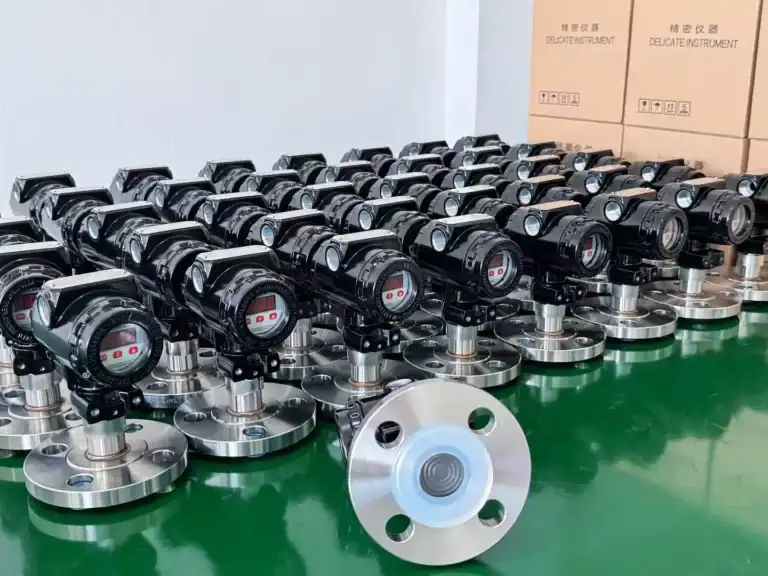
- HM30 micro DP (500 Pa–700 kPa) — default 3-valve for general service. Upgrade to 5-valve if operating in the 0–10 kPa band (JJG 6-month rule applies) or in CIP service.
- HM31 DP (10 kPa–2 MPa, ±0.075–0.5% FS, HART option) — default 3-valve. The 12-month calibration interval and modest range fits the workhorse profile. Upgrade to 5-valve only if HART Sensor Trim is done in service.
- HM3051 smart DP (HART, capacitance, ≤16 MPa) — 5-valve default. The HART trim workflow practically requires 5-valve to avoid disconnect every cycle. Pharma and food customers we’ve delivered always specify 5-valve here.
- HM1151 capacitive DP (16 ranges from 0.25 kPa, level applications) — 5-valve required. Wet-leg level service needs the bleed valves to verify the leg is fully charged after CIP, and to refresh the seal fluid on schedule.
For full DP family specs, see the differential pressure transmitter catalog page. HMK ships 3-valve as the standard included manifold; 5-valve is a quoted option line item.
FAQ
The manifold is not a line item, it’s a 4-hour-vs-90-minute decision repeated every calibration cycle for ten years. Spec it once, spec it for the lifetime cost. If you need a manifold and DP transmitter package matched to your range, accuracy class, and material — contact an HMK pressure engineer.
The 5-valve manifold sits between the impulse lines and the DP transmitter on every flow loop. For the rest of the architecture — primary elements, square-root extraction, AGA-3 / GB/T 2624 standards — see the DP flow measurement guide.