kPa to bar Converter
Divide by 100 and you have the answer — but below about 100 kPa the bar figure turns into a string of leading zeros, and at -100 kPa you have hit a physical wall, not a range option. This converter shows millibar alongside bar and flags the vacuum limit.
The kPa to bar formula and the definition behind it
Both units are fixed to the pascal by definition, so this conversion is exact:
- 1 kPa is exactly 1,000 Pa
- 1 bar is exactly 100,000 Pa
- Therefore bar = kPa ÷ 100, and usefully, 1 kPa = 0.01 bar = 10 mbar
The third line is the one worth memorising. Most people arriving at this conversion are holding a specification in kPa because it was written to SI convention or came from an Asia-Pacific project, and they need bar because the equipment, the gauge dial or the European supplier’s catalogue is scaled that way. Above a few hundred kPa the bar figure is comfortable to read. Below that it stops being comfortable, and millibar takes over — which is why this converter prints both.
Low-range conversion table: 0 to 200 kPa
Air-side and water-side instrumentation lives almost entirely in this band, so it is worth reading at fine resolution.
| kPa | bar | mbar | psi |
|---|---|---|---|
| 0.1 | 0.001 | 1 | 0.0145 |
| 0.5 | 0.005 | 5 | 0.0725 |
| 1 | 0.01 | 10 | 0.145 |
| 2.5 | 0.025 | 25 | 0.363 |
| 5 | 0.05 | 50 | 0.725 |
| 10 | 0.1 | 100 | 1.45 |
| 20 | 0.2 | 200 | 2.90 |
| 25 | 0.25 | 250 | 3.63 |
| 50 | 0.5 | 500 | 7.25 |
| 75 | 0.75 | 750 | 10.88 |
| 100 | 1 | 1,000 | 14.50 |
| 101.325 | 1.01325 | 1,013.25 | 14.70 |
| 150 | 1.5 | 1,500 | 21.76 |
| 200 | 2 | 2,000 | 29.01 |
The 101.325 kPa row is one standard atmosphere. It is in the table because it is the number you add or subtract when a specification switches between gauge and absolute — not because anyone specifies an instrument at that range.
Full-range conversion table: 200 to 10,000 kPa
| kPa | bar | MPa | psi |
|---|---|---|---|
| 240 (typical tyre placard) | 2.4 | 0.24 | 34.81 |
| 250 | 2.5 | 0.25 | 36.26 |
| 400 | 4 | 0.4 | 58.02 |
| 600 | 6 | 0.6 | 87.02 |
| 700 | 7 | 0.7 | 101.53 |
| 1,000 | 10 | 1 | 145.04 |
| 1,600 | 16 | 1.6 | 232.06 |
| 2,500 | 25 | 2.5 | 362.59 |
| 4,000 | 40 | 4 | 580.15 |
| 6,000 | 60 | 6 | 870.23 |
| 10,000 | 100 | 10 | 1,450.38 |
Below 0.1 bar, millibar is the readable unit
Convert 500 Pa of duct static pressure into bar and you get 0.005 bar. Convert a 2 kPa filter alarm setpoint and you get 0.02 bar. Those numbers are correct and almost unusable: they invite a misplaced decimal point every time somebody retypes them into a configuration tool, and they compare badly against an accuracy specification written in percent of span.
The convention that solves it is simple. Once the bar value drops below roughly 0.1, write it in millibar instead — 500 Pa becomes 5 mbar, 2 kPa becomes 20 mbar, and a 100 kPa range becomes 1,000 mbar. This is why European low-pressure instrument catalogues quote ranges such as 400 mbar rather than 0.4 bar, and it is why the converter above prints a millibar row you did not have to ask for.
If your figures are in pascals rather than kilopascals, the same chain applies: 1 kPa = 1,000 Pa = 10 mbar. Low-range air work is covered in more depth in our guides to measuring static pressure in HVAC and choosing an HVAC differential pressure transmitter.
-100 kPa is -1 bar, and that is the physical floor
Negative gauge pressure has a hard limit that unit conversion does not reveal on its own. Gauge pressure is measured relative to the local atmosphere, so the most you can subtract is the atmosphere itself. At sea level that is 101.325 kPa, and the practical convention rounds it to -100 kPa — which converts to exactly -1 bar g.
- -25 kPa g = -0.25 bar g = 250 mbar of vacuum
- -50 kPa g = -0.5 bar g, roughly half an atmosphere removed
- -100 kPa g = -1 bar g, full vacuum for specification purposes
The consequence is practical: a quotation offering a “-2 bar gauge” range is not describing a more capable instrument, it is describing something that cannot exist. Below the floor the only meaningful way to express the measurement is in absolute terms — a few kPa absolute, or in the finer vacuum bands, in torr or millibar absolute. HMK’s HM27G negative gauge transmitter is ranged 0 to -100 kPa precisely because that is where the physics stops, while the HM27A and HM27CA variants cover the absolute side. The wider background is in how to measure vacuum pressure, and the absolute, gauge and vacuum converter handles reference changes directly.
Matching a kPa range to a real transmitter range
HMK scales its catalogue in Pa, kPa and MPa, so if you are converting kPa to bar in order to compare against a European datasheet, this is the map back to hardware. Ranges below are the published instrument ranges.
| Your kPa range | In bar / mbar | Instrument to look at |
|---|---|---|
| 0.1–100 kPa | 0.001–1 bar / 1–1,000 mbar | HE30, 100 Pa to 100 kPa, ±1 % FS on ranges at or below 250 Pa |
| 0.5–700 kPa differential | 0.005–7 bar | HM30, 500 Pa to 700 kPa, response under 2 ms |
| 0 to -100 kPa | 0 to -1 bar | HM27G single-crystal silicon negative gauge |
| 5 kPa to 100 MPa | 0.05–1,000 bar | HM20 at ±0.25 % FS, or HM25 at ±0.1 % FS |
Frequently asked questions
What is the formula for kPa to bar?
Divide the kilopascal value by 100. The relationship is exact because 1 bar is defined as 100,000 Pa and 1 kPa as 1,000 Pa. In the other direction, multiply bar by 100 — see the bar to kPa converter.
Is 1 bar 100 kPa?
Yes, exactly, with no rounding involved.
Is kPa the same as psi?
No. One psi is 6.894757 kPa, so a kPa figure is roughly seven times smaller than the same pressure written in psi. Use the kPa to psi converter for that pair.
What is 240 kPa tyre pressure in bar?
240 kPa is 2.4 bar, or 34.8 psi. That is a gauge pressure, so its absolute equivalent is 341.325 kPa. Note that this page is written for process instrumentation rather than automotive use.
How do I convert kPa gauge to bar absolute?
Add the local atmospheric pressure in kPa first, then divide by 100. At sea level, 250 kPa g becomes 351.325 kPa a, which is 3.51325 bar a. Switch the reference selector above to absolute and the converter does both steps.
Converting a range so you can order the right instrument?
Send the range in kPa, bar or mbar together with the reference — gauge, absolute or differential — and the process medium. We will reply with the matching model, range code and accuracy class.
Related converters and calculators
The reverse direction is the bar to kPa converter, which includes the gauge-to-absolute offset table. Neighbouring pairs: kPa to psi, psi to kPa, psi to bar and the multi-unit pressure unit converter. For low-range air work, the inches of water column converter covers the other unit that band is specified in. Everything is indexed on the engineering tools page.
Low-range and vacuum transmitters
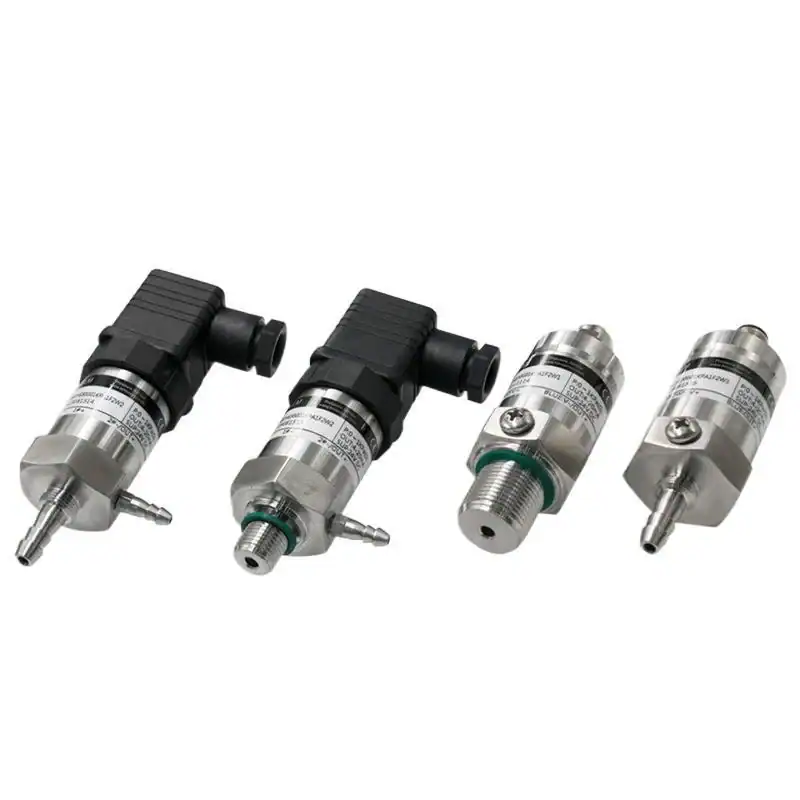 HE30100 Pa to 100 kPa (1 to 1,000 mbar)Non-oil-filled silicon element for wind and micro-differential pressure.
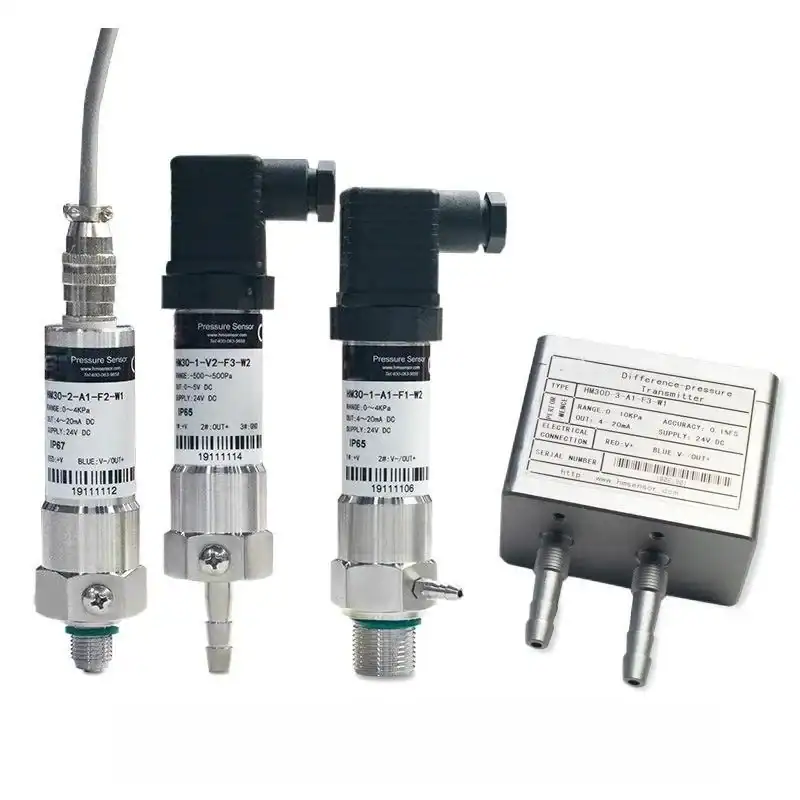 HM30500 Pa to 700 kPa (5 to 7,000 mbar)Micro-differential transmitter, positive and negative configurations, IP65 or IP67.
 HM270 to -100 kPa gauge, plus absolute variantsNegative gauge, silicon absolute and capacitive absolute versions.
Written by Lin Jun · Pressure Instrumentation Engineer, HMK-TECH. Conversion factors follow the SI definitions of the pascal and the bar; instrument ranges quoted are the published ranges of the products linked above.