psi to mmHg Converter
Going from psi to millimetres of mercury has one decision in it: whether your psi figure is absolute or gauge. 1 psi = 51.7149 mmHg, so 14.696 psia is 760 mmHg. This converter handles both references, returns the absolute mmHg value and the vacuum depth, and includes a full psi to mmHg conversion table.
psi to mmHg conversion table
Input is absolute psi (psia); output is absolute mmHg. For a gauge reading, add 14.696 psi before using this table.
| psi (absolute) | mmHg (absolute) | kPa absolute | Fraction of 1 atm |
|---|---|---|---|
| 0.5 | 25.86 | 3.447 | 0.034 |
| 1 | 51.71 | 6.895 | 0.068 |
| 2 | 103.43 | 13.79 | 0.136 |
| 2.32 | 120.0 | 16.00 | 0.158 |
| 5 | 258.6 | 34.47 | 0.340 |
| 7.348 | 380.0 | 50.66 | 0.500 |
| 10 | 517.1 | 68.95 | 0.680 |
| 14.696 (1 atm) | 760.0 | 101.325 | 1.000 |
| 20 | 1034.3 | 137.90 | 1.361 |
| 30 | 1551.4 | 206.84 | 2.041 |
| 50 | 2585.7 | 344.74 | 3.402 |
| 100 | 5171.5 | 689.48 | 6.805 |
Start by deciding whether your psi is absolute or gauge
This is the whole job. Millimetres of mercury are an absolute unit, so an mmHg answer is only meaningful once your psi value is also absolute. Most industrial instruments in psi are gauge instruments, which read zero at ambient air, so their number is not yet in the right reference frame.
The correction is one addition. Absolute psi equals gauge psi plus local atmospheric pressure, and at sea level that is 14.696 psi. A transmitter showing 5 psig is therefore at 19.696 psia, which is 19.696 × 51.714925 = 1018.6 mmHg absolute. If you skip the addition and convert 5 psig directly you get 258.6 mmHg, which is not wrong arithmetic but is the wrong quantity, and it is low by a full atmosphere.
Two details are worth carrying. Local atmospheric pressure is not always 14.696 psi: at 1,500 m elevation it is nearer 12.4 psi, and a deep low-pressure system moves it by a few tenths. And if your instrument is already an absolute type, do not add anything, because its zero is already the vacuum.
The exact factor
One pound per square inch is 6894.757293 Pa and one millimetre of mercury is 133.322387415 Pa, so:
- 1 psi = 51.714925 mmHg
- 1 mmHg = 0.019336777 psi
The check that catches a bad factor immediately is the atmosphere: 14.696 × 51.714925 = 760.0 mmHg, which is standard atmospheric pressure by definition. Discard any factor that fails to return 760 from 14.696 psia.
Reading a vacuum depth in mmHg from a psi instrument
On vacuum service a gauge transmitter reports a negative psig, and vacuum specifications are usually written as an absolute mmHg figure, so the two do not line up until you convert the reference as well as the unit.
Work it in this order. Take the gauge reading, add local atmospheric pressure to get psia, then multiply by 51.714925. A transmitter reading −12.0 psig at sea level is at 14.696 − 12.0 = 2.696 psia, which is 139.4 mmHg absolute. Expressed the other way, the vacuum depth is 12.0 × 51.714925 = 620.6 mmHg below atmosphere.
Notice how quickly resolution runs out at the deep end. Between −14.0 and −14.696 psig lies everything from 36 mmHg absolute down to zero, so a 0 to −15 psig instrument is trying to resolve the entire fine-vacuum region inside the last 5 % of its span. That is why a deep-vacuum specification should be met with an absolute-reference transmitter ranged in mmHg or Pa, not with a gauge instrument used at the bottom of its scale.
mmHg and Torr
A torr is 1/760 of a standard atmosphere, or 133.322368 Pa, against 133.322387415 Pa for a conventional millimetre of mercury. They differ by 1.000000142, which is about 1.4 parts in ten million and is below the resolution of any field instrument. Convert once and label the result to suit your industry; if your paperwork uses torr, the psi to torr converter gives the same numbers.
Worked examples
1. One atmosphere. 14.696 psia × 51.714925 = 760.0 mmHg, the definition of standard atmospheric pressure.
2. A gauge reading on a pressurised line. 30 psig at sea level is 44.696 psia, which is 44.696 × 51.714925 = 2311.4 mmHg absolute. Converting the 30 psig directly would have given 1551.4 mmHg, low by exactly one atmosphere.
3. A vacuum line at −10 psig. Absolute pressure is 14.696 − 10 = 4.696 psia, which is 242.8 mmHg absolute. The vacuum depth is 517.1 mmHg below atmosphere.
4. Working at altitude. The same −10 psig instrument at 1,500 m, where ambient is about 12.4 psi, sits at 2.4 psia or 124.1 mmHg absolute. The gauge number did not change but the absolute vacuum is very different, which is the practical argument for an absolute reference on vacuum duty.
Frequently Asked Questions
How many mmHg are in 1 psi? 51.714925 mmHg. One standard atmosphere, 14.696 psia, is 760 mmHg.
Do I add atmospheric pressure before converting? Only if your psi value is a gauge reading. Gauge psi plus local atmospheric pressure gives absolute psi, and mmHg is an absolute unit.
What is −14.7 psig in mmHg? It is a full vacuum, close to 0 mmHg absolute. At sea level −14.696 psig is 0 psia, which is 0 mmHg.
Is psi to mmHg the same as psi to torr? Numerically yes, to within 1.4 parts in ten million.
Why does my vacuum transmitter lose accuracy near full vacuum? A gauge instrument spanned 0 to −15 psig compresses the whole fine-vacuum region into the last few percent of its span. Use an absolute-reference transmitter ranged for the vacuum you actually need.
Instruments for absolute and vacuum measurement
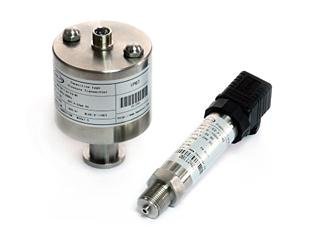
HM27 Vacuum & Absolute Pressure Transmitter
Negative-gauge, silicon absolute from 5 kPa, and a capacitance thin-film absolute variant reading from 0.02 Pa, unaffected by gas composition. Up to ±0.1 % FS with 316 stainless wetted parts.
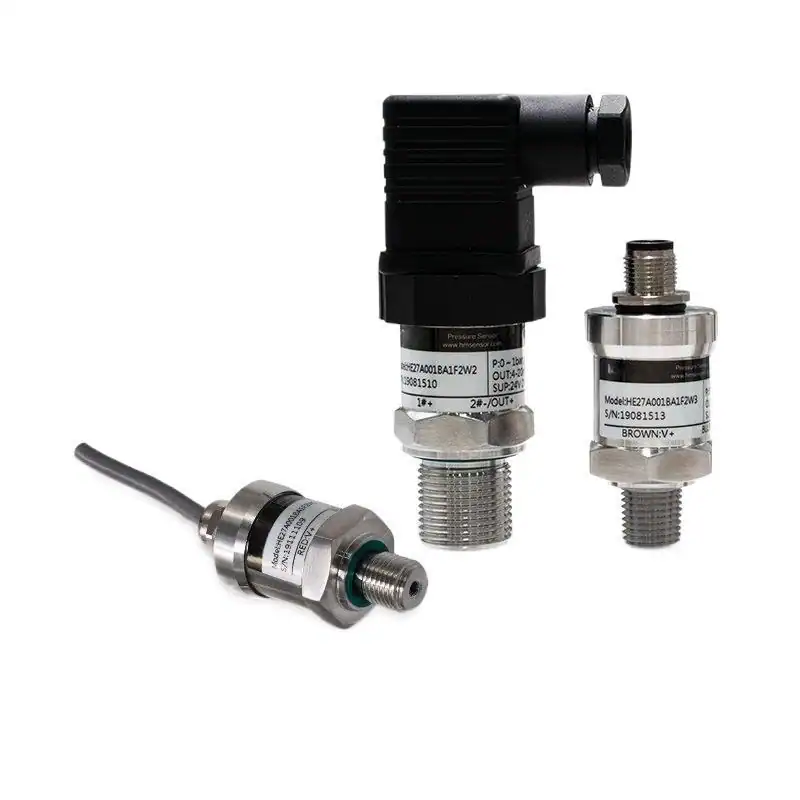
HE27 Vacuum & Absolute Pressure Sensor
The OEM sensor form of the same measurement, for absolute and vacuum ranges built into your own equipment rather than mounted as a field transmitter.
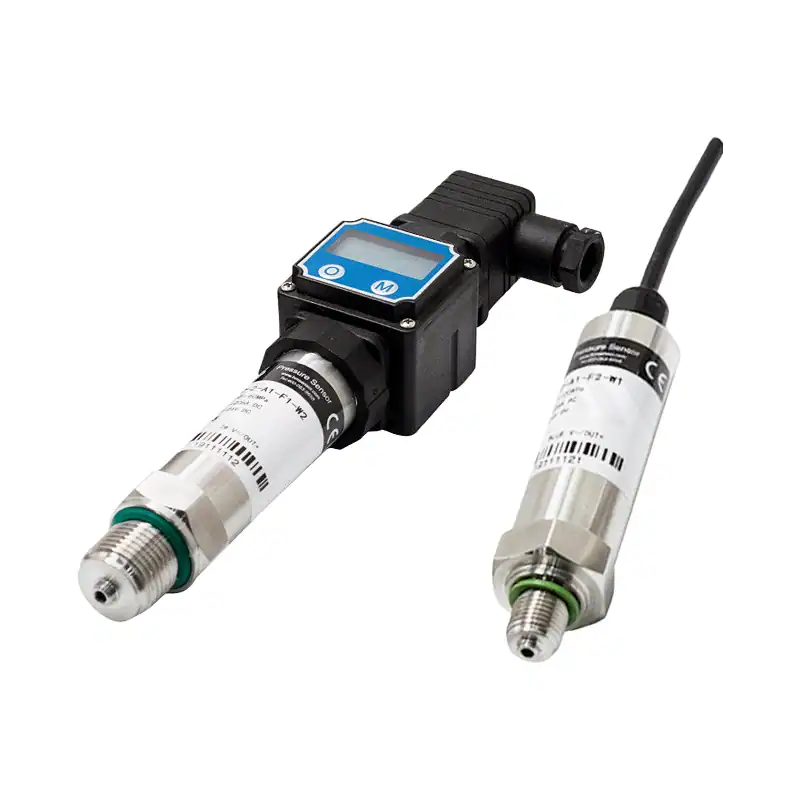
HM20 General Purpose Pressure Transmitter
Gauge or absolute ranges with ±0.25 % FS and a 4–20 mA output, suited to lines that cross between vacuum and positive pressure.