CYG410 — Free-Field Dynamic Pressure Sensor
CYG410 Free-Field Pressure Sensor: Outdoor Blast Wave Measurement
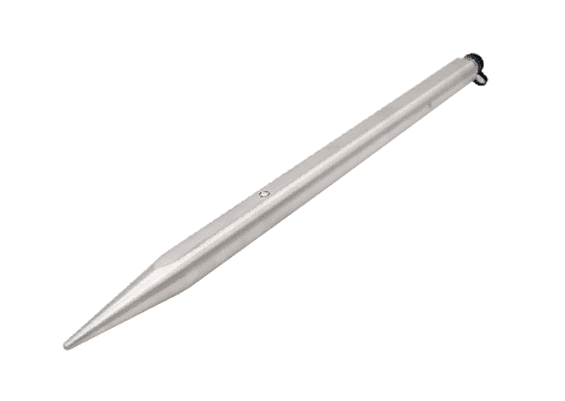
Slim Φ6.5×406 mm teardrop probe for low-distortion wavefront capture in outdoor explosive shock-wave testing. 300 to 800 kPa range, 150-180 kHz natural frequency, 1 µs rise time. Cavity-less flush diaphragm. Anti-IR optical option for near-field detonation environments.
What a Free-Field Pressure Sensor Is
A free-field pressure sensor measures a pressure wave travelling through air or water without being mounted to a wall, manifold, or pressure tap. The sensor sits in the path of the wave on a slim probe, and the wave passes over the sensing diaphragm rather than reflecting off a structure. That is the only way to record the true incident wavefront in an outdoor blast or shock test — any wall-mount adds reflection and structural ringing that distort the signal.
The CYG410 is the low-pressure variant of the CYG400 piezoresistive dynamic pressure family. The probe is a streamlined teardrop, Φ6.5 mm at the head and 406 mm long. Two design choices keep distortion low: the form factor is slender enough that the probe barely perturbs the incoming wave, and the diaphragm sits flush with the probe surface in a cavity-less mount, so there is no internal acoustic resonance to corrupt the rising edge.
Six ranges from 300 kPa to 800 kPa cover the low-amplitude end of outdoor blast measurement — the regime where ground-level pressure from a moderate detonation, an industrial-explosion safety test, or a structural-loading study lives. Above 1 MPa, switch to the CYG411 medium-pressure free-field; above 20 MPa, the CYG412.
CYG410 Technical Specifications
| Group | Parameter | Value |
|---|---|---|
| Sensing | Technology | MEMS piezoresistive silicon strain bridge |
| Diaphragm | Stainless steel, fully flush, cavity-less | |
| Anti-light interference | Anti-IR plus visible-light optical protection (option F4) | |
| Range & Speed | Range span | 300 / 400 / 500 / 600 / 700 / 800 kPa |
| Natural frequency | 150 kHz (300–600 kPa) or 180 kHz (700–800 kPa) | |
| Rise time | 1 µs, all ranges | |
| Accuracy | Sensor accuracy | 0.25% / 0.5% FS |
| Non-linearity | ±0.2% to ±0.5% FS | |
| Zero drift | 0.15 mV / 8 h or 0.2 mV / 8 h | |
| Zero-point temperature coefficient | 0.03% / 0.05% FS/°C | |
| Sensitivity temperature coefficient | 0.03% / 0.05% FS/°C | |
| Power & Output | Power | Sensor: 1 mA or 1.5 mA constant current, or 12 VDC constant voltage. CYG1410 transmitter variant: ±15 VDC, or 12–24 VDC |
| Output | Differential mV signal (sensor); 0–5 V amplified standard signal (CYG1410 transmitter variant) | |
| Mechanical | Probe form | Streamlined teardrop, Φ6.5 mm head × Φ12 mm body × 406 mm length |
| Mounting thread | M20×1.5 | |
| Wetted material | Silicon + stainless steel; non-corrosive media | |
| Environment | Operating temp | -40 to +85°C standard; -55 to +125°C extended |
| Compensation temp | 0 to +70°C (custom ranges available on request) | |
| Transient peak temp | +2000°C / 20 ms (with optional protective measures) |
Range Selection: Six Models, One Probe Form
The CYG410 ships with six pre-defined ranges. The probe geometry, mounting thread, and rise time are identical across all six — only the sensing element is range-matched. Pick the range whose full-scale value sits ~30-50% above the expected peak amplitude of your event, so you keep both headroom and bridge sensitivity.
| Range | Natural frequency | Rise time | Typical event |
|---|---|---|---|
| 0–300 kPa | 150 kHz | 1 µs | Far-field blast, low-amplitude shock-tube work |
| 0–400 kPa | 150 kHz | 1 µs | Outdoor moderate detonation, structural-loading test |
| 0–500 kPa | 150 kHz | 1 µs | Industrial-explosion safety study, gas deflagration |
| 0–600 kPa | 150 kHz | 1 µs | Mid-energy detonation, gel impact |
| 0–700 kPa | 180 kHz | 1 µs | Higher-energy LP detonation; faster response |
| 0–800 kPa | 180 kHz | 1 µs | Top of CYG410 band; transition to CYG411 above 1 MPa |
The 700 kPa and 800 kPa ranges step the natural frequency up to 180 kHz, so the rising edge captures slightly faster transients without changing the 1 µs rise-time spec. If your event peaks above 800 kPa or your wave needs a sub-microsecond rise time, step up to CYG411.
Where the CYG410 Is Used
The 300-800 kPa low-pressure free-field band (the cased-mount counterpart for indoor / fluid-contained measurement in the same pressure range is the CYG405) corresponds to a specific class of events — moderate-energy outdoor pressure waves where amplitude is well below 1 MPa but rising edge is still in the microsecond regime.
Outdoor Blast Wavefront
Far-field detonation pressure profiles, free-air shockwave studies, structural-loading tests where the probe sits at distance from a moderate-energy charge.
Industrial-Explosion Safety
Gas-deflagration vessel testing, dust-explosion characterization, vent-panel certification work where peak pressures sit between 200-600 kPa.
Structural-Loading Tests
Reflected-pressure measurements on wall panels, blast-loading on civil structures, soil-shock studies in instrumented test arenas.
Shock-Tube Research
University and lab shock tubes operating in the kPa range — characterizing diaphragm-rupture profiles, propagating wave fidelity, gas-dynamic transients.
Ballistic-Gel & Medical
Blast-injury research into ballistic gelatin or tissue surrogate, where transmitted pressure stays in the kPa band but rise time is sub-millisecond.
Energetic-Materials Screening
Small-scale propellant or pyrotechnic characterization where output sits below 1 MPa and the test arena allows free-field probe placement.
Installation: Probe Orientation and Mounting
A free-field probe gives a clean reading only when it is oriented and supported correctly. Three rules cover most outdoor blast installations.
Wave alignment. Point the Φ6.5 mm head end toward the source. The streamlined teardrop is shaped so that the wavefront hits the head perpendicular to the diaphragm and the shaft trails away — that minimizes diffraction and reflection at the diaphragm. Off-axis placement of more than ~15° introduces angle-dependent error in peak amplitude.
Mount support. Use a ground stake, a wave-aligned tripod, or a mast clamp at the probe’s threaded mid-section. Clamp on the M20×1.5 thread, not on the probe shaft — clamping on the shaft adds bending mode to the probe and corrupts the rising edge with mechanical resonance. Keep the cable run away from the line-of-sight to the source.
Standoff distance. Place the probe at the radial distance you want to characterize. For repeatability, fix the probe-to-source distance precisely and record it with the test — pressure scales steeply with distance in the near-to-mid field, so a 10% distance error becomes a 20-30% pressure error. The 406 mm probe length lets you mount the support far enough behind the head that the support structure does not interfere with the wave.
CYG410 Ordering Code
The CYG410 sensor and its CYG1410 transmitter sibling share the same selection scheme. Pick the model first, then walk down the segments. Sensor variants use S4 / S7 (mV out); the CYG1410 transmitter variant uses S11–S14 (0–5 V amplified out).
CYG <410 / 1410> (range) <accuracy> <power+output> <cable> <mount> <anti-IR> <custom>
| Segment | Code | Meaning |
|---|---|---|
| Model | 410 / 1410 | Sensor (mV out) or CYG1410 transmitter (0–5 V amplified) |
| Range | 300 / 400 / 500 / 600 / 700 / 800 | Full-scale value in kPa |
| Accuracy | P3 | 0.25% FS |
| P4 | 0.5% FS | |
| P5 | 1.0% FS (CYG1410 transmitter only) | |
| Power + Output | S4 | mV out / 1 mA or 1.5 mA constant current (sensor) |
| S7 | mV out / 12 VDC constant voltage (sensor) | |
| S11 | 0–5 V / 12–24 VDC / 120 kHz BW (CYG1410) | |
| S12 | 0–5 V / ±12 VDC or ±15 VDC (CYG1410) | |
| S13 | 0–5 V / ±12 VDC or ±15 VDC / 100 kHz BW (CYG1410) | |
| S14 | 0–5 V / ±12 VDC or ±15 VDC / 200 kHz BW (CYG1410) | |
| Cable / Output | C1 | Direct lead |
| C2 | Aviation connector | |
| C3 | Round connector | |
| C4 | IP68 waterproof box exit | |
| Mount | A1 | M20×1.5 (standard) |
| A6 | User-defined thread | |
| Anti-IR | F4 | Anti-IR plus visible-light optical protection |
| Custom | Q | Custom selection sheet (special temperature, custom thread, etc.) |
Worked example (sensor): CYG 410 (0–500 kPa) P3 S4 C2 A1 F4 Q — sensor variant, 0–500 kPa range, 0.25% accuracy, mV output on 1 mA constant current, aviation connector, M20×1.5 standard mount, anti-IR optical, custom selection sheet attached.
Worked example (transmitter): CYG 1410 (0–500 kPa) P4 S12 C4 A1 F4 Q — CYG1410 transmitter variant, 0–500 kPa range, 0.5% accuracy, 0–5 V output on ±15 VDC, IP68 waterproof connector, M20×1.5, anti-IR optical, custom sheet.
CYG410 FAQ
Technical Support
Three background guides for engineers specifying or commissioning a CYG410 free-field probe. Open in a new tab; the deep-dives complement the spec-and-selection focus of this page.
Ready to Specify a CYG410?
Send us the expected peak amplitude, the radial distance to the source, the ambient temperature range, and whether near-field IR flash is in play. Our pressure-instrument engineers will reply with a CYG410 range, ordering code, and lead time.
Our engineers typically respond within 12 business hours with detailed technical specifications.