Instrumentation Tool
kPa to PSI Converter
Convert kilopascals to pounds per square inch with the exact factor — plus a gauge-vs-absolute note, a common instrument-range table, and the rounding rule that keeps a calibration sign-off honest.
kPa ↔ PSI Converter
Type a value in either box — the other updates live. The reference selector only labels the result (gauge / absolute); it does not change the number, because a unit conversion never changes the pressure reference (see below).
Kilopascals are the SI unit you meet on most ISO and European instrument datasheets; psi is still the unit on US field gauges, pump nameplates, and calibration sign-off sheets. The conversion itself is a single multiply — the value of a converter built for instrument work is everything around the multiply: keeping the gauge/absolute reference straight, choosing how many decimals a calibration record should carry, and knowing which instrument range a converted value lands in.
The conversion factor, and where it comes from
One pascal is one newton per square metre. One psi is one pound-force per square inch. Working the units through gives an exact ratio:
1 kPa = 0.14503773773 psi
1 psi = 6.8947572932 kPa (since 1 psi = 6 894.757 Pa)
So to go from kPa to psi you multiply by 0.145038; to reverse it, multiply psi by 6.89476. Those two constants are reciprocals of each other — if your spreadsheet uses 0.145 and 6.895 you have already introduced a rounding error before you start, which matters at the high end of a range.
Common instrument ranges, converted
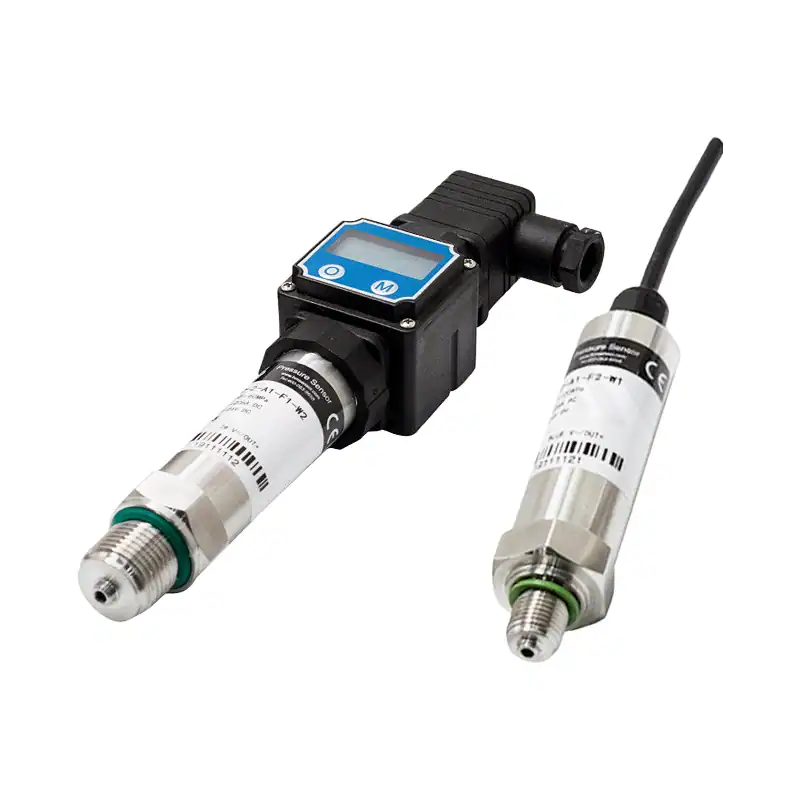
Most of the time you are not converting an arbitrary number — you are converting a transmitter’s range from a datasheet into the psi your work order or US gauge expects. These are the ranges we see most often on general-purpose transmitters (for reference, the HMK HM20 covers 5 kPa to 100 MPa):
| Range (kPa) | Range (psi) | Typical use |
|---|---|---|
| 0–100 kPa | 0–14.504 psi | Low-pressure / tank, HVAC duct static |
| 0–160 kPa | 0–23.206 psi | Pump suction, low hydraulic |
| 0–250 kPa | 0–36.259 psi | Building water, compressed-air headers |
| 0–600 kPa | 0–87.023 psi | Process water, cooling loops |
| 0–1000 kPa (1 MPa) | 0–145.04 psi | General industrial process |
| 0–1600 kPa (1.6 MPa) | 0–232.06 psi | Steam, higher process |
Reading a range this way also tells you whether a converted value even fits a transmitter you already own — a 0–600 kPa unit tops out at 87 psi, so a 120 psi line needs a different range, not a rescale.
Converting units is not converting reference
This is the mistake a plain number converter cannot catch. kPa and psi are both just units of pressure; gauge (G) and absolute (A) are the reference the pressure is measured against. Changing the unit never changes the reference:
| You have | Convert to | You get |
|---|---|---|
| kPaG (gauge) | psi | psig (still gauge) |
| kPaA (absolute) | psi | psia (still absolute) |
Rounding and calibration sign-off
For a quick field check, one decimal is plenty. For a calibration record it can quietly cost you accuracy. Take 100 kPa → 14.5038 psi. If the indicator or work order only allows one decimal (14.5 psi), you have rounded away 0.0038 psi — about 0.026% of that 14.5 psi value. On a transmitter rated 0.075% of span, a 0.026% rounding error has eaten a third of your accuracy budget before the instrument is even in the loop.
Rule of thumb: carry at least two decimals (and ideally match the resolution of the device you are signing off against) whenever the converted psi value is the number of record. Use one decimal only for orientation, never for a calibration certificate.
Quick reference table (kPa → psi)
| kPa | psi | kPa | psi |
|---|---|---|---|
| 1 | 0.145 | 200 | 29.008 |
| 5 | 0.725 | 250 | 36.259 |
| 10 | 1.450 | 300 | 43.511 |
| 20 | 2.901 | 400 | 58.015 |
| 50 | 7.252 | 500 | 72.519 |
| 100 | 14.504 | 600 | 87.023 |
| 101.325 | 14.696 | 800 | 116.030 |
| 150 | 21.756 | 1000 | 145.038 |
FAQ
What is 100 kPa in psi?
100 kPa = 14.5038 psi. If it was a gauge reading (100 kPaG) the answer is 14.5038 psig.
Is 1 bar the same as 100 kPa?
Almost — 1 bar = 100 kPa exactly, which is 14.5038 psi. (Standard atmosphere is 101.325 kPa, slightly more than 1 bar.)
How do I convert psi back to kPa?
Multiply psi by 6.89476. Use the same calculator above — type into the psi box and the kPa box updates live. For other units, the pressure unit converter covers bar, MPa, mbar and more.
Recommended HMK transmitters
Related tools & reading
• psi to kPa Converter (the reverse) • Pressure Unit Converter (all units) • psi to bar • MPa to psi • kPa to bar
• All HMK engineering tools