Absolute, Gauge & Vacuum Pressure Converter
Convert a pressure between absolute, gauge and vacuum references using local atmospheric pressure or altitude — and see why a gauge zero is not an absolute zero.
Most pressure converters only change the unit — psi to bar, kPa to mbar. This one changes the reference, which is a different and more error-prone job. A gauge transmitter reads zero at local atmosphere; an absolute transmitter reads zero at a perfect vacuum; a vacuum gauge reads how far below atmosphere you are. Mix them up and a reading can be off by a full atmosphere — about 14.7 psi at sea level, and noticeably less on high ground. Enter one value, tell the tool its reference and the local atmosphere, and it returns the other two.
The three reference datums
Every pressure number is measured from a zero, and there are three zeros in common use. Absolute pressure is measured up from a perfect vacuum, so it can never be negative; it is what thermodynamics, vacuum work and altitude-independent measurements need. Gauge pressure is measured from whatever the local atmosphere happens to be right now, so a gauge transmitter open to air reads zero by definition. Vacuum is just gauge pressure expressed as a positive number when the process is below atmosphere. The bridge between them is one equation:
Pabsolute = Pgauge + Patmosphere
Read it the other way and gauge pressure is absolute minus atmosphere, which goes negative the moment you drop below atmospheric — that negative gauge value, flipped to positive, is the vacuum reading.
Why a gauge zero is not an absolute zero
Because a gauge transmitter references the local atmosphere, its readings ride up and down with whatever that atmosphere is — and atmosphere falls with altitude. At sea level the air pushes with 101.325 kPa, or 14.70 psia. The tool computes thinner air with the US Standard Atmosphere relation:
Patm = 101.325 × (1 − 2.25577×10⁻⁵·H)5.2559 kPa
| Location | Altitude | Atmosphere | Gauge 0 reads (abs) | Gauge 50 psi reads (abs) |
|---|---|---|---|---|
| Sea level | 0 m | 101.33 kPa / 14.70 psia | 14.70 psia | 64.70 psia |
| Denver | 1,609 m | 83.43 kPa / 12.10 psia | 12.10 psia | 62.10 psia |
| Mexico City | 2,240 m | 77.15 kPa / 11.19 psia | 11.19 psia | 61.19 psia |
The practical consequence is sharp. A gauge transmitter reading 50 psi in Denver is sitting at 62.10 psia, while the same gauge reading at sea level is 64.70 psia — a 2.60 psi difference that comes purely from the thinner air, not from the process. On a low-range or leak-test measurement where a couple of psi matters, that is the difference between a pass and a fail, and it is exactly why altitude-sensitive and weather-independent jobs are specified with an absolute transmitter instead of a gauge one.
The sealed-gauge trap
There is a fourth datum that catches people: sealed gauge. A sealed-gauge transmitter is referenced not to live atmosphere but to a fixed sealed chamber, usually one standard atmosphere. That is convenient for high-pressure hydraulics where a fraction of a bar is noise, but on a low range at altitude it bakes in a fixed offset. A sealed-gauge cell referenced to 101.3 kPa, used at Denver where the real atmosphere is 83.4 kPa, carries a built-in 17.9 kPa bias — nearly 18% of a 100 kPa span. For low ranges, choose true gauge or true absolute and know which one you have.
Vacuum units without the traps
Vacuum is where unit and datum errors compound. A reading of “25 inHg vacuum” is a gauge value — 25 inHg below local atmosphere — not an absolute pressure. At sea level that is 25 ÷ 29.92 × 14.696 = 12.28 psi below atmosphere, so the absolute pressure is 14.70 − 12.28 = 2.42 psia. Compare that with “25 inHgA”, which is an absolute 25 inHg, or about 12.28 psia — five times higher. The two get mixed constantly. The rule: a vacuum-gauge number tells you how far down from atmosphere you are, so you subtract it from atmosphere to get absolute; an absolute number already starts from a perfect vacuum and needs no atmospheric term. This converter keeps the two separate so you do not subtract twice or not at all.
Choosing gauge, absolute or compound — and the HMK cell for it
The datum is a selection decision before it is a conversion. If the measurement must be independent of weather and altitude — vacuum process control, absolute leak detection, pharmaceutical or aerospace work — specify absolute. The HMK HM27 vacuum & absolute transmitter is built for exactly this, with HM27G negative-gauge, HM27A silicon-absolute and HM27CA capacitive-absolute variants covering ranges from 0.02 Pa to 1 MPa at ±0.1% FS; the OEM-oriented HE27 vacuum & absolute sensor serves the same datum in an embeddable form. For ordinary process pressure where the reference is local atmosphere, a gauge instrument such as the HM20 general-purpose transmitter is the right and cheaper choice. When the process swings above and below atmosphere, a compound range spans both. Once the datum and range are set, the pressure unit converter handles the unit side, and the full HMK pressure range lists the options.
Frequently Asked Questions
What is the difference between psia and psig?
psia is pressure measured from a perfect vacuum (absolute); psig is measured from local atmosphere (gauge). They differ by atmospheric pressure: psia = psig + atmospheric pressure, about 14.7 psi at sea level and less at altitude.
Does a gauge transmitter reading change with the weather?
Yes, slightly. A gauge transmitter references live atmosphere, so its absolute reading drifts with barometric pressure and altitude. Where that drift matters, an absolute transmitter removes it.
How do I convert a vacuum reading to absolute pressure?
Subtract the vacuum reading from the local atmospheric pressure. For example 25 inHg of vacuum at sea level is 14.70 − 12.28 = 2.42 psia. Do not confuse “inHg vacuum” with “inHg absolute”.
What atmospheric pressure should I use at altitude?
Use the local value. This tool computes it from altitude with the US Standard Atmosphere model — for instance 83.4 kPa at Denver’s 1,609 m versus 101.3 kPa at sea level.
Recommended Pressure Transmitters
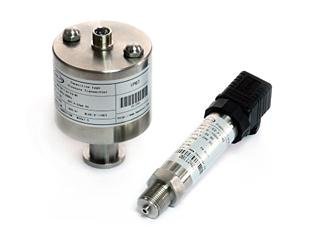 HM27Vacuum & Absolute TransmitterAbsolute datum, 0.02 Pa to 1 MPa, ±0.1% FS.
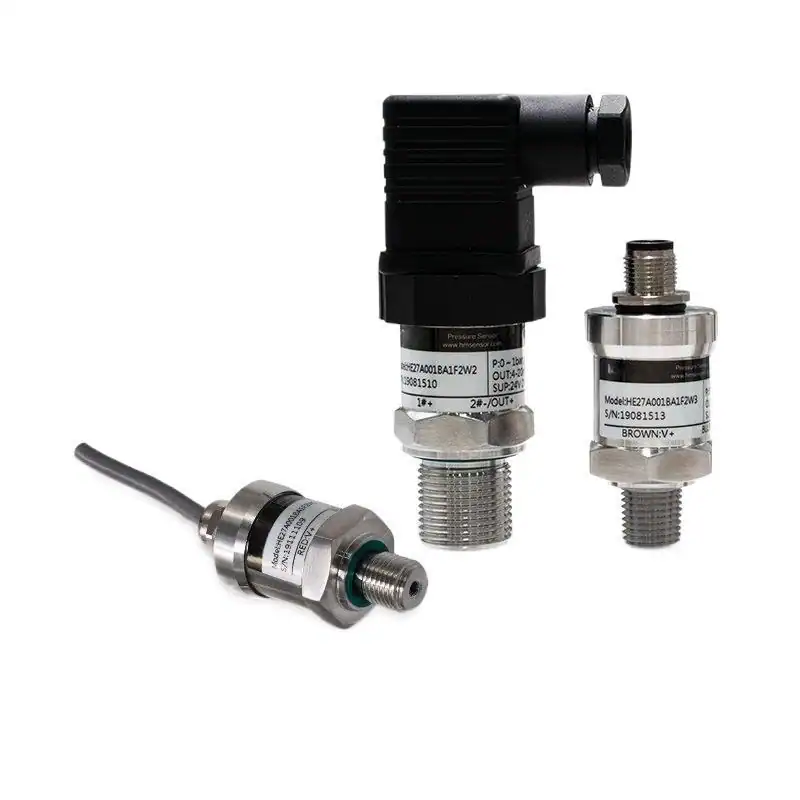 HE27Vacuum & Absolute OEM SensorSame absolute datum, embeddable form.
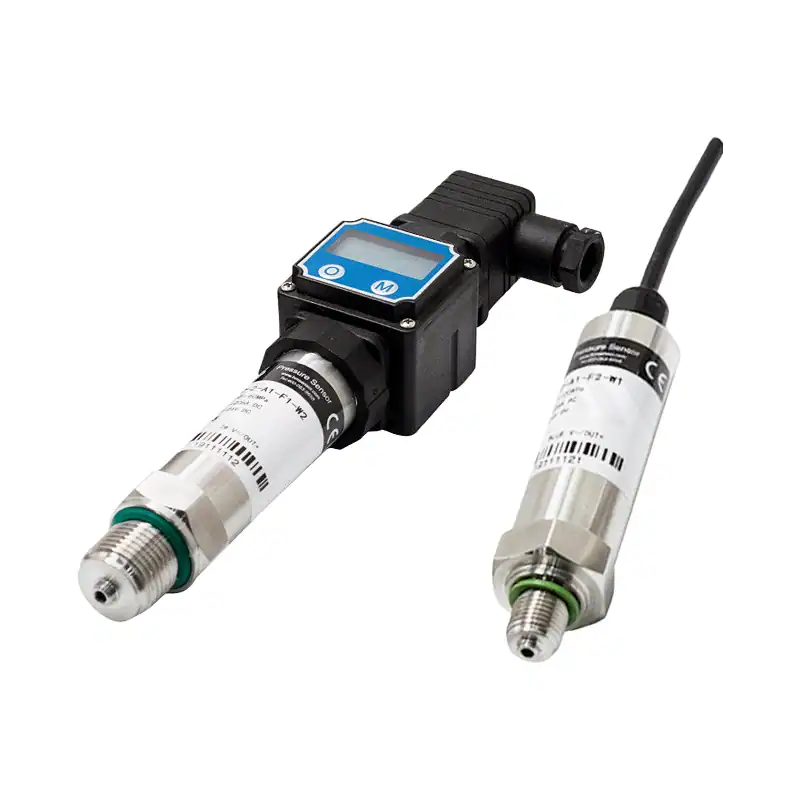 HM20General-Purpose (Gauge)Gauge datum for ordinary process pressure.
Related Tools
Specifying gauge vs absolute for a low-range or vacuum job?
Tell us the process, range, and site altitude, and we will confirm the right reference datum and HMK pressure transmitter.