DP Level Transmitter Calibration Calculator
Find the LRV and URV for a differential-pressure level transmitter on an open or closed tank — wet leg, dry leg, zero suppression and zero elevation, in the units your HART configurator wants.
A differential-pressure transmitter does not measure level directly. It measures the pressure difference between a high-pressure tap near the bottom of the tank and a low-pressure reference, then you map that difference onto a 4–20 mA span by setting two range values: the LRV (the level that gives 4 mA) and the URV (the level that gives 20 mA). The arithmetic is short, but the reference leg and the mounting position shift the zero, and that is where most calibrations go wrong. This calculator does the static-pressure balance for you and tells you whether the result is a zero suppression or a zero elevation.
How the calculation works
The transmitter sees the high side minus the low side: DP = HP − LP. On the high side the process liquid column presses down with a head of ρ·g·h, where h is the height of liquid above the cell. On the low side, an open tank simply vents to atmosphere (zero gauge), while a closed tank carries a filled reference leg that presses down with its own constant column. Put together, the two range values are:
LRV = ρp·g·(levelmin + offset) − ρfill·g·Hwetleg
URV = ρp·g·(levelmax + offset) − ρfill·g·Hwetleg
The wet-leg term is a constant: it shifts both range values by the same amount but never changes the span. That is the single most useful fact in DP level work — the span is always ρp·g·(levelmax − levelmin), no matter what the reference leg or the mounting offset does. The leg and the offset only slide the zero up or down, which is exactly what zero suppression and zero elevation mean.
Zero suppression vs zero elevation
These two terms confuse more commissioning engineers than any other pair in level measurement, yet the rule is one line. If the LRV comes out positive, you have zero suppression: the cell sits below the datum, so even at empty there is a positive head pushing on the high side, and you suppress it so 4 mA still lands at empty. If the LRV comes out negative, you have zero elevation: a wet reference leg outweighs the process head at low level, the cell sees a net negative DP, and you elevate the zero so 4 mA lands where the operator calls empty.
| Case | Process · span | Leg / offset | LRV | URV | Type |
|---|---|---|---|---|---|
| Open, direct-mount | Water · 0–2 m | offset 0 | 0 kPa | 19.61 kPa | None |
| Open, cell below tap | Water · 0–2 m | offset 0.3 m | +2.94 kPa | +22.56 kPa | Suppression |
| Closed, wet leg | Water · 0–2 m | leg 2.5 m | −24.52 kPa | −4.90 kPa | Elevation |
Why a negative LRV is correct, not reversed wiring
The closed-tank row above is the one that stops people. They calculate an LRV of −24.5 kPa, assume they have crossed the high and low connections, and start chasing a wiring fault that does not exist. On a wet-leg closed tank the reference leg is a full, fixed column of fill fluid — here 2.5 m of water-equivalent, about 24.5 kPa — pressing permanently on the low side. At empty, the high side has almost nothing to push back with, so the net DP is strongly negative. That negative number is the LRV, and it belongs in the configurator exactly as calculated. Enter it, set the matching URV, and the loop will read true. If you “fix” the sign, you move the entire calibration off by the reference-leg head and the tank reads full when it is empty.
The fill-fluid drift nobody quotes
Because the wet-leg term is treated as a constant, every error in that constant feeds straight into the zero. If the fill fluid changes density — a glycol leg warming with the seasons, or the wrong fill used at install — by just 1% on a 2.5 m water-equivalent leg, the bias shifts by 0.01 × 1000 × 9.81 × 2.5 ≈ 0.245 kPa. Against a 19.6 kPa span that is a 1.25% of full-scale zero shift that no amount of re-ranging will remove, because the transmitter is faithfully reporting a reference leg that is no longer what you calibrated for. This is why a wet leg should be filled with a stable, known fluid and topped up on a schedule, and why condensing-vapour service often pushes engineers to a sealed remote-diaphragm system instead.
Choosing dry leg, wet leg, or remote seals
A dry leg is the simplest reference and the right choice when the vapour above the liquid will not condense — the low side stays empty and contributes nothing. The trap is condensable vapour: it slowly fills a “dry” leg with liquid, turning it into an uncontrolled wet leg that drifts the zero over days. A wet leg deliberately fills the reference side with a stable fluid so the column is known and constant, which suits steam drums and condensing service. When the process is corrosive, viscous, under vacuum, or runs hot enough to gas off the fill, a remote-seal diaphragm with capillary isolates the cell and removes the leg entirely — at the cost of added temperature sensitivity in the capillary. Pick the reference system first; only then does the LRV/URV arithmetic mean anything.
Matching the HMK DP transmitter
On a closed tank the cell also sees the full static line pressure on both sides, so the transmitter has to tolerate that working pressure while resolving a much smaller differential — the reason DP level work leans on rangeable smart cells rather than low-cost gauge transmitters. The HM3051 smart DP transmitter carries HART, so once this calculator gives you the LRV and URV you can key them straight in and trim in the field; the HM1151 capacitive DP cell handles high static line pressure on sealed tanks; and the HM30 micro DP transmitter covers low-head open-tank and interface duty. Before you commit a range, run the URL and the calibrated span through the turndown & accuracy calculator to confirm the installed accuracy still holds at the turndown your tank demands. The full lineup sits on the HMK differential pressure transmitter page, and if a DP cell is overkill, a submersible probe from the level transmitter range may be the cleaner fit on a vented tank.
Frequently Asked Questions
Why is my DP level LRV negative?
On a closed tank with a wet reference leg, the filled low-side column outweighs the process head at low level, so the net differential pressure is negative. That negative value is the correct LRV (a zero elevation) and should be entered as calculated — it is not a sign of reversed wiring.
Does the wet leg change the span?
No. The reference leg and the mounting offset shift both the LRV and the URV by the same constant, so the span stays ρ·g·(levelmax − levelmin). They move the zero, never the span.
When should I use a dry leg instead of a wet leg?
Use a dry leg only when the vapour above the liquid will not condense into it. On condensing or steam service a dry leg slowly fills and drifts; a controlled wet leg or a remote-seal system is more stable.
Which pressure unit should I enter the range in?
Use whatever your configurator expects — the calculator outputs kPa, mbar, inH2O, psi and mmH2O. North American DCS systems usually take inH2O; many smart transmitters default to kPa.
Recommended DP Transmitters
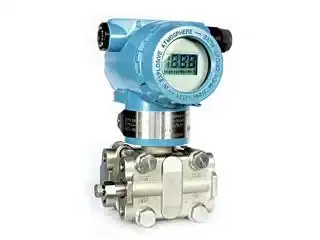 HM3051Smart DP Transmitter (HART)Key in the LRV/URV and trim in the field.
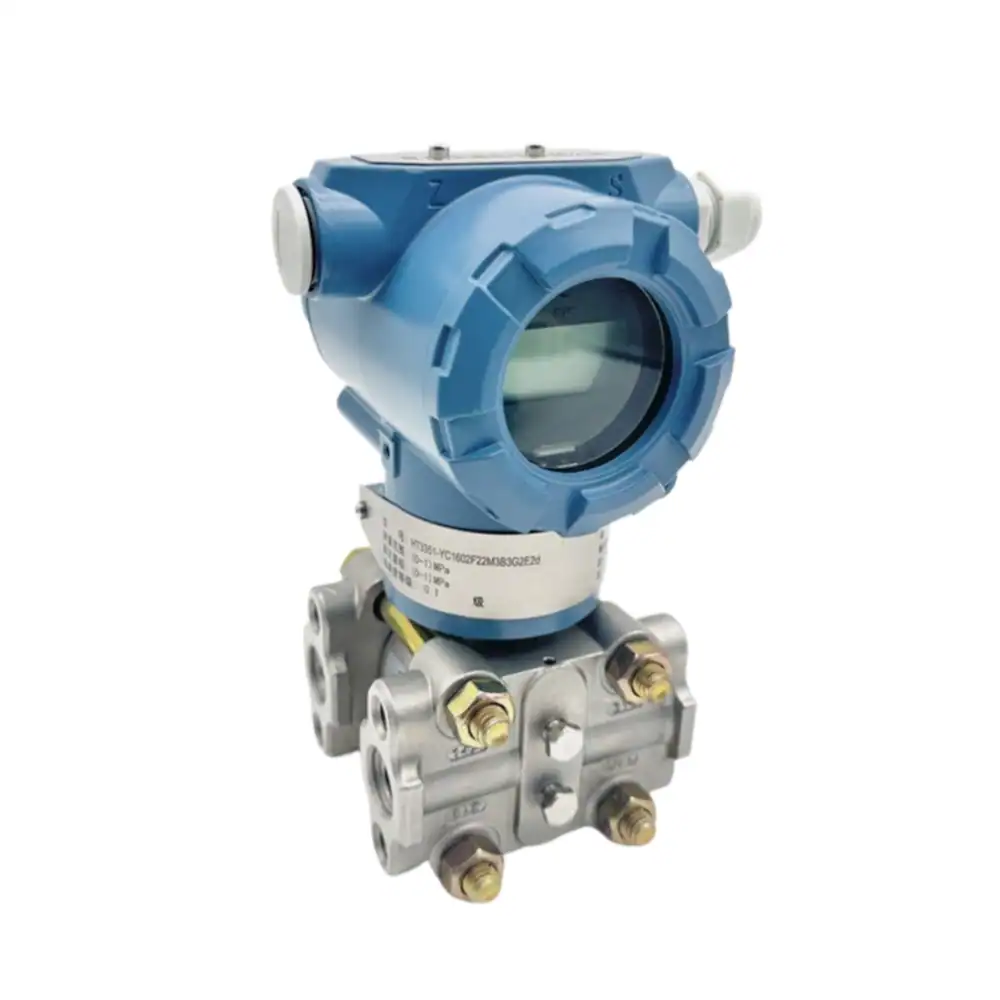 HM1151Capacitive DP CellHigh static line pressure on sealed tanks.
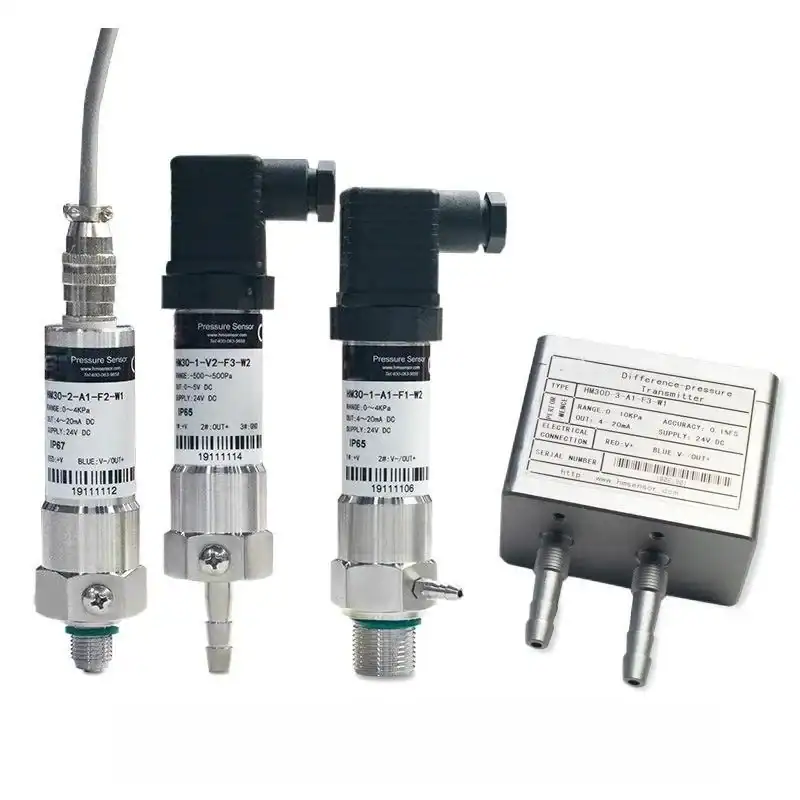 HM30Micro DP TransmitterLow-head open-tank and interface duty.
Related Tools
Calibrating a closed-tank or wet-leg level loop?
Send us the tank height, fill fluid, and mounting, and we will confirm the LRV/URV and the right HMK DP transmitter for the static pressure.