Industrial Temperature Gauges
Gas-Actuated Thermometer — WTZ / WTQ-280 100 mm Dial
All-mechanical dial thermometer with inert-gas capillary transmission. 100 mm dial face, -40 to +500 °C range, 1.5 or 2.5 accuracy class, capillary 1 to 20 m, stem 150 to 300 mm. WTQ version adds independent Hi and Lo electric contacts for direct alarm or contactor switching.
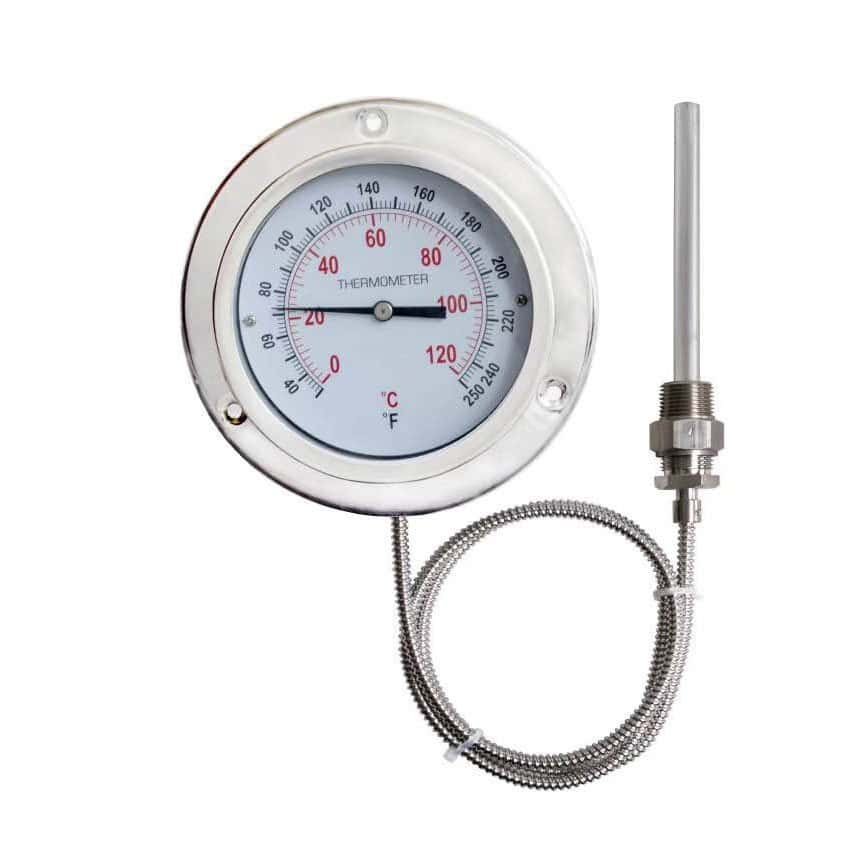
The WTZ-280 and WTQ-280 are gas-actuated industrial thermometers built around a sealed inert-gas fill. The fluid expands with temperature, pressurizes the Bourdon element behind the dial, and drives a mechanical pointer — no electronics, no power supply, no firmware. For process temperatures from −40 to +500 °C, this is the instrument refiners, chemical plants, and boiler houses reach for when the reading has to be local, readable from a walkway, and able to survive a loss-of-power event. The WTQ variant adds two SPDT electric contacts so the same gauge can drive an alarm, a shutdown, or a contactor directly — a single point solving both indication and safety.
Why Choose a Gas-Actuated Thermometer?
Three reasons field engineers specify WTZ / WTQ-280 over electronic transmitters for routine temperature indication.
All-Mechanical Reliability
Sealed gas fill + Bourdon tube + dial pointer. No power, no firmware, no calibration drift from electronics. Reads through a plant-wide power outage, through RF noise, and through any PLC reboot — the gauge simply does not care.
Remote Reading up to 20 m
Flexible capillary 1 to 20 m lets the dial live where operators walk — panel board, walkway, control room corner — while the bulb reads a reactor, a boiler header, or a tank far from daylight. No extension wire, no transmitter, no power loop.
Built-in Electric Contacts (WTQ)
WTQ-280 carries two SPDT contacts at 220 V AC / 1 A / 10 VA, inductive-free. Set one for high-alarm, one for low-alarm, and the dial runs an alarm bell or a contactor without a separate relay or PLC input. Indication and protection in one instrument.
WTZ-280 vs WTQ-280 — How to Choose
Same dial, same capillary system, same temperature envelope. The only real decision is whether the gauge needs to drive an alarm or contactor on its own.
| Attribute | WTZ-280 (Indication) | WTQ-280 (Indication + Contacts) |
|---|---|---|
| Output | Dial pointer only | Dial pointer + 2 × SPDT contacts |
| Contact rating | — | 220 V AC / 1 A / 10 VA, inductive-free |
| Process thread (standard) | M27×2 | M33×2 |
| Dial face | 100 mm, white face, black scale | 100 mm, white face, black scale, red setpoint pointers |
| Accuracy class | 1.5 or 2.5 | 1.5 or 2.5 |
| Needs external power? | No | Only the contact circuit is wired |
| Hazardous-area use | All-mechanical, suitable as display device | Contact circuit must go through certified barrier (Ex zone) |
| Typical application | Local readout only — tanks, walkways, panels | High / low alarm, direct contactor drive, bypass of PLC input |
Technical Specifications
Core envelope of the WTZ / WTQ-280 series. Long-capillary configurations (>12 m) ship with 200–300 mm stems; short-capillary models ship with 150–280 mm stems.
| Dial size | Φ100 mm (all variants) |
| Measuring range | −40 to +500 °C (sub-ranges listed below) |
| Accuracy class | 1.5 or 2.5 (per JB/T 9276 / EN 13190 equivalent) |
| Capillary length | 1 – 20 m (stainless armor, PVC jacket) |
| Stem length | 150 / 200 / 280 / 300 mm |
| Stem diameter | Φ8, Φ10, Φ13, Φ14 mm (copper or SS 304) |
| Fill medium | Sealed inert gas (N₂ / Xe for low-temp sub-ranges) |
| Process thread | M27×2 (WTZ), M33×2 (WTQ); others on request |
| Enclosure protection | IP55 standard, IP65 optional |
| Ambient temperature | −40 to +70 °C at the dial head |
| Contact rating (WTQ) | 220 V AC, 1 A, 10 VA (inductive-free) |
| Contact type (WTQ) | 2 × SPDT, independent Hi / Lo setpoints |
Stem & Capillary Options
Choose the stem diameter to match the thermowell bore and the fluid type; choose the capillary length to reach the dial location. Beyond 12 m of capillary, HMK fits a longer (200–300 mm) stem to keep the fill-volume ratio inside the accuracy envelope.
| Stem diameter | Standard material | Best for |
|---|---|---|
| Φ8 mm | Copper (stainless optional) | Low pressure water / oil systems, HVAC lines, small thermowells |
| Φ10 mm | Copper or SS 304 | General utility steam and hot-water service, boiler returns |
| Φ13 mm | SS 304 | Steam headers, pressurized lines up to ~4 MPa with well |
| Φ14 mm | SS 304 / 316 | Aggressive chemicals, condensate service, demanding Ex zone installs |
Capillary armor is 304 stainless braided with a PVC outer jacket; working ambient along the capillary route is −40 to +70 °C. Runs longer than 20 m are available by agreement but require custom ambient-temperature compensation and are rarely worth the added cost — at that distance, a 4–20 mA temperature transmitter is usually the right answer.
Operating Temperature Ranges
Standard scale spans. Pick the span that keeps your normal operating point near 50 % of full scale — accuracy class applies to the full scale, so a tighter range delivers a tighter absolute error.
| Standard range | Main scale divisions | Typical service |
|---|---|---|
| −40 to +40 °C | 1 °C | Cold storage, refrigeration plant, ambient lubricant tanks |
| 0 to +100 °C | 1 °C | Hot-water systems, HVAC return, cooling towers |
| 0 to +160 °C | 2 °C | LP steam lines, boiler feed, deaerator |
| 0 to +200 °C | 2 °C | Thermal oil systems, oil cooler outlets |
| 0 to +300 °C | 5 °C | MP steam, tar / heavy-oil service, process columns |
| 0 to +400 °C | 5 °C | Superheater outlet, compressor aftercoolers |
| 0 to +500 °C | 10 °C | High-pressure steam, reformer preheaters |
Configuration Options
Six build options cover almost every field installation. Each is selectable per purchase order — the rest are shipped as standard to shorten lead time.
Option 01
Dial Face & Scale
Φ100 mm as standard. White face with black graduations, tempered glass window. Mirrored scale, dual-unit (°C / °F), and red tell-tale pointer available on request.
Option 02
Stem Length
150, 200, 280 or 300 mm. Match the stem to the thermowell U-length, leaving ~10 mm clearance at the bottom of the well to prevent bulb contact.
Option 03
Bulb Diameter
Φ8, Φ10, Φ13 or Φ14 mm. Copper stem ships as standard for utility water and oil; SS 304 (or 316 by request) for steam, chemicals, and any Ex-zone install.
Option 04
Capillary Length
1 to 20 m, armored stainless braid with PVC jacket. Runs over 12 m pair with 200–300 mm stems; runs over 20 m are by agreement — usually better served by a 4–20 mA transmitter.
Option 05
Process Connection
M27×2 (WTZ) or M33×2 (WTQ) as standard. G1/2″ or NPT1/2″ on request. A mating thermowell is recommended for any pressurized or aggressive line.
Option 06
Contact Setpoints (WTQ)
Two SPDT contacts, independently adjustable from the front of the dial. Specify the initial Hi and Lo values — site engineers can re-set them later with the supplied adjustment key.
Ordering — The Six-Line Spec
A gas-actuated thermometer does not need a 20-line datasheet. Six lines on the purchase order cover the full bill-of-materials.
| Line | Field | Example value |
|---|---|---|
| 1 | Model | WTZ-280 or WTQ-280 |
| 2 | Measuring range | 0 – 200 °C |
| 3 | Accuracy class | 1.5 |
| 4 | Capillary length | 5 m |
| 5 | Stem (L × Φ) | 200 mm × Φ10 mm, SS 304 |
| 6 | Contact setpoints (WTQ only) | Hi 180 °C / Lo 60 °C |
Also state whether a thermowell is needed, the process connection if it differs from the standard M27×2 or M33×2, and the zone classification if the gauge sits in an Ex area.
Where Gas-Actuated Thermometers Work Best
Six industries where the WTZ / WTQ-280 outperforms an electronic alternative — not because it is more accurate, but because it survives the environment better and costs less to keep running.
Petrochemical & Refining
Crude preheat trains, reactor overhead, reboiler return lines. Capillary reaches the dial panel outside the blast zone; no conduit / junction box required.
Power Generation
Boiler feedwater, condensate, lube-oil headers, turbine bearing housings. WTQ contacts drive trip relays directly — the gauge survives EMI from large generators.
Chemical Plants
Reactor jackets, batch kettles, heat-transfer oil loops. SS 316 stem + thermowell handles chlorinated solvents, caustics, and dilute acids without drift.
Food & Beverage
CIP return lines, pasteurizer outlets, sterilization holding tubes. SS 316L stem + sanitary thermowell; the dial washes down without damage to electronics there are none.
HVAC & District Energy
Chilled-water risers, hot-water loops, cooling towers, district heating substations. 1 to 20 m capillary keeps dials on the operator panel while bulbs live at the equipment.
Steel & Metallurgy
Cooling-water circuits, lube-oil consoles, hydraulic reservoirs for rolling mills. The gauge reads through vibration, hot dust, and electric-arc noise that would trip a transmitter loop.
Related Products
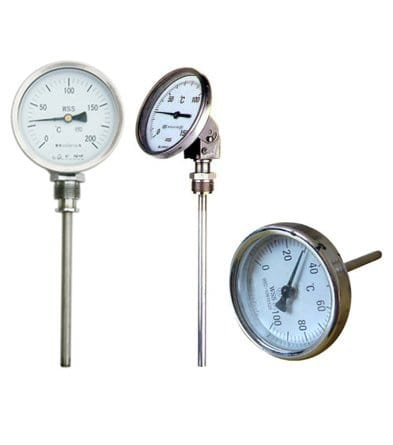
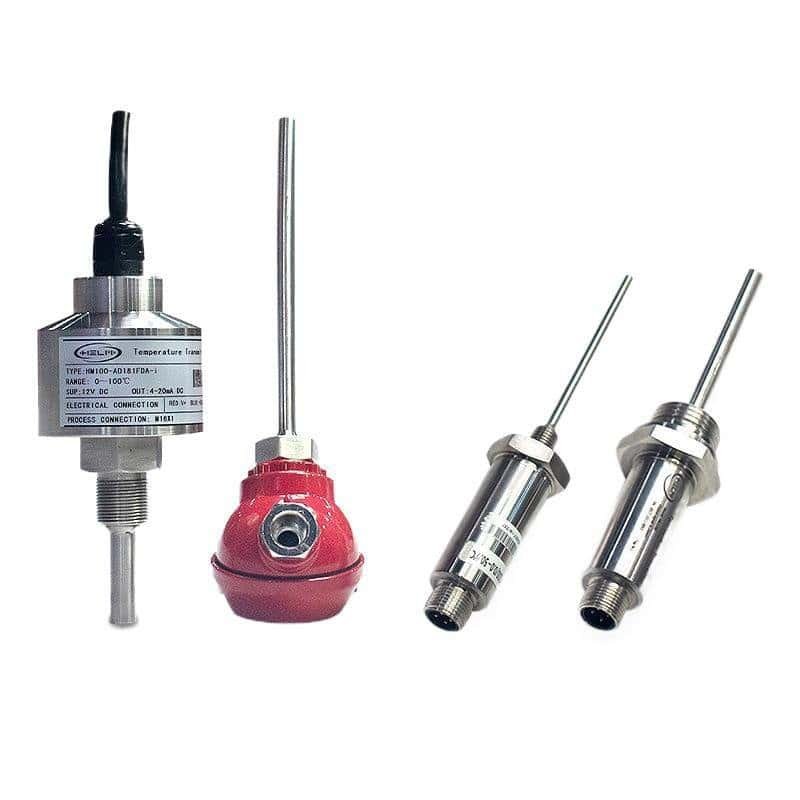
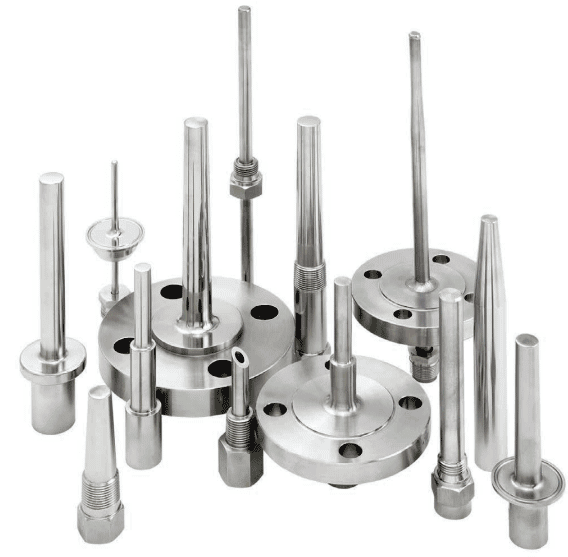
When the WTZ / WTQ-280 is not the right fit, one of these three HMK products usually is.
Frequently Asked Questions
Free Tool: RTD PT100 Resistance ↔ Temperature Calculator
Comparing a gas-actuated thermometer against a Pt100 RTD transmitter for the same point? Convert RTD resistance to temperature (or vice versa) in one click, and see the two-wire / three-wire / four-wire differences side by side.
Need a Custom Gas-Actuated Thermometer Configuration?
Send us the six-line spec — range, accuracy, capillary length, stem length, stem diameter, and (for WTQ) contact setpoints. We reply within one working day with a quotation, a data sheet, and a lead time.