CYG406 — High-Frequency Dynamic Micro-Pressure Sensor
CYG406 Micro-Pressure Dynamic Sensor: Small-Charge Detonation & Surface Pressure Fields
A near-flush micro-tube-cavity probe that reaches down into the kPa band without losing dynamic response. Absolute ranges 20 to 800 kPa, natural frequency up to 300 kHz, rise time to 0.5 µs. Low noise, high resolution, optional double-shielded twisted anti-interference cable for small-amplitude work near electrical noise.
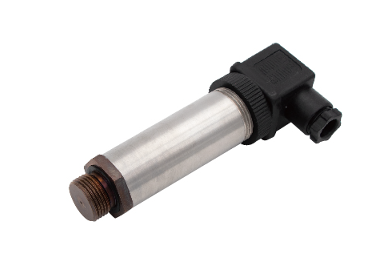
What the CYG406 Is Built For
The CYG406 is the micro-pressure member of the CYG400 high-frequency dynamic family. Its sensing element sits behind a micro-tube-cavity, near-flush stainless diaphragm, so it keeps a clean dynamic response while reaching into ranges other shock sensors cannot resolve. Where the free-field CYG410, CYG411, and CYG412 cover blast over-pressure from hundreds of kPa to 100 MPa, the CYG406 works the small-amplitude end: 20 to 800 kPa absolute, 1 to 600 kPa gauge.
That makes it the right tool for small-charge detonation, and for mapping the pressure field across a structural surface under dynamic load. A piezoresistive silicon strain bridge gives low noise and high resolution at these levels, and the optional double-shielded twisted cable keeps small signals clean when the test rig sits near motors, igniters, or switching gear.
CYG406 Technical Specifications
| Group | Parameter | Value |
|---|---|---|
| Sensing | Technology | MEMS piezoresistive silicon strain bridge |
| Diaphragm | Stainless steel, near-flush, micro-tube-cavity | |
| Cable option | Double-shielded twisted anti-interference cable | |
| Range & Speed | Absolute range | 20 / 50 / 100 / 150 / 300 / 400 / 800 kPa |
| Natural frequency | >5 to >300 kHz (range-matched) | |
| Rise time | 5 µs (20–50 kPa) down to 0.5 µs (400–800 kPa) | |
| Accuracy | Sensor accuracy | 0.25% / 0.5% |
| Non-linearity | ±0.2% to ±0.5% | |
| Zero / sensitivity temp drift | 0.02 to 0.03 %FS/°C | |
| Electrical | Supply (sensor) | Constant current 1 / 1.5 mA, or constant voltage 12 VDC |
| Output | Millivolt (raw); 0–5 V with wideband amplifier | |
| Transmitter version | CYG1406, ±15 VDC or 12–24 VDC supply | |
| Environment | Operating temp | −40 to +85 °C, or −55 to +125 °C (special fill) |
| Compensated temp | 0 to +70 °C (custom available) |
Range Selection: Seven Ranges, One Probe Form
The CYG406 ships in seven pre-matched ranges. The probe geometry, M20×1.5 thread, and near-flush diaphragm are identical across all of them; only the sensing element and its natural frequency change with range. Pick the range whose full scale sits roughly 30 to 50% above the expected peak amplitude, so you keep both headroom and bridge sensitivity. Lower ranges trade frequency for resolution, which is the right trade for small-amplitude micro-pressure work.
| Absolute range | Gauge range | Natural frequency | Rise time |
|---|---|---|---|
| 20 kPa | 1 kPa | >5 kHz | 5 µs |
| 50 kPa | 4 kPa | >5 kHz | 5 µs |
| 100 kPa | 10 kPa | >20 kHz | 2 µs |
| 150 kPa | 25 kPa | >100 kHz | 1 µs |
| 300 kPa | 100 kPa | >150 kHz | 1 µs |
| 400 kPa | 250 kPa | >300 kHz | 0.5 µs |
| 800 kPa | 600 kPa | >300 kHz | 0.5 µs |
Where the CYG406 Is Used
- Small-charge detonation. Capture the pressure-time history of low-energy charges where the peak sits in the kPa band and a high-range blast sensor would lose resolution.
- Structural surface pressure fields. Map dynamic pressure across a wall, panel, or model surface under transient load, with the near-flush diaphragm sitting in the surface plane.
- Shock-tube low-amplitude work. Resolve weak incident and reflected waves at the low-pressure end of a driver tube.
- Acoustic and pulsation testing. Track fast micro-pressure transients where both amplitude and rise time matter.
Form & Installation
The probe body is Φ27 mm, about 131 mm long, with an M20×1.5 process thread and an ED seal groove. Cable exit is a Φ5.8 mm shielded lead; an optional aluminium transmitter box (58 × 64 mm, ~36 mm high) carries the CYG1406 wideband electronics. Mount the diaphragm so it sits in the plane of the surface you are measuring, keep the cable run short or use the double-shielded twisted option near electrical noise, and earth the shield at one end only to avoid a ground loop.
CYG406 Ordering Code
Build the order code by range, then accuracy, supply/output, wiring, and mount. Prefix the model with a “1” for the integrated transmitter version (CYG406 sensor → CYG1406 transmitter).
| Field | Codes |
|---|---|
| Range | 20 / 50 / 100 / 150 / 300 / 400 / 800 kPa absolute (gauge equivalents 1–600 kPa) |
| Accuracy | P3 = 0.25% · P4 = 0.5% · P5 = 1.0% |
| Supply / output | S4 = mV, 1/1.5 mA constant current · S7 = mV, 12 VDC · S11–S14 = 0–5 V (20 / 20 / 100 / 200 kHz bandwidth) |
| Wiring | C1 = direct · C2 = aviation connector · C3 = Hirschmann · C4 = IP68 waterproof direct |
| Mount | A1 = M20×1.5 · A6 = user-specified |
| Options | Wideband processor 0–20 / 0–100 / 0–200 kHz (rise 5 / 1 / 0.2 µs); double-shielded twisted cable; aerospace grade −55 to +125 °C |
Related CYG400 Dynamic Sensors
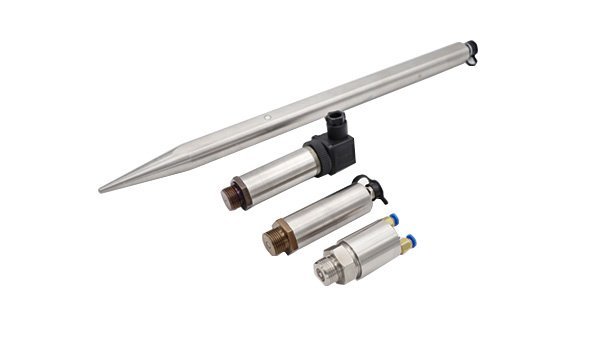
See the full family on the CYG400 high-frequency dynamic pressure sensor overview.
CYG406 FAQ
Seven absolute ranges from 20 to 800 kPa, with gauge equivalents from 1 to 600 kPa. It is the micro-pressure end of the CYG400 dynamic family.
Natural frequency rises with range, from above 5 kHz at 20 kPa to above 300 kHz at 400 to 800 kPa, with rise time from 5 microseconds down to 0.5 microseconds.
The CYG410, CYG411, and CYG412 are free-field teardrop probes for blast over-pressure from hundreds of kPa to 100 MPa. The CYG406 is a near-flush micro-pressure probe for small-amplitude work in the kPa band and for surface pressure-field mapping.
Yes. The sensor outputs millivolt directly; with the wideband amplifier it gives a standard 0 to 5 V output. The integrated transmitter version is ordered as CYG1406.
Specifying a CYG406 for a Micro-Pressure Test?
Tell us your peak amplitude, rise-time need, and mounting surface, and we will match the range, bandwidth, and cabling, or point you to the right CYG400 family member.
Request a Quote Explore the CYG400 Family