HMK Engineering Tools
Tank Volume Calculator
Convert a liquid-level reading into volume for horizontal, vertical and spherical tanks — written for operators turning a level-transmitter reading into usable inventory.
Calculator
Pick a tank type and enter its dimensions plus the current level depth. Volume is reported in cubic metres, litres and US gallons.
Volume Formulas by Tank Type
Three shapes cover most plant storage, and only one of them is linear with level. For a vertical cylinder the wetted volume is simply the base area times depth, V = π(D/2)² × h, so level and volume rise together. A sphere filled to depth h holds a spherical cap, V = πh²(3r − h)/3. The interesting one is the horizontal cylinder, where the liquid forms a circular segment whose area has to be integrated:
A = r²·acos((r − h)/r) − (r − h)·√(2rh − h²), then V = A × L, with r = D/2.
That arccosine term is why a dipstick reading on a horizontal tank never maps to volume in your head, and why a printed strapping chart exists in the first place. The calculator evaluates it for you; the sections below explain what the curve does to inventory accuracy.
Depth % to Volume % (Horizontal Tank)
For a horizontal cylinder these fractions are fixed by geometry, independent of the tank’s actual size. They are computed directly from the circular-segment formula above.
| Depth (% of diameter) | Volume (% of full) |
|---|---|
| 10% | 5.2% |
| 25% | 19.6% |
| 40% | 37.4% |
| 50% | 50.0% |
| 60% | 62.6% |
| 75% | 80.4% |
| 90% | 94.8% |
Why Level Is Not Proportional to Volume
It is worth correcting a claim that circulates on calculator sites: that a horizontal tank at half depth is not half full. For a perfect cylinder that is wrong. By symmetry, 50% depth is exactly 50% volume — the segment above the centreline mirrors the one below it. The real non-linearity lives away from the midpoint. At 25% depth the tank holds only 19.6% of its capacity, and at 75% depth it already holds 80.4%. So a half-full reading is trustworthy, but a quarter-full reading is not: judging inventory by eye, or treating a linear level signal as a linear volume, under-reads the bottom of the tank and over-reads the top. That is exactly where stock reconciliation and high/low alarms go wrong.
Tank Heads: Flat, Dished and Elliptical
The calculator models flat heads, so its horizontal result is the cylindrical body only. Real horizontal vessels usually have dished (torispherical) or 2:1 elliptical heads that add capacity at each end — for 2:1 elliptical heads roughly πD³/24 of extra volume across the pair. When the tank is long relative to its diameter (L much greater than D), that addition is a small percentage and can be ignored for routine checks. For short, fat vessels, or whenever the number feeds custody transfer or accounting, the head contribution matters and you should work from the manufacturer’s strapping chart rather than a flat-head geometric estimate.
From a Level-Transmitter Reading to Volume
A submersible or hydrostatic level transmitter such as the HM21 measures head, not volume: its 4–20 mA output is linear with the height of liquid above the diaphragm, because pressure follows P = ρgh. To turn that linear level into volume you have to apply the geometry above — the transmitter cannot do it. Three practical points follow. First, on a horizontal or spherical tank the DCS or inventory system needs the segment/cap function, not a straight scale, or the totals drift exactly as the table shows. Second, the reading depends on density: a warmer or lighter product gives less head for the same volume, so the level-to-volume map shifts with temperature and fluid. Third, mind the mounting zero — if the transmitter diaphragm sits above the tank floor, its zero is offset and that dead band has to be added back before the geometry is applied. Handle those three and a level transmitter becomes a reliable inventory gauge; ignore them and the volume will quietly disagree with the dipstick.
HMK Level Transmitters
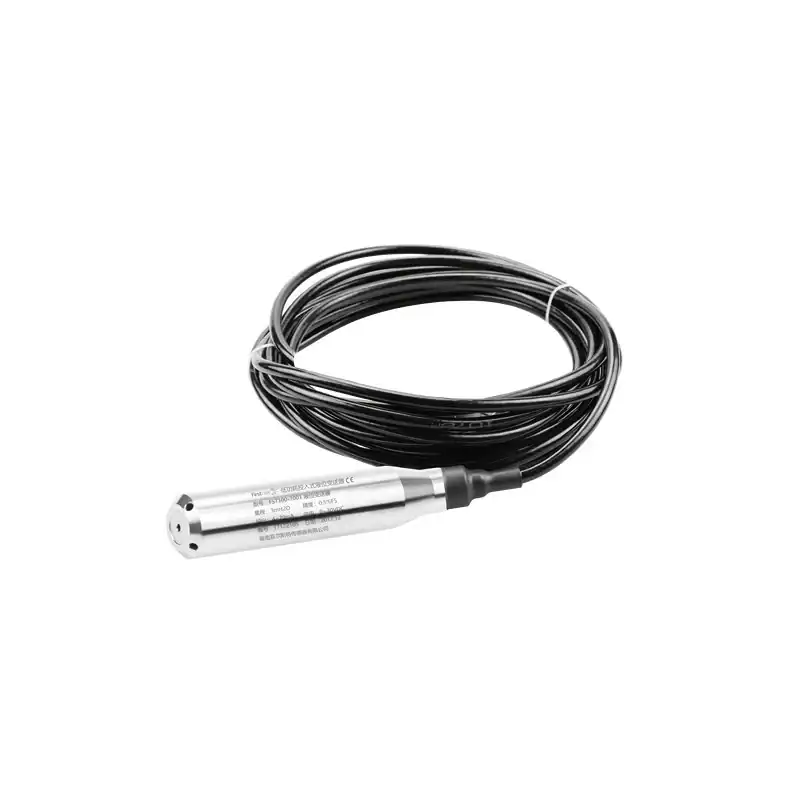 HM21Submersible Level TransmitterHydrostatic head measurement for tanks, wells and sumps.
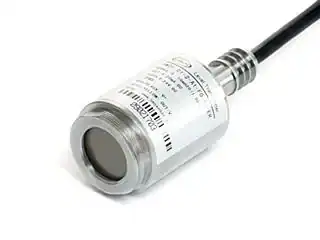 HM21RAnti-Corrosive Level TransmitterPTFE-protected for aggressive or chemical media.
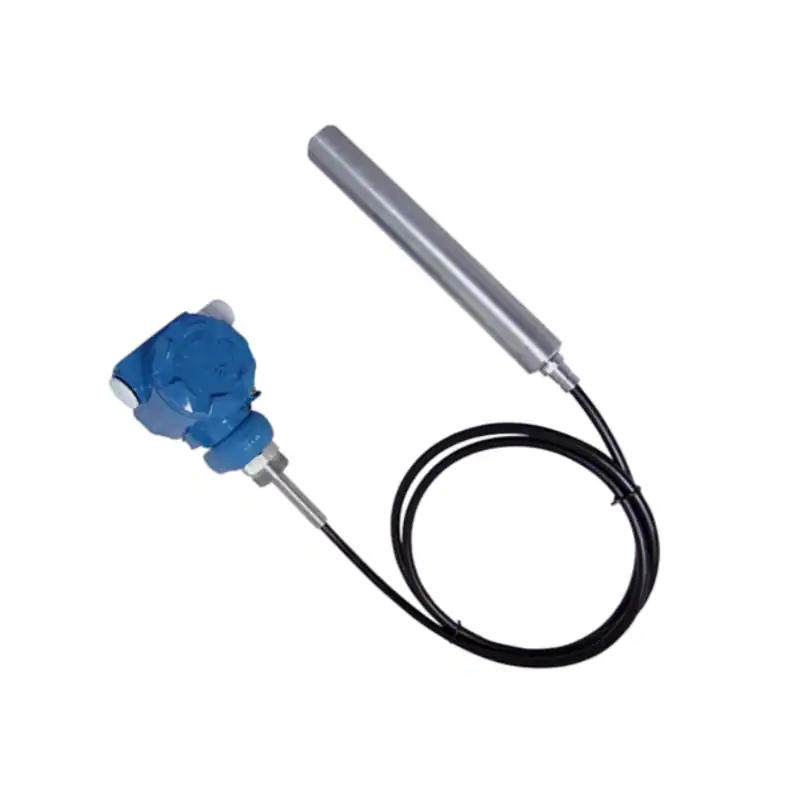 HM21FLightning-Protected Level TransmitterSurge protection for exposed outdoor tank farms.
Related Tools
Frequently Asked Questions
How do you calculate volume in a horizontal cylindrical tank?
Find the area of the liquid segment with A = r²·acos((r−h)/r) − (r−h)·√(2rh−h²), where r is the radius and h the depth, then multiply by the tank length. The calculator above evaluates it for any units.
Why isn’t tank level proportional to volume?
For a horizontal cylinder the cross-section is a circle, so equal rises in level add different amounts of volume. The midpoint is the exception: 50% depth is exactly 50% volume by symmetry, but 25% depth is only 19.6% and 75% depth is 80.4%.
How do I convert a level reading to tank volume?
Take the level height from the transmitter, subtract any mounting-zero offset, then apply the geometry for the tank shape. A level transmitter outputs head linear with depth, so the non-linear volume conversion has to be done in the DCS or inventory system.
How do dished or elliptical heads affect volume?
They add capacity at each end beyond the flat-head cylinder this tool models — about πD³/24 for a pair of 2:1 elliptical heads. The effect is small on long, slender tanks and significant on short, fat ones; use a strapping chart when accuracy matters.
What is a tank strapping chart?
A calibrated table, supplied by the tank manufacturer or produced by survey, that maps measured level directly to volume for that specific vessel including its heads. It is the reference for custody-transfer accuracy where a geometric estimate is not enough.
Need a level transmitter for tank inventory?
Tell us the tank shape, media and depth range — we will match a submersible or hydrostatic level transmitter and help you set up the level-to-volume conversion.