HMK Engineering Tools
DP Flow Calculator
Convert a differential-pressure reading into flow rate through the square-root relationship — built for engineers commissioning orifice, nozzle and venturi DP-flow loops.
Calculator
Flow is proportional to the square root of differential pressure. Enter a reading to see the flow it represents.
The Square-Root Relationship
Across an orifice plate, flow nozzle or venturi, the differential pressure a transmitter measures rises with the square of velocity, so the flow you care about rises only with the square root of that pressure. In span terms the relationship is exact and unit-free:
Q = Qmax × √(ΔP ÷ ΔPmax), which is the same as Flow% = √(ΔP%).
That single square root is the reason a DP-flow loop never reads the way a beginner expects. Half of full-scale differential pressure is not half of full-scale flow — it is just over seventy percent of it. The consequence runs both ways: near the top of the range a large change in flow produces only a small change in DP, while near the bottom a tiny change in DP corresponds to a large swing in flow. Every decision below — where to extract the root, where to set a cutoff, how to read the milliamp signal — follows from this one curve.
% DP to % Flow Reference Table
These values are the square root of the differential-pressure fraction, computed directly. Keep them next to the DCS when you commission a loop; they let you sanity-check the configured square-root block in seconds.
| ΔP (% of span) | Flow (% of max) |
|---|---|
| 4% | 20.0% |
| 10% | 31.6% |
| 25% | 50.0% |
| 50% | 70.7% |
| 64% | 80.0% |
| 75% | 86.6% |
| 90% | 94.9% |
| 100% | 100.0% |
The line to remember is the bold one: 50% differential pressure equals 70.7% flow, not 50%. If a colleague reads “the DP transmitter is at half scale” and reports half flow, the inventory or the control setpoint is already wrong by twenty percent.
Square Root in the Transmitter or the DCS?
The root has to be taken exactly once, and choosing where is a genuine configuration decision rather than a preference.
Linear-DP transmitter + DCS extraction (modern default). The transmitter outputs 4–20 mA linear with differential pressure; the DCS applies the square root in software. This keeps the loop flexible — you can re-range, re-scale or change the primary element without re-ranging the field device — and it is the recommended arrangement for almost every new installation.
Square-root-output transmitter. The transmitter itself extracts the root, so its 4–20 mA is linear with flow. This suits a local indicator or a legacy DCS that expects a linear-with-flow signal, but it bakes the curve into the field device.
The trap: never take the root twice. A square-root-output transmitter feeding a DCS channel that also has square-root extraction enabled will read the fourth root of DP — badly low and impossible to calibrate away. When a flow loop reads nonsensically after a transmitter swap, double extraction is the first thing to check.
Why Low Flow Is Inaccurate (Low-Flow Cutoff)
Because flow is the square root of DP, the slope of the curve steepens without limit as differential pressure approaches zero. Down at the bottom of the range a small absolute error in the DP measurement is magnified into a large error in indicated flow. A transmitter holding 0.1% of span on DP can still be off by several percent of reading on flow at ten percent of full scale, and the indicated flow never settles cleanly to zero because measurement noise gets rooted into a wandering low-end signal. The standard remedy is a low-flow cutoff: below roughly 5–10% of full-scale flow the DCS forces the indication to zero. Set it high enough to kill the noise floor, low enough not to blank out real low-rate operation — and remember that the cutoff hides, but does not fix, the inherent rangeability limit of square-root DP flow.
Worked Examples
Three quick reads of the same physics:
| Situation | Result |
|---|---|
| HM3051 ranged 0–100 kPa, DCS shows 64 kPa, Qmax 200 m³/h | Flow% = √0.64 = 80% → 160 m³/h |
| Linear-DP transmitter reads 12 mA (= 50% of DP span) | Flow% = √0.50 = 70.7% |
| Square-root-output transmitter reads 12 mA | Flow% = 50% (signal already linear with flow) |
The middle and bottom rows are the same 12 mA on the wire yet twenty points apart in flow, purely because of where the root is taken. That is why the 4-20 mA signal calculator and this tool are companions: one converts the current to a span percentage, this one converts the span percentage to flow.
HMK DP Transmitters for Flow
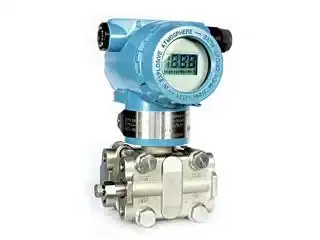 HM3051Smart DP TransmitterDigital cell with configurable square-root output and high turndown for orifice flow.
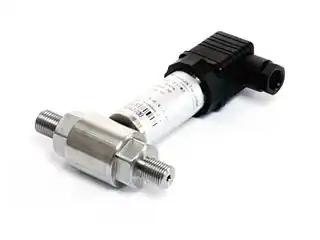 HM31DP TransmitterWorkhorse differential cell for flow, level and filter-drop service.
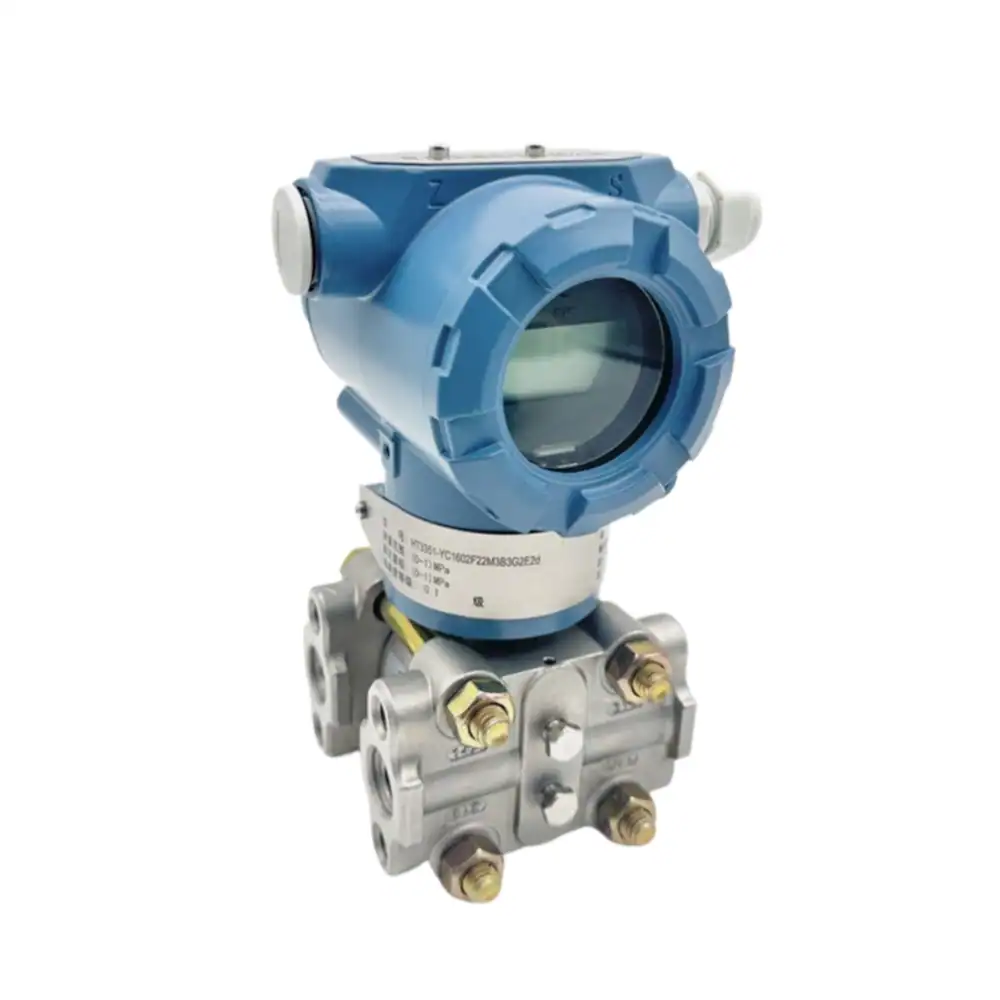 HM1151Capacitive DP TransmitterCapacitive sensing for stable low-DP flow measurement.
Related Tools
Frequently Asked Questions
How do you convert differential pressure to flow?
Take the square root of the differential pressure as a fraction of full-scale span, then multiply by full-scale flow: Q = Qmax × √(ΔP / ΔP_max). The calculator above does this and also gives the flow as a percentage of maximum.
Why is flow proportional to the square root of DP?
Differential pressure across a restriction rises with the square of velocity (and therefore of volumetric flow), so inverting the relationship puts flow on the square root of DP. It is a property of the primary element, not of the transmitter.
Should the square root be extracted in the transmitter or the DCS?
For new loops, keep the transmitter linear with DP and let the DCS extract the root — it stays flexible to re-ranging. Extract in the transmitter only for local indication or legacy systems. Never enable extraction in both, or the loop reads the fourth root of DP.
What is low-flow cutoff?
A threshold, typically 5–10% of full-scale flow, below which the DCS forces the flow indication to zero. It suppresses the noisy, error-amplified signal that the square root produces near zero differential pressure.
Is 50% differential pressure the same as 50% flow?
No. 50% of DP span is 70.7% of flow, because flow follows the square root. Reading half-scale DP as half flow is one of the most common DP-flow mistakes.
Which HMK DP transmitter suits flow measurement?
The HM3051 smart cell offers configurable square-root output and high turndown for orifice flow; the HM31 and HM1151 cover general differential service. See the cards above or the differential pressure transmitter range.
Specifying a DP transmitter for flow?
Tell us the line size, primary element and flow range — we will size the cell so your working span sits at a sensible turndown.