kg/cm² to PSI Converter
Convert kilogram-force per square centimetre (kgf/cm²) to pounds per square inch with the exact factor — plus the bar, atm and gauge-versus-absolute context a legacy kg/cm² gauge actually needs.
The exact kg/cm² to psi factor and where it comes from
The conversion is fixed by two defined constants, not an approximation. One kilogram-force per square centimetre is the pressure of a one-kilogram-force load spread over one square centimetre. A kilogram-force is defined as 9.80665 newtons (standard gravity) and one square centimetre is 1×10⁻⁴ m², so 1 kgf/cm² = 9.80665 N ÷ 0.0001 m² = 98066.5 Pa exactly. One pound-force per square inch is 6894.757293 Pa (NIST SP 811). Dividing gives 98066.5 ÷ 6894.757293 = 14.223343307 psi per kg/cm², and the reverse is 0.070306958 kg/cm² per psi. Rounding to 14.22 is fine for a shop conversion; keep the full figure when you propagate a calibrated span, because the rounding error accumulates across a wide range.
kg/cm² is not the same as bar, at, or atm
This is where most field errors start. Because 1 kg/cm² (98066.5 Pa) sits close to 1 bar (100000 Pa), engineers routinely treat them as interchangeable — but they differ by 1.97%, and that gap is real money on a relief-valve set point or an accumulated calibration budget. The kilogram-force per square centimetre is also the technical atmosphere (symbol at), and the technical atmosphere is not the standard atmosphere (atm): 1 kg/cm² = 0.9678411 atm, while 1 atm = 1.0332275 kg/cm². Four similar-looking units, four different values — the table fixes them against each other so the ~2% never gets lost on a spec sheet.
| 1 kgf/cm² equals | Value | Note |
| psi | 14.223343 | the conversion above |
| bar | 0.980665 | ~1.97% below 1 bar — not equal |
| atm (standard) | 0.967841 | at ≠ atm |
| kPa | 98.0665 | = 98066.5 Pa |
| MPa | 0.0980665 | for high-range gauges |
Gauge, absolute, and the “ata / atg” convention on legacy gauges
Older Asian, Russian and Middle-Eastern equipment often labels its dials in kg/cm² with a reference suffix Western instrument engineers rarely see. kg/cm²G — sometimes atg — is a gauge reading, referenced to local atmosphere. kg/cm²A — written ata — is an absolute reading, referenced to full vacuum. The two differ by roughly one atmosphere, so ata = atg + 1.0332 kg/cm² at sea level. When you map one of these dials onto a modern transmitter the reference must match: a gauge dial pairs with a psig, gauge-type transmitter; an absolute dial pairs with a psia, absolute-type transmitter. Mixing them shifts every reading by about 14.7 psi. This is not academic — the term kg/cm² to psia alone draws steady traffic, which shows how often people are converting the absolute variant specifically.
Converting a legacy kg/cm² gauge range to a modern transmitter span
The practical reason most people convert kg/cm² is to replace an ageing analogue gauge with a 4–20 mA transmitter while keeping the same working range. The table maps common kg/cm² full-scale steps to psi, bar and MPa so you can pick a transmitter span directly. Every one of these ranges falls inside a single general-purpose transmitter — HMK’s HM20 covers −100 kPa to 100 MPa in gauge or absolute, spanning the entire list.
| kg/cm² (FS) | psi | bar | MPa |
| 1 | 14.22 | 0.98 | 0.098 |
| 6 | 85.34 | 5.88 | 0.588 |
| 10 | 142.23 | 9.81 | 0.981 |
| 25 | 355.58 | 24.52 | 2.452 |
| 60 | 853.40 | 58.84 | 5.884 |
| 250 | 3555.84 | 245.17 | 24.517 |
| 400 | 5689.34 | 392.27 | 39.227 |
Why the unit is really kgf/cm² — force, not mass
Written strictly, the unit is kgf/cm² — kilogram-force per square centimetre — because pressure is force divided by area, not mass divided by area. The “f” is dropped in everyday use, which is why the same quantity appears as kg/cm², kgf/cm² and at on different drawings. The technical atmosphere was deprecated by SI decades ago in favour of the pascal and bar, so new instruments are scaled in bar, kPa, MPa or psi and no longer carry a kg/cm² dial. The unit survives only on installed equipment — which is exactly why a reliable conversion, and a transmitter you can order in the matching range, still matters.
Worked example
An older compressor-discharge gauge reads 7 kg/cm²G. Converting: 7 × 14.223343 = 99.56 psi (gauge), about 6.87 bar. To replace it, specify a gauge-type transmitter with a span above the working pressure — a 0–10 kg/cm² dial is 0–142 psi, so a 0–150 psi (≈0–10 bar) transmitter is the natural drop-in.
Frequently asked questions
Is kg/cm² the same as bar?
No. 1 kg/cm² = 0.980665 bar, about 1.97% lower. Close enough to confuse but not equal; use the exact factor when accuracy matters.
How do I convert kg/cm² to psig?
If your dial is a gauge reading (kg/cm²G), multiply by 14.223343 to get psig directly — both are gauge-referenced, so no atmospheric offset is needed.
What does “ata” mean?
ata is an absolute technical atmosphere: a kg/cm² reading referenced to full vacuum. ata = atg + 1.0332 kg/cm² at sea level.
Which transmitter replaces a kg/cm² gauge?
Any general-purpose transmitter whose span covers your kg/cm² full scale and whose reference (gauge or absolute) matches the old dial. HMK’s HM20 covers −100 kPa to 100 MPa in gauge or absolute at ±0.25% FS.
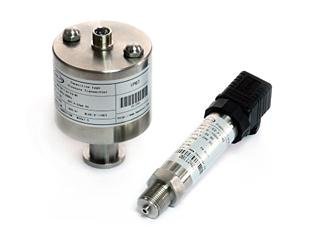
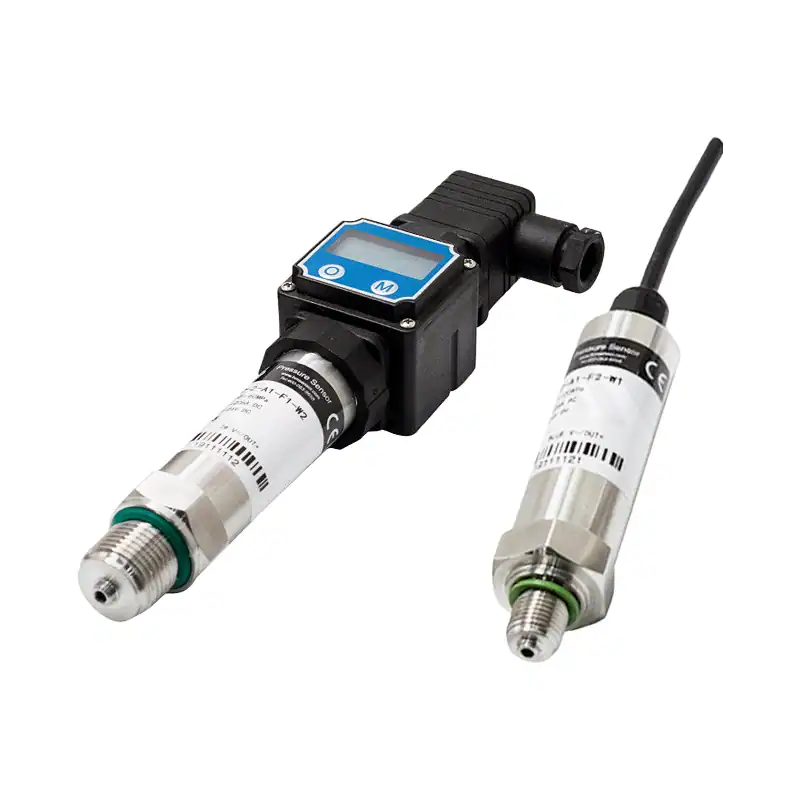
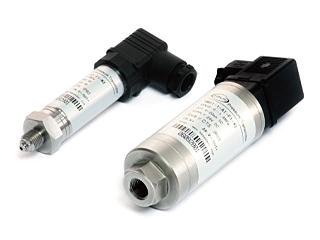
Need the absolute or gauge transmitter behind the number?
Tell us the range in kg/cm², psi or bar and whether it is absolute, gauge or compound, and we will spec the right transmitter.