HMK Temperature Sensors
Sheathed Thermal Resistance (Pt100 RTD)
Mineral-insulated metal-sheathed Pt100 platinum resistance temperature sensors (RTD) with imported thin-film resistive elements. Sheath diameters from Φ3 to Φ8mm, temperature range −196°C to 600°C. Bendable, high-pressure rated, ultra-fast thermal response time (≤3s). Class AA, A, B, C accuracy per IEC 60751.
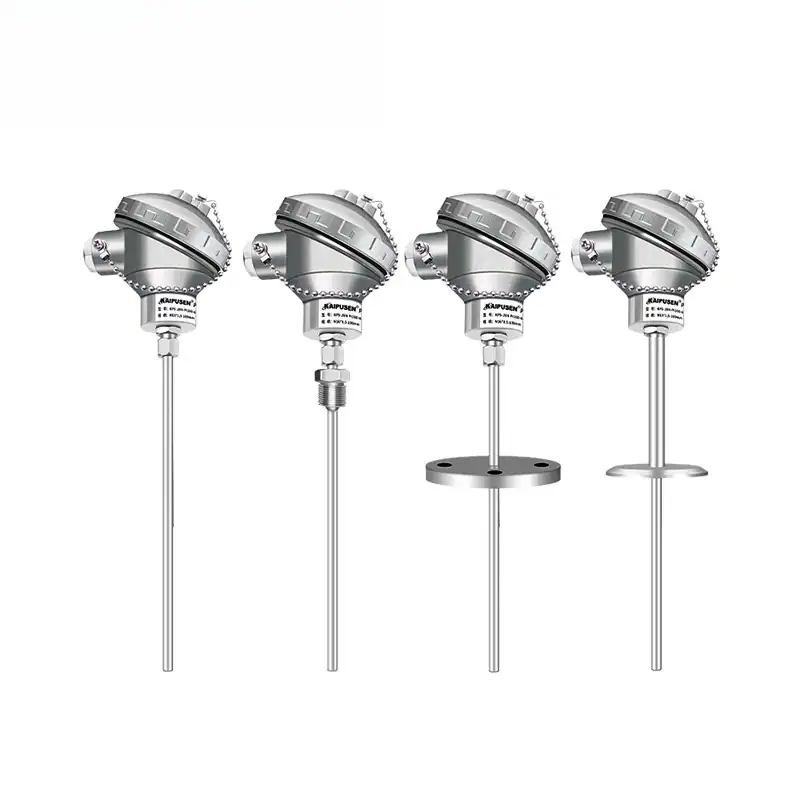
Why Choose Sheathed Thermal Resistance?
Purpose-built for demanding temperature measurement where accuracy, stability, and reliability are critical.
Ultra-Fast Response Time
Φ3 sensors respond in ≤3 seconds, Φ4≤5s, Φ5≤8s, Φ6≤12s, Φ8≤15s. Faster thermal time constant than comparable thermocouples, critical for dynamic process control and rapid temperature transient detection.
Precision Pt100 Element
Imported thin-film Pt100 resistor provides excellent stability, low drift, and repeatability. Available in Class AA (±0.1°C @ 0°C), Class A (±0.15°C), Class B (±0.3°C), and Class C (±0.6°C) per IEC 60751.
Flexible Installation Options
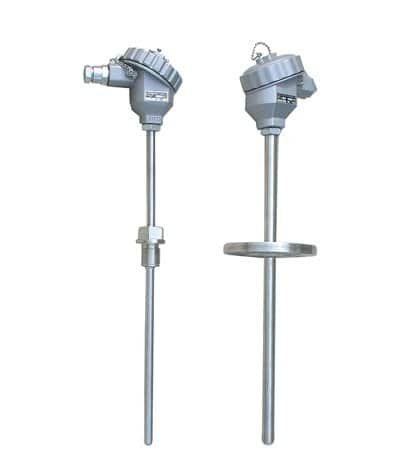
Five installation types (no fixation, fixed/movable-sleeve screw thread, fixed/active-sleeve flange). Multiple junction box configurations: waterproof, circular plug, flat socket, compensating wire, or bare element.
Technical Specifications
Core parameters for mineral-insulated sheathed Pt100 thermal resistance sensors across all accuracy classes.
| Parameter | Value |
|---|---|
| Sensor Element | Pt100 platinum resistance (imported thin-film resistor) |
| Temperature Range (Class AA) | Wire wound −50~250°C; Membrane 0~150°C |
| Temperature Range (Class A) | Wire wound −100~450°C; Membrane −30~300°C |
| Temperature Range (Class B) | Wire wound −196~600°C; Membrane −50~500°C |
| Temperature Range (Class C) | Wire wound −196~600°C; Membrane −50~600°C |
| Accuracy Class AA | ±(0.1 + 0.0017|t|)°C |
| Accuracy Class A | ±(0.15 + 0.002|t|)°C |
| Accuracy Class B | ±(0.3 + 0.005|t|)°C |
| Accuracy Class C | ±(0.6 + 0.01|t|)°C |
| Sheath Diameters (Single) | Φ3, Φ4, Φ5, Φ6, Φ8 mm |
| Sheath Diameters (Double) | Φ4, Φ5, Φ6, Φ8 mm |
| Sheath Material | 1Cr18Ni9Ti stainless steel |
| Response Time (Φ3) | ≤3 seconds |
| Response Time (Φ4) | ≤5 seconds |
| Response Time (Φ5) | ≤8 seconds |
| Response Time (Φ6) | ≤12 seconds |
| Response Time (Φ8) | ≤15 seconds |
| Protection Rating | IP55 (waterproof) |
| Installation Types | 5 types: no fixation, fixed-sleeve screw, movable-sleeve screw, fixed-sleeve flange, active-sleeve flange |
| Junction Box Types | Waterproof, circular plug, flat socket, compensating wire, bare element |
| Insulation Resistance (1m) | ≥1000 MΩ at 500±50V DC |
| Insulation Resistance (10m) | ≥100 MΩ at 500±50V DC |
| Standards | IEC 60751, GB/T 30121-2013 |
| Model Series | WZPK-xxx (W=instrument, Z=thermal resistance, P=Pt100, K=sheathed) |
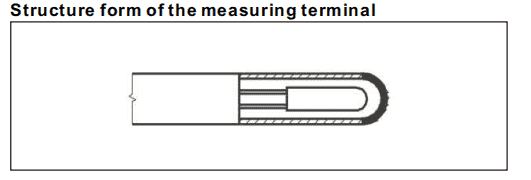
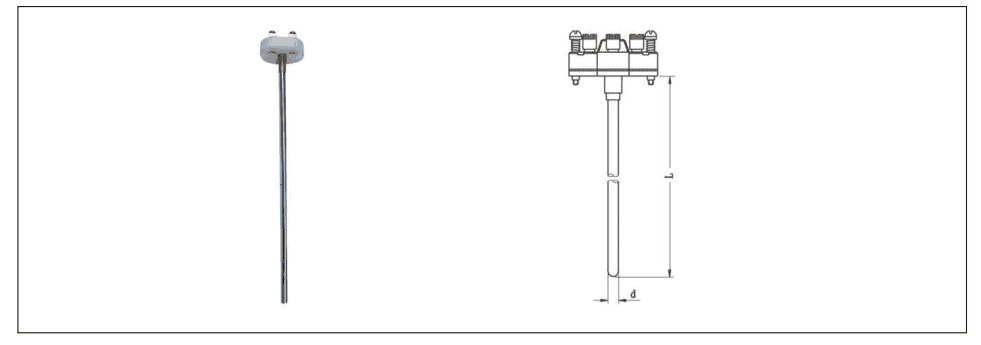
Pt100 Accuracy Class Selection
Four accuracy classes per IEC 60751 allow optimization for cost, precision, and temperature range requirements.
Class AA (Highest Precision)
Tolerance: ±(0.1 + 0.0017|t|)°C
Range: Wire wound −50~250°C; Membrane 0~150°C
Use Case: Laboratory calibration, precision instrumentation, high-accuracy process control
Class A (High Precision)
Tolerance: ±(0.15 + 0.002|t|)°C
Range: Wire wound −100~450°C; Membrane −30~300°C
Use Case: Industrial temperature control, food/pharma processing, HVAC systems
Class B (Standard Precision)
Tolerance: ±(0.3 + 0.005|t|)°C
Range: Wire wound −196~600°C; Membrane −50~500°C
Use Case: General industrial monitoring, petrochemical, power generation
Class C (Extended Range)
Tolerance: ±(0.6 + 0.01|t|)°C
Range: Wire wound −196~600°C; Membrane −50~600°C
Use Case: Cryogenic applications, furnace monitoring, extreme temperature environments
Tolerance = ±(A + B×|t|) where t is temperature in °C
Class AA: A=0.1°C, B=0.0017 – Max ±0.42°C at 250°C
Class A: A=0.15°C, B=0.002 – Max ±0.75°C at 450°C
Class B: A=0.3°C, B=0.005 – Max ±3.3°C at 600°C
Class C: A=0.6°C, B=0.01 – Max ±6.6°C at 600°C
Installation & Configuration Options
Five mounting types and five junction box styles provide complete system flexibility.

No Fixation (Type 1)
Application: Immersion without mechanical support
Best For: Tanks, vessels, liquid media where probe is suspended or inserted directly
Fixed-Sleeve Screw (Type 2)
Application: Permanent installation with NPT or ISO thread
Best For: Equipment mounting where sensor must not move after installation
Movable-Sleeve Screw (Type 3)
Application: Removable installation with screw thread
Best For: Maintenance access, sensor replacement, field adjustments
Fixed-Sleeve Flange (Type 4)
Application: Permanent flange mounting with bolts
Best For: Process piping, high-vibration environments, rugged industrial settings
Active-Sleeve Flange (Type 5)
Application: Removable flange mounting
Best For: Modular systems, rapid changeover, maintenance procedures
Junction Box & Connector Types
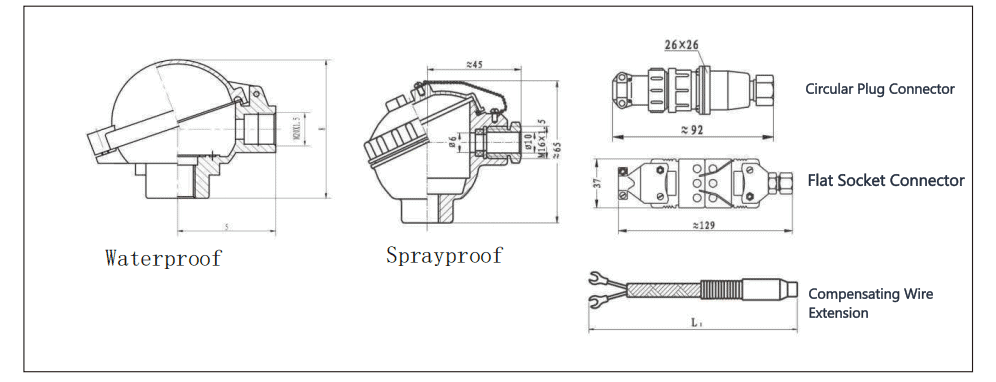
Waterproof Junction Box
IP55 sealed design. Standard for most industrial applications. Protects electrical connections from moisture and splashing.
Circular Plug Connector
DIN or aviation-style connector for quick-connect/disconnect. Ideal for automated assembly lines and sensor replacement.
Flat Socket Connector
Standard spade lug interface. Cost-effective for applications where quick disconnection is not critical.
Compensating Wire Extension
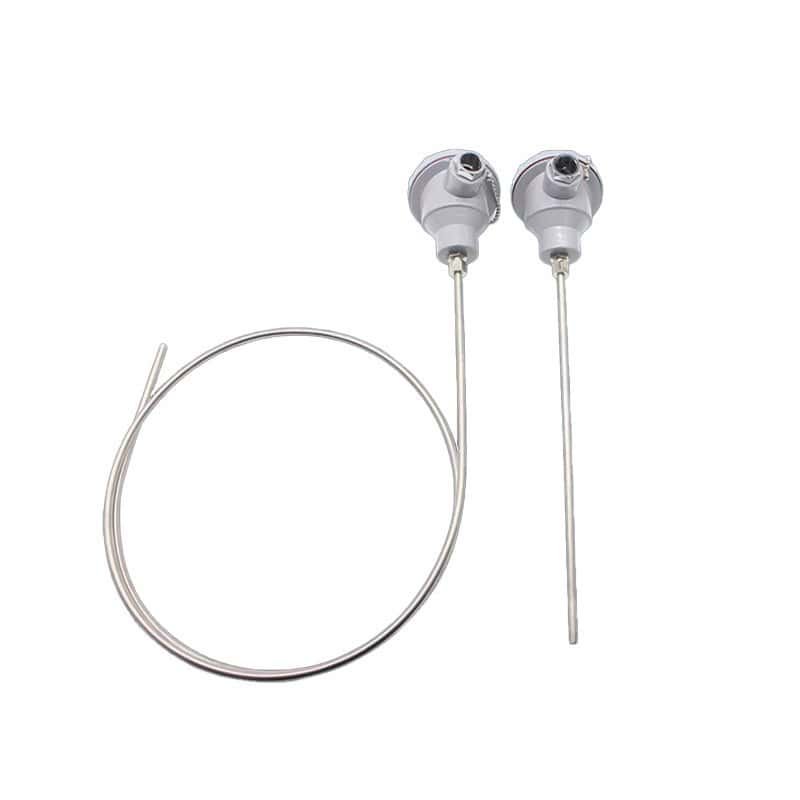
No junction box. Copper-nickel alloy cables extend directly to transmitter or PLC input. Reduces system cost.
Bare Element
Sensor only, no connector. Used in custom installations where integration occurs at system level. Maximum design flexibility.
Order Guide — Model Selection
Use the model naming structure below to specify the exact sheathed thermal resistance configuration you need. Each character position defines a key parameter.
Model Number Structure
Fixed code Configurable options
Example: WZPK-233
W = Temperature instrument |
Z = Thermal resistance |
P = Pt100 element |
K = Sheathed (armored) type
2 = Fixed-sleeve threaded mount |
3 = Waterproof junction box |
3 = Tube diameter 3 mm
Not sure which configuration to choose? Contact our engineers for expert guidance.
Application Scenarios
Sheathed Pt100 RTDs excel in dynamic, demanding industrial temperature measurement.
Petrochemical Processing
Reactor temperature control, distillation column monitoring. Class B Φ4-6 sensors provide fast dynamic response for exothermic reaction management.
Power Generation
Boiler flue gas temperature, turbine inlet/outlet steam. Class A Φ5-8 sensors rated to 450°C for continuous power plant operation.
Chemical Manufacturing
Synthesis vessel control, polymer curing temperature. ≤3s response Φ3 probes detect transients critical for batch quality control.
Food & Beverage
Pasteurization/sterilization temperature logging, freeze-drying chamber control. Class A ensures HACCP and FDA compliance.
HVAC & Building Systems
Chiller outlet control, heat exchanger monitoring. Class A Φ4 sensors provide cost-effective building automation.
Metalworking & Furnaces
Heat treatment profiling, annealing process control. Class B sensors to 600°C enable high-temperature metal processing.
Technical Guide
Frequently Asked Questions
Pt100 RTDs measure temperature by detecting changes in electrical resistance, offering higher accuracy, better stability, and lower measurement noise than thermocouples. RTDs require excitation current and reference resistance. RTDs are preferred for ±0.1–0.15°C accuracy; thermocouples excel in ultra-high temperature (>1100°C) and fast response applications.
Class AA (±0.1°C @ 0°C) for laboratory calibration. Class A (±0.15°C) for industrial process control and food safety. Class B (±0.3°C) for general industrial monitoring. Class C (±0.6°C) for cryogenic and furnace monitoring. Consider: temperature range, required tolerance, cost budget, and calibration frequency.
Response time is the time for the sensor to reach 63% of a step change. Sheathed Pt100 RTDs respond in ≤3s (Φ3) to ≤15s (Φ8). Smaller diameters are faster but less robust. Use Φ3 for dynamic batch processes; Φ6-8 for large vessels and furnaces where mechanical strength is prioritized.
Type 1 (no fixation) for direct immersion in tanks. Type 2 (fixed-sleeve screw) for permanent installation. Type 3 (movable-sleeve screw) for maintenance access. Type 4 (fixed-sleeve flange) for high-vibration pipelines. Type 5 (active-sleeve flange) for rapid sensor changeover. Flange types suit flowing media; screw types suit static tanks.
Pt100 RTDs require 4-wire (highest accuracy) or 3-wire excitation. 4-wire eliminates lead resistance error, ideal for Class AA/A. Signal conditioning via 4-20mA transmitters or DAQ modules with RTD linearization. Use shielded twisted-pair cable for distances >50m to minimize noise pickup.
Yes. Minimum bend radius is 5–6 times the sheath outer diameter (e.g., 30mm for Φ6mm). Bending must be gradual to avoid kinking mineral insulation. Never apply sharp creases or radii less than 5D. Smaller diameters (Φ3-4) are more flexible for tighter routing.
Related Products
Need Precision Temperature Measurement?
Our engineers specialize in sheathed thermal resistance solutions for industrial applications. Whether you need standard Pt100 RTDs or custom configurations for extreme environments, we provide expert guidance on sensor selection, mounting options, and accuracy class specifications.
Our engineers typically respond within 12 business hours with detailed technical specifications and pricing.
Selecting a thermowell? See our guide on how to choose the connection, stem, material and insertion length.