Saturated Steam Table Calculator (by Pressure)
Enter a steam pressure and read the saturation temperature, latent heat and the saturated water and steam densities from IAPWS-IF97 — the numbers you need to size a thermowell, set a DP steam-flow density, or compensate a boiler-drum level.
At saturation, the pressure fixes the temperature
Saturated steam is steam in contact with its own boiling water, and along that saturation line a single pressure allows only one temperature. Raise the pressure and the boiling point rises with it; drop the pressure and the steam gets cooler. That is why a steam table has one row per pressure: once you know the pressure in the header, drum or jacket, the temperature is already decided. There is nothing to measure and nothing to guess — the calculator above returns the exact value from the IAPWS-IF97 industrial formulation, the same equations used by plant heat-balance software.
This one-to-one relationship is also a diagnostic. If a pressure gauge and a temperature probe on the same saturated line disagree with the table, one of them is wrong, the steam is not actually saturated, or there is a non-condensable gas in the space. The table is the reference the two instruments should agree with.
Read the gauge, convert to absolute before you enter the table
Steam tables are built on absolute pressure, but almost every gauge and transmitter in the field reads gauge pressure — zero at atmosphere. The two differ by one atmosphere, about 1.013 bar or 14.7 psi, and at steam conditions that gap is worth several degrees. Ten bar gauge is 11.01 bar absolute and saturates at 184 °C, while ten bar absolute saturates at 180 °C. Set the reference switch above to match your gauge; get it wrong and every temperature, material rating and relief setpoint downstream inherits the error.
The two numbers a steam table gives an instrument engineer
Most steam tables are written for boiler and heat-transfer work, so they bury the two properties that matter most for measurement: the saturated steam density and the saturated water density. Both come straight out of the specific volumes the calculator reports.
Steam density sets your DP flow reading. An orifice or averaging-pitot flow element measures volumetric flow, but plants buy and balance steam by mass. Mass flow scales with the square root of density, so the steam density at the operating pressure is a direct multiplier on the flow output. Take it from the wrong pressure and the mass-flow reading is biased by the same proportion. Feed the density from this page into the DP flow calculator and the two agree.
Both densities set your drum-level compensation. On a boiler drum, a differential-pressure level transmitter measures the head of water in the drum, but that head depends on the density of the hot saturated water in the drum and the saturated steam above it — and both change with drum pressure. Use the saturated water and steam densities at the drum pressure to correct the transmitter, and the indicated level tracks the true level across load swings. This is the density term at the heart of the boiler drum level method, and it is why a raw uncompensated DP level drifts when the boiler pressure moves.
A worked check at 10 bar gauge
Enter 10 bar gauge. The tool adds one atmosphere to get 11.01 bar absolute, then returns a saturation temperature of about 184 °C (363 °F), a latent heat near 1999 kJ/kg, and a steam density of roughly 5.6 kg/m³. Those three numbers do real work: 184 °C is the temperature your thermowell, gasket and transmitter fill fluid must survive; 1999 kJ/kg is the heat each kilogram releases when it condenses in a heat exchanger; and 5.6 kg/m³ is the density that converts a DP flow signal into a mass rate. Switch the reference to absolute and the temperature drops to about 180 °C — a clean demonstration of why the gauge-versus-absolute choice is not cosmetic.
Saturated steam reference table
Common header pressures at absolute reference, from IAPWS-IF97. Latent heat falls and steam density rises as pressure climbs — the reason high-pressure steam carries less heat per kilogram but far more mass per cubic metre.
| Pressure (bar abs) | Sat. temp (°C) | Sat. temp (°F) | Latent heat hfg (kJ/kg) | Steam density ρg (kg/m³) |
|---|---|---|---|---|
| 1 | 99.6 | 211 | 2258 | 0.590 |
| 2 | 120.2 | 248 | 2202 | 1.129 |
| 5 | 151.8 | 305 | 2108 | 2.668 |
| 7 | 165.0 | 329 | 2066 | 3.666 |
| 10 | 179.9 | 356 | 2014 | 5.145 |
| 15 | 198.3 | 389 | 1946 | 7.593 |
| 20 | 212.4 | 414 | 1890 | 10.04 |
| 40 | 250.4 | 483 | 1713 | 20.09 |
Where the saturated table stops
Superheated steam is off the table. Once steam is heated above its saturation temperature at a given pressure, the pressure no longer fixes the temperature and you need both values to find its state. This page returns the saturation point only — the lowest temperature steam can have at that pressure while still touching water.
There is no line above the critical point. Above 220.6 bar absolute and 374 °C, water and steam become indistinguishable and no saturation temperature exists; the calculator flags this rather than returning a number.
Below atmospheric, steam runs cool. Under vacuum — in evaporators, sugar boiling or turbine condensers — saturated steam sits below 100 °C. Set the reference to absolute and enter a sub-atmospheric pressure to see it.
Frequently Asked Questions
What is the temperature of saturated steam at 10 bar?
At 10 bar gauge (11.01 bar absolute) saturated steam is about 184 °C; at 10 bar absolute it is about 180 °C. Match the reference switch to how your gauge reads before you trust the number.
How do I convert my gauge pressure before reading the table?
Add one atmosphere — about 1.013 bar or 14.7 psi — to a gauge reading to get absolute pressure, then read the table. This calculator does it for you when the reference is set to gauge.
What is latent heat of vaporisation on a steam table?
It is the heat each kilogram of steam releases as it condenses to water at that pressure, listed as hfg. It falls as pressure rises, from about 2258 kJ/kg at 1 bar to 1713 kJ/kg at 40 bar.
How do I get steam density for a DP flow calculation?
Read the saturated steam density this page returns at your operating pressure and use it as the density input to a differential-pressure flow calculation. Mass flow scales with the square root of that density, so the operating-pressure value must be used, not a fixed number.
Does superheated steam follow this table?
No. Superheated steam is hotter than the saturation temperature at its pressure, so pressure and temperature are independent and you need both. Use the saturation values here as the starting point, then account for the superheat separately.
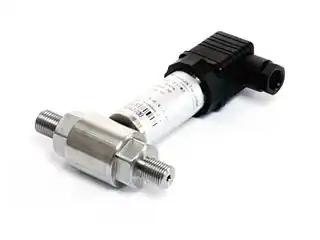
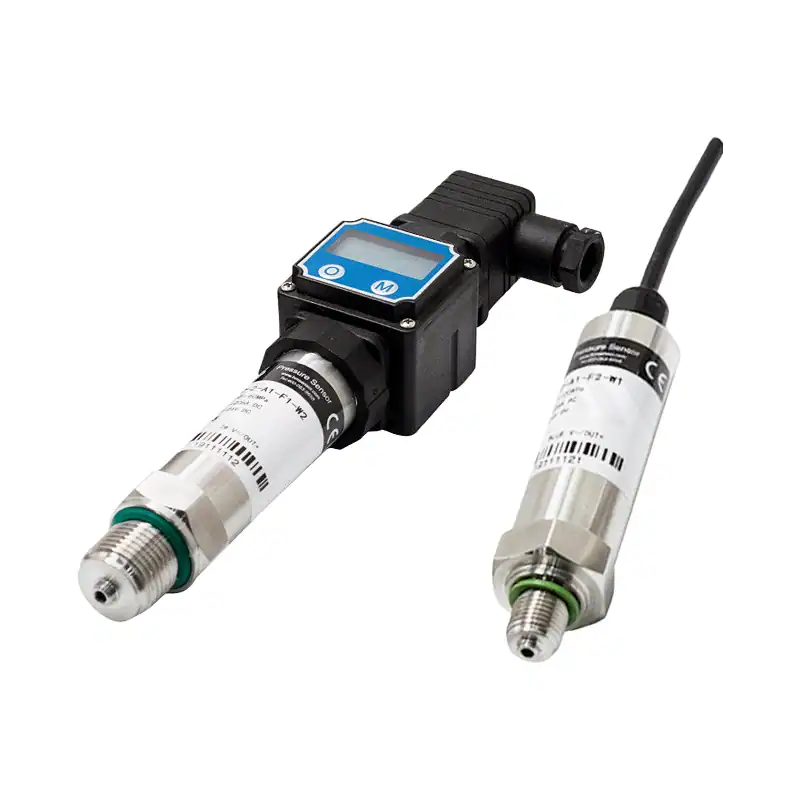

Measuring on a steam system?
Tell us the pressure, the temperature and the service and we will spec the pressure, DP or temperature transmitter to match.